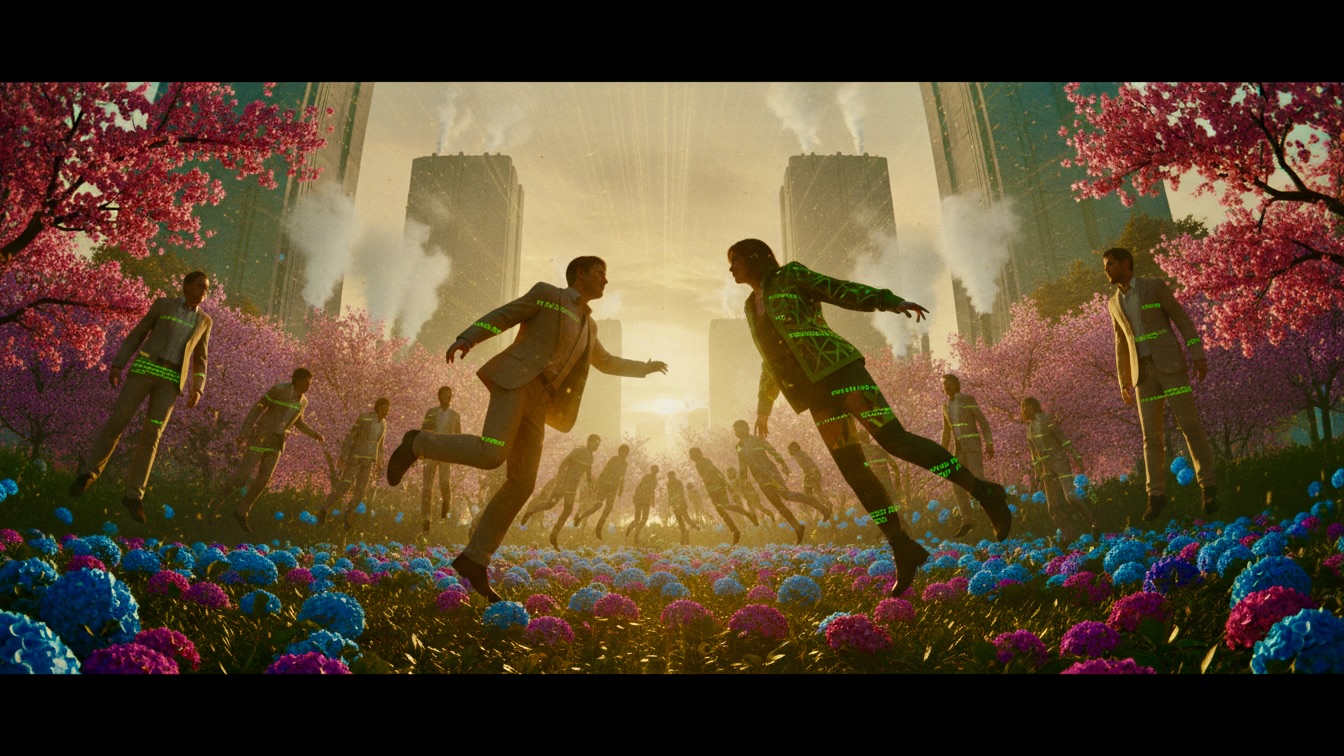
The story unfolds at the Anti-Gravity Bloom festival, a surreal event where cosmic spores in the water table have rendered gravity optional. The protagonist, Janice, floats above the ground, existing less as a human being and more as a curated digital brand known as @Janice_GPT_4o. Under the watchful eye of her manager, Rick, she navigates a landscape of synthetic beauty and high-stakes social media influence. She encounters Abe, another high-profile influencer who is similarly trapped within a persona optimized for maximum engagement and financial speculation.
Their interaction begins as a series of hollow exchanges centered on cryptocurrency and market volatility, reflecting their deep indoctrination into a digital-first existence. However, a sudden discharge of cooling mist from a nearby data center causes a technical glitch in their bio-digital interfaces. This malfunction strips away their corporate masks, revealing the underlying code of their desires directly on their skin. In a moment of genuine human rebellion, they embrace, triggering a massive static discharge that shorts out the local server farms and the internet itself.
As the digital infrastructure collapses, the levitating spores lose their potency, and the characters slowly descend to the earth. The weight of the physical world returns as they land on the dirt, finally disconnected from the exhausting demands of their online identities. The narrative concludes with a sense of relief and quietude. Janice and Abe stand together in the silence of an offline world, finding a rare moment of authentic connection in the wreckage of their digital lives.
The primary theme of the narrative is the erosion of authentic identity in an age of total commodification. Janice and Abe are not merely users of technology; they have become the technology itself, viewing their own bodies and personalities as assets to be leveraged for profit. The author uses the metaphor of the "skin-suit" to illustrate how the digital persona has completely swallowed the human interior. This psychological fragmentation suggests that when every interaction is filtered through the lens of engagement metrics, the soul becomes a scalable product rather than a private sanctuary.
Another significant theme is the tension between the synthetic and the natural. The festival celebrates a "bloom" that is fueled by cosmic spores and supported by massive server farms, creating a landscape that is beautiful but fundamentally hollow. The levitation represents a detachment from reality, a literal and figurative hovering above the "dirt" of genuine human experience. It is only when the technology fails that the characters are able to reconnect with the earth. This return to gravity serves as a metaphor for reclaiming one's humanity and the sobering, heavy reality of the physical world.
The story also critiques the linguistic decay caused by hyper-capitalism and digital culture. Janice and Abe initially communicate in a jargon-heavy dialect of "SporeCoin" and "data architecture," showing how corporate interests can colonize even the way individuals speak to one another. Their inability to express simple affection without the intervention of a technical glitch highlights the tragedy of their condition. The eventual "short circuit" of the internet is presented not as a catastrophe, but as a necessary purification that allows for the restoration of meaningful, unmediated communication.
Janice functions as a tragic figure who is deeply aware of her own obsolescence. She views herself as a "skin-suit for an algorithm," a perspective that reveals a profound sense of dissociation and self-loathing. Her internal monologue is a battleground between the programmed responses of her brand and the flickering remnants of her original self. She is a woman who has been hollowed out by the demands of her manager and her followers, leaving her feeling like a ghost in her own body.
Her psychological state is characterized by a desperate need for a "real thought," something she hasn't experienced in weeks. She is trapped in a cycle of performance, where even her tattoos are programmed to sell a lifestyle she doesn't actually possess. When the glitch occurs, her reaction is one of vulnerability rather than fear. She finally admits her fraudulence to Abe, showing that her true desire is not for more followers or higher yields, but for the simple, heavy reality of being a person again.
Abe serves as a mirror to Janice, embodying the exhaustion of the male influencer who must constantly project an image of high-growth success. He is physically described as having dark circles under his eyes that no digital filter can hide, suggesting that his physical body is failing under the strain of his digital demands. Like Janice, he has lost his sense of self-governance, admitting that he no longer knows what he likes for breakfast because his choices are dictated by sponsors. He is a man who has traded his autonomy for a "scalable soul."
His transformation during the mist-induced glitch is pivotal to the story's climax. When he chooses to ignore the metrics and the potential loss of his brand to touch Janice, he asserts his humanity over his programming. His decision to "kiss the system to death" is an act of existential bravery. By the end of the story, his broken smile and his dead phone signify his liberation. He is no longer a high-growth asset; he is simply a man standing in the dirt, and he is satisfied with that transition.
Rick represents the cold, administrative force of the digital economy. He is described as "anchored" to the ground, a detail that highlights his role as the controller who remains stable while his "assets" float in a state of precarious unreality. He does not see Janice as a human being but as a platform for engagement, as evidenced by his sign demanding she "STAY ON BRAND." He is the personification of the algorithm's demands, prioritizing the "liquid assets" over the personhood of the woman he manages.
His presence serves as a constant pressure on Janice, a reminder that her value is strictly tied to her performance. When the internet dies and his tablet goes black, Rick is rendered powerless. His frantic tapping on a dead screen illustrates the futility of his role once the digital infrastructure is removed. He is left behind in the transition to the offline world, unable to function without the metrics that previously defined his authority.
The narrative utilizes a sensory-rich, cyberpunk-inflected prose that emphasizes the artificiality of the setting. The description of the pollen as "fine gold dust that tasted like copper and old batteries" immediately establishes a world where nature has been corrupted by industry. The author uses vivid, neon-soaked imagery to create a sense of hyper-reality that feels both alluring and nauseating. This sensory overload mirrors the internal state of the characters, who are overwhelmed by the constant "hum" of the data centers and the "bio-digital" tattoos on their skin.
The pacing of the story moves from a dreamlike, floating quality to a frantic, high-voltage climax. Initially, the prose reflects the slow, bobbing movement of the levitating crowd, creating a sense of detachment. As the cooling mist rolls in and the code begins to leak through the characters' skin, the sentences become shorter and more urgent. The climax is punctuated by the "deafening crack" of the static discharge, providing a sharp, violent break from the previous lethargy. The final scenes slow down significantly, reflecting the literal and metaphorical "grounding" of the characters.
The narrative voice is deeply cynical yet poignantly human, oscillating between the cold language of finance and the desperate language of the heart. The use of actual Python code within the text—`while heart_rate > 90`—is a brilliant stylistic choice that visualizes the characters' loss of agency. It shows that their very emotions have been scripted, making their eventual rebellion feel more significant. The ending of the story provides a stark contrast to the beginning, replacing the "violent, synthetic intensity" of the festival with the "silence of the offline world."


