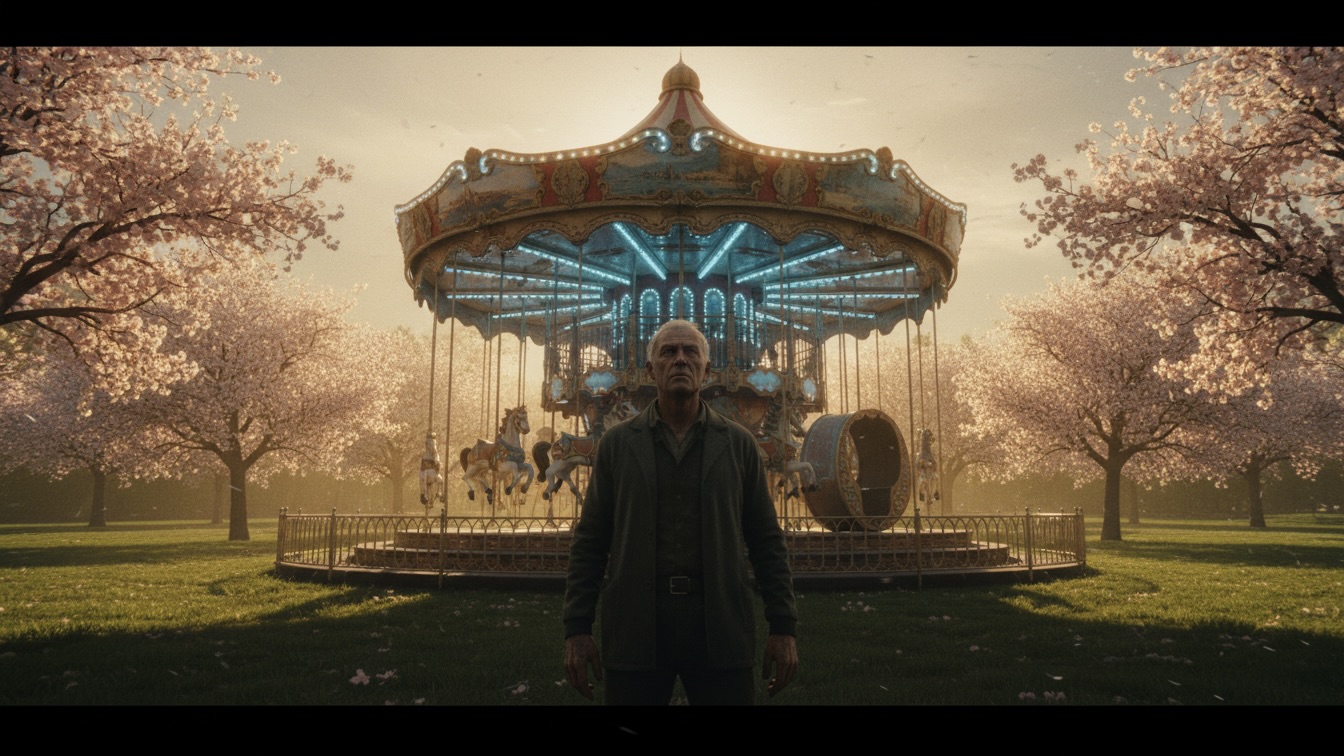
In a park overwhelmed by the aggressive arrival of spring, Mr. Hale maintains a vintage carousel that serves as a secret vessel for a decentralized server network. While the city suffers from frozen bank accounts due to a massive digital glitch, Hale and his associate Sid work to transfer billions in liquidity hidden within the hollow bodies of the carousel horses. Their operation is threatened by Captain Youngsen and a group of Safety Officers who intend to dismantle the ride under the guise of noise abatement and energy conservation.
To complete the data transfer, Hale activates an analog cassette tape containing a hidden digital key, triggering a violent mechanical rotation that incapacitates the officers and repels a mob of protesters. Once the financial data is successfully restored to the grid, the carousel returns to its state as a mere relic. Hale ensures the destruction of the evidence by entrusting the magnetic tape to a young girl who discards it into the river. The story concludes with a return to a hollow peace, where the world remains broken despite the restoration of its wealth.
The narrative explores the friction between the tangible, analog past and the ethereal, digital future. The carousel is not merely a nostalgic relic but a functional host for a decentralized financial system, suggesting that the future often hides within the discarded or overlooked structures of history. The "analog bridge" represented by the cassette tape highlights the necessity of physical, tactile objects in a world increasingly vulnerable to "cloud-based" glitches. This intersection suggests that true security lies not in the invisible, but in the mechanical and the grit of the real world.
The story also examines a society governed by an extreme, weaponized form of sensitivity. The protesters and the Safety Officers represent a bureaucratic obsession with sanitizing the environment of all "auditory micro-aggressions." This hypersensitivity serves as a tool for state control, allowing the government to dismantle historical artifacts under the pretense of public comfort and safety. The conflict is between the messy, grease-stained reality of Hale’s world and the sterile, polished, and ultimately fragile world of the digital authorities.
Finally, there is a pervasive theme of decay disguised as renewal. Hale views the blooming jasmine and cherry blossoms as physical threats and "pink rashes," subverting the traditional literary tropes of spring. This suggests a psychological state where the characters recognize that the "rebirth" of the city’s financial system is merely a temporary fix for a fundamentally broken society. The restoration of the money does not solve the underlying social rot, leaving Hale with a sense of hollow peace as the artificial-looking blossoms fall.
Hale is a man defined by his relationship with the physical world, finding more comfort in the consistency of grease than in the volatility of digital systems. He possesses a deep cynicism toward the modern world, viewing the natural beauty of spring as an aggressive intrusion rather than a welcome change. This psychological alienation suggests he is a man who has been left behind by the rapid pace of technological advancement, yet he remains the only one capable of fixing its failures.
His motivations are rooted in a stoic sense of duty and a quiet rebellion against the sterile authorities that govern his life. He acts as a guardian of both the old machine and the modern wealth, operating with a weary pragmatism that allows him to manipulate the system from within. His decision to give the tape to the girl at the end reveals a hidden protective instinct. He chooses an innocent agent to dispose of the evidence, perhaps hoping to keep her untainted by the complex, corrupt world he inhabits.
Youngsen represents the "digital native" archetype, a man whose entire existence has been mediated by high-speed internet and polished surfaces. His boots are mirror-finished, and his face lacks the lines of experience, indicating a life lived without the friction of manual labor or historical awareness. He is a tool of the institution, using the language of safety and public concern to justify the destruction of something he does not understand.
Psychologically, Youngsen is a creature of the surface, unable to perceive the complexity hidden beneath the "hollow wood" of the carousel. He relies entirely on his tablet and his authority, leaving him completely vulnerable when the physical world—represented by the spinning carousel—reasserts its dominance. His nausea and dizziness at the end of the ride signify the physical rejection of his sterile world-view when confronted with the raw force of mechanical reality.
Sid serves as the frantic, hidden engine of the operation, existing in the literal and metaphorical crawlspace of society. He is described as vibrating at a different frequency than the rest of the world, suggesting that his immersion in the digital realm has physically altered his nervous system. Unlike Hale, who remains grounded and stationary in the central core, Sid is part of the machinery, feeling the heat and the lag of the data as if it were his own physical state.
His anxiety and desperation highlight the high stakes of the operation, providing a sharp contrast to Hale’s calm demeanor. Sid represents the bridge between the two worlds; he understands the "light" of the digital future but is forced to dwell in the "damp earth" of the past to make it function. His emergence from the floorboards at the end, smeared with grease and glowing with blue light, marks him as a hybrid creature born of the friction between two eras.
The author utilizes visceral and often repulsive imagery to describe the natural world, creating a tone of cynical realism. By comparing cherry blossoms to "pink rashes" and pollen to "fiberglass," the narrative voice establishes a profound sense of discomfort with the organic. This stylistic choice mirrors Hale’s internal state, where the "real" is found in grease and gears rather than in the forced joy of a spring festival. These sensory details ground the reader in a world that feels both futuristic and decaying.
The contrast between technological jargon and archaic mechanical descriptions creates a unique "cyber-steampunk" aesthetic. Terms like "256-bit key" and "root directory" are placed alongside "brass levers" and "massive iron beasts," reinforcing the theme of a world caught between two irreconcilable eras. This linguistic blending highlights the absurdity of the setting, where the fate of a global economy rests inside a Victorian amusement ride. It also serves to illustrate the complexity of the "analog bridge" that Sid and Hale are attempting to build.
Pacing in the story transitions effectively from atmospheric tension to chaotic, high-speed action. The initial descriptions of the park and the dialogue with Youngsen move slowly, building a sense of impending dread. This shifts dramatically when the carousel begins to rotate, with the prose becoming more urgent and sensory-focused. The final scenes return to a quiet, somber pace, echoing the "hollow peace" Hale feels as he watches the evidence of his subversion disappear into the river.


