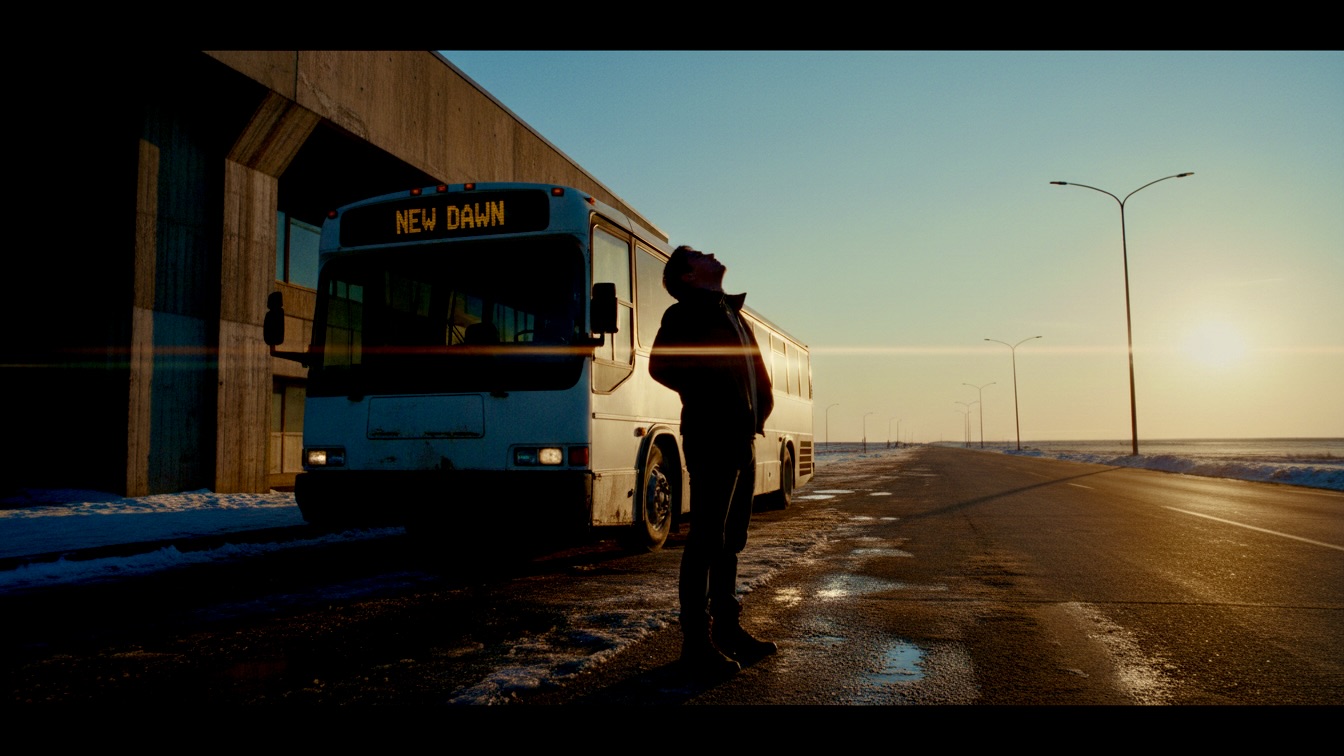
The story follows Tyler, a young man attempting to escape his stagnant life in Winnipeg by boarding a bus to Dryden in the middle of the night. While waiting in a desolate terminal, he encounters a mysterious man in a charcoal suit who provides him with a transit card marked with the command to run. Upon boarding the bus, Tyler meets a fellow passenger named Sarah, who is also fleeing her past. The journey takes a surreal and terrifying turn when the bus enters a fog bank, the driver begins to bleed, and the vehicle eventually crashes after passing through the enigmatic man in the suit. In the aftermath, Tyler and Sarah find themselves in a frozen, alien forest where they are hunted by the faceless figure, realizing too late that their attempt to escape their burdens has led them into a supernatural trap.
The narrative explores the profound psychological weight of failure and the desperate, often futile human desire to outrun one's own history. Tyler views his life in Winnipeg as a source of physical and mental decay, equating his academic and personal shortcomings to a festering wound. By seeking to leave, he attempts to shed his identity as a failure, yet the story suggests that one's past is not a physical location that can be abandoned. The persistent presence of the man in the suit serves as a manifestation of the inescapable nature of guilt and obligation.
Furthermore, the story delves into the illusion of freedom found in transient spaces. The bus terminal and the highway represent liminal zones where characters feel suspended from reality, hoping that movement alone will provide salvation. This search for "clean" air and a fresh start is revealed to be a dangerous delusion. The transition from the mundane, gritty urban setting of Winnipeg to the eerie, frozen landscape of the Shield highlights the terrifying realization that running away often leads to a more hostile environment than the one left behind.
Tyler is a young man paralyzed by his perceived inadequacies and the crushing weight of his unfulfilled potential. He perceives himself as a ghost, an entity that has lost its substance due to his failures in academia and his inability to manage his mundane responsibilities. His internal monologue reveals a deep-seated self-loathing, as he actively avoids the people who represent his obligations, such as his mother and his landlord. He clings to the idea of being a passenger because it absolves him of the need for agency, yet he is ultimately forced to confront his reality when the supernatural threat strips away his ability to remain a passive observer of his own life.
Sarah serves as a mirror to Tyler, embodying a similar state of flight and desperation. She is characterized by a weariness that suggests her journey is not a spontaneous decision but a long-overdue departure from a life that has become unbearable. Her cynical attitude toward the bus schedule and her acknowledgment of the "weirdness" of the Northern Ontario landscape suggest she has seen enough of the world to know that escape is rarely simple. She acts as a catalyst for Tyler's realization, pushing him to acknowledge the danger they are in while simultaneously sharing his vulnerability as they navigate the nightmare of the forest.
The narrative employs a stark, sensory-heavy tone that effectively grounds the reader in the protagonist's malaise. The use of cold, metallic, and industrial imagery—such as the vibrating fluorescent lights and the gritty slush of the city—establishes a pervasive sense of claustrophobia. This atmosphere shifts seamlessly into the surreal as the bus enters the fog, where the language becomes more fragmented and dreamlike. The pacing is deliberate, lingering on the quiet dread of the terminal before accelerating into the chaos of the crash and the final, relentless pursuit.
The narrative voice remains tightly tethered to Tyler's perspective, which enhances the feeling of helplessness as the supernatural elements take hold. By focusing on tactile details like the buzz of the transit card, the smell of diesel, and the freezing cold of the forest, the author creates a visceral experience that emphasizes the physical cost of the characters' journey. The shift from the realistic urban setting to the uncanny, dream-logic of the white woods is handled with a subtle escalation, ensuring that the reader feels as disoriented and trapped as the characters themselves.


