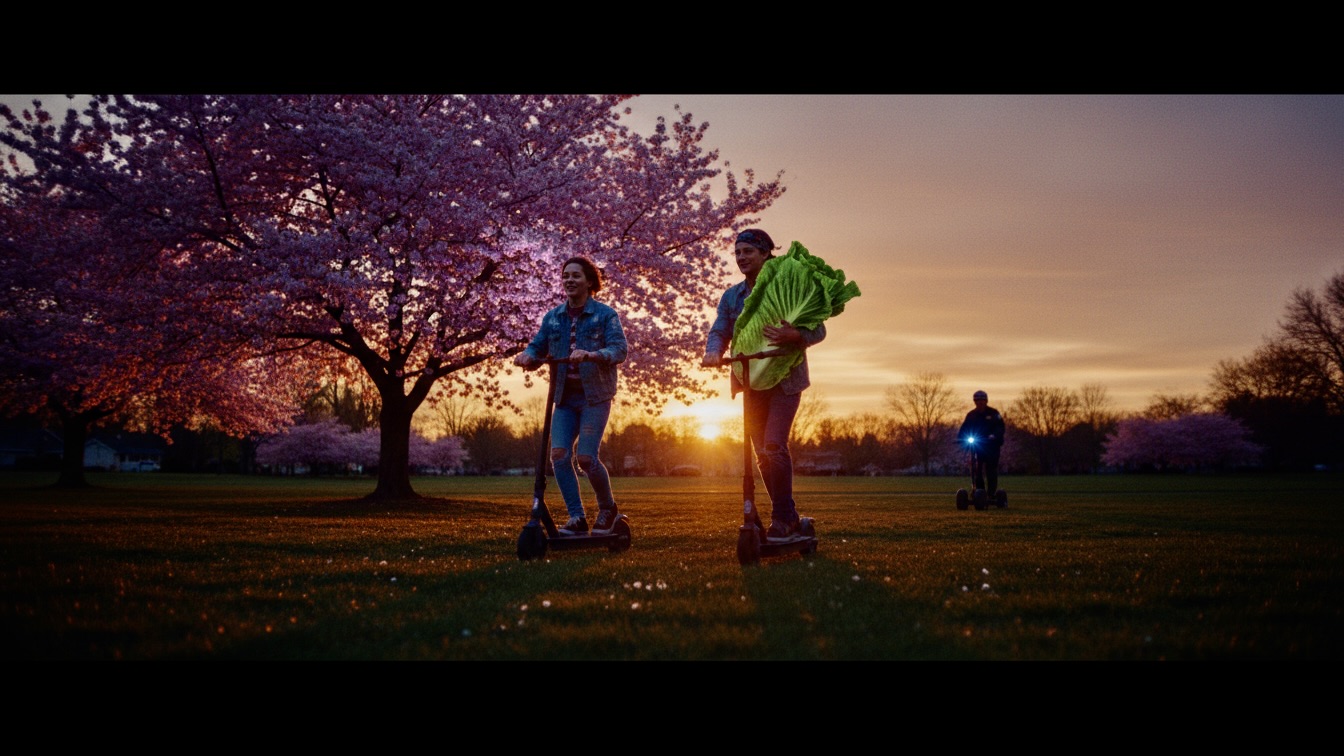
Lance is a young man living in a world where the economy has collapsed to the point that basic produce is a luxury beyond his reach. He desperately wants to take Wendy to prom and provide the Caesar salad she loves, but he only has twenty-three dollars hidden in his shoes. To solve this problem, he recruits his friend Jared, a tech-savvy youth living in a garage, to help him rob the GreenZone. The GreenZone is a heavily guarded, climate-controlled glass box containing the only vibrant greenery left in their brown, dry environment.
The heist begins with a small drone and a simple multi-tool to bypass the aging security of the facility. While inside, Jared’s vanity leads him to take a flash photograph for social media, which triggers a loud alarm and alerts the guard, Officer Griller. The two boys grab what they believe to be heads of lettuce and flee on their electric scooters, narrowly escaping the slow-moving officer. However, their victory is short-lived when they inspect their prize and realize the lettuce is actually a synthetic, rubbery "lab sludge." Instead of falling into despair, the boys find the absurdity of the situation hilarious and decide to settle for bean burgers instead.
A primary theme of the narrative is the tension between artificiality and authenticity in a decaying society. The GreenZone represents a curated, fake version of nature that is sold back to the public at an impossible price point. Lance and Jared risk their lives for what they believe is the "real" thing, only to find that the ultimate symbol of wealth is just as synthetic as the world outside. This revelation highlights the deceptive nature of status symbols in a post-capitalist landscape where even the most basic organic matter has been replaced by industrial gunk.
The story also explores the concept of social currency and the pressure of performance. Lance is obsessed with his "rizz," a modern colloquialism for romantic charisma, and he believes his value is tied directly to his ability to provide a specific meal. His internal struggle shows how young people in desperate environments still cling to traditional social rituals like prom to maintain a sense of normalcy. The fact that he is willing to commit a crime for a salad demonstrates how deeply the scarcity of resources has warped his perception of what is necessary for a successful life.
Finally, the narrative concludes with the theme of absurdist resilience. When the boys realize the lettuce is fake, they do not mourn their failure or the danger they faced; instead, they laugh. This laughter serves as a psychological defense mechanism against a world that no longer makes sense. By rejecting the value of the "lab sludge" and deciding to eat bean burgers, they reclaim their agency and find joy in the reality of their friendship. This shift suggests that human connection is the only authentic thing left in their broken environment.
Lance is a protagonist driven by a mix of adolescent insecurity and genuine affection. He views his financial situation through a lens of social failure, equating his lack of money with a "big, fat hole in the ground" regarding his romantic prospects. His psychological state is characterized by physical manifestations of anxiety, such as the "angry bees" in his stomach. This indicates that he is not a natural criminal, but rather a desperate young man trying to navigate a world that has priced him out of basic happiness.
His internal conflict is resolved when he witnesses the gross reality of the synthetic lettuce. Throughout the story, he is preoccupied with the "math" of his life and the red numbers on the screen, but his laughter at the end shows a release from this mental burden. He moves from a state of hyper-fixation on status to a state of acceptance. By the end of the chapter, he is able to appreciate the simple beauty of the spring air and the pink petals on his sleeve, suggesting a newfound psychological grounding.
Jared serves as the catalyst for the heist and represents the intersection of technology and boredom. He lives in a state of casual detachment, more interested in his drone and his social media presence than the actual gravity of their crime. His decision to take a flash photograph inside the GreenZone reveals a deep-seated need for validation from "the guys" online. This impulsivity nearly costs him his freedom, yet he seems largely unfazed by the danger, treating the entire event like a game.
Despite his recklessness, Jared is a loyal friend who provides the technical means for Lance’s mission. He is the one who first identifies the lettuce as "lab sludge," showing a cynical awareness of the world’s deceptions. His laughter alongside Lance at the end of the story shows that he shares the same coping mechanisms as his friend. He is a character who has adapted to the decay around him by finding entertainment in the ruins of the old world.
Officer Griller acts as the personification of a failing and ineffective authority system. He is described as old and slow, moving like he is traveling through a "pool of pudding," which mirrors the sluggishness of the government mentioned later in the text. While he represents a threat to the boys, he is depicted with a touch of humor rather than true malice. His red face and "official" scooter with its little blue light suggest a man trying to maintain order in a world that has largely moved past the need for his specific brand of policing.
The pacing of the story is expertly handled, transitioning from a slow, contemplative opening to a frantic, high-stakes chase. The initial descriptions of the red numbers and the dry park set a somber, stagnant tone that reflects Lance's hopelessness. Once the heist begins, the sentences become shorter and more punchy, mimicking the rapid heartbeat of the protagonist. This rhythmic shift keeps the reader engaged and heightens the tension during the encounter with Officer Griller.
Sensory details are used to ground the dystopian setting in a visceral reality. The author contrasts the "old oil and burnt toast" smell of Jared’s garage with the "warm, wet, rainy day" scent of the GreenZone. These details help the reader understand the allure of the glass box; it is not just about the food, but about an environment that no longer exists in the outside world. The description of the lettuce as "cold, slimy footballs" that eventually turn into "green goo" provides a physical payoff to the theme of deception.
The narrative voice is distinct, using a blend of youthful slang and poetic observation. The use of the word "rizz" alongside descriptions of the sky as a "bruised peach" creates a unique perspective that feels both modern and timeless. This voice allows the story to tackle heavy themes of economic collapse and environmental ruin without becoming overly bleak. The final image of the pink petals falling on Lance’s head provides a soft, hopeful conclusion to a story that began with the harsh reality of red numbers.


