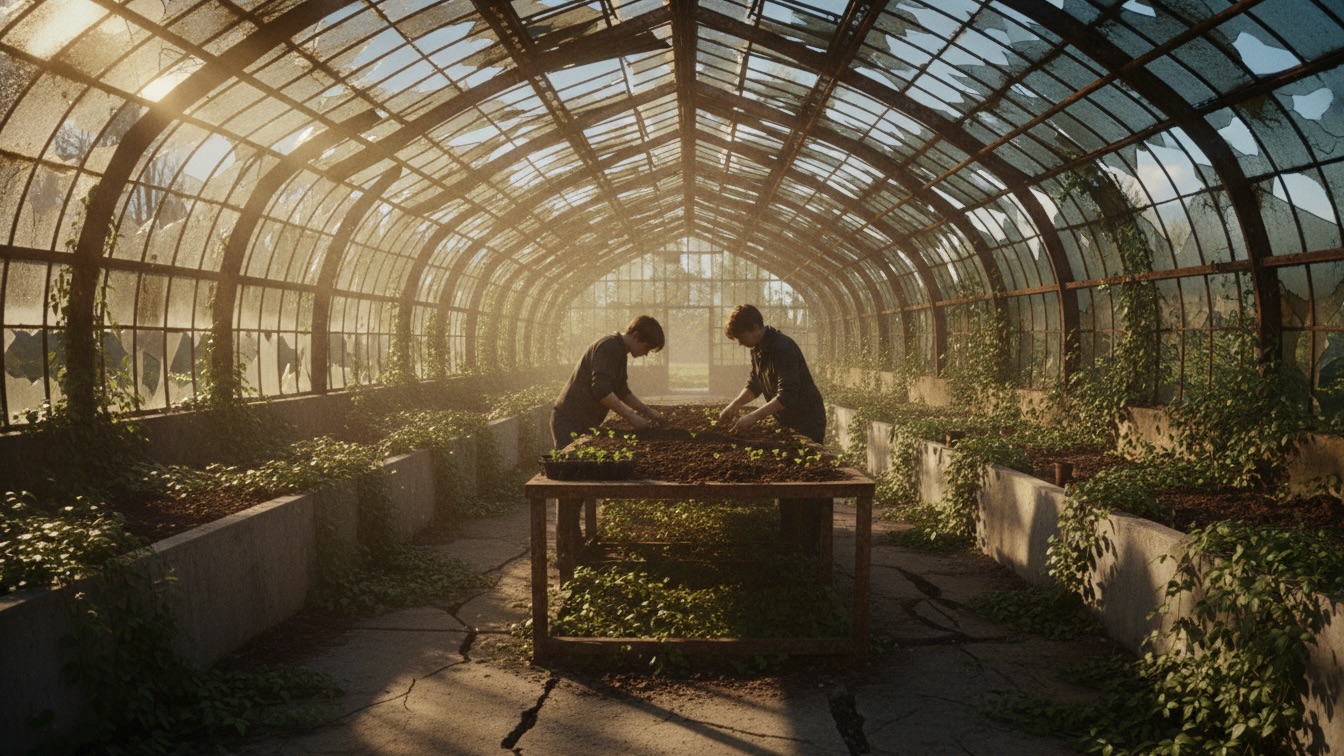
The story follows an unnamed male protagonist who arrives at a decaying university greenhouse to perform mandatory community service. He is struggling with a profound sense of "doomer" anxiety, feeling overwhelmed by a world plagued by environmental collapse and the encroaching dominance of technology. Upon entering the dilapidated structure, he meets Cleo, a resilient woman who is determined to save a batch of heirloom tomato sprouts despite the university's plan to demolish the building for a new server farm. After an initial mishap where the narrator accidentally breaks a water nozzle and floods the work area, Cleo teaches him the delicate art of transplanting the fragile seedlings.
As the two work together in the fading light, the narrator questions the point of their labor given the impending arrival of bulldozers. Cleo offers a grounded philosophy of focusing on the present, explaining that the seeds simply respond to the care they receive regardless of the future. This perspective shifts the narrator’s internal state from nihilistic despair to a sense of protective purpose. The chapter concludes with the two characters deciding to smuggle the fifty plants out of the condemned greenhouse. They carry the tray together into the night, heading toward the narrator’s dorm room in a quiet act of defiance against the destruction scheduled for dawn.
The central theme of the story is the tension between systemic entropy and individual agency. The setting is a microcosm of a world in decline, where the narrator observes that "everything is broken" and "the news is always bad." The university’s decision to replace a greenhouse with a server farm symbolizes the triumph of cold, artificial intelligence over organic life and human heritage. This creates a suffocating atmosphere of nihilism that the narrator refers to as the "heavy, dark blanket" in his brain.
Against this backdrop of decay, the act of gardening serves as a powerful metaphor for hope and resistance. Cleo’s philosophy that "the seed doesn't know" about the bulldozers highlights a focus on the present moment and the inherent drive of life to persist. By tending to the Cherokee Purple heirlooms, the characters reclaim a sense of meaning that the larger institutional world has discarded. The story suggests that while one cannot stop the "bulldozers" of progress or climate change, he can still choose to protect what is fragile and living in his immediate vicinity.
Connectivity and shared labor also emerge as vital themes throughout the text. Initially, the narrator feels isolated and insignificant, describing himself as a "bug" amidst giant gray blocks of concrete. However, through the rhythmic, physical work of mixing dirt and transplanting sprouts, he finds a profound connection to Cleo and the plants. This shared secret transforms his nihilism into a protective instinct, moving him from a state of passive observation to active rescue.
The narrator begins the story in a state of high physiological and psychological distress. He experiences the world through a lens of sensory overload and anxiety, noting the "dirty" light and the "screaming" birds. His internal monologue reveals a deep-seated nihilism, which he uses to distance himself from a world that feels increasingly hostile. He feels physically small and insignificant, a psychological projection of his lack of agency in a society that seems to be ending.
This sense of powerlessness is exacerbated when he accidentally breaks the hose, reinforcing his belief that he is inherently clumsy and destructive. However, his interaction with Cleo provides a therapeutic shift in his perspective. As he engages in the tactile, grounding work of transplanting the tomatoes, his focus moves from the macro-scale of global collapse to the micro-scale of a single root. This transition helps him manage his anxiety by grounding him in the physical reality of the present.
By the end of the chapter, he moves from passive resignation to active participation. He is the one who suggests moving the plants to his dorm, showing a burgeoning sense of responsibility and a rejection of his earlier passivity. He chooses to risk his own comfort and potential disciplinary action to ensure the survival of the sprouts. This evolution suggests that his "doomer" outlook was a defense mechanism against a feeling of uselessness, which is cured by meaningful work.
Cleo serves as the story's emotional and philosophical anchor, representing a figure of weary but steadfast resilience. She is portrayed as being permanently marked by her labor, with dirt smudged on her face and black handprints on her shirt. Unlike the narrator, she does not indulge in the narrative of global despair, even though she is fully aware of the impending destruction of her workspace. Her focus is entirely pragmatic, rooted in the biological needs of the plants she tends.
Her history with the heirloom seeds connects her to a lineage of survival that predates the current crisis. By saving seeds from 1998, she acts as a bridge between a more stable past and an uncertain, technological future. She treats the narrator with a gruff but necessary honesty, refusing to coddle his mistakes while encouraging him to try again. This lack of sentimentality makes her eventual acceptance of his help more meaningful.
Cleo’s declaration that she can "only control today" is the catalyst for the narrator's transformation. She demonstrates a stoic form of hope that is not based on optimism, but on the duty to care for life because it is alive. Her decision to live in a van further emphasizes her outsider status and her commitment to her values over traditional security. She is a protector of heritage in a world that values only the new and the digital.
The narrative voice is characterized by a stark, minimalist prose style that mirrors the narrator's psychological state. Short, declarative sentences create a sense of urgency and fragmentation, reflecting a mind that is constantly on edge. The repetitive use of onomatopoeia—such as "Scrape. Pop. Crumble. Pinch."—grounds the reader in the physical reality of the scene. This technique emphasizes the eventual meditative rhythm of the narrator's work as he moves away from his initial panic.
Sensory details are used effectively to create a visceral atmosphere of decay and rebirth. The author contrasts the "dirty yellow light" and "old plastic" with the "bright, angry green" of the weeds and the "tiny white strings" of the roots. The olfactory descriptions of "wet dirt" and "old chemicals" evoke a sense of dampness and stagnation that permeates the greenhouse. These details do more than set the scene; they represent the psychological weight of the environment on the characters.
The pacing of the chapter follows a curve from chaotic distress to focused, rhythmic calm. The middle section, detailing the transplanting process, slows down significantly to mimic the careful movements required for the task. This deliberate slowing of the narrative allows the reader to experience the narrator’s growing mindfulness and his transition into a state of flow. The final scene, where the characters exit into the "spring night air," brings a sense of resolution and quiet determination.


