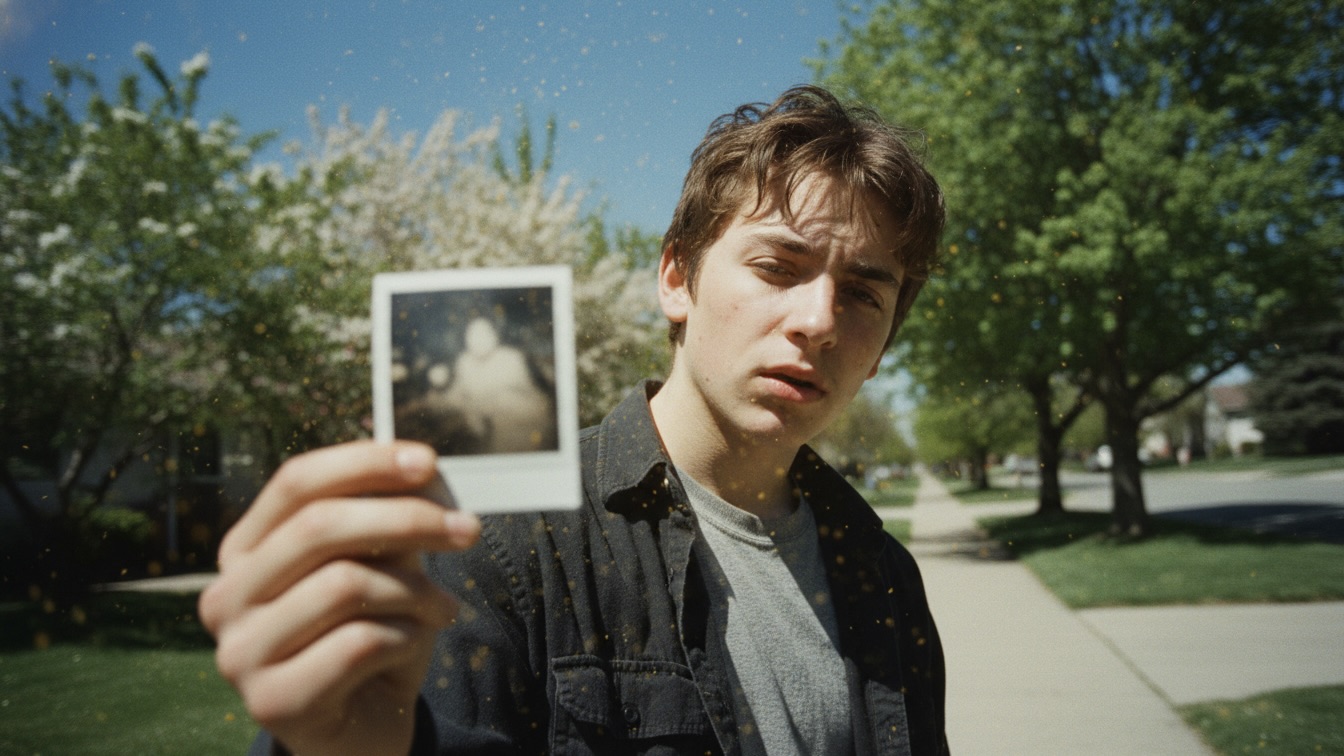
The chapter begins with Larry waking up in a state of profound physical and mental disarray, nursing a severe hangover and discovering a literal hole in his smile where his canine tooth used to be. He is greeted by a mysterious, uninvited dog that seems to judge his every move as he struggles to regain his bearings. Choked by aggressive spring pollen and a sense of impending doom, he discovers he has been digitally exiled by his closest friends, Jackson and Sarah. His journey for answers is guided by a series of haunting polaroid photographs that suggest he engaged in a violent or unhinged confrontation the night before.
Larry eventually tracks his friends to the basement of their high school, where the terrifying mystery of his injuries dissolves into a pathetic and humiliating reality. He learns that his missing tooth was not the result of a heroic struggle or a criminal assault, but rather a failed, drunken attempt to "rap battle" his principal. After a clumsy "mic drop" led to a face-plant against metal bleachers, he was left with a shattered reputation and a physical reminder of his hubris. However, as he leaves the school with his recovered tooth, the discovery of the principal’s car keys in his pocket suggests that the night held darker, unexplained complexities beyond a simple drunken accident.
The central theme of the narrative revolves around the fragility of identity and the "gap" between self-perception and external reality. Larry’s missing canine tooth serves as a visceral metaphor for the holes in his memory and the loss of his social standing. Throughout the text, he attempts to construct a narrative of himself as a victim of a crime or a participant in a high-stakes drama. This psychological defense mechanism is shattered when he is confronted with the reality of his own absurdity. The physical pain he experiences is secondary to the "social death" he suffers when he realizes his peers viewed his behavior not with fear, but with pity and mockery.
Another prominent theme is the violence of transition, mirrored in the aggressive arrival of spring. The author describes the season not as a time of gentle renewal, but as a "violent" arrival characterized by "aggressive" sun and "toxic" pollen. This environmental hostility reflects Larry’s internal state as he transitions from the safety of childhood friendships into the harsh, judgmental world of late adolescence. The yellow pollen that coats everything acts as a film of truth that Larry cannot escape, irritating his senses and forcing him to face the "sickly, pale glow" of his own reflection.
The narrative also explores the theme of digital isolation and the modern "disappearance." In the contemporary social landscape, being blocked or finding "User Not Found" is a form of non-existence that triggers a cold, sinking knot of panic. Larry’s identity is tied to his digital presence, and when Jackson wipes him from his digital existence, Larry feels as though he has been erased from the world itself. This highlights the precarious nature of modern relationships, where years of shared history can be severed by a single tap on a screen.
Larry is a character defined by his lack of agency and his profound dissociative state. From a psychological perspective, he exhibits signs of intense cognitive dissonance as he tries to reconcile his self-image with the "unhinged" version of himself captured in the polaroids. He is a man searching for a version of the truth that allows him to remain the protagonist of a serious story, rather than the punchline of a joke. His fixation on the physical "gap" in his mouth represents his desperate need to fill the void in his own narrative.
His motivations are driven primarily by social anxiety and the need for closure. He cannot simply wait for the hangover to pass; he must hunt down the evidence of his own disgrace to regain a sense of control. Even when faced with the crushing weight of his embarrassment, he remains a magnet for the unexplained, as seen in his relationship with the mysterious dog. Larry is a character who is physically present but mentally and socially displaced, caught between the person he thinks he is and the "idiot" everyone else saw.
Jackson serves as the narrative’s anchor to reality, representing a friend who has finally reached the threshold of his patience. While he shows a lingering sense of loyalty by ensuring Larry got home safely the night before, his decision to block Larry indicates a deep psychological exhaustion. He is no longer willing to be the caretaker for Larry’s self-destructive impulses. His flat tone and "miserable laugh" suggest a man who is mourning the loss of a friendship that has become too heavy to carry.
His role in the story is to deliver the "bathos"—the sudden shift from the serious to the ridiculous. By returning Larry’s tooth and explaining the "rap battle," he strips Larry of his delusions of grandeur. Jackson is the voice of consequences, forcing Larry to see the reality of his actions without the buffer of friendship. He is a character who has chosen self-preservation over the enabling behaviors that often characterize long-term childhood bonds.
Sarah acts as the personification of social judgment and the "spectator" to Larry’s downfall. Her perspective is devoid of the nostalgia that Jackson feels, allowing her to view Larry’s actions with "pure, concentrated judgment." She represents the wider community’s reaction to Larry’s behavior, emphasizing that his actions were not just embarrassing but a "hate crime against music." Her presence in the prop room highlights Larry’s status as an outcast, as she is more concerned with her own missed social opportunities than with Larry’s physical well-being.
Psychologically, she serves as the reality check that Larry cannot ignore. While Jackson might be moved by Larry’s distress, Sarah is moved only by the inconvenience he has caused. Her "dripping pity" is more damaging to Larry’s ego than outright anger would be. She reinforces the theme of social death, making it clear that Larry’s actions have rendered him a persona non grata in their shared social circle.
The pacing of the chapter is expertly handled, beginning with a slow, sensory-heavy focus on Larry’s physical discomfort before accelerating into a tense, mystery-driven search for answers. The author uses a "limited third-person" perspective that keeps the reader as disoriented and paranoid as Larry himself. This creates a sense of dread that mimics a thriller, making the eventual reveal of the "rap battle" even more jarring. This stylistic choice of "bathos" serves to heighten the reader's empathy for Larry's embarrassment by first leading them to believe something truly terrible had happened.
Sensory details are used with surgical precision to create a visceral experience for the reader. The author frequently references the taste of "copper" and "old blood," the smell of "wet dirt and old Fritos," and the "piercing" sounds of the morning. These details ground the story in a gritty, unpleasant reality that contrasts with the absurdity of the plot. The recurring motif of "yellow"—from the sunlight to the pollen to the tooth root—creates a cohesive visual palette that feels sickly and stifling, perfectly capturing the atmosphere of a post-blackout morning.
The narrative voice is clinical yet evocative, blending the protagonist's internal panic with a detached description of his environment. This creates a psychological distance that allows the reader to observe Larry’s plight with a mix of concern and morbid curiosity. The final twist involving the Honda keys is a masterful stylistic pivot, shifting the tone from cringe-comedy back into the realm of the unexplained. It leaves the reader in a state of suspended tension, suggesting that while the "gap" in the tooth is explained, the "gap" in the night's events is far from closed.


