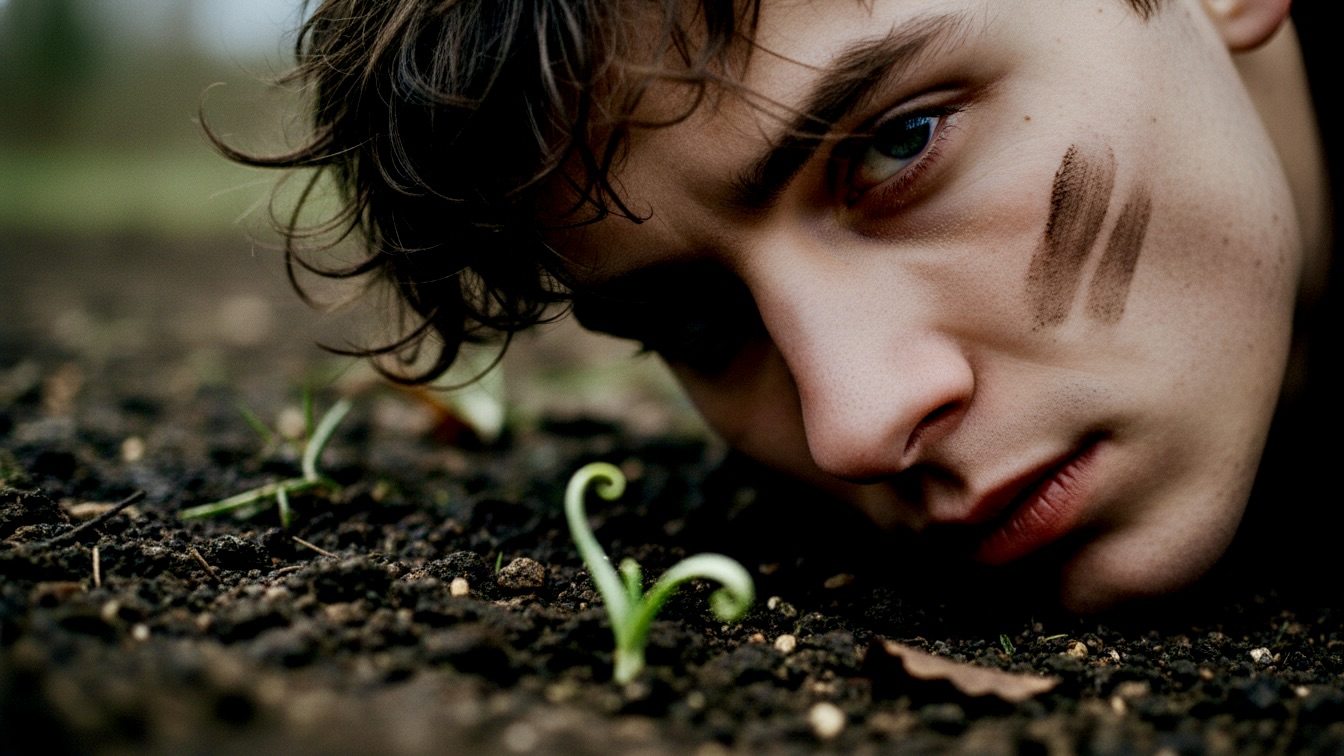
Jack struggles with frozen soil and mental static until a winter garden forces him to finally start breathing.
"You're overthinking the hole, Jack. It's dirt, not a career path."
Jack looked up, his breath blooming in a thick cloud that vanished against the flat gray of the sky. Mrs. Linder stood over him, wrapped in a coat that looked like it had survived three wars and a house fire. She wasn't looking at him. She was looking at the trowel in his hand, which he was holding like it might explode if he applied too much pressure.
"I'm just trying to make sure it's level," Jack said. His voice sounded thin to his own ears. It was the voice he used when he was explaining to his parents why he hadn't found a 'real' job yet or why his screen time was fourteen hours a day. "The guide said six inches."
"The guide was written by people who don't have frost in their joints," she snapped. "Push it in. Harder. You aren't going to hurt the earth. It's been here longer than your anxiety."
Jack looked back down at the patch of dark, half-frozen mud. It was February. Everything was dead, or supposed to be. The community garden was a graveyard of shriveled tomato vines and skeletal bean poles. He didn't know why he was here. Actually, he did. His therapist had suggested 'grounding.' Literally. Get your hands in the dirt, Jack. Stop living in the cloud, Jack. Find the physical world, Jack.
He shoved the trowel down. It hit something hard with a dull clack. The vibration traveled up his arm, buzzing through his wrist and settling in his elbow.
"Rock?" he asked.
"Ice," Mrs. Linder said. "Keep going. Get under it."
Jack leaned his weight onto the tool. He felt the resistance of the soil—the dense, packed reality of it. It wasn't like a keyboard. There was no undo button here. If he snapped the trowel, it stayed snapped. If he cut a worm in half, it stayed cut. The physical stakes were tiny, but they felt massive because they were so loud. Everything in his life for the last six months had been quiet. Muted. Digital pings. Slack notifications. The hum of his laptop fan. This was loud. The scrape of metal on stone. The whistle of the wind through the chain-link fence. The smell of woodsmoke from a chimney three blocks over.
His brain was doing that thing again. The flickering. He was thinking about the email he hadn't replied to. He was thinking about how his bank account looked like a countdown clock. He was thinking about how his ex-girlfriend’s Instagram story had featured a hand that definitely wasn't hers holding a drink he couldn't afford.
Flicker. Flicker. Flicker.
"Jack."
He blinked. Mrs. Linder was staring at him. Not with pity—she didn't seem like the type to waste energy on pity—but with a kind of clinical observation.
"You're vibrating," she said.
"Cold," he lied.
"No. You're thinking. Stop it. You can't plant garlic while you're thinking about whatever is happening on that glass rectangle in your pocket. The soil knows when you're distracted. It won't hold for you."
"That sounds like some New Age stuff," Jack muttered, but he put more muscle into the dig.
"It's physics, kid. Intention. Force. Now, give me that bulb."
He reached into the burlap sack. The garlic bulbs were papery and dry, smelling faintly of a kitchen he hadn't visited in years. He handed one to her. Her fingers were gnarled, the skin like parchment, but she moved with a precision that made him feel clumsy. She peeled away the outer layer, revealing the cloves.
"Root side down," she commanded. "Pointy side up. Like a rocket."
Jack took a clove. It felt small. Insignificant. "Is it actually going to grow? It’s like ten degrees out."
"It needs the cold," she said. "Some things don't wake up unless they’ve been frozen for a while. It’s called vernalization. If it stays warm all year, the garlic never forms a head. It just stays a single, sad little scallion. It needs the struggle. It needs the winter to know it’s alive."
Jack looked at the clove in his palm. It needs the struggle. He felt a weird, sharp pang in his chest. It wasn't poetic. It just hurt. He thought about the three months he’d spent in his apartment with the curtains drawn, eating ramen and watching the same five sitcoms because the world outside felt like too much data to process. He’d been trying to avoid the freeze. He’d been trying to stay in a climate-controlled stasis.
He pushed the clove into the hole he’d managed to gouge out. The dirt was freezing. It bit at his fingertips, a sharp, stinging cold that forced his brain to stop the flickering.
Cold. Dirt. Sharp.
Suddenly, the mental static cleared. It was like a window had been smashed open in a stuffy room. The air rushed in—real air, tasting of ice and wet pavement. He took a breath. A real one. Not the shallow, chest-only sips of air he’d been surviving on for weeks. A deep, lung-expanding pull that made his ribs ache.
"There," Mrs. Linder said, her voice softer now. "You finally stopped holding your breath."
"I didn't realize I was,"
"Most people don't. They walk around like they're underwater, wondering why they're tired all the time. Cover it up. Two inches of soil. Then the straw."
Jack used his hands this time. He pushed the loose dirt over the garlic clove. He liked the way it felt—the grit under his fingernails, the weight of the earth. It was grounded. It was heavy. It was there. He grabbed a handful of straw from the bale nearby and spread it over the patch.
"Why the straw?" he asked.
"Insulation. Keeps the ground from heaving when it thaws and freezes again. It’s a blanket. Even things that need the cold need a little protection."
They worked in silence for the next hour. Jack dug, Mrs. Linder prepped the cloves, and Jack covered them. The urgency shifted from a frantic, internal panic to a rhythmic, external pace. Dig. Plant. Cover. Dig. Plant. Cover.
His back started to ache. His knees were damp from the mud. His phone buzzed in his pocket—a ghost limb sensation—but he didn't reach for it. He didn't care who was texting. He didn't care about the news cycle. He cared about the next hole. He cared about the fact that his hands were starting to glow with a strange, internal heat despite the temperature.
"You're doing okay," Mrs. Linder said as they reached the end of the row. She stood up, rubbing her lower back. "For a city kid who probably thinks milk comes from a carton and dirt is a health hazard."
Jack wiped a smear of mud off his forehead. "I didn't say I liked it."
"You don't have to like it. You just have to do it. There’s a difference."
She looked at the rows they’d finished. They looked like nothing. Just disturbed earth and some scattered straw under a depressing sky. But Jack knew what was under there. He knew there were fifty little rockets waiting for the spring. He knew that while he was sleeping and scrolling and worrying, those cloves would be sitting in the dark, doing the slow, heavy work of becoming something else.
"What happens now?" Jack asked.
"Now?" Mrs. Linder picked up the empty burlap sack. "Now we wait. We go inside, we drink something hot, and we let the winter do its job. You can't rush a bulb, Jack. You can't optimize growth. It happens when it happens."
Jack looked down at his hands. They were ruined. Stained dark, skin chapped, a small cut on his thumb where he’d hit a sharp rock. They looked like hands that actually did things. He felt a sudden, inexplicable surge of clarity. The claustrophobia of his own mind had receded, leaving behind a wide, empty space. It was scary, but it was clean.
"I should probably wash these," he said, gesturing to his hands.
"Probably," she agreed. "But don't be in such a hurry to get back to the clean world. The dirt suits you. Makes you look less like a ghost."
As they walked toward the small tool shed, Jack felt the weight of the last few months lifting. It wasn't gone—he still had no job, his debt was still real, and he was still lonely—but the burden had changed shape. It was no longer a suffocating fog. It was a physical weight, like the shovel, something he could pick up and put down. Something he could work with.
He reached the shed door and paused, looking back at the garden. The wind picked up, swirling a few dead leaves across the straw. It was a brutal, ugly day, and for the first time in a long time, Jack felt like he was exactly where he was supposed to be.
He reached into his pocket and felt the smooth, cold glass of his phone. He thought about pulling it out. He thought about the notifications waiting for him.
Then he let go of it and gripped the handle of the shed door instead.
“He reached into his pocket and felt the smooth, cold glass of his phone, but his fingers remained curled around the muddy handle of the garden gate.”