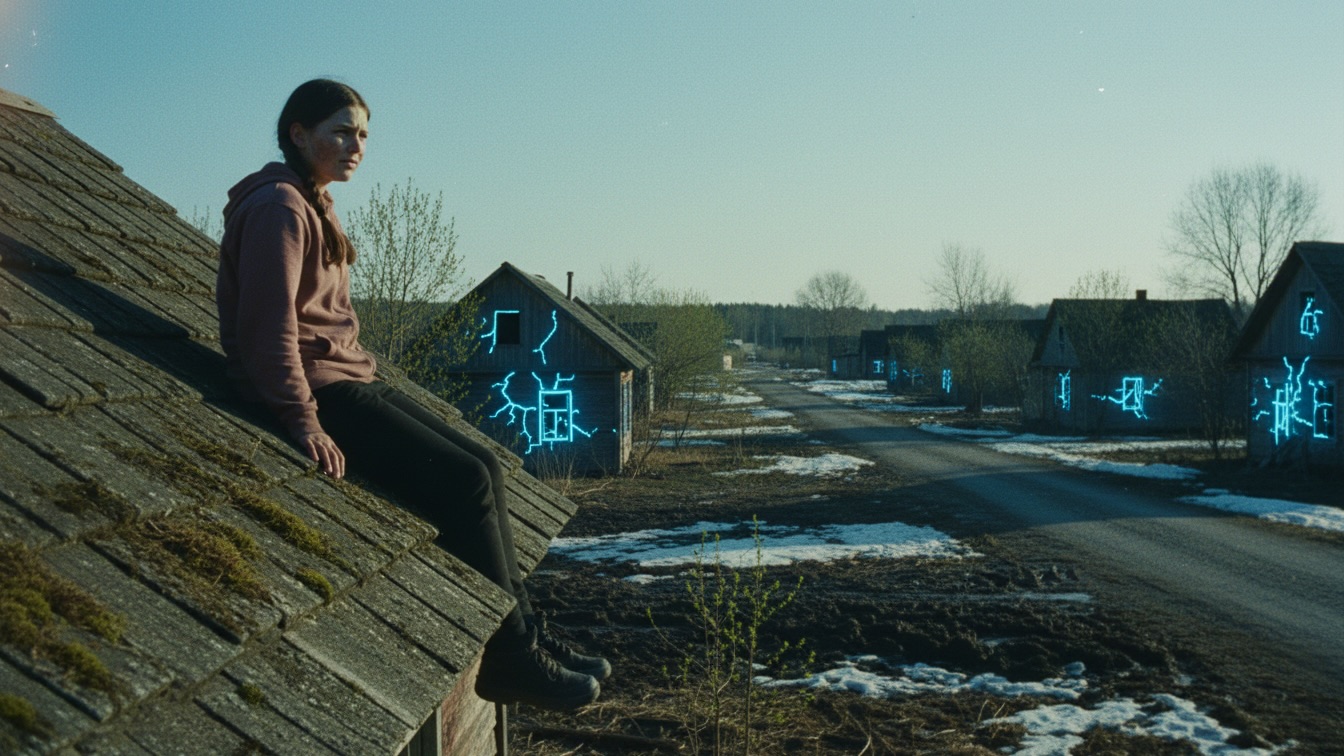
The story follows Stella, a young woman living in a neglected house on an Indigenous reservation in Northwestern Ontario. Surrounded by the damp rot of a spring thaw and the pervasive presence of toxic black mold, she discovers a startling anomaly. When she plays high-energy hyper-pop music, the mold in her closet begins to pulse with a bioluminescent blue light. This discovery occurs just as Inspector Urren, a cold government official, arrives to flag the home for immediate evacuation due to its hazardous conditions.
Refusing to be displaced to invisible modular units in the city, Stella begins to experiment with the mold using frequency generator apps. She realizes the organism acts as a biological antenna, boosting cellular signals when tuned to specific resonances. She clandestinely teaches other local youths how to "feed" the mold in their own homes, creating a decentralized, community-wide communication mesh.
The utility of this biological network is tested when a severe late-season storm knocks out the region's power and official telecommunications. In the total blackout, the "mold-net" remains active, glowing with a protective blue light. Stella uses her phone to route an emergency call through the mesh, successfully summoning medical aid for a neighbor experiencing chest pains. The chapter concludes with Stella watching the community glow with rhythmic blue light, signaling a new era of technological sovereignty and visibility.
The narrative explores the profound theme of reclamation, specifically how a community can transform the physical manifestations of systemic neglect into tools of empowerment. The black mold, traditionally a symbol of decay and government failure, is reimagined as a biological miracle. By finding utility in the very substance meant to justify their displacement, the characters assert their right to remain in their ancestral space.
This shift from "rot" to "resonance" serves as a powerful metaphor for Indigenous resilience. Stella does not wait for the government to fix the infrastructure that has been failing since 1994; instead, she hacks the environment she was given. This highlights a move toward technological sovereignty, where the community bypasses unreliable state-provided services to create a closed-loop system that they own and control.
There is also a significant exploration of the intersection between nature and technology. The story suggests that the divide between the organic and the digital is porous. By treating the mold as a "living circuit," Stella engages in a form of bio-hacking that feels both futuristic and deeply rooted in the land. The mold-net represents a synthesis of the environment and modern necessity, suggesting that survival in a neglected landscape requires a radical re-envisioning of what constitutes a resource.
Finally, the theme of visibility versus invisibility permeates the text. Inspector Urren sees the residents as mere statistics or "red flags" on a sensor, viewing their homes as hazards to be condemned. However, by the end of the story, the houses are literally glowing. This bioluminescence serves as a beacon of defiance, making the community impossible to ignore and transforming a site of supposed squalor into a luminous, organized collective.
Stella is a protagonist defined by her sharp intellect and a simmering, righteous anger. Psychologically, she exists in a state of high-alert survivalism, evidenced by her ability to navigate a world of cracked screens and zero signal bars. Her initial reaction to the mold is one of cynical observation, but her curiosity quickly evolves into a sophisticated understanding of acoustics and biology. This transition reveals her as a natural leader and an innovator who thrives in the margins of society.
She experiences a profound internal conflict between the desire to hide her reality and the need to weaponize it. Initially, she uses charcoal to mask the mold, a defensive act intended to avoid the gaze of the state. However, as she realizes the potential of the "mold-net," her motivation shifts from evasion to revolution. She moves from a state of "fever dream" isolation to a role as a community architect, demonstrating a psychological shift from victimhood to agency.
Her connection to the mold is almost symbiotic; she feels the pulse of the network in her fingertips and views herself as the "server" or the "switchboard." This suggests a deep yearning for connection in a world that has tried to isolate her. By the end of the chapter, her anger has been channeled into a protective force. She stands on the roof not as a refugee of a condemned building, but as the guardian of a new, vibrant ecosystem.
Inspector Urren serves as the personification of bureaucratic coldness and the dehumanizing nature of the state. He is characterized by his sensory detachment from the environment he inspects, smelling of "peppermint and expensive laundry detergent" in a world of rot. His refusal to look Auntie Bev in the eye or respect Stella’s personal space indicates a psychological framework where the inhabitants are obstacles rather than people.
His motivations are purely procedural; he seeks to "condemn" and "evacuate" without offering genuine solutions. To him, the house is a "sponge for toxins" and a "fire hazard," a perspective that lacks any empathy for the displacement he is mandating. He represents the "void of government assistance" that Stella critiques, acting as a catalyst for the community's radical shift toward self-reliance.
The pacing of the narrative is masterfully handled, beginning with a heavy, stagnant atmosphere that mirrors the damp Northwestern Ontario spring. The early descriptions of "muddy, gray sludge" and "heavy lungs" create a sense of claustrophobia and decay. However, the tempo accelerates as Stella begins her experiments, shifting from a slow, observational tone to a high-energy, rhythmic pulse that mimics the hyper-pop music she plays.
Sensory details are used to create a vivid contrast between the sterile world of the government and the visceral reality of the reservation. The "spiderweb of cracks" on Stella's phone and the "wet dog" smell of the air ground the story in a gritty realism. This makes the eventual introduction of the "neon blue light" and the "electric" hum of the walls feel even more magical and transformative. The author uses color—specifically the transition from matte black and gray to vibrant blue—to track the emotional arc of the story.
The narrative voice is first-person and highly intimate, allowing the reader to experience Stella’s "hot flash of anger" and her eventual sense of awe. Her voice is characterized by a blend of modern slang and poetic observation, making her feel like a contemporary teenager facing ancient, systemic problems. The use of technical language like "1.2GHz frequency" and "mesh network" alongside descriptions of "charcoal dust" creates a unique "rez-tech" aesthetic.
The final scene provides a powerful stylistic climax, moving from the chaotic action of the storm to a moment of hushed, visual grandeur. The image of the "protective blue light" pulsing through the cracks of condemned houses is both haunting and hopeful. This concluding imagery effectively resolves the tension of the chapter, leaving the reader with a sense of a world that has been irrevocably changed by a "collective heartbeat."


