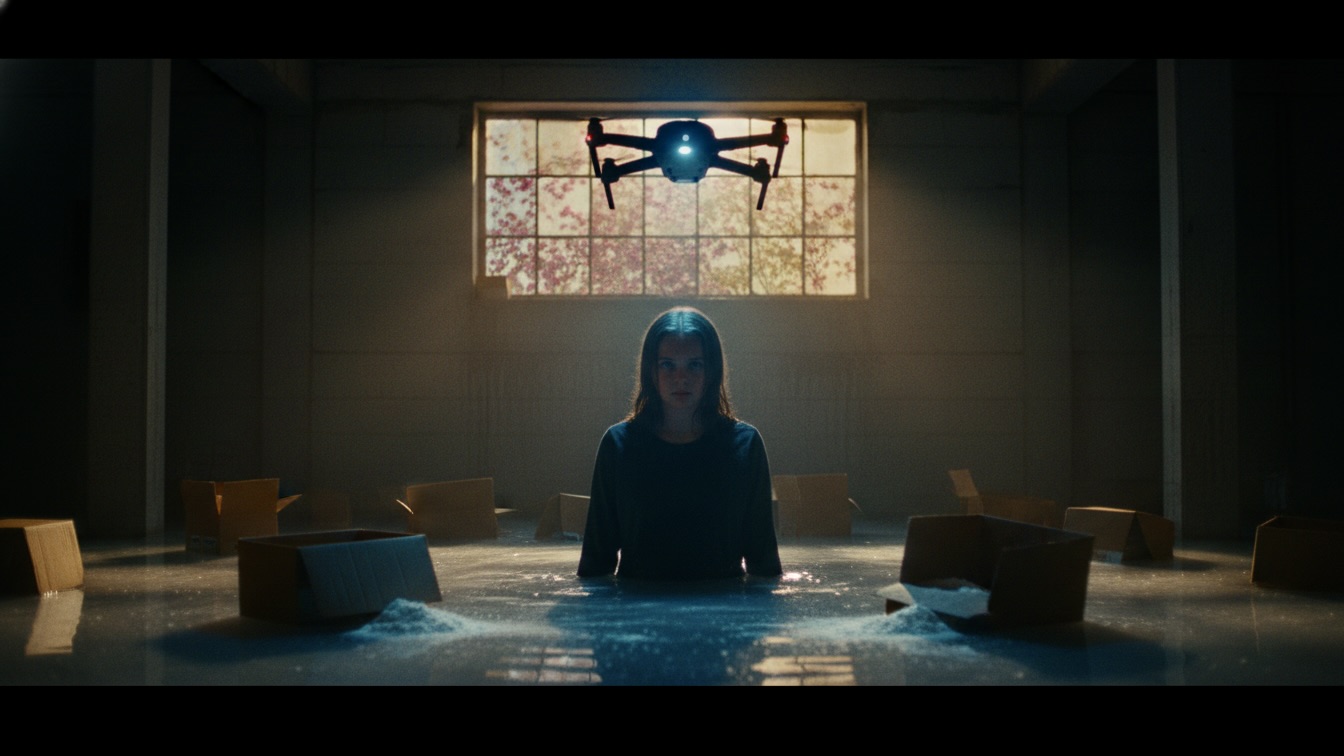
Patti is a seventeen-year-old girl navigating the bleak, slushy landscape of Winnipeg in March. She survives by salvaging discarded goods, specifically baby formula labeled as unfit for sale by a local supermarket. Accompanied by her tech-savvy friend William, she transports the haul to a condemned basement to distribute it to hungry families in her neighborhood. Her internal world is defined by a neurodivergent focus on expiration dates and sensory details, which she uses to make sense of a hostile urban environment.
The mission is interrupted when a corporate security drone discovers their cache, followed shortly by Inspector Crandin, a man from Patti's past who represents the bureaucratic system that once separated her family. Crandin demands entry to seize and destroy the food, citing public safety regulations. In a desperate act of defiance, Patti chooses to flood the basement with freezing runoff water. By destroying the formula herself, she prevents the system from tracking it or using it as evidence against her, asserting her own agency over what is considered unfit.
One central theme explored in the text is the dehumanization inherent in corporate and bureaucratic systems. The story highlights how essential resources like baby formula are labeled "unfit for sale" and guarded by drones, prioritizing profit margins and legal liability over human survival. This systemic cruelty is personified in Inspector Crandin, who views Patti not as a person in need, but as a liability or a data breach. The act of bleaching food to prevent consumption by the poor illustrates a world where property rights and algorithmic logic supersede the basic right to eat.
Another major theme is the intersection of neurodivergence and survival in a hostile environment. Patti’s perspective is shaped by her sensory processing and her fixation on expiration dates, which she uses as a framework to understand her own value in a society that treats her like trash. Her physical reaction to the drone’s high-frequency whine shows how the modern environment is weaponized against those with sensory sensitivities. Yet, her neurodivergence also provides her with the hyper-focus and pattern recognition necessary to survive and resist.
Finally, the story explores the concept of unfitness and the power of definition. The city labels the building, the food, and Patti herself as unfit, yet she subverts this by creating her own moral economy. By flooding the basement, she exercises the only power she has: the power to destroy what she cannot keep. This act of erasing the data is a radical rejection of a world that only values what it can track, sell, or control. She chooses to become the one who decides what is truly ruined.
Patti is a deeply complex protagonist whose internal world is a mix of trauma-induced hyper-vigilance and neurodivergent processing. She views the world through a lens of countdowns and seams, finding a sense of control in the very numbers and labels that the system uses to exclude her. Her obsession with the expiration dates on formula reflects her own fear of being discarded by a society that has already labeled her a liability. She is not merely a victim; she is a self-appointed gatekeeper who takes on the burden of communal survival.
Her psychological state is characterized by intense sensory overload, particularly when she is confronted by the Sentinel-7 drone. The high-frequency whine and the blue light trigger a dissociative state she describes as glitching, suggesting a history of systemic trauma. Despite this vulnerability, she possesses a fierce, grounded morality that prioritizes the hunger of children over her own legal safety. Her decision to flood the basement shows a high level of executive functioning under extreme pressure.
William serves as a quiet, stabilizing anchor for Patti, providing the technical skills necessary for their clandestine operations. He is described as a shadow who knows how to code, suggesting he also exists on the margins of society, perhaps sharing a similar background of displacement. His silence is not a lack of character but a form of communication that Patti finds comforting and non-intrusive. He understands her without the need for the excessive space or noise that other people occupy.
His role is primarily supportive, yet he demonstrates a deep intuitive understanding of Patti’s intent. When she decides to flood the basement, he does not question her or hesitate; he simply prepares to leave and waits for her at the exit. This level of trust suggests a long-standing bond forged in the shared struggle of the North End. By saving the final can of peaches, he provides a small but significant gesture of care, acknowledging their shared humanity in a world that views them only as data points.
The narrative voice is stark and visceral, utilizing a first-person perspective that immerses the reader in Patti’s sensory-rich reality. The prose is rhythmic, often mirroring the mechanical sounds of the screeching cart or the hum of the drone. This creates a sense of immediacy and tension, as the reader experiences the physical discomfort of the Winnipeg cold. The use of short, punchy sentences reflects Patti’s focused and sometimes fragmented thought process, making the narrative feel urgent and personal.
Sensory details are used to emphasize the bleakness of the setting and the high stakes of the conflict. The bruised grey snow and the vomiting ground paint a picture of an environment that is not just decaying but actively hostile to life. The contrast between the cold, slimy peaches and the white powder of the formula highlights the thin line between survival and ruin. These descriptions serve to ground the high-tech surveillance themes in a gritty, material reality that feels both futuristic and ancient.
The pacing of the chapter is expertly handled, moving from the slow, rhythmic drudgery of hauling the cart to the frantic confrontation in the basement. The introduction of the drone shifts the tone from a survivalist heist to a psychological thriller, heightening the sense of claustrophobia. The final scenes, characterized by the rising water and the silent walk through the sleet, provide a somber resolution. The ending suggests a cyclical nature to Patti's struggle, emphasizing that while this specific battle is over, her resistance against the grey remains.


