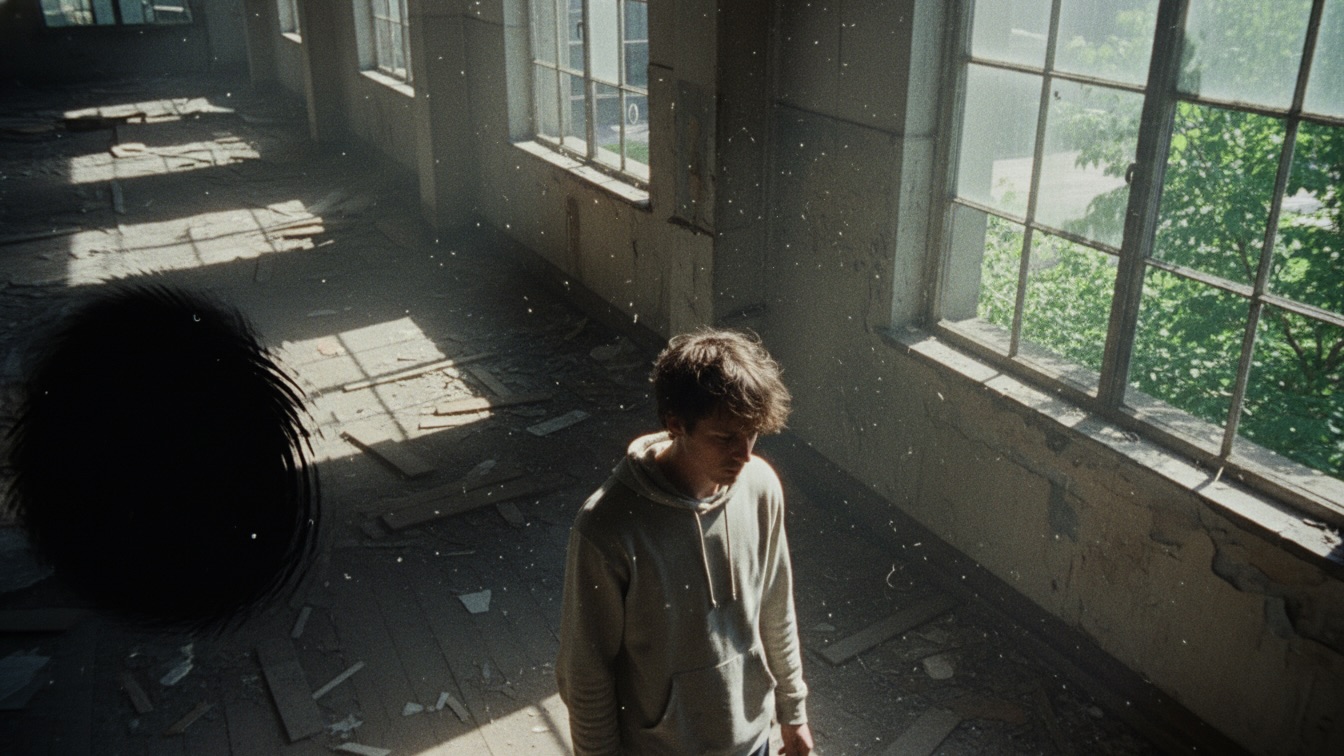
Leo is a young artist who has returned to his hometown after failing to establish a career in the city. He spent his morning in the Old Mill, preparing an avant-garde art installation while battling feelings of inadequacy and exhaustion. During his preparations, he discovered a bizarre, three-dimensional black smudge in the corner of the room that seemed to defy the laws of physics. His friend Sarah arrived to assist him, and while she eventually acknowledged the strange atmosphere, she initially struggled to see the visual anomaly that Leo perceived so clearly.
The situation escalated when Miller, a representative of the town council, arrived to threaten the cancellation of the show due to its "inappropriate" nature. Miller accidentally interacted with the shadow mass, which resulted in a physical injury to his hand, yet he remained psychologically unable to process the supernatural nature of the event. Instead, he blamed Leo for bringing "weirdness" into the town and called the police. This confrontation highlights the deep-seated tension between Leo’s creative ambitions and the rigid, stagnant expectations of his community.
After being forced out of the building by the authorities, Leo and Sarah realized that the shadow was growing and that the townspeople were entirely blind to its presence. They broke back into the mill, discovering that the shadow had taken on a humanoid shape and was feeding on the history and repressed negativity of the town. Leo realized the entity was a reflection of his own self-doubt and the town’s collective denial. By shattering his own artwork, he managed to break the metaphysical loop and disperse the figure, though the victory was short-lived.
As Leo and Sarah fled the town, they discovered that the "glitch" was not confined to the Old Mill. The sky itself began to show signs of digital corruption, and a black square appeared in the center of the sun. The story concludes with the realization that the fabric of reality is unraveling on a global scale. Leo saw a message manifest on his own skin, urging him to run, as he and Sarah drove toward an uncertain and flickering horizon.
The narrative explores the theme of stagnation and the psychological toll of returning to a place that refuses to change. The Old Mill serves as a metaphor for the town itself, a structure filled with "stagnant air" and "dust motes" that do not dance. This environment represents a closed loop where the past is constantly polished to hide a decaying present. Leo’s struggle to fit his "experimental" art into this world reflects the broader conflict between innovation and the safety of tradition.
Denial functions as a primary defensive mechanism for the community. Characters like Miller and Mrs. Gable are literally unable to see the "hole in reality" because it does not fit into their curated worldview. This blindness suggests that the town’s survival depends on ignoring anything that challenges its perceived perfection. The shadow mass is the physical manifestation of everything they refuse to acknowledge, including economic decline and personal resentment.
The story also delves into the relationship between art and the artist’s psyche. Leo’s installation is not just a collection of glass and wire; it is a conduit for his internal state. The shadow mass takes the form of Leo’s own perceived failures, showing him the version of himself that he fears most. By destroying the art, he is forced to destroy the medium through which he defines his worth, suggesting that true liberation requires letting go of external validation.
Finally, the theme of "The Glitch" introduces a modern take on cosmic horror. Instead of ancient gods, the threat is a systemic failure of reality, described in technological terms like "dead pixels" and "Photoshop errors." This implies that the world is an artificial construct that has become too "toxic" or "heavy" to sustain itself. The ending suggests that the rot of a single small town might be symptomatic of a much larger, universal collapse.
Leo is a protagonist defined by his sensitivity and his profound sense of displacement. He carries the heavy burden of the "failed artist" archetype, having returned to his roots with a "bruised ego" and no clear path forward. This vulnerability is exactly what allows him to see the shadow mass when others cannot. His perception is tuned to the fractures in reality because he himself feels fractured and out of place in his own home.
His internal conflict is a battle between self-destruction and the urge to create. When he reaches into the shadow mass, he acknowledges that he is leaning into a "self-destructive urge" as a way to maintain control over his own ruin. He would rather destroy himself than let the town council do it for him. This reveals a man who is deeply tired of fighting against a system that he believes has already judged and discarded him.
By the end of the chapter, Leo undergoes a crucial psychological shift. He recognizes that the shadow is not just an external threat, but a reflection of the narrative the town has forced upon him. When he tells the shadow, "You’re just a story," he is reclaiming his agency. Although he is still running at the end of the story, he does so with a renewed sense of reality and a connection to Sarah that transcends his previous isolation.
Sarah serves as the pragmatic anchor for Leo’s spiraling psyche. Unlike Leo, she stayed in the town and "kept her head down," working at the library and navigating the mundane realities of their community. She represents the potential for stability, yet she is not blind to the town's flaws. Her willingness to support Leo, despite her skepticism, highlights her loyalty and her own underlying dissatisfaction with the status quo.
She acts as a bridge between the "normal" world and the supernatural events unfolding in the mill. While she initially dismisses Leo’s concerns as a breakdown, she is the first person to truly see the shadow once she allows herself to look past the town's collective denial. Her physical intervention when Leo is being pulled into the mass shows her protective nature. She is not just a passive observer; she is an active participant in his survival.
Sarah’s character also highlights the theme of shared trauma and connection. The "tension" between her and Leo suggests a history of unspoken feelings that they are both too exhausted to address. However, when the world begins to dissolve, she chooses to face the unknown at his side. Her presence provides the emotional warmth necessary to counter the "bone-deep chill" of the void that threatens to consume Leo.
Miller is the personification of the town’s rigid social order and its refusal to evolve. As a representative of the board, he views art solely through the lens of "community-appropriate content," which is a code for anything that doesn't challenge or disturb. His aggression toward Leo is not just about the art; it is a reaction to the "weirdness" that Leo represents. He sees Leo as a contaminant in a controlled environment.
His psychological blindness is his most significant trait. Even when his own hand is injured by the shadow mass, he cannot process the event as something supernatural. He immediately reframes the trauma as a "safety hazard" caused by Leo’s negligence. This demonstrates a high level of cognitive dissonance, where he would rather believe a lie than accept a truth that threatens his sense of authority and order.
The narrative voice is grounded in a gritty, sensory realism that makes the eventual shift into cosmic horror more jarring. The author uses tactile descriptions, such as "skin peeling around the cuticles" and the "smell of sawdust and old oil," to establish a firm sense of place. This realism creates a sharp contrast with the "matte black" of the shadow, which is described as a "smear" or a "dead pixel." These metaphors bridge the gap between the physical and the digital.
Pacing is used effectively to mirror Leo’s increasing anxiety. The story begins with a slow, atmospheric focus on light and dust, reflecting the lethargy of the town. As the shadow grows and the authorities intervene, the sentences become shorter and the action more frantic. The climax in the mill is a "whirlwind of destruction," with the sound of breaking glass and the "sub-bass hum" creating a sensory overload that mimics a panic attack.
The tone of the piece is one of pervasive melancholy, punctuated by moments of sharp, cynical humor. Leo’s internal monologue is self-deprecating, which aligns with his role as a "cliché" art kid. However, the tone shifts into something much more urgent and existential as the "glitch" spreads beyond the mill. The final imagery of the blank road sign and the black square in the sun leaves the reader with a sense of profound unease.
The use of light and shadow is a recurring stylistic motif throughout the chapter. The "sharp, intrusive morning light" is portrayed as something that exposes failure rather than something that brings warmth. This subversion of typical light symbolism reinforces the idea that in this town, even the sun is a source of judgment. By the end, the sun itself is compromised, signaling that there is no longer any safe or "natural" place for the characters to hide.


