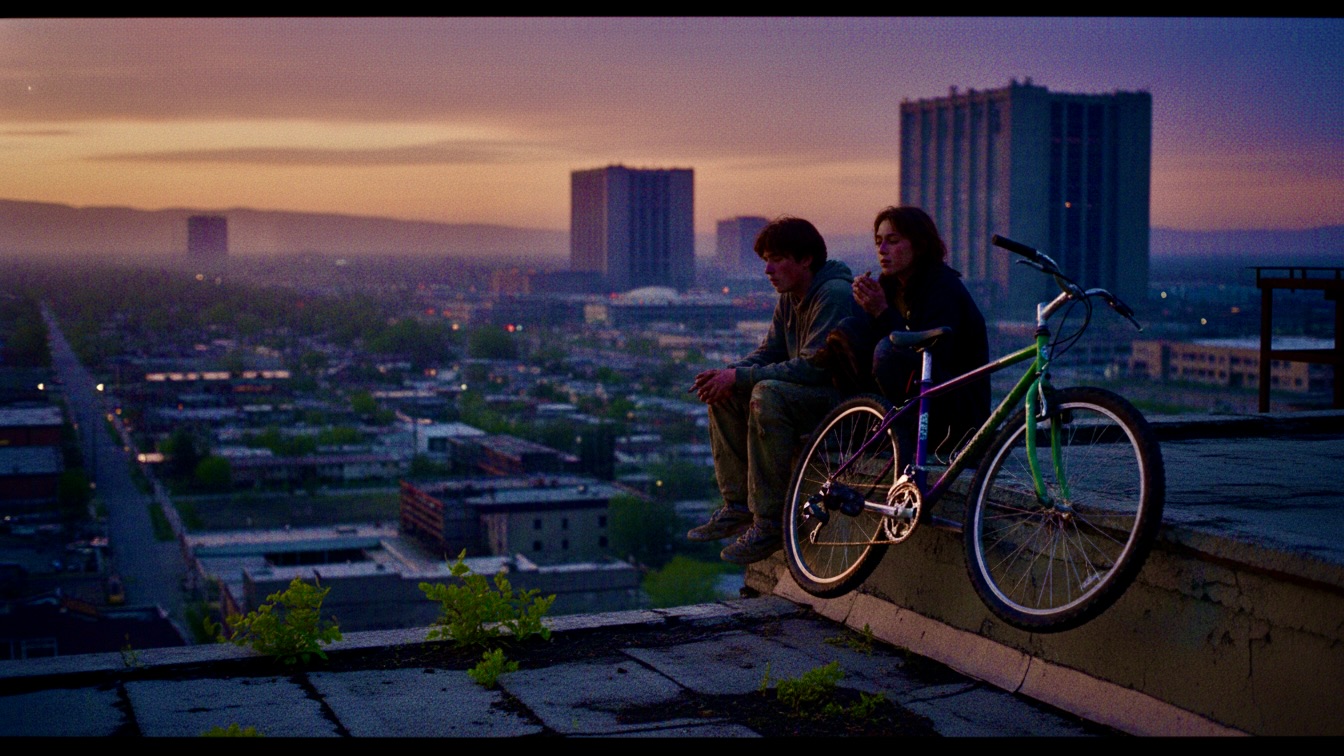
Two friends navigate a decaying suburban landscape, dodging automated tolls and searching for sustenance amidst a failed technological spring.
"Move, Ben!" Riley hissed, her voice cutting through the humid morning air. "The sensor's tracking the heat signature. If it pings the server, we're hit with a fifty-credit fine we can't pay."
I didn't answer. I couldn't. My lungs felt like they were full of wet wool as I stood on the pedals of my bike, a nineteen-nineties mountain frame with gears that screamed every time I shifted. The bridge was a skeleton of rusted rebar and crumbling concrete, spanning a dry creek bed filled with plastic bottles and discarded VR headsets. In the center of the span sat the toll-bot—a squat, white plastic pyramid with a flickering red eye. It looked like a discarded kitchen appliance, but it was the only thing on this side of the county that still had a working uplink. It was hungry for money we didn't have.
"I'm going!" I wheezed. My thighs burned. I hit a pothole that nearly sent me over the handlebars. The bike rattled, a loose screw somewhere in the frame singing a high-pitched note of impending failure. Behind me, I heard the toll-bot's speaker crackle to life, a pre-recorded voice that sounded way too cheerful for a world that was falling apart.
"Welcome to the New Spring corridor!" the bot chirped. "Please stop for a mandatory maintenance contribution."
"Contribution my ass," Riley muttered, swerving her bike around a hunk of fallen masonry. She was faster than me, leaner, her eyes always scanning the horizon for the next thing that was going to break. She wore a faded neon jacket that might have been fashionable in 2015, now stained with grease and salt. We banked hard to the left, diving off the main road and down an embankment just as the bot's scanner swept the space where my head had been a second ago. The red light washed over the dead grass, finding nothing but shadows.
We skidded to a halt in the shade of a massive data center. The building was a windowless box of corrugated metal, humming with a low-frequency vibration that made my teeth ache. This was the 'New Spring' initiative the billboards kept talking about. They'd promised a park with fountains and community gardens. Instead, they’d paved over the dirt and built a hive for servers that processed transactions for people who didn't live here anymore. A decorative sign nearby was half-covered in vines, the words 'A Greener Tomorrow' barely visible under a layer of grime.
"You okay?" Riley asked, not looking at me. She was checking her chain. She always checked her chain when she was annoyed.
"Fine," I lied. I wiped sweat from my forehead with the back of a dirty hand. "Just need a minute. My stomach's doing that thing again."
"The 'I haven't eaten a real meal in three days' thing?" she said. "Yeah, me too. Come on. There’s a scrap yard two miles up. Maybe we can find something to trade. Or at least some shade that doesn't hum."
We pushed the bikes through a field that wasn't a field anymore. It was a graveyard of 2010s optimism. We passed a row of abandoned electric car charging stations, their cables cut and stripped of copper. They looked like hanging nooses. The air tasted like ozone and old rubber. Spring in this part of the world didn't smell like flowers; it smelled like damp earth trying to reclaim a parking lot.
"Look at that," I said, pointing toward a gap in a chain-link fence.
Inside a jagged perimeter of crushed cars and rusted washing machines, a patch of bright yellow and violet exploded out of the dirt. They were real wildflowers—stubborn, messy things growing out of the upholstery of a ruined sedan. They looked violent in their brightness against the gray of the scrap heap.
Riley snorted, glancing at the blossoms. "Aesthetic cope," she said. "The dirt’s probably full of heavy metals. Those things are just nature’s way of putting a bandage on a gunshot wound. Don't look at them too long, Ben. It’ll make you soft."
"They're just flowers, Riley."
"They're a distraction. Focus on the ground. Watch for glass."
She was right, of course. That was the problem with Riley. She was always right in the most exhausting way possible. We found the entrance to the yard, a sliding gate manned by a guy sitting in a lawn chair that had lost most of its webbing. He was wearing a grease-stained jumpsuit and a hat with a logo for a defunct drone delivery service. He looked about eighty, but in this light, everyone looked a decade older than they were.
"Whatcha got?" the scrap dealer asked. He didn't stand up. He didn't even move his hands from his lap. He just watched us with eyes that had seen everything worth seeing and decided none of it was impressive.
"Just passing through," Riley said, her hand resting on her handlebars. "Looking for a trade. You got any calories?"
The dealer looked at my bike. I saw his eyes linger on the frame—the original paint, the lack of rust on the main tubes. It was a collector's item to some people, a functional tool to me. To him, it was a payday.
"I got a protein bar," he said. "Old stock, but the seal's good. Tastes like chalk and fake chocolate. I'll give it to you for the bike."
I felt a surge of indignation. "The bike? For a bar? You're joking."
"It’s a vintage frame, kid. But frames don't fill your belly. And you look like you're about to fall over. That bike’s heavy. You'd be doing yourself a favor by walking."
"Not happening," I said, gripping the grips tighter. The rubber was tacky and peeling, leaving black residue on my palms. "We'll keep going."
"Suit yourself," the dealer said, closing his eyes. "There’s a machine at the old transit hub. Last one in the county. Maybe it's got something that isn't expired. If you can get it to work."
We left him there, a statue of indifference in a kingdom of junk. The road ahead was worse—cracked asphalt that had been pushed up by tree roots, forming miniature mountain ranges we had to navigate. The sun was higher now, a pale, insistent heat that made the horizon shimmer with heat haze. We didn't talk for a while. The effort of pedaling took everything we had.
By the time we reached the transit hub, my legs were shaking. The hub was a glass-and-steel pavilion that had once been the pride of the county. Now, the glass was mostly gone, replaced by plywood or left as gaping maws. In the corner, tucked behind a pillar covered in peeling posters for a concert that happened five years ago, stood the machine. It was a massive, old-school vending unit. The lights inside were actually on, a miracle in itself.
"No way," I whispered. I leaned my bike against the pillar and stumbled toward it. Inside, behind the scratched plexiglass, were rows of crinkled bags. Salty snacks. Sugar. Things that weren't gray or brown.
"Don't get your hopes up," Riley said, though she was moving toward it just as fast. "Look at the interface."
I looked. The coin slot was modified. A small, hand-drawn sign was taped over the credit card reader: 'TOKENS ONLY.' Below it was a picture of a coin with a stylized joystick on it.
"Arcade tokens?" I said, my heart sinking. "From the place at the mall? That place has been a data center for years."
"The 'Pixel Palace,'" Riley said, a rare note of genuine bitterness in her voice. "I used to have a jar of those. I threw them out when I moved into the shelter. I thought they were useless."
I hit the glass with the side of my fist. It didn't break. It just vibrated, a dull thud that echoed in the empty hall. We stood there for a long time, staring at the snacks we couldn't have. It was a perfect microcosm of our lives—the resources were right there, visible and preserved, but the system required a currency that no longer existed.
"It’s a joke," I said. "The whole world is just one big, broken joke."
"Yeah, well," Riley said, turning away. "Nobody's laughing. Come on. The sun's going down. We need to find somewhere to sleep before the sweepers come out."
We climbed up to the roof of the hub, dragging the bikes up a service stairwell that smelled of damp concrete and old cigarettes. The roof offered a view of the entire valley. In the distance, the skyline of the city was a jagged silhouette against a sky that was turning a strange, bruised purple. The smog from the industrial zones caught the light, refracting it into layers of orange and gold that looked almost beautiful if you didn't think about what was in the air.
I sat on the edge of the parapet, my legs dangling over the side. The wind was cooler now, smelling of the fresh green leaves from the few trees that had survived the paving. It was a genuine spring breeze, fleeting and indifferent to the wreckage below.
"The light," I said, nodding toward the horizon. "It’s not bad."
Riley sat down next to me, her shoulders finally dropping an inch. She pulled a crumpled pack of cigarettes from her pocket—mostly floor sweepings rolled in scrap paper. She lit one, the smoke vanishing instantly in the wind.
"If the world's ending," she said, exhaling a thin stream of gray, "at least the light looks cool. It’s the only thing they haven't figured out how to tax yet."
We sat in silence, watching the orange glow fade into a deep, murky blue. The humming of the data centers below us seemed to get louder as the world grew quiet, a digital heartbeat for a dying suburb. My stomach growled, a sharp, physical reminder of the day's failures, but for a moment, the weight of the consequences felt a little lighter. We were still here. The bikes were still holding together. The tokens were gone, but the sunset was free.
I looked at the vintage frame of my bike, the metal cooling in the evening air, and wondered how many more springs it had left in it.
“I reached into my pocket and felt a single, circular piece of metal I hadn't noticed before, its edges sharp and unfamiliar.”


