Skip to content
Melgund Recreation, Arts and Culture

Melgund Recreation, Arts and Culture

Arts and Culture

MELGUND-RECREATION-ARTS-AND-CULTURE
Primary Menu
  • Home
  • About
    • Board and Leadership
    • Books
    • Our Communities
      • Art Borups Corners Collective
      • Borups Corners
      • Dyment
    • Local Services Board of Melgund
  • News
    • Arts, Culture, and Community Innovation
    • Community Lens
    • Events
    • Growing Up in Dyment Video Series
    • Photos and Stories
    • Recipes
    • Research
  • Facilities
    • Cook Shack
    • Dyment Recreation Hall
    • Melgund Lake Ice Shack
    • The Pavilion
  • Programs
    • Easy EPUB Reader and Library
    • Games Nights
    • Melgund: Come Eat With Us Cookbook
    • Melgund History Database
    • The Arts Incubator
    • The Dyment Museum
    • Framework for Recreation in Canada
    • Spring Short Stories
    • Winter Stories
  • Research
    • Digital Capacity Building: Winter Stories
    • ECO-STAR North
    • Emerging Practices in AI-Enabled Storytelling
    • Food Security and Agriculture
      • Melgund: Come Eat With Us Coolbook
      • Relationship Development and Engagement with the Minneapolis College of Art and Design and University of Minnesota Duluth
      • Towards a Framework for Northern Food Systems Innovation
    • Melgund Integrated Nuclear Impact Assessment Project
    • Melgund 综合核影响 评估项目
  • Exhibitions
    • 2026 Spring Exhibition
  • Contact Us
  • Home
  • Community Garden
  • Improving Food Security Through Recreation Programs
  • Community Garden

Improving Food Security Through Recreation Programs

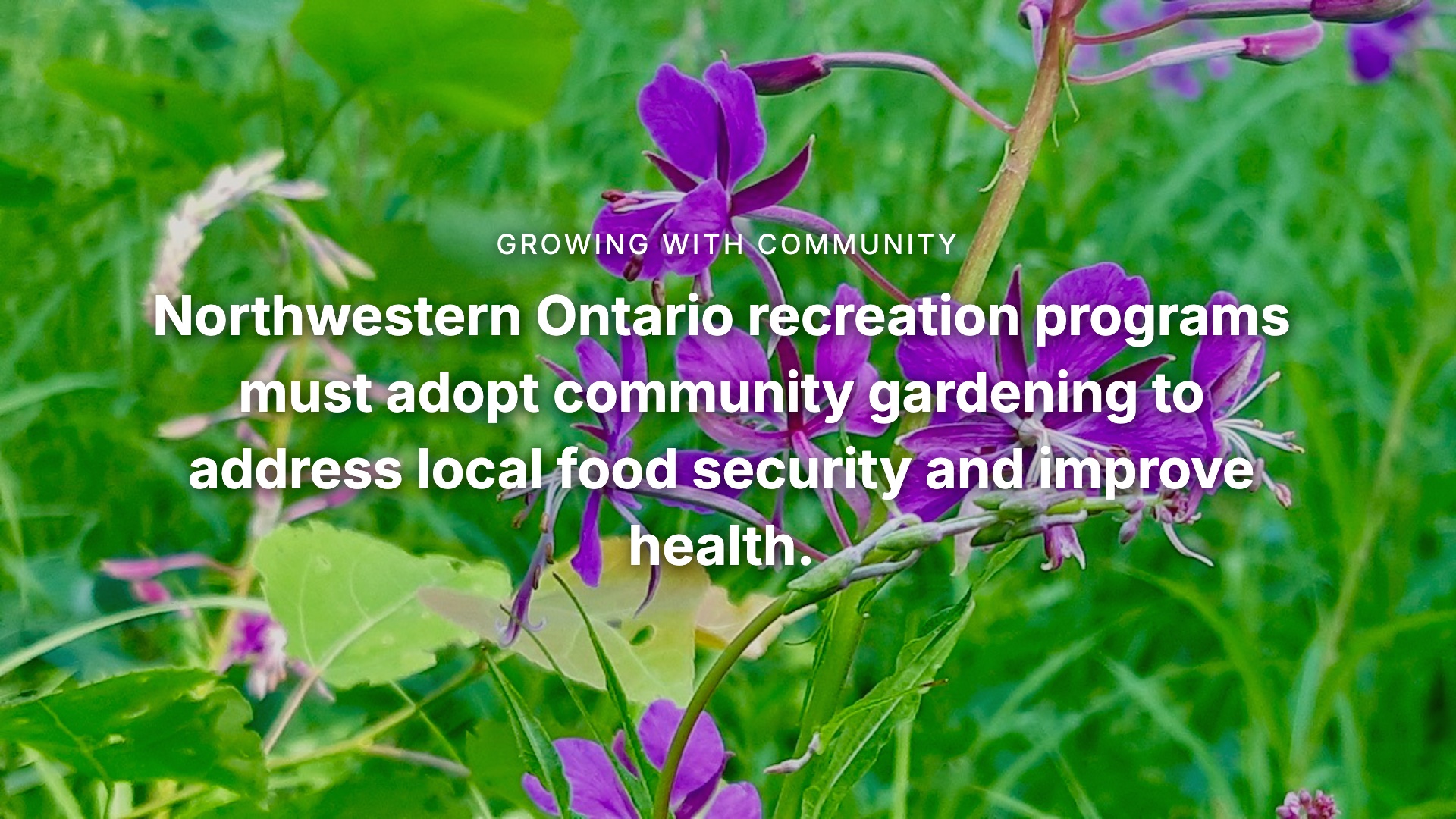
Northwestern Ontario recreation programs must adopt community gardening to address local food security and improve health.
Melgund Come Eat With Us 8 Mar 2026 5 minutes read
Let’s build food security in Northwestern Ontario. Community gardens are more than a hobby; they are essential infrastructure. #SDG2 #ZeroHunger

How community-led gardening initiatives can address hunger and build local resilience.

We’ve all seen the shelves in our area stores, and the price of a head of lettuce rising every month. Food security remains a top priority for families across Northwestern Ontario. The Northwestern Health Unit estimates approximately 21.3% of households are now food insecure.

We live in a region where the distance between distribution centres creates high costs and limited variety. This geographical reality forces us to look for local solutions. One of those areas to look at, is recreation, because community gardens can provide a way to close some of those gaps. We need to move beyond small hobby plots and view these spaces as essential infrastructure for community health.

Access to fresh produce should not depend on how far a truck can travel on a winter highway. Let’s also not forget it’s an hour-and-a-half drive to get to and from a grocery store.

Overcoming Northern Logistical Barriers

The supply chains that bring food to Northwestern Ontario are long and fragile. We often pay a premium for produce that has traveled thousands of kilometres. This transit time reduces the nutritional value of the vegetables we buy. We also face a shorter growing season that limits what we can produce outdoors without help. These barriers make it difficult for our neighbours to access fresh, healthy ingredients throughout the year.

We need to build systems that work with our climate rather than against it.

Practical Tips for Recreation-Based Food Security

That’s why we feel recreation programs can play a central role in this work. One of the suggestions we’ve had is to focus on succession planting to maximize the short summer. Start with cold-tolerant crops like spinach and radishes in early May. This year, we’re planning to install heavy-duty raised beds to keep the soil warm and protect plants from the lingering frost in late spring. These beds also allow for better drainage and easier access for participants of all ages.

Tool libraries are another way to support participants. We often find that the cost of shovels, rakes, and wheelbarrows prevents people from starting a garden. Not everyone has these things. Providing these items at the recreation hall and complex can remove a major hurdle. We’re looking at hardy varieties such as kale, potatoes, and northern-bred tomatoes. These plants handle the temperature swings of our region better than varieties developed for Southern Ontario. We are also looking at ways to set up communal composting sites to turn local waste into rich soil for the next season.

Community Support and Land Use

We need local and regional leadership to dedicate permanent space for these projects. Recreation departments like ours can lead the way by making better use of our underused parkland or grassy areas. Reliable water access is a requirement for any successful site. We’re looking at upgrading our Cook Shack and complex water system so our volunteers can focus on growing food rather than hauling water.

Sustainable Development and SDG 2

Our efforts align with SDG 2: Zero Hunger. Our programming works to end hunger by creating sustainable food production at the community level. This means more than just handing out seeds. It means dedicating permanent park space to food production. When we produce our own food, we reduce the carbon footprint of our meals and improve the health of our community.

Taking Local Action

You have a role to play in this change. We invite you to speak with our local recreation department about helping to expand and rejuvenate our garden space. Volunteer to mentor a new gardener or help maintain a communal plot. We build a more resilient community when we grow food together.

Our health and our future depend on local connections. We need to treat food production as a public service, similar to recreation, roads or water systems. Let’s come together for a future where every person in has a place to grow their own nutrition. Together, we can ensure that no neighbour goes without fresh, local food.
Let’s build food security in Northwestern Ontario. Community gardens are more than a hobby; they are essential infrastructure. #SDG2 #ZeroHunger

Learn More with the Melgund Recreation, Arts and Culture Food Security Program

The Melgund Township Recreational Community Garden supports sustainable and regenerative agriculture, food security, active living, and community connection in Dyment and Borups Corners. The garden is a shared space where residents can grow fresh foods, spend time outdoors, and enjoy hands-on learning in a welcoming community environment.

Through seasonal gardening, skill-sharing, and community activities, the program encourages healthy lifestyles while helping people learn practical skills like planting, harvesting, and caring for the land. It’s a place for neighbors of all ages to connect, have fun, and take part in building a stronger, more resilient local food system.

Contact us today at info@artsincubator.ca to learn more or get involved.

About the Author

Melgund Come Eat With Us

Melgund Come Eat With Us

Author

Rooted in the hearts of Dyment and Borups Corners, this recreational, participatory food security project brings people together through the joy of cooking. Explore more creative recipes in the Melgund: Come Eat With Me Cookbook—a food security initiative proudly supported by Art Borups Corners and Melgund Recreation, Arts and Culture.

Visit Website View All Posts

Post navigation

Previous: Cultivating Connection and Health
Next: Colonialism and Reconciliation in DGR Process

Related News

newest-apples-grow-boxes-orchard-2.jpg
  • Community Garden

Scaling Local Food Systems

Melgund Come Eat With Us 11 Mar 2026
melgund-township-northwestern-ontario-cooking-recreation-program.jpg
  • Community Garden
  • Photos and Stories

Transforming Food Systems With Community Gardens

Melgund Come Eat With Us 10 Mar 2026
multi-inter-arts-borups-corners-september-2025-cindy-vegetables.jpg
  • Community Garden

The Case for Community-Led Food Systems in Melgund Township

Melgund Come Eat With Us 9 Mar 2026

The Latest News

  • We’re Open
  • Scaling Local Food Systems
  • Addressing Barriers to Impact Assessment Participation
  • Revell DGR: Community Concerns on FPIC
  • Transforming Food Systems With Community Gardens
  • Understanding the Revell Site Man Camp

You may have missed

45B56613-2762-480E-BA65-6E498B4DD342_1_201_a
  • Photos and Stories

We’re Open

Melgund Recreation 11 Mar 2026
newest-apples-grow-boxes-orchard-2.jpg
  • Community Garden

Scaling Local Food Systems

Melgund Come Eat With Us 11 Mar 2026
Melgund Recreation, Arts and Culture
  • Community Lens

Addressing Barriers to Impact Assessment Participation

Melgund Recreation 11 Mar 2026
Building trust one story at a time — by sharing authentic community voices, testimonials, and real impact stories, nonprofits use social proof to show they are active, trusted, and making a difference. Consistent updates keep this connection alive, helping supporters feel part of a larger community and encouraging them to get involved.
  • Community Lens

Revell DGR: Community Concerns on FPIC

Melgund Integrated Nuclear Impact Assessment Project 10 Mar 2026

SUPPORTING COMMUNITY

Melgund Recreation, Arts and Culture is a non-profit arts and recreation services provider supporting programs in Melgund Township, Northwestern Ontario. Business Number 741438436 RC0001.

Ontario Arts Council Multi and Inter-Arts Projects Program

NORTHWESTERN ONTARIO ARTS

Programming is made possible with funding from the Ontario Arts Council Multi and Inter-Arts Projects Program. We gratefully acknowledge and thank them for their support.

Ontario Arts Council Multi and Inter-Arts Projects Program

COMMUNITY RECREATION

Recreation and community arts programs in Dyment and Borups Corners and Melgund Township are supported with funding from the Government of Ontario. We thank them for their support.

Ontario Arts Council Multi and Inter-Arts Projects Program
Copyright © All rights reserved. | MoreNews by AF themes.