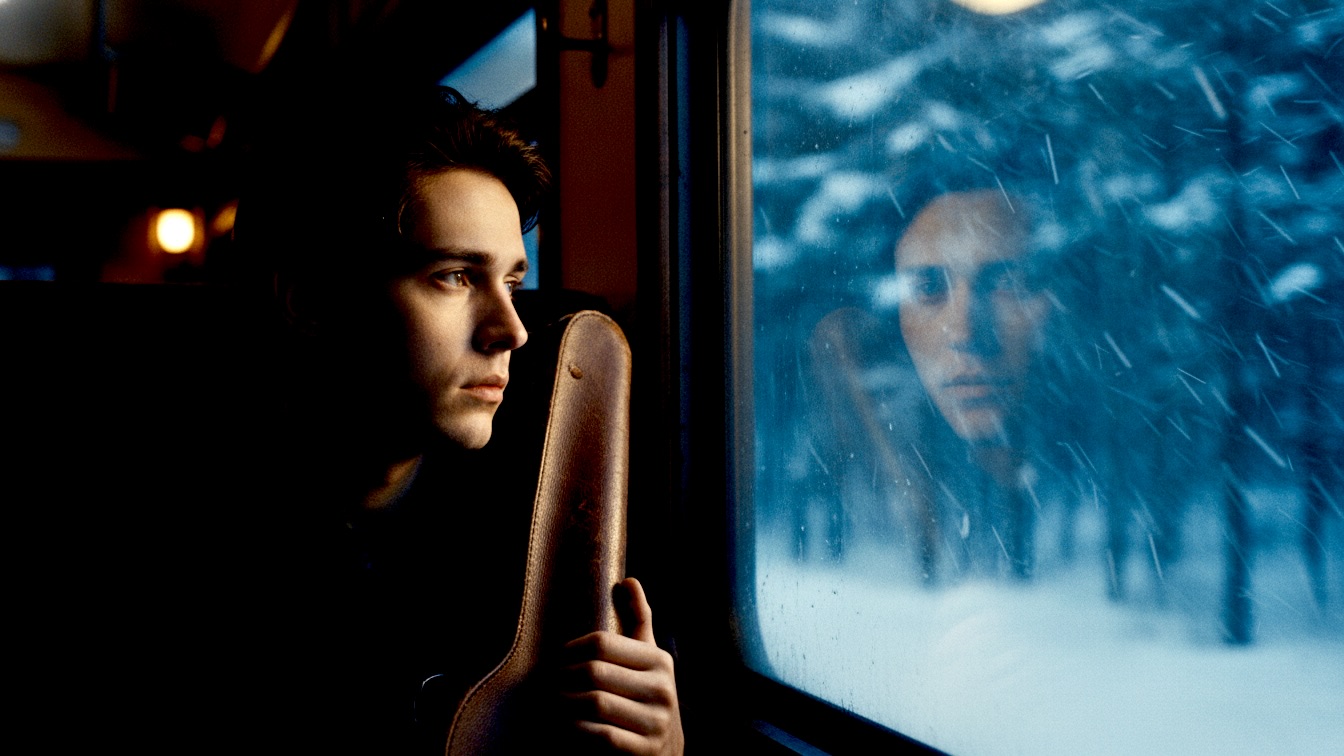
Format: Short Film / Anthology Episode | Est. Length: 10-12 minutes
Imagine an anthology series, "The Still Point," where each episode explores a moment when the world stops for a small group of strangers. Trapped in liminal spaces—a stalled elevator, a fog-bound ferry, a snowbound train—characters are cut off from their destinations and forced to confront the lives they were rushing towards. "The Glass Nocturne" serves as a perfect entry point, establishing the series' core theme: that in moments of profound impotence, true purpose can be found not in reaching a destination, but in connecting with those who are stranded alongside us.
A passenger train shudders to a final, definitive halt in the middle of a blinding blizzard. Inside, a young violinist clutches her instrument, her heart pounding as the conductor’s tinny voice announces they are stranded indefinitely—and her once-in-a-lifetime audition, scheduled for the next morning, begins to evaporate with every falling snowflake.
A brilliant but anxiety-crippled violinist, trapped on a snowbound train, is set to miss the audition that defines her entire life. To comfort her freezing and fearful fellow passengers, she must overcome her paralysis and discover that the true purpose of her music lies not in perfection, but in connection.
The episode explores the conflict between personal ambition and collective humanity. It deconstructs the nature of "performance," contrasting the pressure-fueled, judgmental context of a Julliard audition with the selfless, communal act of creating art for comfort. The narrative suggests that true artistic purpose is not found in achieving external validation but in its power to forge connection and offer solace in moments of shared vulnerability. It is a story about finding freedom in failure, where the death of one dream allows for the birth of a more meaningful purpose.
A secondary theme is the stripping away of social masks in a crisis. The "businessman," the "grandmother," and the "prodigy" are reduced to their essential selves by the cold and the fear. Their pre-written life stories are interrupted, forcing them to improvise new roles based on empathy and shared need, revealing a deeper, more authentic humanity that was buried beneath their daily routines and ambitions.
The stakes are both deeply personal and collective. For ELARA, the protagonist, the immediate stake is her career-defining audition at Julliar, the culmination of eighteen years of sacrifice and the sole focus of her identity. For the other passengers, the stakes are equally critical to their own lives: CARMEN is set to miss her daughter's wedding; MR. JENKINS will fail to close a career-making deal; and for TRACEY, the stakes become primal as the dropping temperature threatens the well-being of her young son, LEO. Ultimately, as the night wears on, the collective stake is survival—not just against the cold, but against the despair and isolation that threaten to consume them.
The primary antagonistic force is the external, indifferent power of nature—the blizzard that has buried the tracks and frozen the world, rendering all human ambition and scheduling irrelevant. This external conflict creates the story's "pressure cooker" environment. The core internal conflict resides within Elara: her crippling performance anxiety and self-centered ambition are at war with a nascent empathy for the suffering of those around her. She must overcome the internal voice of judgment and fear—the parasitic twin that has defined her relationship with her music—to answer a more fundamental human need.
ELARA, a brilliant but anxiety-ridden violinist, is on a train to her career-defining Julliard audition when a severe blizzard forces the train to a halt, stranding the passengers in a remote, frozen landscape. As hours pass and the hope of reaching her destination dies, Elara's personal panic consumes her, isolating her from the other passengers who are dealing with their own interrupted lives. The cold inside the carriage deepens, and the shared fear begins to give way to small acts of connection, initiated by a kind older woman, CARMEN.
The turning point comes when a toddler, LEO, begins to cry uncontrollably from the cold and distress, a sound that pierces through Elara's self-absorption. Witnessing another passenger, MR. JENKINS, selflessly give his own expensive coat to the child and his mother, Elara is shamed out of her paralysis. In a moment of pure impulse, she takes out her violin and, for the first time, plays not to perform or impress, but simply to offer comfort. The simple, heartfelt music transforms the atmosphere in the car, creating a profound moment of shared peace and humanity, and in doing so, fundamentally changes Elara's understanding of her art and her purpose.
ELARA (18): A violin prodigy, technically brilliant but emotionally brittle and consumed by a crippling performance anxiety.
* Psychological Arc: Elara begins in a state of terrified self-absorption, where her identity and self-worth are entirely fused with her success as a musician. The train stopping is, for her, an existential crisis. She ends the story liberated from the tyranny of her ambition, having discovered that her "gift" is not a tool for personal validation but a bridge for human connection, finding a quiet strength in serving others rather than seeking their applause.
CARMEN (60s): A grandmotherly woman with a calm, knowing presence. She is the quiet center of the group, the first to offer food and foster a sense of community. She represents wisdom and the perspective that life is more than a single destination.
MR. JENKINS (40s): A businessman in an expensive suit, initially defined by his professional anxieties. His arc is one of shedding a hollow corporate identity to reveal a core of decency, culminating in his selfless act of giving his coat to the freezing child.
TRACEY (20s) & LEO (2): A young single mother and her toddler. Their vulnerability, especially Leo’s crying, serves as the emotional catalyst for the entire car, transforming the abstract problem of being stranded into an immediate, human crisis that demands a response.
BEAT 1: THE STILLNESS. The train lurches to a final stop, plunging the carriage into an unnerving silence that magnifies Elara's internal panic about her audition. The world outside the window is an erased, white void, mirroring her feelings of a future being wiped clean. Her anxiety is a physical, suffocating presence.
BEAT 2: THE VERDICT. The conductor's announcement over the intercom confirms they are stranded indefinitely, a death sentence to Elara's dream. We see the hope drain from the faces of the other passengers—Mr. Jenkins swiping uselessly at a dead phone, Carmen pausing her knitting—as the reality of their shared prison sets in. The cold begins to seep into the car, a tangible threat.
BEAT 3: THE COMMUNION. As hours crawl by and twilight falls, small acts of humanity fracture the isolation. Carmen shares her emergency oatmeal raisin cookies, a simple offering that coaxes the passengers, including a reluctant Elara, into a fragile community. Their shared stories of missed weddings and business deals begin to contextualize Elara's crisis, making it feel less singular.
BEAT 4: THE CATALYST (Midpoint). The cold becomes dangerous, and Tracey's son, Leo, begins to cry with real distress, a piercing sound of misery that no one can ignore. Without a word, Mr. Jenkins removes his expensive overcoat and wraps it around Tracey and Leo, a stark, selfless act that shames Elara's passive, internal focus. This is the moment her perspective is forced to shift from her own loss to the immediate needs of others.
BEAT 5: THE NOCTURNE (Climax). Driven by an impulse she doesn't understand, Elara unlatches her violin case. Ignoring the monumental, complex pieces she'd prepared for her audition, she plays a simple, familiar lullaby—not as a performance, but as a prayer. The pure, warm notes cut through the cold and despair, silencing Leo's cries and creating a moment of profound, shared peace.
BEAT 6: THE DAWN. The rescue arrives, breaking the spell of the long night. At a makeshift relief center, Elara learns her audition can be rescheduled, but the news lands with a strange lack of impact. Standing on the platform as the sun rises, she understands that missing the audition was not the end of the world; it was the beginning of a new understanding of herself and her music, a purpose rooted not in ambition, but in grace.
The episode's emotional journey moves from a state of high-strung, claustrophobic anxiety to a deep, shared despair. This dread is then punctuated by small moments of warmth and connection, building towards the critical turning point of selfless action. The climax is a moment of pure catharsis, as the music washes over the characters and the audience, transforming the mood from tense desperation to a serene, melancholic peace. The final scenes are quiet and contemplative, leaving the audience with a sense of hopeful resolution and the quiet power of a changed perspective.
If expanded into a multi-episode arc, Elara's journey would continue beyond the train. The following episodes could explore her attempt to integrate this newfound purpose into the highly competitive world of classical music. She might deliberately seek out unconventional venues—hospitals, shelters, community centers—while struggling with the expectations of her teachers and the ghost of her father's legacy. Her central conflict would become: can she succeed on the world's terms without losing the profound lesson she learned in that frozen train car?
A season-long arc could see her preparing for her rescheduled audition, but this time her approach is different. She is less focused on technical perfection and more on emotional truth, a change that both confuses her mentors and deepens her artistry. The season would culminate in the audition itself, where the outcome is secondary to the fact that she plays with a newfound freedom and authenticity, having finally conquered the anxiety that once defined her.
The visual style will be intimate and claustrophobic, relying on handheld or tightly framed shots to keep the audience locked inside the train car with the characters. The camera will focus on small details: the condensation on the window, the texture of a wool coat, the trembling of a hand, the reflection in a violin's varnish. The color palette will be starkly contrasted: the initial scenes will be dominated by cold, desaturated blues and grays from the storm outside, which will slowly give way to the warm, isolated glow of the car's emergency lighting, creating a womb-like, intimate atmosphere.
The tone is contemplative, tense, and ultimately cathartic, reminiscent of the contained human dramas in films like Locke or the emotional resonance of a character-focused episode of The Leftovers. The sound design is critical, moving from the rhythmic clatter of the moving train to a profound, ringing silence, and finally to the singular, pure voice of the violin that fills that void. The overall mood is one of quiet intensity, finding epic emotion in a small, contained space.
The target audience consists of adults aged 25-55 who appreciate character-driven, psychological dramas and high-concept anthology series. Viewers of shows like Room 104, Black Mirror, and Tales from the Loop, who are drawn to thoughtful, emotionally resonant storytelling, will connect with the episode's themes and intimate focus. It is designed for a viewing context that encourages reflection, making it ideal for premium cable or streaming platforms where audiences seek out prestige, auteur-driven content.
The narrative pacing is deliberately slow and atmospheric, mirroring the characters' experience of time stretching and slowing down. The first act, establishing the setup and Elara's anxiety, is brief. The second act is the longest, allowing the tension, cold, and sense of confinement to build organically through quiet observation and small interactions. The climax arrives suddenly, a sharp release of the accumulated tension, followed by a brief, quiet denouement that allows the emotional impact of Elara's transformation to settle with the viewer. The short 10-12 minute runtime is crucial for maintaining this focused intensity without overstaying its welcome.
The single-location nature of the story makes this a contained and budget-conscious production. The primary challenge lies in making the static environment of the train car visually compelling. This will be achieved through dynamic lighting changes (daylight fading to twilight to emergency lights), creative camera angles that emphasize the claustrophobia, and strong art direction that makes the space feel lived-in and authentic.
The verisimilitude of the blizzard outside the windows is critical and can be achieved through a combination of practical on-set effects (blown snow against the glass) and digital enhancement. Sound design will be paramount; the contrast between the oppressive silence and the rich, resonant sound of the live-recorded violin performance is the core sensory experience of the film. Securing a highly skilled violinist for both the on-screen performance and the soundtrack is non-negotiable.