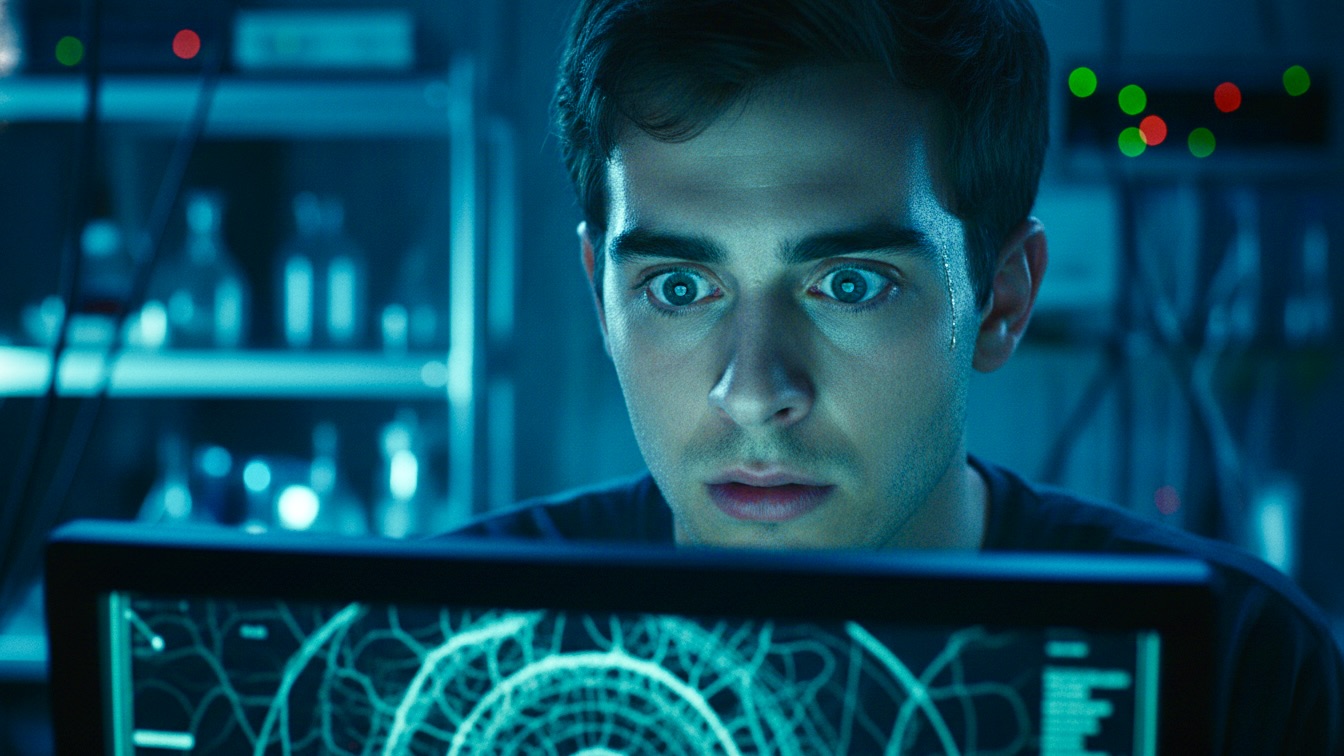
Format: Short Film / Anthology Episode | Est. Length: 10-12 minutes
Imagine a world existing in the quiet corners of our own, where the laws of physics are not broken, but bent by forces we are only beginning to perceive. The Hush Protocol serves as a standalone entry or a pilot episode for a series titled ANOMALY, an anthology exploring isolated encounters with sentient, physics-defying phenomena. Each episode presents a new protagonist—a scientist, an artist, a regular person—who stumbles upon a localized event that unravels their understanding of reality, forcing them to confront the terrifying and sublime implications of a universe far stranger than we know.
In the dead of a Winnipeg winter, a graduate physics student working late in his apartment realizes the profound, snow-dampened quiet of the city has been replaced by something impossible: a perfect, total, and physically oppressive silence.
A brilliant physics student discovers an expanding, perfectly circular field of absolute silence is consuming his city, a phenomenon he believes to be an alien entity feeding on sound. Dismissed by his mentor as delusional, he must race against an ever-growing void to build a sonic weapon and confront the anomaly alone.
The primary theme is the conflict between established scientific rationalism and an inexplicable, terrifying reality. Dr. Kim represents the institution of science, which is rigid and dismissive of data that does not fit existing models, while Daniel represents the true spirit of inquiry, forced to trust his observations even when they lead to "fantastical" conclusions. This creates a powerful undercurrent of intellectual and psychological isolation, amplified by the literal silence blanketing the city. The episode is a sci-fi horror story that explores the "Cassandra Truth"—the torment of knowing a terrible truth that no one will believe—and questions whether humanity's greatest strength, its logic, is also its most profound vulnerability when faced with the truly alien.
The narrative also delves into the theme of sensory deprivation as a form of cosmic horror. The silence is not peaceful; it is a predatory void, an active consumption of a fundamental aspect of existence. This transforms the mundane urban landscape into an alien frontier, where the absence of sound signifies not peace, but the presence of an unknowable, hungry force. The story taps into a primal fear of the unknown and the terror of being the sole witness to an impending, incomprehensible apocalypse.
The immediate stakes are the survival of the city of Winnipeg and its populace. If the field continues to expand, it will render all communication impossible, leading to societal collapse before eventually consuming every living thing in its path. For Daniel, the personal stakes are immense: his academic career, his sanity, and ultimately his life. By choosing to confront the entity, he risks being ignored and ostracized by the scientific community he so respects, or worse, being the first victim of a force he cannot possibly comprehend.
The primary antagonistic force is the silent, expanding entity at The Forks—an unknowable, seemingly intelligent phenomenon that acts as a predator. Its passive, inexorable growth and its complete absorption of all energy make it an overwhelming and mysterious external threat. A significant secondary conflict is man-vs-man, embodied by Daniel's confrontation with Dr. Kim, who represents the institutional inertia and condescending skepticism of the scientific establishment. Internally, Daniel battles with the classic conflict of reason versus instinct; his scientific mind struggles to accept the impossible data his own instruments provide, forcing him to overcome self-doubt and the terror of his profound isolation.
Daniel, a physics graduate student, becomes aware of an unnatural silence blanketing his Winnipeg neighborhood. His investigation reveals it's not a weather phenomenon but a perfect, impossible absence of sound. Using the university's acoustic sensors, he discovers a perfectly circular field of "negative acoustic pressure" is expanding from the city's center, consuming all sound energy in its path and growing at a measurable rate—a clear sign of an artificial, and possibly predatory, entity.
Armed with this terrifying data, Daniel seeks help from his mentor, Dr. Kim, who dismisses his findings as the product of stress and faulty equipment, leaving Daniel utterly alone. Realizing that no one will believe him until it's too late, Daniel is forced to take matters into his own hands. He constructs a makeshift sonic resonator, a desperate gambit to disrupt the entity by finding and weaponizing its resonant frequency, and heads to the epicenter for a final, terrifying confrontation.
DANIEL: A sharp, analytical, and somewhat isolated physics student in his mid-20s.
* Psychological Arc: Daniel begins as a confident academic, secure in his understanding of wave mechanics and the predictable laws of the universe. The anomaly shatters this worldview, forcing him through a rapid progression from intellectual curiosity to paranoia, to abject terror, and finally to a state of desperate, hardened resolve. He is transformed from a theoretical scientist into a reluctant, hands-on soldier in a war only he knows is being fought.
DR. ANDY KIM: Daniel's mentor and department head, a respected academic in his late 50s.
* Psychological Arc: Dr. Kim is a static character within this episode, representing the immovable object of scientific dogma. He begins and ends as a man of reason, but his reason has become a form of intellectual pride and condescension. He is incapable of considering a reality beyond his established framework, viewing Daniel's extraordinary evidence not as a discovery, but as a symptom of his student's psychological distress.
BEAT 1: PERCEPTION (INCITING INCIDENT)
In his cluttered apartment, physics student Daniel notices an unnaturally perfect silence that exerts a physical pressure on his ears, a void where the familiar hum of the city and his appliances should be. His initial scientific curiosity turns to unease as he realizes this is not a dampening of sound, but a complete and impossible erasure. The scrape of his chair is shockingly loud and instantly consumed, confirming that the very physics of his world has been violated.
BEAT 2: INVESTIGATION
Daniel ventures into the eerily muted city, witnessing cars glide past like ghosts in a silent photograph. He infiltrates his university's sub-basement lab and hijacks a network of high-sensitivity acoustic sensors he helped build. The data on his screen is a flat line at absolute zero—a value that should not exist in nature, confirming his deepest fears that this is not a natural event.
BEAT 3: DISCOVERY (MIDPOINT)
Triangulating data from sensors across the city, Daniel creates a topographical map that reveals the horror: a perfect, expanding circle of negative acoustic pressure, an active "sound vacuum." He pinpoints the epicenter at The Forks, the city's historic heart, and discovers that the field seems to feed on energy, growing faster when he broadcasts test signals at it. The threat is now defined, measurable, and monstrously alien.
BEAT 4: REJECTION
Daniel presents his terrifying findings to his mentor, Dr. Kim, who calmly and condescendingly dismisses the data as an equipment malfunction and Daniel's theory as a "fantastical narrative" born of stress. Dr. Kim turns off the monitor, symbolically erasing the threat and finalizing Daniel's isolation. In this moment, Daniel realizes that the establishment will not save them; he is completely on his own.
BEAT 5: CONFRONTATION (CLIMAX)
Driven by desperate resolve, Daniel scavenges parts and builds a powerful, makeshift sonic resonator designed to shatter the entity by finding its resonant frequency. He carries the heavy device to the silent, frozen epicenter at The Forks, a desolate landscape under the eerie glow of the northern lights. As he powers up his weapon, he stands alone against the immense, watching silence, unsure if he is about to save his city or ring the dinner bell for a cosmic horror.
The episode's mood begins with a sense of intellectual unease and quiet dread, mirroring the creeping silence itself. This escalates into paranoia and focused anxiety during Daniel's investigation in the lab. The midpoint brings a moment of awe-filled terror with the discovery of the expanding circle, which is immediately followed by the crushing frustration and isolation of Dr. Kim's rejection. The final act shifts into a high-tension, suspense-fueled race against time, culminating in a climax of profound dread and desperate, uncertain hope as Daniel prepares to face the unknown.
Should this episode launch a full season, the final scene would see Daniel activate his device, with an ambiguous result—perhaps the entity reacts in an unexpected way, or the device reveals something even more terrifying about its nature. This event puts him on the radar of a clandestine government agency or a hidden network of researchers who have been secretly monitoring these "anomalies" worldwide. The season arc would follow Daniel, now a fugitive or a reluctant recruit, as he is pulled into a global shadow conflict against these phenomena.
The overarching story would explore the origin and purpose of the anomalies. Are they weapons, terraforming engines, or simply the biological processes of a higher-dimensional life form we cannot comprehend? Each episode could introduce a new type of anomaly (e.g., a localized gravity distortion, a zone of accelerated time), with Daniel and his new allies trying to understand the "new physics" and survive, while the world's institutions remain oblivious or actively hostile to the truth.
The visual style is grounded, cold, and clinical, reflecting Daniel's scientific perspective. The cinematography will utilize static, observational shots and a desaturated color palette of blues, greys, and stark whites to emphasize the oppressive cold of the Winnipeg winter and Daniel's isolation. The tone is one of slow-burn, cerebral horror, prioritizing atmospheric tension and existential dread over jump scares, drawing tonal comparisons to Denis Villeneuve's Arrival for its intellectual sci-fi approach and the early work of M. Night Shyamalan (Signs) for its masterful build-up of suburban dread.
Lighting will play a crucial role, contrasting the warm, cluttered intimacy of Daniel's apartment and lab with the cold, empty, sodium-lit streets. The entity itself is never seen, only its effect: the perfect silence. This absence becomes the central visual and auditory motif, making the familiar world feel alien and menacing. The visual style should make the audience feel the cold, the quiet, and the crushing weight of Daniel's solitude.
The target audience is adults (16-45) who are fans of high-concept, psychological science fiction and horror. This includes viewers of anthology series like Black Mirror and The Twilight Zone, as well as audiences who appreciate cerebral, atmospheric films such as Annihilation, Coherence, and A Quiet Place. The ideal viewer is someone who enjoys slow-burn tension, complex scientific ideas presented accessibly, and stories that provoke thought and existential dread long after the credits roll.
For a 10-12 minute runtime, the pacing must be relentless and efficient. Act One (The discovery of the silence) should be swift, establishing the mystery and Daniel's character in the first 2-3 minutes. Act Two (Investigation, discovery of the circle, and rejection by Dr. Kim) forms the core of the story, building tension and stakes over the next 5-6 minutes. Act Three (Building the device and the final confrontation) is a compressed, high-tension climax lasting the final 2-3 minutes, ending abruptly on the cliffhanger of Daniel activating his device.
The most critical production element is the sound design. The "silence" cannot simply be the absence of audio; it must be designed as an active, oppressive soundscape. This can be achieved through the use of extremely low-frequency rumbles (felt more than heard), subtle tinnitus-like high frequencies to create ear pressure, and the hyper-realistic amplification of diegetic sounds that violate the silence (Daniel's breathing, the thumping of his heart, the rustle of his jacket). These isolated sounds should feel shockingly loud and intrusive.
Visually, the key effect will be the data visualization on Daniel's computer screens. These graphics must look authentic and scientifically plausible, effectively communicating the terror of the data he is discovering. The Winnipeg winter setting is essential for the story's tone of isolation and can be achieved practically with on-location shooting or effectively simulated with snow machines and cold-weather breath effects, which will be crucial for selling the frigid, desolate atmosphere.