Format: Short Film / Anthology Episode | Est. Length: 10-12 minutes
Imagine a dramatic anthology series, also titled Black Ice Gospel, set in the forgotten corners of North America's rust and snow belts. Each episode is a self-contained story focusing on a blue-collar character whose life, identity, and last hopes are tied to a local sport—be it hockey, boxing, or dirt track racing. The series explores the quiet desperation and fleeting moments of grace found in these pursuits, weaving a larger tapestry of working-class lives, broken dreams, and the search for meaning when the final buzzer sounds.
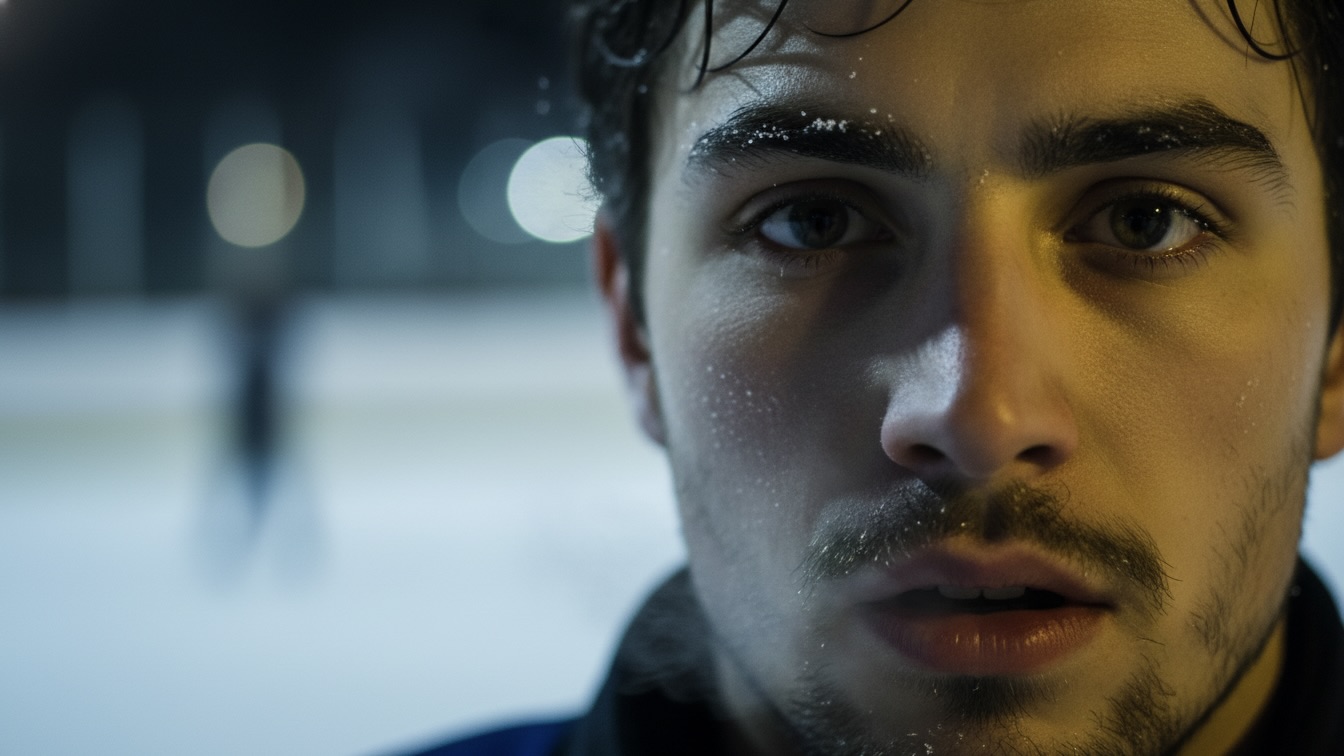
Haunted by the memory of a failed pro tryout, a former hockey prospect named Joey stands alone by a poorly-lit outdoor rink. His friend's tired voice cuts through the night: "You gonna just stare at it or you gonna play?"
A washed-up hockey prospect, crippled by the belief that he lacks the necessary "fire" to succeed, joins a brutal game of late-night shinny. In a desperate attempt to prove his worth, he unleashes a reckless aggression that results in a catastrophic injury for an opponent, forcing him to confront the ugly, destructive nature of his buried ambition.
This story is a gritty, psychological examination of toxic masculinity and the death of a dream. It delves into the internal world of a young man whose identity was forged in the hyper-competitive arena of sports, and who is now lost without it. The episode explores the fine line between competitive fire and destructive rage, questioning the "win at all costs" mentality by revealing its devastating human toll. It is a tragedy about the quiet desperation that festers in the aftermath of failure, and the search for redemption in the wrong places.
The genre is a grounded, character-driven sports drama with the brooding atmosphere of a noir. It uses the visceral, kinetic energy of hockey not for triumphant spectacle, but as a lens to view the characters' internal violence, frustration, and regret. The story is less about the game itself and more about what the game represents: a last chance, a forgotten language, and a violent ballet where men act out the failures they cannot put into words.
The primary stakes for Joey are internal: his last shred of self-respect and the validation of his former identity as a hockey player. He is fighting to silence the voice in his head that tells him he is a coward. The physical stakes are immediate and real—the risk of serious injury in a violent, unregulated game on bad ice. For the other players, the stakes are a temporary escape from the drudgery of their lives and a chance to feel like they matter, even if it's just for one night on a frozen patch of nowhere.
The central conflict is Joey versus his own internal demons: the paralyzing self-doubt, the creeping apathy, and the haunting voice of the scout, Peterson, who pronounced him a failure. This internal battle manifests externally on the ice. The primary antagonistic force is Marco, a player who embodies the brute-force aggression Joey was told he lacked, serving as a physical and psychological mirror. The unforgiving environment itself—the brutal Winnipeg cold, the scarred and unpredictable ice—acts as a constant, oppressive force, reflecting the harsh realities of the characters' lives.
Joey, a former hockey prospect now adrift in a life of quiet regret, is reluctantly pulled into a late-night game of shinny on a rough, outdoor rink. He is haunted by the words of a scout who told him he "lacked the fire," and his initial play is hesitant and fearful, confirming his own worst insecurities. Each fumbled pass and avoided check is a fresh entry in the ledger of his own perceived cowardice, pushing him deeper into his internal turmoil.
Goaded by his past failures and a growing, unspoken rivalry with an aggressive player named Marco, Joey's frustration finally curdles into a cold, reckless rage. In a climactic moment, he abandons all caution, driving to the net and initiating a violent collision with Marco to score a meaningless goal. The fleeting triumph is instantly shattered by the sight of Marco lying on the ice with a severe leg injury, forcing Joey to confront the horrific, real-world consequences of the "fire" he so desperately wanted to find.
JOEY (20s): A skilled but hesitant former hockey prospect, now defined by a single critique that shattered his confidence. Psychological Arc: Joey begins the story in a state of numb resignation, paralyzed by the fear of paying the physical price of the game. He ends the story having finally unleashed the violent aggression he was told he needed, only to discover it is not a source of strength or redemption, but an ugly, destructive force that leaves him more broken and haunted than before.
SHAWN (20s): Joey's friend, a weary but loyal presence who still finds simple joy in the game. He functions as the anchor to reality, trying to pull Joey out of his own head. He witnesses Joey's transformation from apathy to reckless violence with a sense of growing concern that turns to weary disappointment.
MARCO (20s): An aggressive, physical player who represents everything Joey is not. He is not a villain, but a mirror—a man playing with the same grim determination and desperation, just expressed through brute force instead of finesse. His presence on the ice is the catalyst that forces Joey to confront his own perceived inadequacies, making him the unwitting victim of Joey's tragic catharsis.
BEAT 1 - THE INVITATION: Joey stands by a scarred, poorly-lit outdoor rink, lost in his thoughts until his friend Shawn calls him out, goading him into a game they need another body for. Joey reluctantly grabs his frayed stick, the familiar ritual a painful reminder of a life that feels like it belongs to someone else. He steps onto the ice, not as a player, but as a ghost returning to the scene of his own death.
BEAT 2 - THE GHOST OF PETERSON: The chaotic game absorbs Joey, and a flashback to a sterile office introduces the voice of Peterson, the scout who calmly diagnosed him as lacking "fire." This memory is triggered when Joey gets the puck with a clear passing lane but hesitates for a fraction of a second, getting knocked down and losing the chance. The physical cold of the ice seeping through his clothes is nothing compared to the chill of the memory.
BEAT 3 - THE COWARD'S PASS: The puck finds Joey again, this time with a clear shot on goal, but he sees the aggressive Marco closing in like a freight train. Haunted by Peterson’s words about "paying the price," Joey makes a conscious choice to avoid the collision, making a soft, useless pass instead of shooting. The moment of opportunity vanishes, earning him chirps from other players and deepening his self-loathing.
BEAT 4 - THE SHARD OF ICE (MIDPOINT): The simmering frustration in Joey finally boils over into a cold, mean anger—not a noble fire, but a petty fury. He stops gliding and starts driving his legs, chasing the puck with a newfound, desperate intensity. This marks a significant shift in his play style, from passive and hesitant to aggressive and focused.
BEAT 5 - THE PRICE (CLIMAX): Joey manufactures another breakaway, but this time he drives straight through a younger defenseman and barrels toward the net, where Marco stands as the final obstacle. Hearing Peterson's voice one last time as a challenge, Joey puts his head down and initiates a violent, reckless collision, forcing his way through Marco. In the chaotic aftermath, he manages a desperate swipe at the puck, scoring just as he hears the sharp crack of a breaking stick and the wet crunch of bone and gear.
BEAT 6 - THE STILLNESS: The celebratory whoops from his teammates die instantly as everyone realizes Marco is down and not getting up. The game dissolves into a silent, horrified circle around Marco's body, his leg bent at an unnatural angle. The raw reality of the injury shatters the fantasy of the game, leaving only the cold, the darkness, and the sight of a broken man on the ice.
BEAT 7 - THE SIREN: As the first flakes of snow begin to fall like a shroud, the distant wail of an ambulance cuts through the night. Joey stands apart from the others, clutching the jagged half of his broken stick, the puck he scored sitting like a black hole in the snow. The approaching siren is a sound of consequence, a judgment rushing toward him, and he understands with chilling certainty that his victory was the most profound loss of all.
The episode begins in a state of melancholic apathy, immersing the audience in Joey's numb and regretful headspace. The mood shifts to one of rising tension and anxiety as the on-ice action becomes more physical and Joey's internal conflict intensifies. The climax is a sudden, brutal release of kinetic violence, designed to be cathartic for a split second before plunging the audience into shock and horror. The final act is defined by a heavy, dreadful stillness, leaving the viewer with a lingering sense of profound tragedy and the bitter taste of a hollow victory.
If expanded, the series Black Ice Gospel would use Joey's story as a pilot to establish the tone and world of this Winnipeg hockey community. A full season could explore the ripple effects of Marco's injury: an episode could follow Marco's painful recovery, the loss of his manual labor job, and his struggle to find an identity beyond the rink. Another could focus on the "kid with the new skates," showing his perspective on the violence and how it affects his own journey as a prospect facing the same pressures that broke Joey.
The overarching narrative would be the slow fracturing of this community, held together by the ritual of the game. Joey would become a pariah, forced to confront the consequences of his actions, potentially seeking a way to atone. The season would culminate in the dead of winter, with the characters forced to decide if the game that has cost them so much is a source of salvation or just a cycle of self-destruction they need to break.
The visual style will be gritty, intimate, and visceral, utilizing handheld camerawork to create a sense of immediacy and instability, especially during the on-ice sequences. The lighting will be stark and expressionistic, relying on the sickly, malfunctioning orange glow of city streetlights to cut through the deep blacks and blues of the winter night. Shallow depth of field will frequently be used to isolate Joey, blurring the chaotic game around him into an abstraction and trapping the viewer inside his claustrophobic headspace.
The tone is a grounded, melancholic sports-noir, prioritizing psychological realism over spectacle. It shares the character-driven tension and authentic, working-class setting of films like The Drop or Out of the Furnace. The on-ice physicality should feel as brutal and unglamorous as the hockey in Goon, but stripped of all comedy and replaced with a pervasive sense of dread and inevitability, echoing the tragic character arcs of a film like The Wrestler.
This project is aimed at a mature audience (ages 25-50) that appreciates character-driven dramas, psychological thrillers, and sports stories that transcend the game. It will appeal to fans of gritty, atmospheric filmmaking from directors like Taylor Sheridan, Jeremy Saulnier, or the Safdie Brothers. The ideal viewer is someone who prefers slow-burn tension, complex anti-heroes, and stories that explore the darker, more melancholic aspects of human ambition and failure.
The episode's pacing is designed to mirror Joey's psychological state. The first act will be deliberately paced, characterized by long takes, contemplative silence, and the use of voiceover or flashbacks to establish his internal world. The second act will accelerate dramatically as the hockey game intensifies, employing quick cuts, jarring sound design, and chaotic camera movement to build tension. The climax will be a brief, explosive burst of action, immediately followed by an abrupt shift to a slow, silent, and somber final act, allowing the weight of the consequences to settle heavily on the audience.
The primary production challenge is the execution of the on-ice hockey sequences, which must feel authentic, violent, and un-choreographed. This will require casting actors with strong skating and hockey skills, or utilizing skilled stunt doubles for the more intense physical moments, particularly the climactic collision. A dedicated hockey choreographer will be essential to design the plays for maximum narrative impact while ensuring actor safety.
Authenticity of the environment is paramount. The production should be shot on location in a city like Winnipeg during the winter, on a real, imperfect outdoor rink. The visible breath of the actors, the scarred surface of the ice, and the natural snowfall are not just background details but crucial characters in the story. The sound design will be a key storytelling tool, contrasting the muffled, internal world of Joey's tinnitus and memories with the sharp, percussive, and ultimately sickening sounds of the game.