Format: Short Film / Anthology Episode | Est. Length: 10-12 minutes
Imagine "Unseasonable" as a standout episode in an anthology series titled Glitches, which explores near-future scenarios where humanity's attempts to control, brand, and monetize every aspect of life are disrupted by unpredictable, organic events. Each episode would be a self-contained story set within a different hyper-corporate enclave, examining the fragile boundary between manufactured reality and the chaos of the natural world. The series would track a growing undercurrent of rebellion as individuals, pushed to the brink, begin to question and dismantle the systems that suffocate them.
A low-level employee in a hermetically sealed corporate resort wakes not to the familiar, productivity-optimized hum of the system, but to a deep, suffocating, and utterly unauthorized silence. Through her window, she sees an impossible sight: a world buried under a thick blanket of real, unbranded snow.
In a hyper-controlled corporate resort where even the weather is patented, a cynical barista and a disgraced meteorologist must steal proof of a natural snowstorm that the regime has declared a "hostile agent." They must escape with the truth before the corporation can vaporize the evidence and erase reality itself.
The primary theme is the conflict between authentic nature and manufactured reality. The story critiques a hyper-capitalist future where every natural element is either suppressed or commodified, and anything that cannot be branded is deemed a threat. It explores the absurdity of corporate-speak and propaganda, where snow becomes "unverified precipitation" and then a "hostile agent," highlighting how language is used as a tool of control to manage perception and incite fear.
Beneath the sci-fi thriller surface, the episode is a satirical look at influencer culture, curated lifestyles, and the societal panic that ensues when a perfectly controlled system experiences a minor, organic glitch. It's a story about the loss of common sense in a world obsessed with optimization and branding. The emotional undercurrent follows a journey from cynical apathy to active rebellion, suggesting that even the smallest act of defiance—like proving snow is just snow—is a revolutionary act in a world built on lies.
The stakes for Sarah are immediate and personal: her job, her housing, and her financial freedom within the closed-loop economy of Liz Peak™. By defying the lockdown and collaborating with Ben, she risks contract termination and financial ruin, effectively being exiled from the only world she knows. For Ben, the stakes are about vindication and the preservation of truth; failure means his life's work remains discredited and the corporation successfully proves it can erase any reality that doesn't fit its business model. For the Liz Peak™ corporation, the stakes are existential: allowing an "un-monetized weather event" to occur undermines their core brand promise of total environmental control, threatening their authority and market dominance.
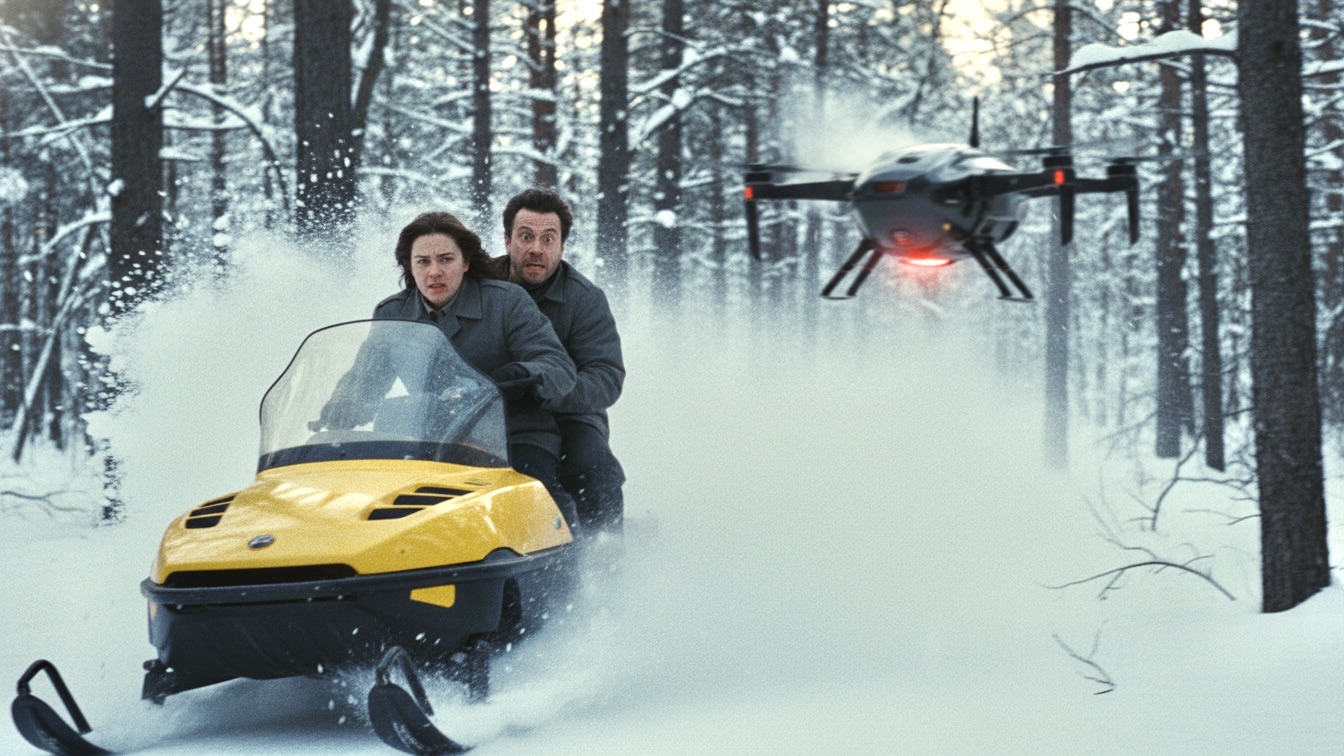
The primary external conflict is a classic David vs. Goliath struggle: Sarah and Ben, armed with only a snowmobile and a thermal flask, against the monolithic power of the Liz Peak™ corporation. This force is personified by the unseen but ever-present Director Carter and manifested through its technological enforcers: the "Peacekeeper" automatons, the surveillance grid, and the menacing heated drones. The environment itself—the deep, difficult snow—is both the object of their quest and a physical obstacle. Internally, Sarah's main conflict is her journey from resigned cynicism to proactive rebellion, overcoming the learned helplessness ingrained in her by the corporate system to take a stand for something real.
Sarah, a debt-ridden barista living and working in the totally-controlled corporate resort of Liz Peak™, wakes to a profound system failure: a natural, un-branded snowstorm has blanketed the valley. While the resort's AI calls it an "unscheduled atmospheric phenomenon" and the residents descend into hashtag-fueled panic, Sarah recognizes the absurdity of the corporate response. Her cynicism pushes her to defy the mandated lockdown and venture outside to her job.
In the snow-filled plaza, she encounters Ben, the resort's disgraced ex-meteorologist, who was fired for predicting such an "unprofitable" event. When the resort's director escalates the situation, publicly labeling the snow a "hostile agent" and deploying "Decontamination Teams" with heated drones to vaporize it, Sarah and Ben realize they must act. They decide to secure a sample of the snow as proof of its natural origin, leading to a desperate plan to steal a snowmobile and escape the resort's security grid before the evidence—and the truth—is melted into oblivion.
Sarah: A sharp, cynical, and debt-laden service worker in her late 20s, trapped in the Liz Peak™ ecosystem.
* Psychological Arc: Sarah begins the story as a passive observer, deeply aware of the absurdity of her world but too beaten down by debt and corporate culture to do anything about it. The snowstorm acts as a catalyst, transforming her quiet cynicism into active defiance. By the end, she is no longer just a cog in the machine but a nascent revolutionary, having taken a tangible risk for a truth she believes in, and realizing the fight is far from over.
Ben: A brilliant but disgraced meteorologist in his 40s, living as an outcast on the fringes of the resort he once helped manage.
* Psychological Arc: Ben starts as a bitter, vindicated hermit, a Cassandra figure whose warnings were ignored. The arrival of the storm and his meeting with Sarah reignites his scientific passion and sense of purpose. He transitions from a man haunted by his past failure to an active agent of truth, using his suppressed knowledge and skills to fight back against the system that discarded him.
Director Carter (Supporting): The unseen but authoritative voice of Liz Peak™ Risk Mitigation. He represents the faceless, profit-driven corporate antagonist whose only goal is to maintain control of the narrative and the environment, no matter how absurd the lie.
Beat 1 (Inciting Incident): The Unnatural Silence. Sarah wakes to a world gone wrong—no hum, no chimes, and a strange, unbranded white light. The oppressive quiet and the sight of real frost on her window signal a fundamental break from her controlled reality. This anomaly triggers her initial unease and curiosity, setting her on a path of investigation.
Beat 2 (Rising Action): The Corporate Response. Sarah witnesses the resort's absurd reaction, labeling the snow "unverified precipitation" and inciting curated panic among the residents. She sees through the corporate spin, and her cynicism hardens into a quiet defiance as she decides to venture outside against orders. This beat establishes the antagonist's methods and the societal brainwashing she is pushing against.
Beat 3 (Midpoint): The Alliance. In the snow-covered plaza, Sarah finds Ben, the disgraced meteorologist, who confirms the snow is a natural phenomenon the resort is trying to erase. Director Carter escalates the situation by declaring the snow a "hostile agent," forcing Sarah and Ben to make a choice: comply or fight. They form an alliance, deciding to steal a snowmobile to secure a sample, turning their passive dissent into active rebellion.
Beat 4 (Climax): The Chase. Sarah and Ben escape the vehicle depot on a snowmobile, pursued by heated drones intent on vaporizing the evidence. They race towards the safety of the old-growth forest, with Sarah executing a dangerous maneuver to collect a clean sample of snow in a thermal flask. The climax is a high-stakes action sequence that tests their resourcefulness and commitment, culminating in them securing the proof just as they escape the resort's immediate reach.
Beat 5 (Resolution/New Beginning): The Thaw and the Truth. In Ben's hidden workshop, they confirm the sample is just water, a small victory against a massive lie. As the sun comes out and the "hostile agent" begins to melt into messy, unmarketable mud, they realize their fight isn't over. They now possess the truth, but face the much larger challenge of convincing a brainwashed society to accept an imperfect reality.
The episode begins with an atmosphere of eerie, unsettling quiet, creating a sense of mystery and unease. This quickly shifts to a tone of dark, satirical humor as the corporate and social response to the snow is revealed. As Sarah and Ben team up, the mood becomes tense and conspiratorial, building into a high-stakes, adrenaline-fueled thriller during the snowmobile chase. The story concludes on a moment of quiet, bittersweet victory, which immediately gives way to a sober, daunting realization of the larger, more difficult fight that lies ahead, leaving the audience with a sense of thoughtful urgency.
This episode serves as a powerful inciting incident for a season-long arc. The immediate fallout would see Sarah and Ben as fugitives, hunted by Liz Peak™'s formidable security forces. Their primary goal would be to disseminate their proof—the "hostile agent" is just water—while the corporation launches a massive propaganda campaign to discredit them, possibly framing the resulting "mud season" as a new, more dangerous bio-contaminant from the "attack."
Over the season, their quest would expand beyond Liz Peak™. They could discover that similar "glitches" in nature are occurring in other corporate-controlled zones around the world, suppressed with equal ferocity. This would lead them to connect with a nascent network of other rebels, scientists, and whistleblowers, transforming their isolated act of defiance into a coordinated movement. The overarching story would become a high-stakes information war, with Sarah and Ben fighting to expose the fundamental fragility of these manufactured realities before the corporations can "patch" nature out of existence entirely.
The visual style is built on a stark contrast between the two worlds. The Liz Peak™ resort is defined by a cold, minimalist, and sterile aesthetic—all clean lines, recycled polymers, and controlled blue-tinted lighting, reminiscent of the production design in Gattaca or Severance. This pristine, artificial world is violently interrupted by the soft, chaotic, and organic texture of the real snow, which should be shot to feel both beautiful and deeply alien in this context.
The tone will shift in concert with the plot. It opens as a quiet, atmospheric sci-fi mystery, transitions into sharp social satire, and then accelerates into a grounded, visceral action-thriller during the chase sequence. Despite the high-concept premise, the characters' reactions and the physics of the chase should feel real and weighty. Tonal comparables include the satirical edge of Black Mirror's "Nosedive," the corporate dread of Severance, and the grounded sci-fi rebellion of Children of Men.
The target audience is fans of intelligent, speculative science fiction, dystopian dramas, and social satire. This includes viewers aged 18-49 who are drawn to thought-provoking series like Black Mirror, Severance, and Westworld, as well as films like Ex Machina and Gattaca. The story will appeal to those who appreciate world-building, sharp social commentary, and character-driven narratives that explore the impact of technology and corporate overreach on the human condition.
For a 10-12 minute runtime, the pacing must be tight and purposeful. Act One (The discovery of the snow and the corporate response) should occupy the first 2-3 minutes, quickly establishing the world and the core conflict. Act Two (The alliance, the plan, and the chase) forms the bulk of the story, running approximately 5-7 minutes and containing the primary tension and action. Act Three (The analysis of the sample and the final realization about the thaw) will be a brief 2-minute resolution that serves as a thematic coda and a springboard for a potential series, ending on a powerful, lingering final shot of the messy, real mud.
The key visual challenge is creating a believable contrast between the hyper-sterile corporate interiors and the wild, snow-covered exterior. The resort interiors can be achieved through minimalist set design, specific color grading (cool blues and greys), and subtle on-screen graphics for the dead displays. The exterior scenes will rely heavily on high-quality practical snow effects to convey the tactile reality and texture of the "unverified precipitation."
VFX will be essential for creating the sleek, menacing heated drones and their heat-beam effects, which should look dangerously real as they carve steaming scars into the snow. Sound design is a critical narrative tool. The film must open with an unnerving, absolute silence, which is then contrasted by the synthetic corporate chimes, the panicked chatter of residents, and finally, the organic, satisfying crunch of boots on real snow and the roar of the snowmobile engine—sounds that represent a return to a more authentic, chaotic reality.