Melgund Township Winter Story Library
Sticky Fingers in Sector Four - Treatment
by Jamie F. Bell | Treatment
by Jamie F. Bell | Treatment
Format: Short Film / Anthology Episode | Est. Length: 10-12 minutes
Imagine a series set in a slightly heightened, bureaucratic version of Canada, where every mundane government department hides a world of low-stakes espionage and high-stakes personal drama. From the strategic reserves of maple syrup to the fiercely competitive world of ice fishing permits, "Northern Exposure" (working title) would be an anthology exploring the absurd conspiracies simmering just beneath the surface of polite Canadian society. Each episode follows ordinary people who stumble into these hidden conflicts, forcing them to navigate life-or-death situations over things most people take for granted.
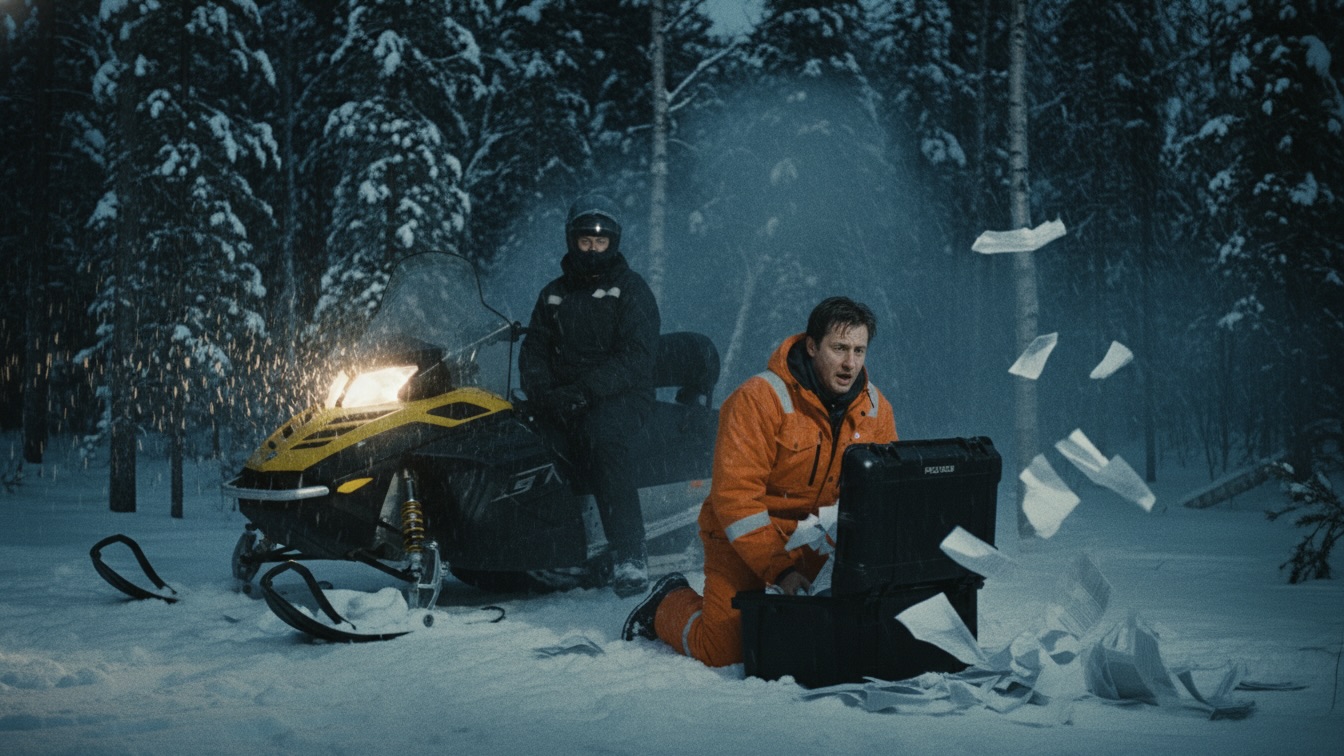
Deep in the snow-choked Canadian wilderness, a pragmatic outdoorsman named Arthur tries to figure out why his friend Benoit, clad in a ridiculous neon orange snowsuit, has stopped their snowmobiles to frantically whisper about low-frequency rotor blades and a mysterious "hum."
A cynical outdoorsman’s ice-fishing trip is hijacked by his paranoid colleague, who has stolen shredded documents exposing a conspiracy within Canada's strategic maple syrup reserve. He must navigate both the unforgiving wilderness and his friend's escalating delusions to survive the day.
The episode is a dark comedy exploring the absurdity of bureaucracy and the comical gap between perceived and actual threats. It juxtaposes the high-stakes language of espionage thrillers with the mundane reality of a maple syrup scandal, creating a satirical commentary on how institutions can inflate their own importance. A secondary theme is mismatched partnership, examining how a pragmatic survivalist and a paranoid desk jockey must rely on each other when faced with the indifferent, and very real, dangers of nature.
The story operates on the emotional undercurrent of relatable frustration escalating into surreal chaos. Arthur’s simple desires—warmth, food, functioning equipment—are constantly thwarted by Benoit’s complex, farcical problems. This tension creates a comedic exploration of loyalty and the limits of friendship when one person’s reality seems to have completely detached from the other’s.
For Arthur, the stakes are immediate and physical: survival. He risks freezing to death due to his malfunctioning snowmobile, frostbite from the extreme cold, and being stranded forty kilometers from civilization. By helping Benoit, he also risks becoming an accomplice to a federal crime, however ridiculous, and being permanently entangled in his friend's paranoid mess. For Benoit, the stakes are existential: he believes he is fighting for the integrity of a national resource and that failure will result in professional ruin, the loss of his pension, and potential "disappearance" at the hands of a powerful, sticky "syrup cartel."
The primary external conflict is Man vs. Nature. The brutal cold, deep snow, and failing equipment are the most tangible threats to the characters' survival. This is amplified by the appearance of a massive moose, a real and unpredictable danger that dwarfs Benoit's imagined pursuers. The secondary external conflict is the (mostly imagined) threat of the "Federation" or "syrup cartel," a force that exists entirely in Benoit’s mind but whose perceived presence dictates his every panicked action. Internally, Arthur battles his own cynicism and frustration against a reluctant sense of duty to his friend, while Benoit struggles with his crippling anxiety and a misguided, hysterical sense of civic responsibility.
Arthur, a pragmatic and world-weary outdoorsman, is on a snowmobiling trip with his anxious colleague, Benoit, when the journey takes a bizarre turn. Stranded in the remote Canadian wilderness, Arthur's frustration with his faulty equipment is overshadowed by Benoit's escalating paranoia about being followed. The purpose of their trip is revealed not to be ice fishing, but a desperate escape, as Benoit confesses to having "rescued" bags of shredded documents from his job at the Ministry.
The documents, Benoit hysterically explains, are proof of a conspiracy to dilute Canada's Strategic Maple Syrup Reserve with corn syrup—an act of "liquid treason." As Arthur struggles to process the absurdity of fleeing a "syrup cartel," their imagined threats are suddenly replaced by a very real one: a massive moose that wanders into their camp. After the terrifying encounter, Arthur takes charge, dismissing Benoit's plan to bury the evidence and deciding their only option is to reach his uncle's remote cabin and burn the shredded paper, turning state secrets into simple kindling.
Arthur: The story's cynical, grounded protagonist. He is practical to a fault, more concerned with his numb thumb and failing engine than his friend's wild conspiracy theories.
* Psychological Arc: Arthur begins the story in a state of pure annoyance, viewing Benoit as an incompetent burden. Through the escalating absurdity and the genuine threat of the moose, he transitions from a reluctant tagalong to a begrudging protector, finding a dark humor in the situation and ultimately taking decisive action to ensure their mutual survival.
Benoit: A high-strung, anxious government employee with a flair for the dramatic and a deep-seated belief in conspiracies. He sees himself as a heroic whistleblower, but his paranoia and lack of practical skills make him a danger to himself and others.
* Psychological Arc: Benoit starts at a fever pitch of panic, convinced shadowy forces are hunting him. His fear is abstract and overblown until confronted by the moose, a real and immediate danger he cannot comprehend. By the end, his free-floating paranoia has a new anchor: he is entirely dependent on Arthur, trading his imagined competence for a desperate reliance on his friend's real-world skills.
Beat 1 - The Anxious Stop: The story opens on the stark, cold wilderness, establishing Arthur's physical discomfort and frustration with his gear. Benoit’s frantic, paranoid behavior creates an immediate sense of mystery and conflict, as Arthur’s grounded complaints clash with Benoit’s whispers of being followed by drones. The tension is built not on action, but on the widening gap between their two realities.
Beat 2 - The Sticky Reveal: Benoit, ignoring Arthur’s sarcastic jabs, unveils the contents of his high-tech Pelican case: Ziploc bags filled with shredded paper. This is the story's midpoint, where the premise pivots from a simple survival story into a farcical espionage thriller. Benoit’s confession about the maple syrup dilution and the "liquid treason" he's fighting solidifies the absurdly low stakes that are driving the high-stakes drama.
Beat 3 - The Real Threat: As Benoit’s paranoia peaks and he mistakes the sounds of the forest for an "extraction team," a genuine threat emerges in the form of a massive moose. This moment grounds the story, presenting a real, terrifying force of nature that makes Benoit's imagined "surveillance moose" and "syrup cartel" seem utterly ridiculous. Arthur’s calm, knowledgeable reaction to the animal solidifies his role as the competent survivalist in contrast to Benoit's panicked incompetence.
Beat 4 - The Reluctant Plan: After the moose departs, the adrenaline forces a decision, serving as the episode's climax. Arthur seizes control, dismissing Benoit's impractical ideas for disposing of the evidence and formulating a clear, actionable plan: travel to a nearby cabin to use the wood stove. He asserts his leadership, and the final image is of the two racing off on their snowmobiles, a reluctant team united by circumstance, fleeing a bizarre conspiracy into the darkening woods.
The episode's emotional trajectory charts a course from grounded frustration to surreal, comedic tension. It begins with the relatable annoyance of being cold and dealing with faulty machinery, lulling the audience into a familiar survival scenario. This mood is steadily disrupted by Benoit's anxiety, injecting confusion and dry humor that builds until the reveal of the shredded paper, at which point the tone fully embraces dark comedy. The appearance of the moose provides a sharp spike of genuine fear and awe, before the mood settles into one of resigned, farcical determination as Arthur takes charge. The audience is left with a feeling of amused bewilderment, laughing at the absurdity of it all.
If expanded into a series, this episode would serve as the inciting incident for Arthur's unwilling entanglement in Canada's bureaucratic underworld. The season could see Arthur and Benoit failing to completely destroy the evidence, leaving a trail that is discovered not by a powerful cartel, but by an equally pedantic and determined internal affairs auditor from the Ministry. This would trigger a season-long, low-speed chase across rural Ontario, with the duo encountering other mundane "conspiracies," such as a turf war between rival butter tart bakeries or espionage related to the export of prized Canadian lumber.
The overarching story would follow Arthur's transformation from a man who just wants to be left alone into a reluctant expert in navigating absurd crises. Benoit's paranoia could be revealed as a broken compass—mostly wrong, but occasionally pointing towards a real, albeit ridiculous, truth. The ultimate antagonist wouldn't be a Bond villain, but a terrifyingly competent mid-level manager with a budget to balance and quotas to meet, making the threat both utterly serious to the characters and hilarious to the audience.
The visual style will be grounded and naturalistic, emphasizing the vast, indifferent beauty and brutal cold of the Canadian winter. The cinematography will use a palette of muted whites, greys, and deep greens, making Benoit's neon orange snowsuit a constant, comical point of visual contrast. Handheld or shoulder-mounted cameras will be used during moments of panic to create a sense of immediacy and chaos, while wide, static shots will capture the immense scale of the landscape, highlighting the characters' insignificance.
The tone is a dry, dark comedy heavily influenced by the Coen Brothers' Fargo and the deadpan absurdity of films by Aki Kaurismäki. The humor is derived from playing the ridiculous premise completely straight, with characters reacting to the "syrup conspiracy" with the deadly seriousness of a nuclear threat. The dialogue is understated and driven by the clash between Arthur’s weary sarcasm and Benoit’s breathless, jargon-filled panic.
The target audience is adults aged 25-55 who appreciate character-driven, dark comedies and quirky, offbeat thrillers. This includes fans of television series like Fargo, Barry, and Patriot, as well as films from the Coen Brothers, Martin McDonagh, and Taika Waititi. The ideal viewer enjoys humor that is situational and dry, and appreciates stories with a strong, atmospheric sense of place.
For a 10-12 minute runtime, the pacing will be deliberate yet tense. Act One (approximately 3 minutes) will establish the setting, the character dynamic, and the initial mystery of Benoit's behavior. Act Two (approximately 5 minutes) will contain the central reveal of the syrup plot and the tense moose encounter, serving as the story's midpoint and major turning point. Act Three (approximately 2-4 minutes) will be brisk, focusing on Arthur's decisive plan and their final, frantic escape, ending on a note of unresolved, comedic uncertainty.
The primary production consideration is the location. Shooting in a genuine, snow-covered northern wilderness is essential for the film's authenticity and tone. This will require a robust production plan that accounts for extreme cold, remote locations, snowmobile operation and safety, and potential weather delays. The verisimilitude of the cold—visible breath, frost on clothing, the specific sound of snow crunching underfoot—is a critical, non-negotiable element.
The moose encounter presents a significant production challenge. A combination of techniques would be ideal: using a trained animal for wide shots to establish scale and presence, and employing a highly detailed animatronic or CGI for close-ups and specific actions to ensure actor safety and directorial control. The visual contrast between Benoit's pristine, brightly colored gear and Arthur’s worn, practical equipment should be emphasized in costume design to visually reinforce their conflicting personalities.