Format: Short Film / Anthology Episode | Est. Length: 10-12 minutes
Imagine "The Longest Block" as a standout episode in a grounded, near-future anthology series titled Curfew or The Unregistered. Each episode would be a self-contained story focusing on the human cost of a society under authoritarian control, where citizenship is conditional and those deemed "unregistered" are hunted by a militarized federal force. The series would explore themes of survival, resistance, and family bonds in a fractured America, with this episode serving as a tense, street-level introduction to the brutal realities of this world.
The hiss of an empty inhaler. The thin, whistling sound of a child who can't breathe. In a city under lockdown, with 911 unresponsive, a father realizes the only thing standing between his daughter and death is six blocks of silent, patrolled darkness.
In a city under martial law, an undocumented father must risk a terrifying journey through militarized patrols to get life-saving medicine for his daughter. To save her, he must cross the six most dangerous blocks of his life, where being seen is a death sentence.
At its core, "The Longest Block" is a thriller about the primal power of parental love in the face of systemic oppression. It explores the theme of invisibility—how a person can be forced to live as a ghost in their own city, and the terrifying moment they are forced into the light. The narrative dissects the dehumanizing nature of a surveillance state, where a simple errand becomes a life-or-death mission, and the line between protector and prey is erased.
The genre is a grounded, high-tension sci-fi thriller, stripping away fantastical elements to focus on a terrifyingly plausible near-future. The emotional undercurrents are desperation, suffocating anxiety, and the fierce, defiant hope that drives a person to risk everything for family. It is a story about the systems that fail us and the personal sacrifices required to survive them.
The stakes are immediate and absolute. Primarily, the life of James's young daughter, Ellen, hangs in the balance; without the medicine, she will suffocate. For James, the personal risk is his freedom and his life—if caught by the federal patrols, he will be taken, and his family will never see him again. This leaves his wife, Mandy, and Ellen completely alone and vulnerable, raising the secondary stake of his family's entire future and survival.
The primary external conflict is Man vs. State. James must physically navigate a hostile urban environment, with the federal patrol trucks and their unseen agents serving as the direct, lethal antagonists. The city itself—with its darkness, blind corners, and lack of resources—is an oppressive force. Internally, James battles a profound conflict between his paralyzing fear of being caught and his desperate, overpowering need to save his daughter. This is amplified by Mandy, who embodies the voice of caution and the terrifying reality of their situation, creating a relational conflict born not of malice, but of shared terror.
In a city under a strict curfew, James and Mandy listen helplessly as their daughter Ellen suffers a severe asthma attack. Their last inhaler is empty, and the 911 line is an automated recording. James, an undocumented resident hunted by federal patrols, knows that stepping outside is a death sentence, a fact his terrified wife, Mandy, desperately reminds him of. Driven by the sound of his daughter’s labored breathing, James makes the impossible choice to run six blocks to a 24-hour pharmacy, leaving a terrified Mandy behind.
He slips into the silent, dark city, a ghost moving through a predator’s territory. Every shadow and sound is a threat as he evades the sweeping searchlights of an armored patrol truck in a heart-pounding close call. He successfully reaches the pharmacy and gets the inhaler, a moment of powerful relief. But his journey back is cut short when he finds his street blocked by agents making an arrest. Forced into a maze of back alleys, he takes a wrong turn and hits a dead end, trapped. As panic sets in, he hears footsteps approaching in the darkness and sees the glint of metal, his brief hope replaced by immediate, unknown terror.
JAMES: A man defined by fear and a sense of powerlessness. At the start, he is trapped—by the apartment, by his legal status, and by the suffocating reality of his daughter's illness. His psychological arc is a forced transformation from passive victim to active protector, where his love for Ellen becomes a weapon against his terror. By the end, though still terrified, he has acted with incredible bravery, his state shifting from one of helpless paralysis to one of desperate, focused action.
MANDY: The anchor of pragmatism and the voice of the family's shared fear. She is not an obstacle to James but a reflection of the impossible stakes; her pleas for him to stay are born from a desperate desire to keep her family intact. Her state remains one of terrified waiting, her role being to ground the narrative in the emotional reality of what James stands to lose and what he has left behind.
ELLEN: The unseen catalyst. Her suffering is the ticking clock and the emotional core of the story. While not physically present for most of the narrative, her struggle to breathe is the soundtrack to James's journey, motivating his every action.
The Catalyst: Inside the claustrophobic apartment, a final, empty hiss from an inhaler confirms their worst fears as Ellen's breathing deteriorates into a high-pitched whistle. James's frantic attempts to call 911 are met with a useless automated message, cementing their isolation. Over Mandy's desperate, logical pleas, James makes the gut-wrenching decision to run, establishing the life-or-death stakes of his journey.
The Journey Begins: James descends a cold, metal fire escape into a city that feels unnervingly dead, the silence broken only by the distant rumble of patrols. He moves through oppressive darkness, with every scrape of his shoe sounding like a gunshot, establishing the hostile environment and the rules of survival. This sequence is pure, simmering tension, showcasing his vulnerability in a world where he is the prey.
Midpoint / Close Call: Crossing an empty schoolyard, the rumble of a patrol truck grows into a roar, forcing James to dive behind a dumpster. A blinding searchlight sweeps inches above his head, the proximity of the heat and distorted radio voices creating a moment of heart-stopping terror. Surviving this near-miss doesn't make him feel powerful; it deepens his understanding of his fragility but steels his resolve to keep moving for Ellen.
The Oasis: James reaches the pharmacy, a lone beacon of light in the dark, and successfully acquires the inhaler in a silent, sterile transaction through a service drawer. This moment provides a powerful, albeit brief, surge of relief and hope, as he clutches the small paper bag containing his daughter's next breath. For a fleeting second, it seems like he might actually make it.
The Climax / The Trap: Turning to retrace his steps, James freezes as he sees patrol lights flashing at the end of his block, his path home completely cut off. Forced into a labyrinth of unfamiliar back alleys, he makes a wrong turn and runs into a brick wall topped with razor wire—a dead end. As the crushing weight of his mistake lands, he hears footsteps echoing towards him, and a silhouette with something glinting in its hand emerges from the darkness, ending the story on a cliffhanger of absolute dread.
The audience experience begins with the suffocating anxiety and helplessness of the opening scene inside the apartment. This transitions into a sustained state of high-stakes, breathless tension as James navigates the city, with the audience feeling every near-miss and amplified sound. The successful pharmacy trip offers a sharp, powerful exhalation of relief, a peak of hope that is immediately and brutally crushed, sending the emotional trajectory plummeting into renewed fear and disorientation. The final moments ratchet the tension to its highest point, culminating in a spike of pure panic and unresolved dread.
If expanded, the cliffhanger would resolve with the stranger being an ally—a member of an underground railroad helping the "unregistered." This would pull James into a larger conflict, forcing him to reconcile his desire to protect his family by staying hidden with the need to fight back. A season arc would follow James's reluctant evolution from a desperate father into a key operative in this network, undertaking increasingly dangerous missions to secure medicine, food, or passage for other families.
The overarching story would explore the origins and motivations of the oppressive federal regime, introducing key figures on both sides of the conflict. Thematic escalation would move from personal survival to community resistance, questioning what it costs to remain human in an inhuman system. James's journey would parallel the network's larger goal: not just to survive the curfew, but to one day end it.
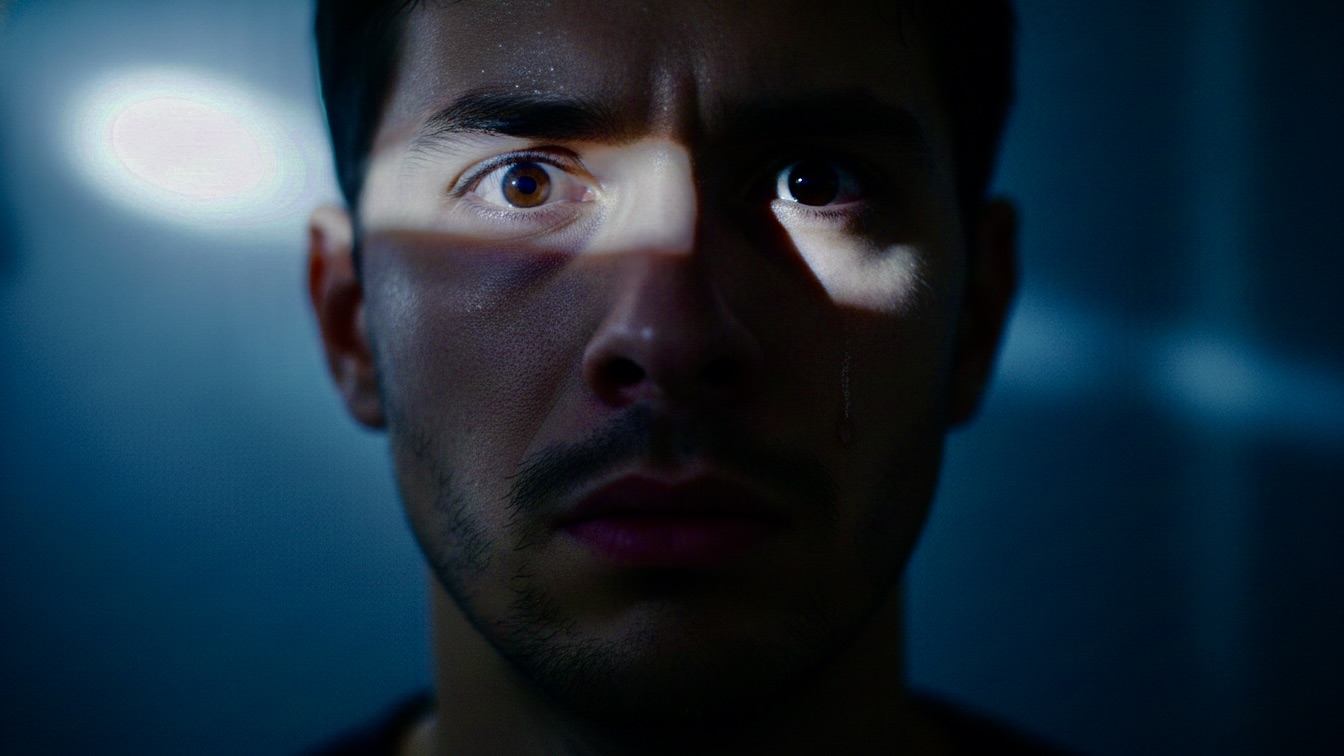
The visual style will be gritty, immersive, and claustrophobic, utilizing a handheld camera to place the audience directly in James's headspace. The lighting will be high-contrast and naturalistic, embracing the deep shadows of the night and using the harsh, cold beams of the patrol searchlights as a menacing visual motif. The color palette will be heavily desaturated, dominated by cold blues, grays, and the sickly yellow of isolated street lamps, emphasizing the urban decay and oppressive atmosphere.
The tone is one of relentless, grounded suspense, akin to Children of Men for its visceral, street-level perspective on a dystopian society, and A Quiet Place for its masterful use of sound and silence to build tension. The film should feel less like science fiction and more like a headline from the near future. The goal is not spectacle, but a palpable sense of dread and immediacy.
This treatment is aimed at a mature audience (18-49) that appreciates character-driven, high-tension thrillers and grounded speculative fiction. It will appeal to fans of series like Black Mirror and The Handmaid's Tale, and films like Sicario and '71, who are drawn to intense, atmospheric storytelling with strong social commentary. The ideal viewing context is one that allows for full immersion, such as a premium streaming platform or a film festival circuit.
The narrative is built on a foundation of relentless forward momentum, designed for a tight 10-12 minute runtime. The first act within the apartment is deliberately paced to build a sense of claustrophobia and dread. The second act—James's journey—alternates between tense, quiet stalking and sharp bursts of adrenaline. The final act accelerates rapidly, moving from the relief of the pharmacy to the panic of the dead-end in a matter of minutes, ending abruptly on the cliffhanger to maximize impact and leave the audience breathless.
Sound design is paramount to the success of this piece. The contrast between the oppressive silence of the city and the sharp, diegetic sounds—Ellen's wheezing, James's frantic breathing, the scrape of a shoe on gravel, the low rumble of the truck—will be the primary tool for building tension. The auditory landscape is as important as the visual one.
Visually, the production can be achieved on a modest budget. It relies on creating atmosphere through lighting and location scouting rather than extensive special effects. The patrol trucks can be suggested more than shown, using their lights and sounds to represent their presence, making the unseen threat even more menacing. The focus should be on practical effects and capturing the raw, visceral performance of the lead actor.