Melgund Township Winter Story Library
The Caucus in the Cold - Treatment
by Jamie F. Bell | Treatment
by Jamie F. Bell | Treatment
Format: Short Film / Anthology Episode | Est. Length: 10-12 minutes
Imagine an anthology series set against the vast, unforgiving backdrop of the Canadian North, where the isolation of the landscape mirrors the moral isolation of its characters. Each episode is a self-contained, neo-noir thriller, exploring how ordinary people—politicians, miners, conservation officers, Indigenous leaders—are pushed to extraordinary limits by greed, desperation, and the primal struggle for survival. "The Caucus in the Cold" serves as a signature episode, blending the high-stakes paranoia of political conspiracy with the visceral terror of a wilderness survival story, setting the tone for a series about the darkness that thrives in the coldest of places.
Two political staffers—one a jaded veteran, the other a dangerously ambitious upstart—are on a brutal winter camping trip miles from civilization. The punishing trek is merely a prelude to the true purpose of their journey: a high-stakes gamble with a stolen hard drive that could bring down the government.
A cynical political aide is dragged into the remote northern wilderness by his younger colleague to handle a stolen hard drive containing career-ending government secrets. When they realize they've been followed, their dangerous political game becomes a desperate fight for survival.
The episode is a study in the corrosive nature of ambition and the illusion of control. It contrasts the manufactured, back-room power of politics with the raw, indifferent power of nature. Stephan believes he can manipulate the system for personal gain, using the wilderness as a sterile meeting room, only to find that out here, the rules of politics are meaningless. The story explores the generational divide in political morality: Gord’s exhausted pragmatism, born from years of compromise, clashes with Stephan’s reckless, tech-enabled belief that he can short-cut the system for a quick payday.
Ultimately, the central theme is the irrelevance of human conspiracy in the face of primal threat. The hard drive, representing millions of dollars and the fate of a government, becomes just a useless piece of plastic when the crunch of a boot in the snow signals a more immediate danger. It’s a story about how quickly the complex hierarchies of man are flattened by the simple hierarchy of predator and prey.
The initial stakes are professional and legal: if their blackmail scheme fails, Gord and Stephan face career ruin, public humiliation, and potential prison time for stealing Crown property. For Gord, it’s the potential loss of a pension and the last vestiges of his professional integrity. For Stephan, it’s the risk of his entire future. As the story pivots, the stakes escalate dramatically to life and death. The political fallout becomes a secondary concern to the immediate, physical threat of being hunted in an isolated environment with no hope of escape or rescue.
The conflict operates on three levels. The primary external conflict is Man vs. Nature, with the brutal blizzard and freezing temperatures serving as a constant, oppressive force that weakens the characters both physically and mentally. The central interpersonal conflict is Man vs. Man, pitting Gord’s weary caution against Stephan’s reckless ambition in a tense battle of wills over the fate of the hard drive. Finally, an unknown Antagonist Force emerges—the unseen figure on the ridge—transforming the narrative into a Man vs. Predator struggle, where the characters are outmatched and exposed. Internally, Gord battles his own cynicism and exhaustion, forced to decide whether to save his soul or his skin.
Gord, a jaded, middle-aged political staffer, is reluctantly dragged on a punishing winter camping trip by his energetic and ambitious younger colleague, Stephan. Battling a blizzard and his own exhaustion, Gord learns the true purpose of their isolation: Stephan has stolen a hard drive containing damning evidence of high-level government corruption, including illegal dealings involving the Premier’s Chief of Staff. Stephan’s plan is not to expose the corruption, but to use the data to blackmail the government for lucrative consulting contracts.
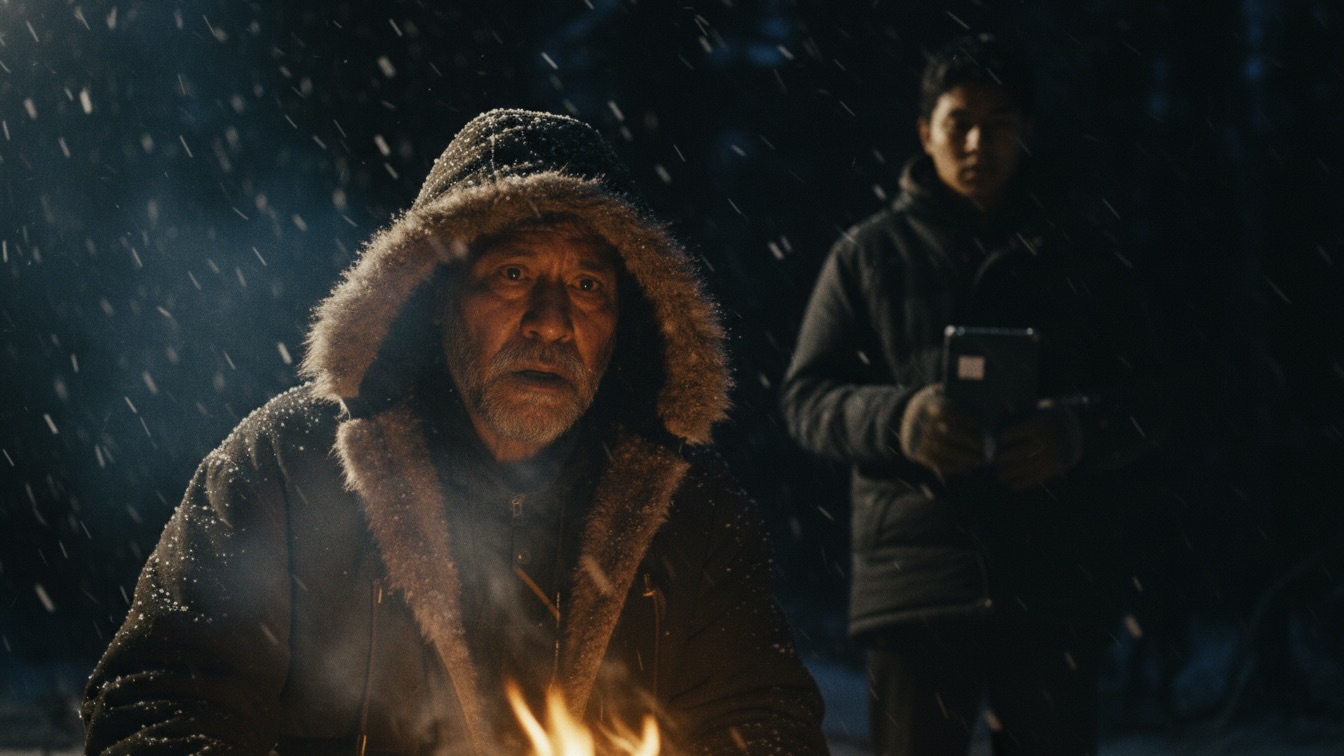
As they huddle around a failing campfire, Gord argues for anonymously leaking the data to the press, seeing it as the only clean way out. Stephan furiously rejects this, viewing the drive as his one shot at wealth and power. Their ideological and personal conflict escalates into a physical confrontation, which is abruptly cut short by a distinct, mechanical sound from the dark ridge overlooking their camp. In a terrifying instant, they realize they have been followed, and their political thriller has just become a fight for their lives against an unknown hunter.
GORD (44): A cynical, overweight, and exhausted political operative who has traded his ideals for a steady paycheck and a sense of weary resignation. He is pragmatic to a fault, understanding the brutal mechanics of power and the foolishness of Stephan’s plan.
* Psychological Arc: Gord begins the story in a state of passive defeat, a passenger in Stephan’s reckless scheme. The discovery of the unseen pursuer shocks him out of his political stupor, reawakening a primal, survivalist instinct that has long been dormant, transforming him from a tired bureaucrat into a cornered animal.
STEPHAN (28): Sharp, fit, and vibrating with a dangerous combination of intelligence, arrogance, and naivete. He sees the corrupt system not as something to fix, but as a ladder to climb, and believes his digital leverage makes him untouchable.
* Psychological Arc: Stephan starts with a manic, god-like confidence, believing he is the master of his destiny. The arrival of the hunter shatters his illusion of control, stripping away his bravado and exposing the terrified, inexperienced young man who has massively overplayed his hand.
Opening: Gord struggles through a disorienting blizzard, his physical misery a clear contrast to Stephan’s relentless, cheerful pace. This opening establishes the harsh, unforgiving environment and the fundamental friction between the two men. The wilderness is immediately presented as an antagonist.
Inciting Incident: Huddled in the relative calm of a clearing, Stephan reveals the stolen hard drive and his plan to blackmail the Premier's Chief of Staff. The trip is no longer about clearing their heads; it's a criminal conspiracy. This forces Gord to engage, shifting the story from a simple survival trek to a high-stakes political thriller.
Rising Action: The two men argue fiercely over the drive, their conflicting philosophies—Gord’s risk-averse plan to leak versus Stephan’s high-risk blackmail plot—clashing over the dying campfire. The tension peaks as Gord reaches for the drive and Stephan physically stops him, their partnership breaking down into a raw power struggle. This moment solidifies their opposing goals and the point of no return.
Midpoint & Climax: Their fight is instantly silenced by a sharp, unnatural click-whir from the darkness above, followed by the crunch of a heavy boot in the snow. The abstract threat of political retribution is immediately replaced by the concrete, terrifying threat of a physical pursuer. This is the story's major turning point, flipping the genre and escalating the stakes from career to survival.
Ending: Gord kills his headlamp, plunging them into near-total darkness as a human silhouette materializes on the ridge, watching them. The episode ends abruptly on this image of primal fear. They are trapped, hunted, and their political machinations have become utterly irrelevant.
The episode begins with a mood of weary frustration and atmospheric dread, as the audience shares in Gord’s physical suffering. This transitions into a tense, claustrophobic paranoia during the campfire confrontation, where the dialogue is sharp and the stakes are political. The final act executes a sharp pivot into visceral, heart-pounding terror, leaving the audience with a spike of adrenaline and an unnerving sense of exposure as the credits roll.
This episode serves as a powerful prologue and inciting incident for a full season. The immediate aftermath would see Gord and Stephan attempting to escape their pursuer through the brutal wilderness, a cat-and-mouse game that tests their already frayed alliance. The central mystery of the season becomes: who is hunting them? Is it an agent of Harrison, the Chief of Staff, sent to retrieve the drive and silence them? Or is it a third party—a rival political faction or a corporate entity implicated on the drive—who wants the data for themselves?
A season arc would follow Gord, potentially separated from Stephan, as he is forced to use his deep knowledge of political strategy and dirty tricks not to win an election, but to stay alive and expose the truth. He would become an unwilling fugitive, navigating a web of conspiracy that reaches the highest levels of power, all while being hunted by a relentless operative who is as comfortable in the wilderness as Gord is in a caucus room. The season would explore the fallout of the data, whether it's suppressed or strategically leaked, and Gord's transformation from a cynical cog in the machine to the one man who can bring it all down.
The visual style is grounded, visceral, and claustrophobic. The camera is often handheld and tight on the characters, emphasizing their labored breathing and the stinging snow on their faces, making the viewer feel the cold. These intimate shots are contrasted with vast, isolating wide shots that dwarf the men against the immense, indifferent snow-covered landscape. The color palette is stark and monochromatic—whites, greys, and deep blacks—with the only sources of warmth and color being the failing campfire and the artificial slice of a headlamp beam, creating a sense of a fragile human presence in an overwhelming void.
Tonally, the piece is a blend of the paranoid political thriller and the stark survival horror, reminiscent of Taylor Sheridan’s Wind River meets Alan J. Pakula’s The Parallax View. The sound design is a critical component, prioritizing the immersive, naturalistic sounds of the storm—the howling wind, the creak of snow-laden branches, the rhythmic crunch of snowshoes. The oppressive noise of the blizzard makes the sudden, dead silence of the clearing feel deeply unsettling, and the final, sharp mechanical click is engineered to be a jarring, terrifying intrusion of the human predator into the natural world.
The target audience is mature viewers (25-55) who appreciate intelligent, slow-burn genre fare. It will appeal to fans of character-driven thrillers, neo-noir, and survival dramas found on premium cable and streaming platforms like HBO, FX, and Netflix. Viewers who enjoy the tense atmosphere of shows like Ozark and True Detective or the bleak, high-stakes storytelling of films like The Grey and A Simple Plan will be drawn to the episode's blend of political intrigue and primal fear.
For a 10-12 minute runtime, the pacing is relentless and efficient. Act One (The Trek) is a brisk, atmospheric setup, establishing character and environment in under three minutes. Act Two (The Reveal & Confrontation) is the longest, a dialogue-driven pressure-cooker scene that builds tension methodically. Act Three (The Hunter) is a sharp, shocking pivot in the final two minutes, designed to deliver a powerful jolt and end on a breathless cliffhanger, maximizing impact and leaving the audience demanding to know what happens next.
Authenticity is key to the production. Filming should take place in a genuine, harsh winter environment to capture the actors' real physical reactions to the cold—visible breath, chattering teeth, clumsy movements with frozen fingers. The challenges of shooting in deep snow and potentially severe weather must be factored into the schedule and budget, with a focus on crew and cast safety.
The sound design requires meticulous attention. The contrast between the cacophony of the blizzard and the sudden, dead stillness of the sheltered clearing is a vital storytelling tool. The specific click-whir sound that signals the hunter must be carefully designed to be distinctly unnatural—not an animal or a natural phenomenon, but clearly the sound of man-made technology. This single sound effect is the pivot point for the entire story and must land with chilling precision.