Melgund Township Winter Story Library
The Silence and the Sound - Treatment
by Jamie F. Bell | Treatment
by Jamie F. Bell | Treatment
Format: Short Film / Anthology Episode | Est. Length: 10-12 minutes
This story is envisioned as a standalone episode within a near-future anthology series titled The Quiet Places. Each episode explores the lives of individuals or families who have chosen to disconnect from a hyper-integrated, data-saturated urban society to seek refuge in the last pockets of the analog world. The series examines the tension between humanity's reliance on technology and its primal need for nature, often blurring the lines between psychological drama, science fiction, and modern folklore as characters confront the "ghosts"—both real and digital—they've brought with them into the wild.
A tech-addicted teenager, forcibly relocated with his family to a remote winter cabin, is confronted by a silence so absolute it feels like a physical threat, a void where the constant hum of the city used to be.
A city-born teenager, convinced a mythical monster is stalking his family's isolated cabin, uses his engineering skills to build a high-tech trap. He ensnares not a beast, but a reclusive old woman, forcing him to confront the true nature of fear, loneliness, and connection in a world stripped of technology.
The primary theme is the conflict between the digital and the natural worlds. The story contrasts the city's "noise"—a constant, overwhelming stream of data and connection—with the "silence" of the wilderness, questioning which is truly empty and which is truly full. It explores how technology can be both a crutch and a tool, a means of isolation and a bridge to understanding, depending on the user's intent.
A secondary theme is the modernization of folklore and fear. Les's fear of the unknown is initially shaped by the ancient legend of the Wendigo, a spirit of the winter wilderness. However, his method of confronting this fear is entirely modern—building sensors, alarms, and mechanical traps. The story deconstructs a classic monster tale, revealing the "monster" to be a human using clever, analog technology to protect herself, suggesting that in our age, the scariest things are not supernatural beasts, but the lengths people will go to for solitude and the misunderstandings that arise from our disconnection from one another.
The stakes for Les are both psychological and physical. Initially, he fears for his and his family's safety, believing a dangerous creature is lurking outside their door. More deeply, what's at stake is his sanity and his ability to cope in this new environment; if he succumbs to his anxiety, he will become completely isolated and unable to function. For his parents, Harris and Anna, the stakes involve the success of their drastic life change and the potential collapse of their family unit if the move fails to heal their underlying stress. For Odelia, the stakes are her cherished solitude and the preservation of a way of life she has fought hard to build, which is threatened by the arrival of new people.
The primary external conflict is Man vs. Nature, with Les pitted against the intimidating and unfamiliar wilderness. This is personified by the "monster" he believes is hunting him—the source of the howl and the strange tracks. The true antagonist, however, is revealed to be Odelia, who acts as an opposing force not out of malice, but out of a fierce desire to protect her privacy. The internal conflict resides entirely within Les, who battles his own tech-dependency, anxiety, and feelings of powerlessness. He must overcome his city-bred mindset to understand the new rules of the forest and learn to distinguish a genuine threat from the echoes of his own fear.
Les, a teenager withdrawn and anxious after his family abruptly moves from a hyper-connected city to a remote winter cabin, is unnerved by the oppressive silence. The first night, a terrifying, unnatural howl echoes through the woods, and his father's attempt to explain it away with an old legend of the Wendigo only solidifies Les's fear. After discovering a set of large, non-human tracks near the cabin, Les decides to fight back, using his tech-savviness to build a sophisticated, high-tensile wire net trap to capture the creature.
The trap is sprung in the dead of night. Armed with a flashlight and a fireplace poker, Les ventures into the dark woods to confront the beast he has caught. He discovers not a monster, but a tiny, fierce old woman named Odelia tangled in his net. She is a reclusive ex-engineer who reveals she created the "monster" persona—using custom snowshoes and a sound-projection device—to scare away intruders. This reveal transforms Les's terror into profound embarrassment, but leads to a connection. He discovers her hidden yurt workshop, filled with masterful clockwork creations, and recognizes in her the same desire to escape the digital "noise" that his family feels. Seeing that she is unprepared for an approaching storm, Les offers his skills to help, and in doing so, finds a new purpose and a genuine, analog connection he never had in the city.
LES: A smart but anxious teenager whose identity is tied to his skill with technology. He begins the story feeling powerless, stripped of the digital environment where he feels competent, and his fear of the wilderness manifests as a tangible monster. His psychological arc is one of empowerment and re-contextualization; by applying his technical skills to a "real-world" problem, he rediscovers his confidence, and in meeting Odelia, he learns that true connection isn't about network speed but about shared understanding and purpose. He ends the story grounded, calm, and at home in the very silence he once feared.
ODELIA: A fiercely independent and cantankerous hermit who was once a brilliant city engineer. She is the story's "monster," a deliberate persona she has crafted to protect her solitude. She starts as a mysterious threat and, upon being revealed, an abrasive antagonist, but her gruff exterior hides a deep-seated weariness with the digital world and a passion for tangible creation. Her arc is one of reluctant acceptance; Les's persistence and ingenuity break through her defenses, forcing her to accept help and, perhaps, her first real connection in years.
HARRIS & ANNA: Les's well-meaning parents, who serve as the catalyst for the story. They are running from their own city-induced burnout but are initially blind to the depth of Les's anxiety, trying to solve his fear with dismissive logic ("it's just the wind"). They represent the transitional state between the digital and natural worlds, still clinging to their slates and Wi-Fi pucks while trying to embrace a simpler life. Their journey is in the background but is essential for establishing the story's premise.
THE ARRIVAL: Les and his family arrive at the isolated cabin, the transport's dying hum replaced by a silence so profound it feels like a pressure on his eardrums. His parents' forced optimism grates on him as he unpacks his tech gear, which feels alien and useless in the rustic environment. He confesses to his mom that the quiet feels "empty," establishing his core internal conflict.
THE HOWL & THE FOOTPRINTS: The first night, a deep, metallic howl shatters the silence, sending Les into a panic. His father's attempt to soothe him with a local legend of the Wendigo backfires, giving a name to his terror. The next morning, Les finds a trail of huge, bizarre tracks with mechanical-looking claw marks, confirming a physical threat and solidifying his resolve to act.
THE PLAN: Retreating into his element, Les unpacks his Maker-Kit, his anxiety transforming into focused determination. He designs a two-part trap system—a silent tripwire alarm and a counterweighted net—cannibalizing his drones and gadgets for parts. This sequence showcases his ingenuity and marks the shift from passive fear to proactive defense.
THE HUNT (MIDPOINT): Under the cover of failing light, Les ventures deep into the woods, the territory of his supposed monster, to set his trap. The tension is palpable as he works, every snap of a twig amplified by the silence and the feeling of being watched. He successfully arms the complex net trap, turning his fear into a coiled, waiting machine.
THE CAPTURE (CLIMAX): In the dead of night, Les's wrist-controller buzzes—the first alarm is triggered. After a tense wait, he hears the distant crash of the second trap springing. Adrenaline overriding his fear, he grabs a flashlight and a fireplace poker and goes out into the total darkness to confront what he has caught.
THE REVEAL: In the beam of his flashlight, Les finds not a monster, but a tiny, furious old woman named Odelia tangled in his net. She berates him for his "elegant contraption" and reveals the howl was a recording and the tracks were from her custom-forged snowshoes—all part of an elaborate ruse to protect her solitude. The story's central tension instantly shifts from horror to bewildered, dark comedy.
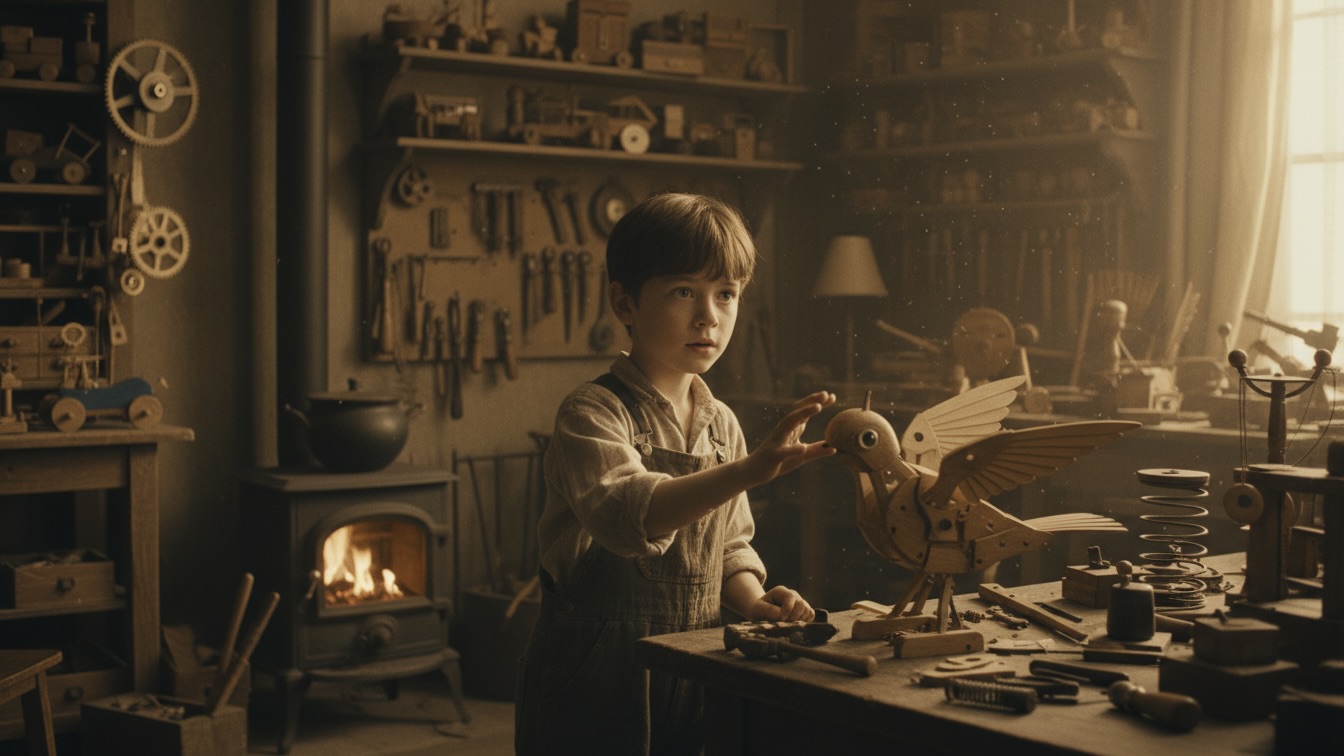
THE WORKSHOP: After helping her down, Les follows Odelia to her hidden yurt, a warm, magical workshop filled with incredible, handmade clockwork automata. He sees she is a master craftswoman and a fellow refugee from the city's digital noise, and a silent understanding passes between them. He recognizes her vulnerability—a sprained ankle from his trap and a meager woodpile—and offers to help.
THE ALLIANCE: The final beat shows Les in a new rhythm, finding purpose and peace as he splits wood and helps Odelia prepare for a coming storm. The silence of the woods is no longer empty but filled with the satisfying sounds of real work and quiet companionship. He has found a new kind of connection, more tangible and meaningful than any network he left behind.
The episode begins with a tone of alienation and simmering anxiety, as Les feels like a stranger in a strange land. This quickly escalates into suspense and dread with the introduction of the howl and the tracks, pushing the mood toward folk horror. The midpoint, where Les builds and sets his trap, shifts the emotional current to one of tense determination and empowerment. The climax delivers a sharp tonal pivot from terror to surprise and awkward humor, completely subverting audience expectations. The final act resolves into a feeling of quiet warmth, wonder, and earned contentment, leaving the audience with a sense of peaceful resolution and thoughtful optimism.
If expanded into a season, the story would follow the growing relationship between Les and Odelia, with Les becoming her apprentice in the analog arts. The central conflict could escalate as the reasons for the mass "detox" from the cities become clearer; perhaps a pervasive AI or corporate entity is making authentic life impossible, and the remote communities are pockets of resistance. Les's parents would have their own arc, struggling to adapt and perhaps clashing with the fiercely independent ethos of long-term residents like Odelia.
A season-long storyline could involve a larger threat to their isolation, such as a resource-prospecting drone or a corporate team sent to survey the "empty" land, forcing Les and Odelia to combine his new-world tech skills and her old-world ingenuity to protect their sanctuary. This would evolve the central theme from a personal journey of disconnection to a communal struggle for autonomy in a world that refuses to let anyone go offline. Les would transform from a boy running from his fears to a young man actively defending his new home and its values.
The visual style will be built on stark contrast. The city, seen only in brief flashbacks or on device screens, will be portrayed with clean, cold lines, a palette of blues, grays, and neon, and a claustrophobic framing. The wilderness, by contrast, will be vast and raw, shot with wide lenses that emphasize the smallness of the characters within the landscape. The color palette will be desaturated and natural—the stark white of snow, the black of tree trunks, the deep green of pine—with the warm, firelit interiors of the cabin and yurt serving as pockets of safety and color.
The tone is contemplative and atmospheric, prioritizing mood over jump scares. It blends the quiet, character-focused science fiction of Tales from the Loop with the eerie, isolated suspense of films like The Witch, but ultimately lands on a more hopeful and humanistic note. The sound design is critical: the oppressive, layered silence of the woods will be a character in itself, making the few key sounds—the crunch of snow, the metallic howl, the thunk of an ax—incredibly impactful.
The target audience is adults and older teens (16+) who appreciate thoughtful, character-driven science fiction and atmospheric thrillers. It will appeal to fans of anthology series like Black Mirror and Room 104, as well as viewers who enjoy the slow-burn, philosophical sci-fi of films like Arrival and Annihilation. The story's focus on the tension between technology and nature will also resonate with audiences interested in contemporary social themes and "digital detox" culture.
For a short film format of 10-12 minutes, the pacing will be deliberate yet efficient. Act One (The Arrival & The Threat) will move quickly, establishing the setting, characters, and inciting incident within the first 2-3 minutes. Act Two (The Investigation & The Trap) will form the bulk of the runtime, using a slower pace to build suspense and focus on Les's methodical process. The Climax and Resolution in Act Three will be concise, with the reveal of Odelia happening swiftly to maximize surprise, followed by a quiet, contemplative final scene that allows the emotional resolution to land effectively.
The key production challenge is creating a believable contrast between Les's sleek, near-future technology and the rustic, timeless wilderness. Les's Maker-Kit, drone parts, and wrist-controller should have a clean, minimalist design aesthetic that looks jarringly out of place against the rough-hewn logs of the cabin. Odelia's "monster" gear—the hand-forged snowshoes and the phonograph-like sound device—must be designed to look both intimidating at a distance and cleverly homespun up close.
Odelia's yurt workshop is the most important set. It needs to feel magical and real, filled with dozens of practical, working (or semi-working) clockwork props. These items are not just background dressing; they are the physical manifestation of the story's soul and themes. Extensive use of a remote, snow-covered location is essential, and the production plan must account for the logistical challenges of filming in a cold, natural environment to capture the authentic sense of isolation and beauty required by the narrative.