Format: Short Film / Anthology Episode | Est. Length: 10-12 minutes
Imagine this story as a single, self-contained episode within a larger anthology series titled PROTOCOL. Each episode explores a different clandestine operation carried out by the defunct, off-the-books Department of Special Analysis (DSA). The series would build a mosaic of a shadow government's power, following the unrelated individuals—analysts, journalists, civilians—who stumble upon its secrets and face the terrifyingly efficient agents, like Morrison, sent to contain the breach. Overarching themes would include the erosion of privacy, the nature of control in the digital age, and the human cost of state-sponsored secrets.
A passenger train is dead on the tracks, frozen in the middle of a Wyoming blizzard. As the power dies and a bone-deep cold sets in, a young data analyst clutches a hidden hard drive, realizing the storm and the train's failure are no accident—they are the walls of a purpose-built trap.
A whistleblower fleeing with proof of a terrifying government conspiracy finds himself trapped on a snowbound train with a hundred other passengers. He must identify the calm, calculating agent sent to retrieve him and find an ally before his meticulously orchestrated capture is complete.
The primary theme of The December Protocol is the nature of modern power, contrasting overt violence with subtle, psychological manipulation. Morrison’s control over the train car is not achieved with a gun, but with logic, preparedness, and feigned benevolence, exploring how fear and uncertainty can make a population compliant and even grateful to their captor. This is a story about paranoia in a surveillance state, where the most terrifying threat isn’t a brute, but an intelligent, patient predator who can weaponize social dynamics and the environment itself.
At its core, the episode is a claustrophobic paranoid thriller that dips into psychological horror. It examines the fragility of social order and the illusion of safety, showing how quickly societal norms can be replaced by a new hierarchy when a crisis is manufactured by a single, controlling hand. The emotional undercurrent is one of creeping dread and isolation, culminating in the horrifying realization that salvation and damnation can look identical.
The stakes for the protagonist, Leo Caine, are absolute: his life, his freedom, and the exposure of the "December Protocol," a monstrous government plan. If he is caught, the evidence he carries will be buried, and he will disappear without a trace. For Linda, the student, the stakes escalate from mere survival of the storm to becoming collateral damage in a shadow war she never knew existed; her alliance with Leo puts a target on her back. For the antagonist, Morrison, the stakes are professional: the successful, clean, and quiet retrieval of the data and the neutralization of the threat, reinforcing the absolute efficiency and reach of his clandestine agency.
The central conflict is the tense cat-and-mouse game between Leo and Morrison. The external conflict is multifaceted: Leo versus the highly skilled and manipulative Morrison; the passengers versus the deadly blizzard (Man vs. Nature); and ultimately, the individual versus a faceless, omnipotent state apparatus. The internal conflict resides within Leo, who must battle his paralyzing fear and paranoia to think strategically, forcing him to decide whether the risk of trusting a stranger like Linda is greater than the certainty of being caught alone.
Leo Caine, a junior data analyst on the run with a damning data drive, finds his escape plan derailed when his train becomes stranded in a severe Wyoming blizzard. As panic gives way to a creeping, freezing dread among the passengers, Leo identifies a fellow traveler, the calm and prepared Morrison, as the government agent sent to capture him. Leo realizes with horror that the storm is not a random act of nature but a deliberately engineered trap designed to isolate him completely.
Morrison doesn't use force; instead, he masterfully manipulates the passengers through psychological tactics, establishing himself as their benevolent leader and savior in the crisis. Leo forms a fragile, whispered alliance with Linda, an observant student who also senses that Morrison is not who he appears to be. Together, they confirm he is an operative from a supposedly defunct shadow agency. The episode culminates not with a rescue, but with the arrival of military-style helicopters, an extraction team summoned by Morrison, revealing the terrifying scale of the operation as the trap closes shut.
Leo Caine (Protagonist): A junior data analyst in his late 20s, Leo begins the story as a bundle of nerves and adrenaline, a tech-savvy but physically unremarkable man in over his head. His psychological arc is a rapid evolution from a state of reactive terror to one of proactive, albeit desperate, strategy. He is forced to shed his civilian mindset and begin thinking like his opponent, learning to observe, analyze, and take calculated risks, culminating in his decision to form an alliance and create a contingency for the data he carries.
Morrison (Antagonist): A man in his late 40s, Morrison is the embodiment of calm, professional lethality. He starts as an utterly forgettable, helpful passenger, a "gray man" who blends in perfectly. His arc is the slow, deliberate reveal of his true nature—from a provider and protector in the eyes of the passengers to the triumphant, smiling hunter in the final moments. He is not evil in a theatrical sense; he is a master of his craft, a terrifyingly efficient tool of the state whose greatest weapon is his understanding of human psychology.
Linda (Ally): A sharp, analytical political science student in her early 20s. Linda begins as just another passenger, an observer on the periphery. Her psychological arc is that of an ordinary person unwillingly drawn into the conspiracy, moving from passive suspicion to active, dangerous participation. She represents the potential for civilian resistance, her intelligence and courage making her an unexpected variable in Morrison's otherwise perfectly controlled environment.
Beat 1 (The Trap is Sprung): The train dies in the blizzard, plunging the passengers into a cold, dark panic. Leo Caine, clutching a hidden data drive, understands this is no accident and scans the car, his paranoia locking onto Morrison, a man whose calm preparedness is more terrifying than the storm. The oppressive cold and claustrophobia of the train car are established as the physical and psychological prison for the narrative.
Beat 2 (The Shepherd Emerges): Morrison quells a passenger revolt with calm, unassailable logic, then solidifies his control by distributing rations from his own briefcase. Leo watches in horror as Morrison wins the trust of the other passengers, realizing the agent's strategy is not brute force but psychological dominance. This act confirms for Leo that he is not just being hunted, but is part of a meticulously managed operation.
Beat 3 (A Fragile Alliance): Under the pretense of searching for a dropped item, Leo makes contact with Linda, a student who also views Morrison with suspicion. In a whispered exchange, they confirm their fears: Morrison is an agent from a defunct shadow organization, and he knows they are watching him. This midpoint shifts the dynamic from Leo's solo struggle to a two-person resistance, offering a sliver of hope against an overwhelming force.
Beat 4 (The Collection): The sound of helicopters brings cheers of relief from the passengers, who believe they are being rescued. But as blinding searchlights illuminate the car, Leo sees Morrison standing in the aisle, looking directly at him with a small, triumphant smile. The horrifying truth dawns: this is not a rescue, but a meticulously planned extraction, and the trap has just reached its perfect, inescapable conclusion.
The episode's emotional journey for the audience begins with the high-strung, immediate tension of Leo's paranoia, which quickly bleeds into a slow-burn, claustrophobic dread as the cold and isolation set in. A brief, fragile spark of hope is introduced at the midpoint with the formation of the alliance between Leo and Linda, offering a momentary feeling that resistance is possible. This hope is systematically extinguished, leading to a climax of profound, chilling horror—not of violence, but of the terrifying perfection of the antagonist's plan, leaving the audience with a sense of inescapable despair and awe at the villains' power.
This episode serves as a powerful inciting incident for a season-long narrative. The final moments could see Leo create a last-second diversion, allowing him to pass the data drive to Linda before he is taken. The subsequent season would then follow Linda, no longer an ordinary student but the unwilling custodian of a dangerous secret, as she is hunted by the DSA and tries to get the information to someone who can use it.
This arc would expand the world, introducing other characters affected by the DSA's operations: a disgraced journalist, a retired agent, a family member of a past victim. Morrison would evolve from a single-episode antagonist to a recurring, formidable threat, the face of the organization. The season's central mystery would be uncovering the full scope of the "December Protocol" and the ultimate goal of the DSA, escalating from a personal story of survival to a nationwide conspiracy thriller.
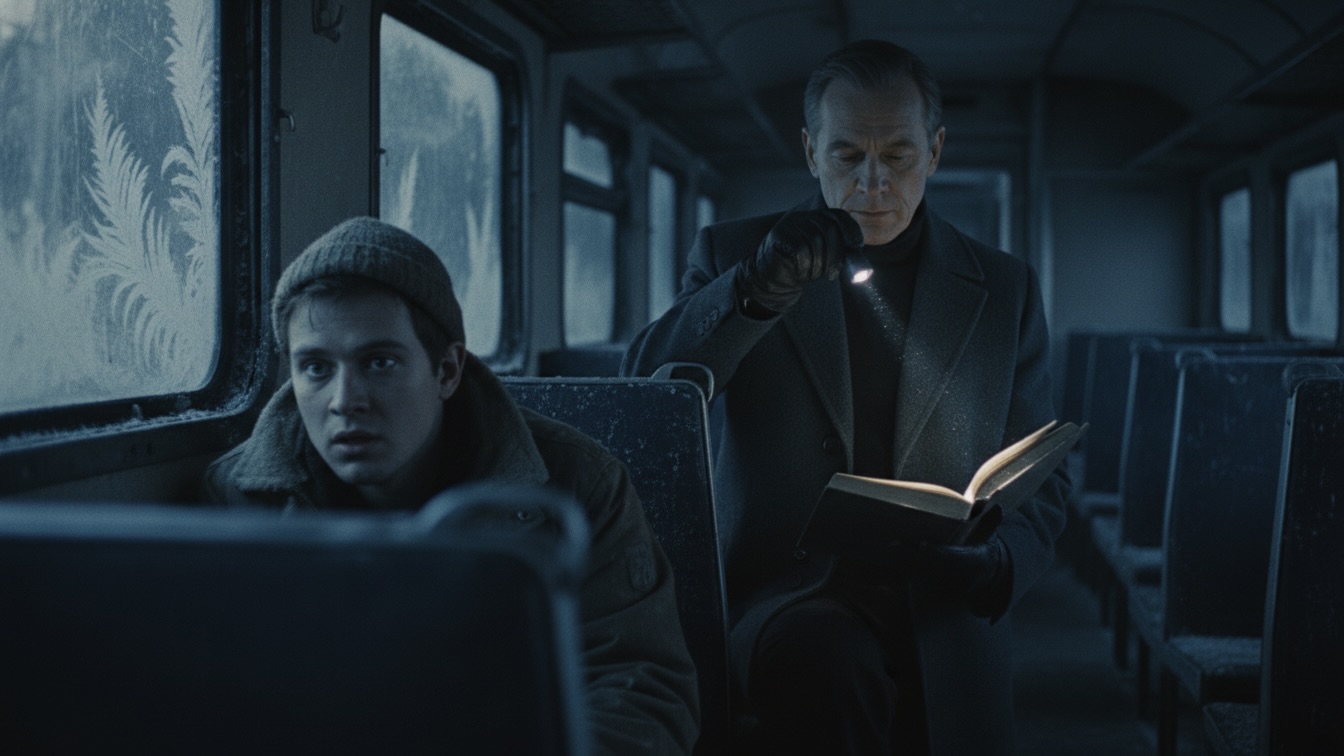
The visual style is defined by claustrophobia and cold. The cinematography will rely on tight, handheld shots to enhance the sense of confinement and paranoia, frequently using reflections in the dark train windows to layer characters over the swirling snow outside, symbolizing their trapped state. The color palette is stark and desaturated, dominated by cold blues, deep blacks, and the sickly yellow of the failing emergency lights, creating a nearly monochromatic world. The only consistent point of warmth is the small, controlled beam of Morrison’s reading light, representing his singular control over the environment.
The tone is one of sustained, quiet dread, drawing inspiration from the cold, procedural thrillers of the 1970s and modern slow-burn horror. The atmosphere should feel heavy and oppressive, with sound design playing a critical role—the constant, screaming wind, the groaning metal of the train, and the unnerving quiet within the car. Tonal comparables include the contained tension of Snowpiercer, the cold professionalism of the antagonists in Sicario, and the inescapable, tech-driven paranoia of Black Mirror.
The target audience is adults aged 25-55 who appreciate intelligent, slow-burn psychological thrillers and conspiracy dramas. This includes viewers who are fans of character-driven, atmospheric storytelling over action-heavy plots. The episode would appeal to audiences of series like Severance, Mr. Robot, and Homecoming, as well as fans of filmmakers like Denis Villeneuve and David Fincher who excel at creating palpable tension and mood.
The pacing is deliberately methodical and tense for the first two acts, mirroring the creeping cold and the slow burn of Leo's paranoia. The narrative unfolds through observation rather than exposition, using long takes and minimal dialogue to build suspense. The runtime would be heavily weighted towards this sustained tension, allowing the audience to feel trapped alongside the characters. The final act, beginning with the sound of the helicopters, marks a dramatic acceleration in pace, shifting from slow dread to shocking, rapid-fire clarity as the nature of the "rescue" is revealed in the final two minutes.
The primary production advantage is its contained setting. The entire story can be shot on a single, dressed train car set, minimizing location costs and logistical complexity. The key technical challenge will be creating a convincing and relentless blizzard outside the windows. This would likely be achieved with a combination of practical effects on set (high-powered fans, snow machines) and digital VFX for the wider landscape shots, seamlessly integrated to maintain the illusion of being buried in a storm.
Lighting design is paramount to the storytelling. The production requires a lighting plan that can transition effectively from the flat, normal lighting of a functioning train to the moody, unreliable emergency lights, and finally to near-total darkness punctuated only by practicals (phone screens, Morrison's penlight). The climactic scene demands powerful, sweeping exterior light sources to simulate the helicopter searchlights, creating harsh shadows and a dramatic, interrogative atmosphere for the final reveal.