Format: Short Film / Anthology Episode | Est. Length: 10-12 minutes
Imagine a series, THE DEAD-DROP, an anthology of espionage thrillers focusing on intelligence operatives who have been decommissioned, disavowed, or put into deep-freeze retirement. Each episode is a self-contained story about one such operative being violently pulled back into the world they tried to leave behind, forcing them to confront ghosts from their past and the moral compromises that defined their lives. "The Woodpile Rule" serves as a potential pilot, introducing the world's core concept: you can never truly leave the game, because the game never leaves you.
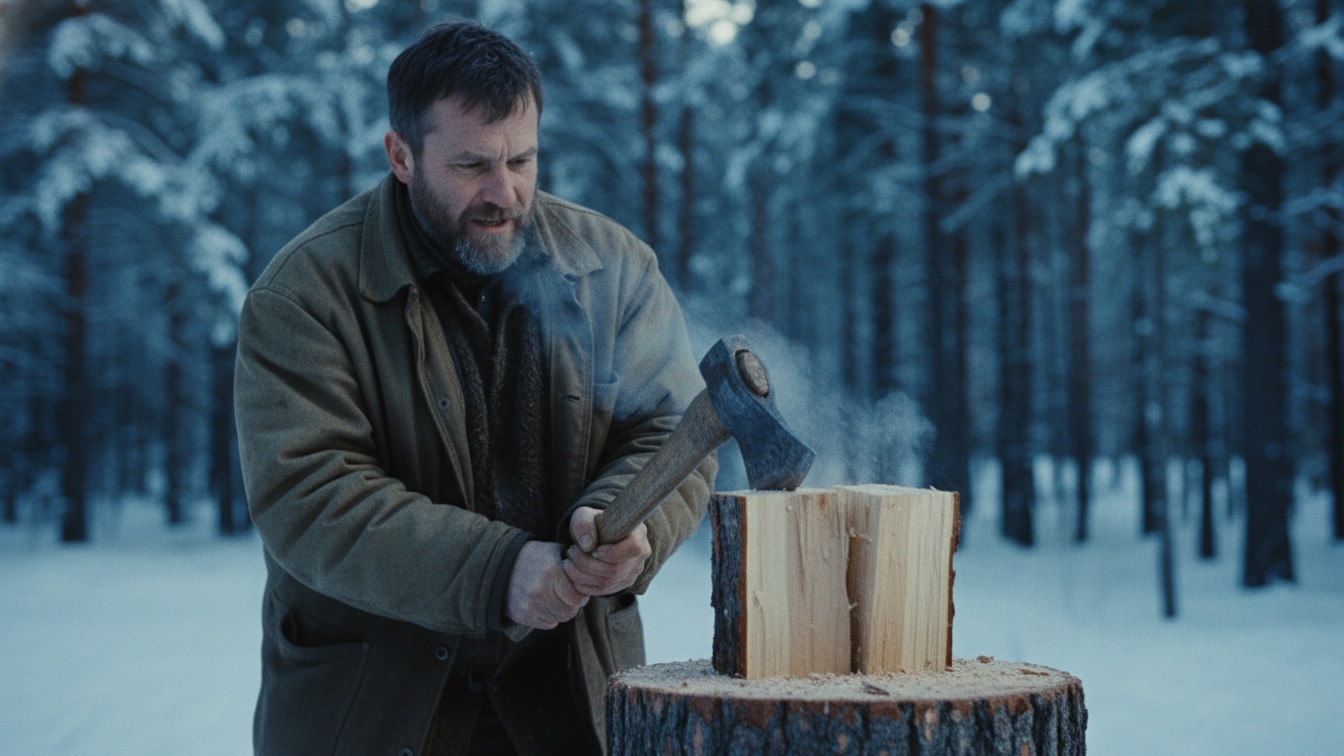
In the profound silence of a snow-covered wilderness, a man finds a fragile peace in the simple, brutal rhythm of splitting firewood. That peace is shattered by the one sound he has not heard in months: the grinding engine of an approaching vehicle.
A retired black-ops agent, living in self-imposed exile, is tracked down by a former handler with a warning that his last mission has come back to haunt him. He soon learns the ghost from his past is not only alive but is systematically hunting his old team, with him as the final target.
The primary theme is the futility of escape and the inescapability of one's past. Silas attempts to trade the moral ambiguity and deception of his old life for the physical certainty and "honesty" of manual labor, but the story demonstrates that identity is not so easily shed. The "woodpile rule"—a task with a clean beginning, middle, and end—is a metaphor for the simple life he craves, a stark contrast to the tangled, unending "loose ends" of espionage.
A secondary theme is the nature of betrayal. The narrative hinges on the revelation that an asset Silas vouched for was, in fact, a master manipulator playing a long game. This explores the professional and personal fallout of misplaced trust in a world where paranoia is a survival trait, forcing Silas to confront the fatal error in judgment that led to his current predicament and the deaths of his colleagues.
The immediate stakes are life and death for Silas and the remaining members of his former unit from the Minsk operation. An active, well-funded network is hunting them down, and as the "hermit," Silas is an isolated and vulnerable target. The personal stakes are the complete destruction of the quiet, monastic life he has painstakingly built for himself—his last attempt at finding a semblance of peace and redemption. If he is pulled back in, he loses the last piece of his soul he believes is still clean; if he refuses, he will be hunted down and killed in the one place he felt safe.
The primary external conflict is the manhunt orchestrated by Julian, the supposedly dead asset from the Minsk operation. This force is unseen but imminently threatening, represented by the news of Petrenko's assassination and the intercepted message targeting Silas. Lena acts as the immediate antagonistic force; while not an enemy, she is the agent of conflict, disrupting Silas's sanctuary and forcing him to confront the reality he has been hiding from. The central internal conflict rages within Silas: his powerful desire to remain detached and "retired" versus the reawakening instincts of the operative, his sense of duty, and the primal need to survive.
Silas, a middle-aged former operative, lives in quiet isolation in a remote, snow-covered cabin, finding solace in the physical ritual of chopping wood. This fragile peace is shattered by the arrival of Lena, his former handler, who brings dire news: the network they supposedly dismantled during their last operation in Minsk is active again. Worse, it is hunting down and eliminating everyone involved in the operation.
Silas initially refuses to be drawn back in, clinging to the simple, honest life he has built. But Lena reveals the architect of the new threat is Julian, the very asset Silas recruited and believed had died during the mission. Julian was playing them all along, using the operation to consolidate his own power, and is now tying up loose ends—with Silas, the man who brought him in, as the final piece of the puzzle.
SILAS (47): A physically capable but soul-weary former intelligence operative. He is stoic, disciplined, and craves simplicity as an antidote to a life of complexity and deceit.
* Psychological Arc: Silas begins in a state of self-enforced penance, believing he can cleanse himself through physical labor and isolation. The arrival of Lena and her news forces him to confront the naivete of this belief, stripping away his carefully constructed peace and reawakening the cold, pragmatic killer he tried to bury. He ends the story with the grim acceptance that his past is not a memory but an active predator, and his only way forward is to become a predator once more.
LENA (40s): A calm, professional, and concise intelligence handler. She is pragmatic and mission-focused, viewing Silas not as a person but as a strategic asset to be redeployed.
* Psychological Arc: Lena's role is primarily that of a catalyst. She enters the story with a clear objective and executes it with clinical precision. Her state remains unchanged; she is the embodiment of the unfeeling system Silas fled, serving as a mirror that reflects how much he has tried—and failed—to change.
THE RITUAL: The episode opens with long, quiet shots of Silas chopping wood in a vast, silent, snow-covered forest. We establish his methodical rhythm—breathe, swing, crack—and the immense, orderly woodpile as a monument to his new life. This is a man who has found a fragile peace in a simple, physical task, the "good pain" in his back a welcome substitute for the psychological wounds of his past.
THE INTRUSION: The meditative silence is broken by the alien sound of an engine. Silas doesn't react outwardly, continuing his work, but his body tenses, his senses instantly on high alert. The arrival of a car and a woman, Lena, at the edge of his clearing introduces a sharp, immediate tension, a collision between his spartan world and the one he left behind.
THE RECKONING: In a terse, clipped exchange on the cabin porch, Lena delivers the news of Petrenko's death and the reactivated Minsk network. Silas resists, his words short and dismissive as he tries to physically and verbally push her and her world away. He clings to the idea that his contract is over and he is done, but Lena methodically dismantles his defenses with cold facts.
THE HOOK (CLIMAX): Lena delivers the final, devastating blows of information. The architect of their doom is Julian, the asset Silas vouched for and believed was dead. The final line reveals the ultimate trap: Julian isn't just the target; he's the bait, and he is personally asking for the man who recruited him—Silas. The camera holds on Silas's face as the illusion of his escape evaporates, the "good pain" in his back replaced by the cold dread of inevitability.
The episode begins with a mood of meditative solitude and melancholic peace, inviting the audience into Silas's quiet routine. This tranquility is abruptly fractured by the arrival of the car, shifting the tone to one of suspense and quiet dread. The dialogue with Lena builds a palpable tension, moving from Silas's resentful resistance to a growing sense of alarm. The final revelation acts as a gut punch, plunging the mood into one of grim finality and shocked betrayal, leaving the audience with the chilling realization that Silas's prison was never a sanctuary, only a waiting room.
As the first episode, "The Woodpile Rule" sets the stage for a season-long cat-and-mouse game. The overarching story would follow Silas as he is forced back into the field to hunt Julian across a cold, unforgiving European landscape. This journey would force him to reconnect with other surviving members of the Minsk operation, each living their own version of a compromised retirement, creating a network of paranoid and untrustworthy allies.
The season would escalate from a simple revenge mission to unraveling Julian's true endgame, which could involve exposing a deep-seated conspiracy within their own agency or seizing control of a vast criminal enterprise. Silas's character evolution would be central, as he struggles to keep the violence and moral compromises of the hunt from extinguishing the last embers of the man he was trying to become in the woods. The central question would shift from "Can Silas survive?" to "Can Silas survive and still recognize himself?"
The visual style is grounded, patient, and atmospheric, emphasizing the stark contrast between the natural world and the cold, clinical world of espionage. The color palette is desaturated and cool, dominated by the whites, greys, and dark greens of the winter forest, making any splash of color (like blood on snow) feel jarring and significant. Cinematography will utilize a mix of static, composed wide shots to establish Silas's isolation and intimate, often handheld, shots to capture his internal state and the rising tension.
The tone is a blend of a melancholic character study and a taut, slow-burn thriller. The pacing is deliberate, allowing silence and environment to build atmosphere and suspense, punctuated by moments of sharp, efficient violence. Tonal comparables include the patient intelligence of Tinker Tailor Soldier Spy, the isolated protagonist focus of The American, and the psychological tension of Michael Clayton.
The target audience is mature viewers (25-55+) who appreciate character-driven, atmospheric thrillers over action-heavy blockbusters. This includes fans of prestige television dramas on platforms like HBO, FX, and Netflix, as well as audiences for neo-noir and modern espionage films. The story will appeal to those who enjoy complex protagonists, moral ambiguity, and a narrative that values suspense and psychological depth.
For a 10-12 minute runtime, the structure is tight and efficient. Act One (The Ritual) is deliberately slow and atmospheric, using the first 2-3 minutes to establish character and setting with minimal dialogue. The Inciting Incident (The Intrusion) marks a sharp shift in pace. Act Two (The Reckoning & Climax) is dialogue-heavy but moves quickly, with each line of conversation escalating the stakes and stripping away Silas's defenses, culminating in the final, rapid-fire revelations that propel the story forward.
The primary production consideration is securing a location that conveys profound isolation: a simple cabin in a vast, snow-covered forest. The authenticity of this environment is crucial to the story's themes. The production design should be minimalist and lived-in, reflecting Silas's spartan existence.
Sound design is a critical storytelling tool. The contrast between the natural sounds of the forest—the wind, the crack of the axe, the crunch of snow—and the mechanical intrusion of the car engine is key. The silence should feel heavy and meaningful, making the sparse dialogue land with greater impact. No complex special effects are required; the focus is on performance, atmosphere, and a palpable sense of cold, both literal and emotional.