Format: Short Film / Anthology Episode | Est. Length: 10-12 minutes
Imagine "The Glacial Ballet" as a key episode in a larger series titled GRIDFALL, a post-apocalyptic saga set centuries after a climate and technological collapse froze the world. The series follows disparate groups of survivors: corporate remnants clinging to failing technology in fortified enclaves, nomadic tribes who blend ancient wisdom with salvaged tech, and "Conduits"—rare individuals with a latent ability to connect to the dormant global consciousness network known as the Great Grid. Each episode explores a different corner of this desolate, beautiful world, slowly weaving together an overarching narrative about the race to either reboot the Grid for the benefit of all humanity or weaponize it for ultimate control.
A person is violently ripped from a synthetic sleep chamber by a mysterious, armored figure. Without a word, they are forced into an insulated suit, strapped to the back of a powerful, custom skidoo, and launched into the heart of a vast, frozen wasteland under a bruised twilight sky.
Abducted from a stasis pod with no memory of their past, a traveler is forced on a high-speed journey across a frozen, post-apocalyptic Earth by an enigmatic Indigenous guide. They must survive the brutal tundra and forge an unlikely bond to discover their true purpose as a key to reawakening the planet's dormant consciousness.
The story is a meditation on connection in a disconnected world. It explores the bond between two individuals forged in extreme circumstances, the symbiotic relationship between ancient wisdom and future technology, and humanity's lost connection to a global consciousness (the Grid). It questions the nature of identity when memory is erased, suggesting that purpose and a sense of self can be forged through action and relationship, rather than inherited from the past.
A secondary theme is the contrast between the cold, indifferent brutality of the natural world and the warmth of human intimacy. The glacial landscape is both an antagonist and a canvas, a place of immense danger and sublime, desolate beauty. Against this backdrop, the smallest gestures—a reassuring touch, a shared warmth, a moment of eye contact—become profoundly significant acts of survival and love.
The immediate stakes are survival against the elements; the freezing cold and treacherous terrain pose a constant, lethal threat. For the protagonist, the Traveler, the stakes are deeply personal: the recovery of their identity and the comprehension of their sudden, violent purpose in a world they don't understand. For Taran, the stakes are higher: the success of a critical mission that is part of a much larger effort to save what's left of their world, and the protection of the Conduit they have been tasked with delivering.
The primary antagonistic force is the environment itself—a relentless, post-apocalyptic arctic tundra that is actively hostile to human life. This external conflict manifests as brutal wind, extreme cold, and treacherous ice formations that threaten to end the journey at any moment. Internally, the Traveler battles profound disorientation, amnesia, and terror, struggling to trust their enigmatic captor-turned-guide. An unseen, systemic antagonist is hinted at—the corporate entities who represent a selfish, fractured approach to survival, contrasting with Taran's holistic, community-driven mission to restore the Grid.
Ripped from a deep sleep, a nameless protagonist (the Traveler) is abducted by Taran, a stoic Indigenous pilot, and thrust into a desperate high-speed journey across a frozen wasteland on a powerful skidoo. Initially terrified and confused, the Traveler begins to form a reluctant, intimate bond with their silent guide, forged through shared peril and the necessity of their physical proximity. The journey is a flight through the ruins of a forgotten civilization, hinting at a world lost to ice and time.
During a forced stop at a mysterious energy "nexus," Taran reveals their purpose: they are following the dormant energy currents of the "Great Grid," a mythical global network of pure thought. Taran explains that the Traveler is a "Conduit," someone with a unique resonance capable of reawakening this network. As the Traveler begins to feel the Grid's pull themselves, their fear transforms into a sense of purpose, and their reliance on Taran deepens into a profound emotional connection. They arrive at a hidden settlement of survivors, where Taran declares the first leg of their journey complete, leaving the Traveler with a new quest and the promise of a shared future.
The Traveler: The story's protagonist, beginning in a state of synthetic calm before being plunged into raw terror and confusion. They are a blank slate, stripped of memory and identity, defined only by their immediate sensory experience of fear and cold. Their psychological arc is one of moving from a passive victim to an active participant in their own destiny, as they begin to trust Taran, accept their strange new reality, and feel the first stirrings of their own power and purpose. By the end, their amnesia is no longer a source of terror but an opportunity to forge a new identity, anchored by their connection to Taran and the Grid.
Taran: The enigmatic pilot and guide, initially presented as a formidable, almost robotic force of nature. Taran is a bridge between worlds—an Indigenous person who honors the "ancient currents" while masterfully piloting advanced technology. Their psychological arc involves the gradual peeling away of their stoic, theatrical exterior to reveal a person of deep conviction, vulnerability, and a profound sense of duty. They evolve from a captor to a mentor, protector, and ultimately, a partner, whose quiet strength and rare moments of warmth become the Traveler's anchor in the storm.
The Abduction: The Traveler is jolted from a sleep chamber into the biting cold, wordlessly forced into a suit and onto a high-tech skidoo by the imposing figure of Taran. The world is a blur of frigid wind and violet exhaust as they launch into the desolate white expanse, establishing immediate disorientation and high-stakes mystery. The journey is brutal, a physical and emotional assault that forces the Traveler to cling to Taran out of sheer survival instinct.
The First Connection: A sudden lurch as the skidoo narrowly avoids a shard of ice throws the Traveler into a panic, their grip tightening desperately around Taran. In a fleeting, surprising moment of humanity, Taran’s gloved hand covers theirs, a firm, reassuring pressure that communicates more than words ever could. This is the turning point, where the Traveler’s fear begins to be tempered by a nascent trust in their silent guide.
The Nexus (Midpoint): The skidoo's engine dies, plunging them into a sudden, deafening silence beside the skeletal ruins of a massive structure. Taran dismounts and finally speaks, revealing their name and the true purpose of their journey: they follow the currents of the dormant Great Grid. As a stunning aurora ignites the sky, revealing frozen circuitry beneath the ice, the Traveler realizes they have no name to offer in return, confronting the totality of their amnesia.
The Awakening: Taran explains that the Traveler is a "Conduit" chosen by the Grid for their unique "resonance," and that Taran is merely the "ferryman." The Traveler, initially skeptical, begins to feel a strange pull, a hum of energy that aligns with the aurora's glow. This tangible connection to the Grid transforms their fear into awe and a burgeoning sense of purpose, solidifying their bond with Taran through this shared, mystical experience.
Arrival and New Purpose (Climax): The skidoo arrives at a hidden settlement, a warm haven of light and community amidst the frozen dark. The journey on the skidoo is over, and the physical closeness that defined their relationship is broken, creating a moment of tension and uncertainty. Taran gives the Traveler a glowing stone—a key to their next steps—and explains that while their shared ride is over, the Traveler's true journey to master their connection with the Grid has just begun, ending the episode on a note of hopeful, epic melancholy.
The episode's emotional trajectory is a rapid descent from synthetic calm into visceral terror and confusion. This fear gradually gives way to a sense of awe at the desolate beauty of the world and a growing, tense intimacy with the mysterious pilot. The midpoint introduces a sense of wonder and mythological purpose, shifting the emotional core from pure survival to a quest narrative. The burgeoning bond between the Traveler and Taran provides a warm, emotional through-line, culminating in a feeling of profound, bittersweet connection and hopeful purpose as the Traveler accepts their new path.
If expanded, Season 1 would follow the Traveler's training within the haven, learning to interpret the Grid's "song" and control their resonance. This arc would be intercut with Taran's own missions, acting as a scout and protector for the community, their paths crossing at critical moments. The primary seasonal antagonist would be introduced: a ruthless commander from a corporate enclave who is hunting for Conduits, believing the Grid is a weapon to be controlled, not a consciousness to be communed with.
A multi-season arc would see the Traveler and Taran reuniting to embark on a larger quest: to find other dormant Conduits and journey to the Grid's central core before their corporate adversaries can seize it. This would escalate the stakes from personal survival to a battle for the soul of the planet. The central relationship between the Traveler and Taran would be tested by separation, conflicting duties, and the immense weight of their world-saving mission, forming the emotional backbone of the entire series.
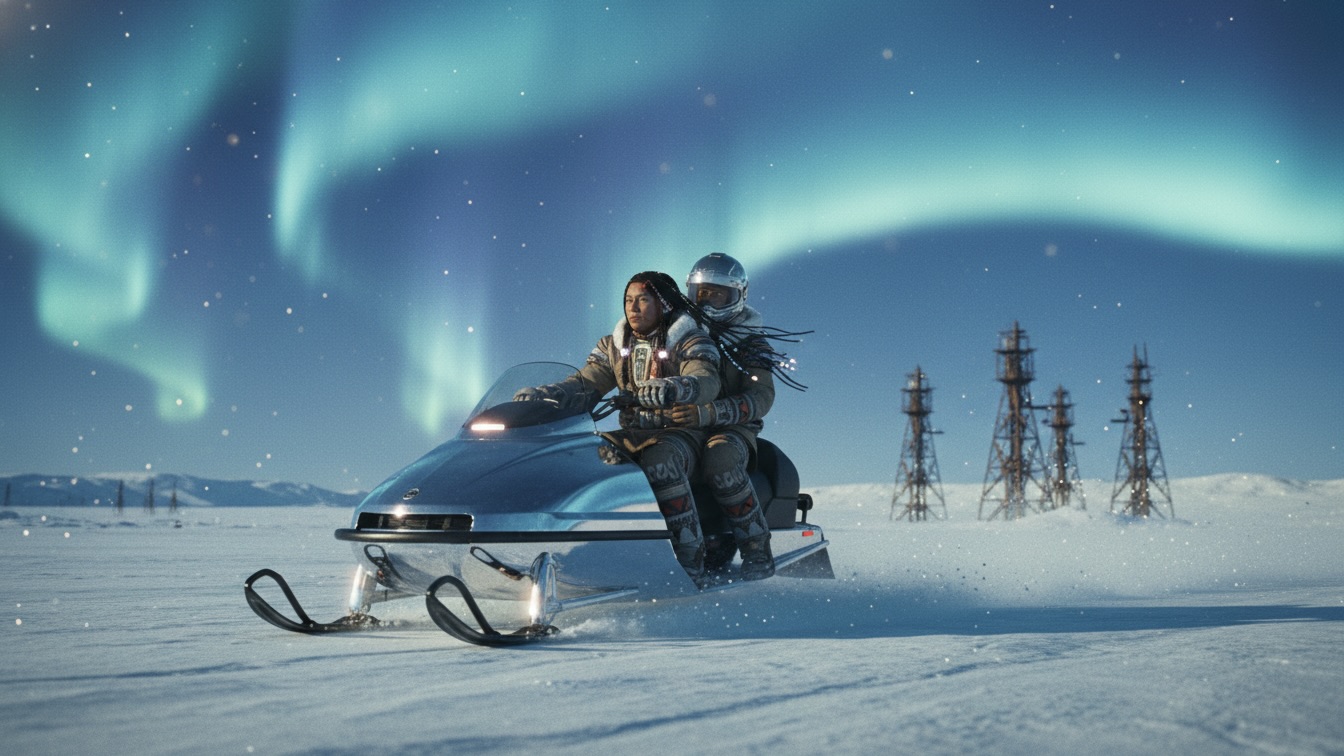
The visual style is one of stark, minimalist grandeur, emphasizing the vast, monochromatic emptiness of the snow-covered landscape. Cinematography will utilize wide, sweeping shots to establish a sense of scale and isolation, contrasted with tight, intimate close-ups inside the helmets and during moments of connection. The color palette is dominated by whites, blues, and greys, punctuated by vibrant, unnatural light sources: the violet pulse of the skidoo's engine, the electric blues and golds of the aurora, and the warm, inviting orange glow of the survivor settlement.
The tone is somber, atmospheric, and mysterious, blending the desolate beauty of a post-apocalyptic world with a core of quiet, resilient hope. It is a character-driven piece where the environment is as much a character as the protagonists. Tonal comparables include the melancholic, awe-inspiring visuals of Blade Runner 2049, the desperate, grounded journey of Children of Men, and the minimalist, high-concept science fiction of Arrival.
The target audience is mature viewers (16+) who appreciate character-driven, atmospheric science fiction and speculative drama. It will appeal to fans of post-apocalyptic narratives that prioritize world-building and emotional depth over constant action. The story's blend of futuristic technology, Indigenous mysticism, and a central, developing romance gives it broad appeal to viewers who enjoy franchises like Dune, The Last of Us, and cerebral indie sci-fi films.
For a 10-12 minute runtime, the pacing is crucial. The first act is relentless and kinetic, driven by the motion of the skidoo and the Traveler's terror, with minimal dialogue. The second act, centered around the stop at the nexus, slows dramatically, becoming contemplative and exposition-heavy to allow for character and world development. The third act resumes the journey with a new emotional tone—less about fear, more about purpose—before settling into a quiet, hopeful, and open-ended conclusion at the settlement.
The custom skidoo is a key visual element and should be designed as a character in itself—a blend of salvaged parts and sleek, futuristic technology, suggesting its unique origin. Its violet lighting provides a signature visual motif. Extensive use of CGI and advanced visual effects will be necessary to create the otherworldly aurora, the glowing circuitry within the ice, and the vast, ruined landscapes. The contrast between practical effects (snow, wind, detailed costumes) and digital enhancements will be critical to grounding the fantastical elements.
Sound design is paramount. The production must create a powerful contrast between the deafening, constant roar of the skidoo's engine and the profound, wind-swept silence of the tundra when it stops. The subtle, low-frequency hum of the Grid should be a recurring auditory cue, growing stronger as the Traveler's connection deepens, serving as a non-visual indicator of their evolving abilities.