Format: Short Film / Anthology Episode | Est. Length: 10-12 minutes
Imagine "The Solidarity Fund" as a standalone episode within a larger anthology series titled The Signal, which explores the dark side of modern activism and the unintended consequences of digital-age crusades. Each episode would present a contained, character-driven story where well-intentioned people are drawn into morally complex situations by the very tools they use to fight for justice. The series would track the subtle and terrifying ways idealism can be corrupted, radicalized, or weaponized, questioning where the line between protest and terrorism lies in a hyper-connected world.
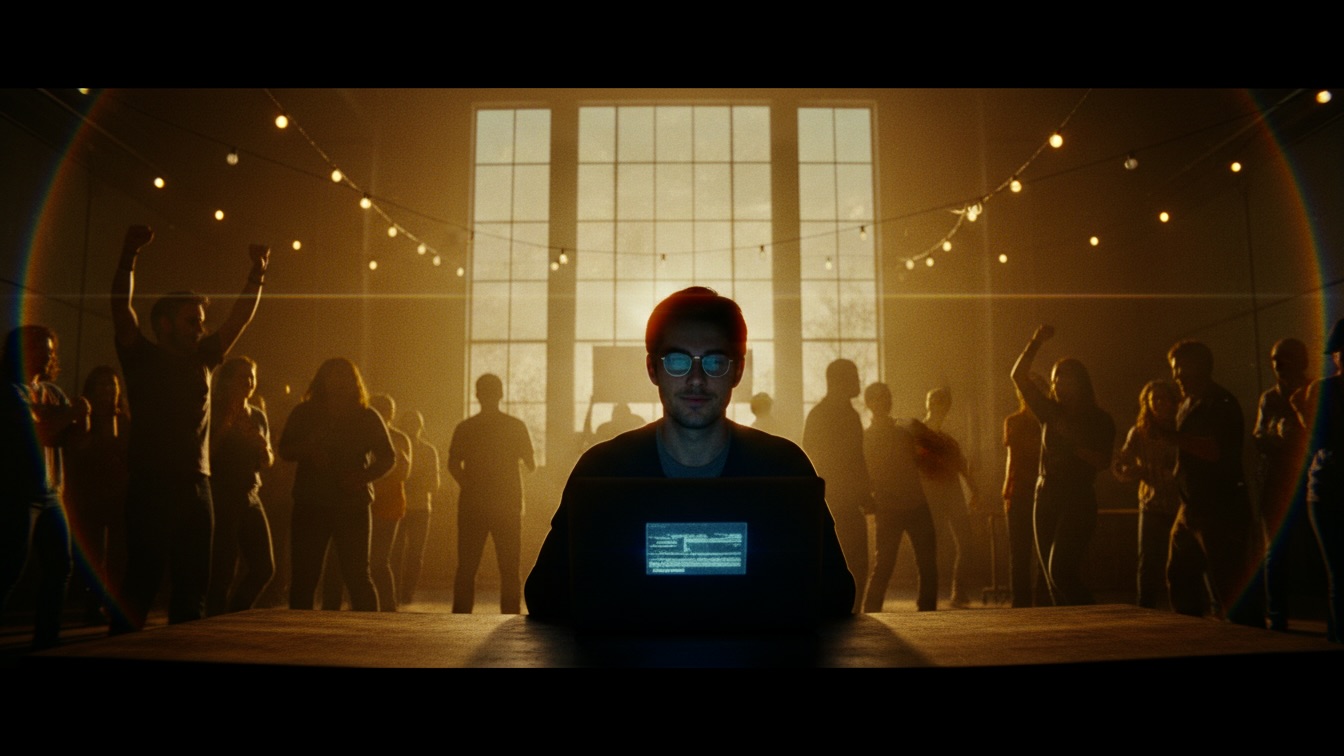
The story opens in the chaotic, sweat-soaked crush of a victory party in a cramped activist office. Our protagonist, BEN, the architect of an incredibly successful online fundraiser, is hailed as a hero as he stumbles into the celebration, overwhelmed by the energy of a community that believes they have finally, truly made a difference.
An idealistic student activist launches a viral fundraiser for the family of a woman killed in a federal raid, raising a staggering amount of money. When his charismatic leader convinces him to launder the funds to protect them from the government, he discovers he has unwittingly financed a violent act of domestic terrorism.
The primary theme is the perversion of idealism. It explores how pure, community-driven intentions can be co-opted and twisted into something violent and unrecognizable by more radical elements hiding in plain sight. This story is a cautionary tale about the seductive nature of charismatic leadership and the naivety of believing that the digital world is a safe battleground for social justice, showing how easily a click can become a trigger.
A secondary theme is the blurry line between activism and extremism. The narrative delves into the frustration of peaceful protest and the dangerous allure of direct, violent action as a perceived solution to systemic injustice. It questions the moral calculus of a movement, asking what compromises are acceptable in the fight for a greater good and who gets to make that decision.
The stakes for Ben are catastrophic and deeply personal. He faces the loss of his freedom and future, as he is now legally and morally complicit in a domestic terror attack. More devastatingly, he must live with the knowledge that his act of pure goodwill was directly responsible for violence and that he has betrayed the victim's family, leaving them with nothing but a shattered hope. For Maria’s family, the stakes are the loss of a financial lifeline and the horror of their loved one's memory being desecrated and tied to the very violence they decry.
The primary antagonistic force is RYAN, the charismatic and manipulative leader who preys on Ben’s idealism and fear. He represents the hidden radicalism within the movement, using the language of protection and justice to orchestrate a violent plot. The external conflict escalates from a perceived threat (the Feds potentially freezing the account) to a real one (the approaching sirens and the manhunt that will inevitably follow). Internally, Ben’s conflict is a devastating journey from proud naivety and blind trust in his mentor to dawning suspicion, frantic panic, and finally, the crushing weight of his complicity.
Ben, a young poli-sci student, is the hero of his local activist group after his online fundraiser for Maria, a nurse killed in a botched federal raid, goes viral, raising over $90,000. At a wild victory party, he is moved to tears by a message from Maria’s sister, Sofia, thanking him for giving her family "a space to breathe." This moment solidifies his belief in the pure, unassailable good of their work.
His celebration is cut short when Ryan, the group's magnetic leader, warns him that a sum that large will be immediately frozen by the feds. Ryan convinces a trusting Ben that the only way to protect the money is to "clean" it by transferring the full amount to a secure crypto wallet he controls. Later that night, alone in his dorm, Ben completes the transfer, only to be seized by a growing panic when the transaction completes instantly and Ryan becomes unreachable. His worst fears are confirmed when a news alert flashes on his phone: a fire at the federal courthouse, with an anonymous group claiming responsibility and citing funding from "a supportive community." As the sirens close in on his dorm, Ben realizes his act of solidarity was the fuel for an act of terror.
BEN: A smart, earnest, but politically naive college student. His Psychological Arc begins with a state of euphoric pride and a pure belief in the power of collective action; he sees himself as a successful agent of positive change. He ends the story in a state of shattered disillusionment and cold terror, stripped of his idealism and forced to confront his own gullibility as he becomes an unwitting accomplice to a violent crime, his future destroyed in a single night.
RYAN: The confident, articulate, and magnetic leader of the activist cell. He presents as a pragmatic and protective mentor, the visionary who guides the group's passion. His arc is a revelation of his true nature: he begins as a trusted leader and ends as the story's villain, a cold, calculating radical who masterfully manipulates his followers' trust and exploits tragedy to fund his own violent agenda.
SOFIA (Supporting): Maria’s sister, who exists only through her text message. She is the emotional heart of the story, representing the innocent victims and the pure intention behind the fundraiser. Her message, "a space to breathe," becomes the tragic, ironic symbol of the hope that Ben and Ryan ultimately corrupt.
Opening Beat - The Victory: Ben pushes his way into a raucous, crowded party, the air thick with the smell of sweat and victory. He is celebrated as the "man of the hour" for the fundraiser's success, and he finds his laptop, the total still climbing past $87,000, feeling an overwhelming sense of accomplishment. He reads a deeply moving message from the victim's sister, which solidifies the profound, personal meaning of his work.
Midpoint Beat - The Seduction: Ryan, the group's charismatic leader, pulls Ben aside, his calm demeanor cutting through the party's noise. He expertly plants a seed of fear, explaining how the Feds will inevitably freeze such a large sum of money, framing it as another act of systemic oppression. He presents a simple, clean solution: transfer the entire balance to a secure crypto wallet he has prepared, assuring Ben he will "protect" the funds and ensure the family gets every cent.
Climax Beat - The Transfer & The Silence: Alone in the quiet of his dorm room, Ben initiates the transfer, filled with a solemn sense of purpose, believing he is taking the final, necessary step to protect the family. The transfer completes instantly, and a knot of dread forms in his stomach as his calls and texts to Ryan go unanswered. The silence in his room grows heavy, amplifying the sound of his own panicked heartbeat as the reality of the situation begins to dawn on him.
Final Beat - The Revelation: Ben's phone buzzes with a breaking news alert: a fire at the federal courthouse. He clicks the link and reads a report quoting a communiqué from the attackers, who boast that their operation was "funded entirely by the generous donations of a supportive community." The words connect in his mind with sickening clarity, and as the sound of sirens grows unmistakably closer, he is paralyzed by the horrifying truth of what he has done.
The episode's emotional trajectory is a steep and rapid decline from light into darkness. It begins with the euphoric, communal high of the victory party, a feeling of pure, unadulterated success. This transitions into a moment of profound, quiet purpose upon reading Sofia's message. The mood then shifts into one of low-grade tension and conspiracy during the conversation with Ryan, which curdles into frantic, heart-pounding panic as Ben sits alone in his room, unable to reach his leader. The final moments plunge the audience into a state of cold, sickening dread and absolute horror, ending on a note of inescapable doom.
If this episode were the pilot for a series, the season would follow Ben as he goes on the run, a fugitive from both the federal government and Ryan's radical cell. The overarching story would be Ben's desperate attempt to clear his name and expose Ryan, forcing him to navigate the activist underworld he once belonged to, unsure of who he can trust. This would fracture the original group, with some members siding with Ryan's radical vision and others horrified by his actions.
The season would escalate the stakes, with Ben trying to warn Sofia and her family while evading capture. The central thematic question would evolve from "What is the line between activism and terrorism?" to "What do you do when your own movement becomes the monster?" Ben's character would be forced to evolve from a naive idealist into a hardened, resourceful survivor, using the same digital skills he used for fundraising to now fight for his life and expose the truth.
The visual style will be grounded and naturalistic, creating a stark contrast between the two primary settings. The opening party scene will be shot with a kinetic, handheld camera, immersing the viewer in the chaotic energy, with warm, dim lighting, lens flares, and a shallow depth of field to capture the claustrophobic intimacy of the celebration. The tone here is energetic and hopeful.
When the story shifts to Ben's dorm room, the style will become static, cold, and isolating. The camera will use locked-off, wider shots, emphasizing the sterile emptiness of the room and Ben's solitude. The lighting will be stark and singular—the cold, blue-white glow of the laptop and phone screens casting long shadows, creating a tone of rising dread and paranoia. Tonal comparables include the intimate, subjective tension of Sound of Metal and the grounded, dark realism of a political thriller like The East.
The target audience is young adults and adults aged 18-40 who are drawn to character-driven psychological thrillers and contemporary social dramas. This includes viewers who appreciate content that engages with complex moral questions and current events, such as fans of series like Mr. Robot, Homeland, or films like Nightcrawler. The episode is designed to resonate with a digitally native audience familiar with online activism and crowdfunding, providing a dark, cautionary twist on that world.
The 10-12 minute runtime will be structured with sharp, deliberate pacing shifts. Act One (the party, the message) is rapid and energetic, establishing the success and emotional core in the first 3-4 minutes. Act Two (Ryan's proposal, Ben's decision) will slow down dramatically, building tension through dialogue and quiet contemplation. The final act, beginning with the transfer, is a compressed, real-time escalation of suspense, with the final two minutes unfolding in a rapid-fire sequence of reveals that deliver the climactic gut-punch.
This is a highly contained and budget-conscious production, relying on performance and atmosphere over spectacle. The primary locations are a single office interior (which can be dressed for the party) and a dorm room, both readily available and inexpensive. The key props—a laptop and a smartphone—are central to the visual storytelling, with screen content (the fundraising page, the QR code, the news alert) being a critical narrative device.
The courthouse fire does not need to be staged. It can be conveyed entirely through news footage displayed on Ben's phone screen, which can be created with stock footage and simple motion graphics. This approach keeps the climax intimate and focused on Ben's reaction, making his internal horror the centerpiece of the scene rather than the external event, while also being extremely production-friendly.