Format: Short Film / Anthology Episode | Est. Length: 10-12 minutes
Imagine a near-future America where civil liberties have been eroded in the name of security. Zero Visibility serves as a standalone episode within a larger anthology series, Gridlock, which explores life under an authoritarian regime that uses climate catastrophe and civil unrest as justification for total control. Each episode is a street-level story focusing on the individuals caught in the conflict—the rebels, the collaborators, and the ordinary citizens trying to survive—collectively painting a portrait of a society on the brink of collapse, where the fight for truth is the last act of defiance.
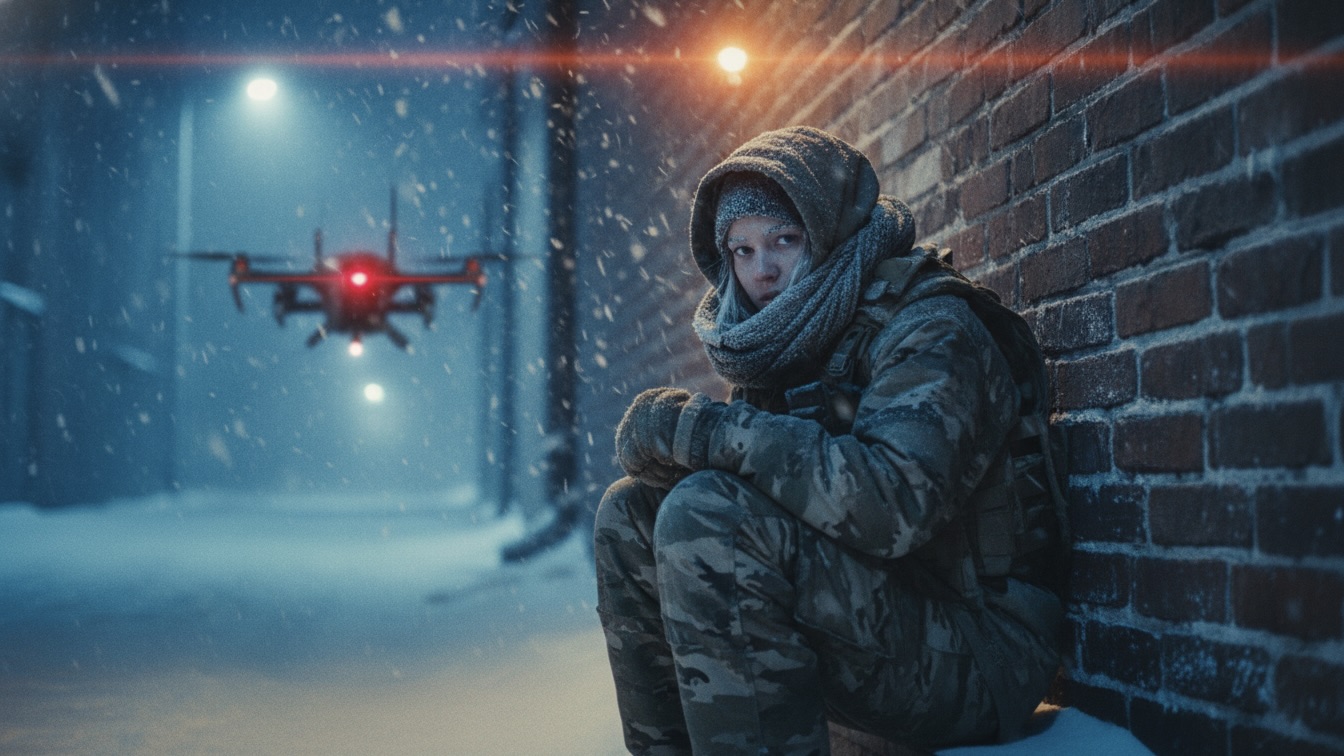
In a city locked down by a -40 degree curfew, a lone operative navigates a frozen alley, her every move stalked by the thermal-scanning eye of a predatory government drone.
A resistance courier must deliver critical data and aid to refugees hiding in a frozen city, all while evading a technologically advanced security force. When she learns the authorities are closing in, she must risk everything to expose a state-sanctioned murder before she becomes their next target.
At its core, Zero Visibility is a story about survival against two overwhelming forces: the brutal, indifferent cold of nature and the calculated, technological cruelty of an oppressive state. It explores the theme of truth as a weapon, contrasting the state’s polished, efficient propaganda with the messy, dangerous reality on the ground. The narrative delves into the dehumanizing effect of constant surveillance and extreme conditions, questioning where the line between tactical survival and losing one's humanity lies.
The episode also examines the nature of resistance in a world of total information control. It posits that true rebellion isn't just about armed conflict, but about bearing witness and preserving the truth against a regime determined to erase it. The physical cold is a metaphor for the emotional and societal chill of authoritarianism, where human warmth and connection are the most dangerous and vital resources.
The stakes are immediate and layered. For the protagonist, Emily, failure means capture, interrogation, and almost certain death. For the four hundred lives represented by the data on her hard drives—informants and refugees—her failure means their exposure and elimination. For Hassan and the families hiding in his freezer, discovery by the authorities is a death sentence, either by execution or exposure to the elements. On a larger scale, the truth about Linda Morales's murder is at stake; if Emily fails to get the information out, the state’s false narrative becomes history, justifying further violence and solidifying its control.
The conflict is a desperate struggle of human resilience against an overwhelmingly powerful system. The primary external antagonist is the faceless security state, represented by its instruments of control: the relentless, insect-like drones, the heavily armed tactical teams, and the pervasive surveillance grid. This is compounded by the second external antagonist: the lethal, -40 degree environment, which is as much an enemy as any soldier. Internally, Emily battles against fear, paranoia, and the encroaching numbness—both physical and emotional—required to survive, forcing her to reconcile her tactical discipline with the burning rage fueled by the regime's injustices.
In the depths of a brutally cold, curfew-enforced night, resistance courier Emily Torres navigates the frozen back alleys of a locked-down city. Hunted by a thermal-scanning drone, she narrowly evades detection and reaches her destination: a derelict meatpacking plant. Inside, she delivers critical supplies and intelligence to Hassan, the terrified manager who is hiding refugee families in the walk-in freezers—the only place they can hide from the drones' infrared eyes.
Her mission accomplished, Emily braves the lethal cold once more. On her return, she receives encrypted messages revealing that the state is broadcasting a false narrative about the recent killing of a civilian nurse, painting her as an armed insurgent. Just as she learns a city-wide grid lockdown is imminent, Emily realizes the net is closing. She sprints to her apartment, a race against time to disseminate the truth, only to find that she has been tracked. As she begins to type her witness statement, armored vehicles surround her building, and a tactical spotlight blasts through her window, pinning her in its beam.
Emily Torres: A highly competent and disciplined operative for the resistance, Emily is pragmatic and mission-focused, having suppressed her emotions to survive. Her Psychological Arc begins with her operating as a hardened soldier, treating people and data as assets to be managed. The revelation of the state's lie about Linda Morales, combined with the visceral fear she sees in Hassan and the thought of her own family, cracks this armor, transforming her mission from a tactical delivery to a personal, desperate act of defiance against a system that murders mothers and calls them terrorists.
Hassan: The night manager of the meatpacking plant, Hassan is a good man trapped in an impossible situation. He represents the civilian conscience, terrified of the consequences but unable to turn his back on those in need. He begins the story wracked with fear and on the verge of breaking, but his interaction with Emily—and her stark reminder of why they fight—stiffens his resolve, leaving him to guard his precious cargo with a newfound, albeit fragile, sense of purpose.
Beat 1 (The Hunt): Emily moves through a frozen, hostile cityscape, the physical danger of the cold matched only by the technological threat of a patrolling drone. She uses her knowledge of the environment and her thermal-shielding gear to narrowly evade the drone's sweeping red scanner. This beat establishes Emily’s competence, the oppressive setting, and the constant, impersonal threat she is under.
Beat 2 (The Sanctuary): Reaching the meatpacking plant, Emily delivers supplies to a terrified Hassan, who reveals he is sheltering families in the industrial freezers to shield them from thermal scans. The abstract data Emily carries is given a human face, raising the personal stakes of her mission. This moment of quiet dread inside the plant contrasts sharply with the howling wind outside, highlighting that there is no true safety.
Beat 3 (The Truth): On her perilous return journey, Emily receives encrypted alerts: raw footage of a nurse's murder, the state's official news story labeling the victim an "insurgent," and a warning of an imminent sector lockdown. This midpoint turn transforms her mission from one of delivery to a frantic race to expose the lie. The external threat escalates as she realizes the authorities are not just patrolling, but actively closing a net around her.
Beat 4 (The Trap Closes): Emily reaches her apartment and begins uploading her evidence and writing a counter-narrative, a final act of defiance. The climax is not a confrontation but a moment of crushing inevitability as the sounds of armored vehicles fill the street below and a tactical spotlight blasts through her window, freezing her in place. Her fight for visibility ends with her being caught in the blinding glare of the enemy, her fate sealed.
The episode's emotional trajectory is a relentless descent from high tension into claustrophobic despair. It begins with the cold, sharp anxiety of a thriller, as the audience experiences the hunt alongside Emily. This tension briefly gives way to a somber, dreadful quiet inside the meatpacking plant, grounding the conflict in human stakes. The arc then spikes into righteous, urgent anger with the revelation of the state's propaganda, before culminating in a final, suffocating feeling of inevitability and dread as the trap closes, leaving the audience with a chilling sense of the protagonist's impending doom.
This episode serves as a powerful catalyst for a season-long narrative. Emily's capture would not be an end, but a beginning; the hard drives she carried become a central MacGuffin, with the resistance launching desperate operations to retrieve them from evidence lockup before the data is decrypted. Her final, half-finished message could go viral within the resistance network, turning Linda Morales into a martyr and Emily into a symbol, sparking wider, more organized civil unrest in other sectors.
A full season would expand the world, introducing other key figures in Emily's cell: Carlos, the tech genius who builds her gear; Linda Perron, the high-placed source feeding her intel; and the leaders of the extraction teams. The antagonists would also become more defined, moving beyond faceless drones to a specific DHS commander tasked with crushing the Sector 4 insurgency. The season's arc would follow the escalating cat-and-mouse game between the two sides, exploring the moral compromises made in the fight for freedom and culminating in a city-wide event triggered by the secrets on Emily’s hard drives.
The visual style is grounded, gritty, and tactile, emphasizing the brutal cold. The color palette will be heavily desaturated, dominated by icy blues, sterile whites, and deep blacks, making the artificial red of the drone's scanner and the flashing blue-and-red of police lights feel violent and intrusive. Cinematography will utilize a mix of tense, locked-off shots that emphasize Emily's isolation in the vast, empty city, and claustrophobic, handheld shots during moments of high stress to place the viewer directly in her experience.
The tone is one of relentless, paranoid tension, akin to a cold-war thriller set in a near-future dystopia. The goal is to create a palpable sense of physical discomfort in the viewer, making them feel the biting wind and the oppressive weight of the surveillance state. Tonal comparables include the grounded, street-level sci-fi of Children of Men, the procedural tension and moral ambiguity of Sicario, and the stark, isolated horror of The Thing.
The target audience is mature viewers (18-49) who gravitate towards intelligent, high-stakes speculative fiction and character-driven thrillers. This includes fans of dystopian series like The Handmaid's Tale, Andor, and Black Mirror, as well as viewers of tense, atmospheric films like Blade Runner 2049 and Arrival. The episode is designed for a streaming context, where its taut pacing and intense atmosphere can be consumed in a single, uninterrupted viewing.
With an estimated runtime of 10-12 minutes, the pacing must be relentless and economical. The narrative follows a compressed three-act structure with almost no downtime. Act One (The Journey) establishes the world and threat. Act Two (The Delivery & Revelation) raises the personal and ideological stakes. Act Three (The Race & Capture) is a desperate, breathless sprint that accelerates directly into the stark, abrupt climax, leaving no time for resolution and maximizing the impact of Emily's capture.
The creation of a believable -40 degree environment is the primary production challenge. This will require a combination of on-set practical effects (wind machines, snow dressing, specialized makeup for frostbite) and significant digital VFX for atmospheric elements like persistent breath vapor, blowing snow, and frost accumulation. The seamless integration of these elements is crucial to selling the hostility of the environment.
The Wraith-4 drone is a key CGI asset that must be designed to feel both futuristic and menacingly real, with its movements inspired by predatory insects. Sound design will be paramount, creating a dynamic soundscape that contrasts the overwhelming roar of the wind outside with the suffocating, tense silence of the interior locations. The score should be minimalist and electronic, using low-frequency drones and sharp, percussive stings to underscore the tension rather than overt melody.