Melgund Township Winter Story Library
The Other Side of the Mountain - Analysis
by Tony Eetak | Analysis
by Tony Eetak | Analysis
The cold glass of the window pane is a deceptive membrane, a transparent barrier that chills the skin even as it offers a view of a transformed world. It represents the harsh, physical limit of the observer’s safety, separating the warm, stagnant air of the past from the biting, dangerous purity of the unknown. Pressing against this surface requires a willingness to endure discomfort for the sake of clarity, acknowledging that the view is only accessible to those who accept the freeze. In this narrative, the glass is the threshold between the suffocating noise of urban memory and the terrifying, blank canvas of a new life, demanding that the protagonist break the seal and step into the cold to find meaning.
The narrative operates firmly within the coming-of-age genre, utilizing the classic motif of the "fresh start" to explore themes of displacement and identity. However, the story subverts the typical romanticization of a new beginning by immediately introducing the physical brutality of the environment. The snow is not merely a decoration; it is a transformative agent that erases the familiar geometry of the world, turning trucks into lumps and fences into abstractions. This "erasure" mirrors the protagonist’s internal desire to wipe away her own history of exclusion, suggesting that true reinvention requires a period of blankness, a "cotton-ball silence" where the self can be redrawn without the interference of past noises.
The narrator’s voice is earnest and highly sensory, filtered through a lens of desperate optimism. She perceives the mountain initially as a magical entity, a "snow planet" that promises equality because it covers the old paths. This perspective is inherently limited by her naivety; she sees the aesthetic beauty of the snow but fails to understand the mechanics of survival within it. Her narration leaves unsaid the inherent indifference of nature. The mountain does not care about her fresh start; it only respects gravity and physics. This gap between her romantic projection and the physical reality of "catching an edge" creates the central tension of the early chapters, highlighting the difference between looking at a landscape and living within it.
Ethically and existentially, the story grapples with the concept of "earning" one's place in the world. The contrast between the commercialized resort—driven by spreadsheets, noise, and the "bottom line"—and the silent, sacred space of the backcountry creates a moral dichotomy. Meaning is not found in the transaction of buying a lift ticket or winning a competition, but in the shared endurance of the cold. The narrative suggests that isolation is not cured by merely being around people, as seen in the crowded resort, but by sharing a moment of authentic stillness. The winter setting acts as a crucible that strips away social pretenses, leaving only the essential human need for connection against the vastness of the elements.
Psychological State:
Cindy exists in a state of liminal anxiety, suspended between the identity she left behind in the city and the one she is trying to construct in the mountains. Her internal landscape is defined by a "deep, heavy quiet" that she initially finds unsettling, projecting her own feelings of emptiness onto the silence of the house. She uses the environment as a mirror for her emotional needs, interpreting the snowfall as a personal invitation rather than a meteorological event. This projection is a defense mechanism against the profound loneliness of being the outsider, the "girl from the city" who lacks the shared history of her peers.
Mental Health Assessment:
Her mental health appears robust but fragile, characterized by a high degree of adaptability and a proactive approach to coping. Rather than retreating into depression, she channels her isolation into action, viewing the physical challenge of snowboarding as a somatic therapy. She is cognitively reframing her situation constantly, turning the "costume" of her winter gear into a "uniform," thereby granting herself permission to belong. However, her reliance on external validation—needing the mountain to accept her—suggests an underlying insecurity that requires the tangible feedback of physical progress to stabilize.
Motivations & Drivers:
Her primary driver is assimilation through mastery. She does not want to simply exist in the town; she wants to learn its "language," which she identifies as speed and snow. This desire is fueled by a need to erase the stigma of being the "new kid" and to bridge the gap between herself and the community. The winter environment acts as the catalyst for this drive; the snow covers the ground, making everyone equal in her eyes, and providing a literal and metaphorical blank slate upon which she intends to carve a new narrative.
Hopes & Fears:
Cindy hopes for integration and the cessation of the "ache of loneliness" in her chest. She yearns for the "magic" she perceives through the window to become a tangible reality she can inhabit. Conversely, her deepest fear is remaining an observer behind the glass, permanently frozen on the outside of the warmth of community. She fears that her "fresh start" will result in the same old exclusion, just against a different backdrop. The cold intensifies this fear, serving as a constant somatic reminder of her vulnerability and isolation.
Psychological State:
Rob is characterized by a profound emotional numbness, a defensive shell constructed to protect himself from the trauma of his injury and the crushing weight of expectation. He views the winter landscape not with wonder, but with the cynical detachment of a laborer viewing a factory floor. His psyche is dominated by the "physics" of the mountain rather than its poetry; he has dissected the magic until only the mechanics remain. The cold for him is not fresh; it is a numbing agent that dulls the pain of his shattered dreams and the pressure of his father's ambitions.
Mental Health Assessment:
He exhibits signs of situational depression and anhedonia, specifically related to his environment. The "joy part" of his life has been excised by the trauma of his fall, leaving him functioning on autopilot. He is caught in a cycle of obligation, performing the role of the local hero while internally disassociating from the act. However, his resilience is evident in his continued presence on the mountain; he has not fled the site of his trauma but is instead enduring it, waiting for a reason to reconnect with the environment that betrayed him.
Motivations & Drivers:
Initially, Rob is driven solely by duty and the external pressure of his father’s business. He operates to satisfy the "bottom line" and the expectations of sponsors. However, beneath this resignation lies a dormant desire to reclaim the mountain for himself, separate from the commercial machinery. His interaction with Cindy reawakens this drive; her naive wonder forces him to re-evaluate his cynicism. He is motivated to show her the "other side" not just to teach her, but to remind himself that the sanctuary still exists.
Hopes & Fears:
Rob fears that he has permanently lost the ability to feel the "magic" of the sport he once loved. He fears becoming his father, seeing the mountain only as a spreadsheet or a conquest. Deep down, he hopes for a reconciliation with the landscape, a way to exist in the snow without the burden of performance. He hopes to find a space where the noise of expectations is silenced, allowing him to return to the simple, pre-fall purity of watching the light change.
The emotional trajectory of the chapter moves from a suffocating, internal isolation to a vast, shared liberation. It begins in the claustrophobic quiet of the house, where the silence feels "heavy" and "cotton-ball" like, creating a sense of entrapment. This tension is released explosively by the visual shock of the snow, which transforms the anxiety of the unknown into the excitement of potential. The emotion here is brittle, however, based on visual idealization rather than experience. As Cindy steps outside, the "slap" of the cold grounds the emotion in physical reality, shifting the tone from dreamlike to visceral.
A secondary emotional arc is constructed through the friction between Cindy’s enthusiasm and Rob’s apathy. This creates a dissonance that mirrors the physical struggle of learning to snowboard; there is a push and pull, a series of painful falls and misunderstandings. The chairlift scene serves as the pivotal structural beam in this architecture. When the lift stops, the narrative physically suspends the characters in mid-air, forcing the emotional tension to peak. The silence here is no longer the "heavy" silence of the house but a "huge" silence of the void. In this suspended state, vulnerability is exchanged, and the emotional distance between the characters collapses.
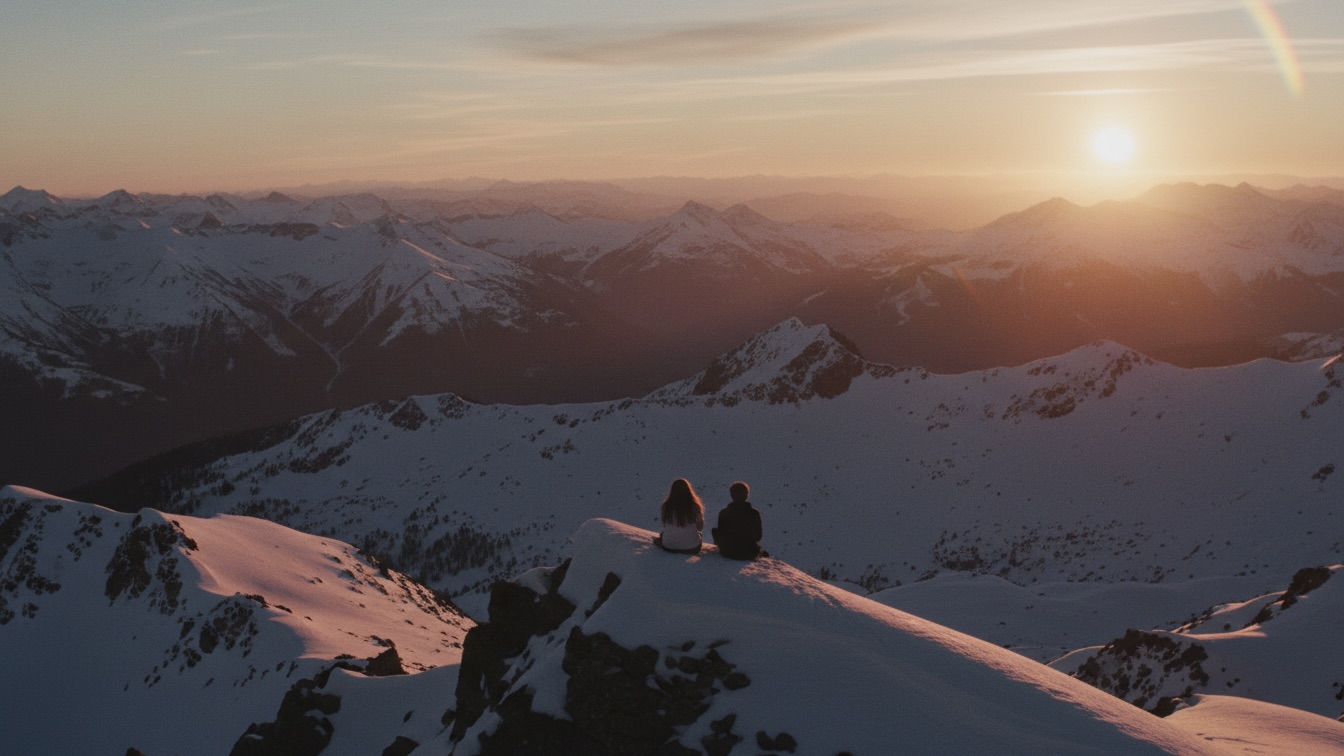
The final transfer of emotion occurs during the alpenglow sequence. The anxiety of the competition and the physical pain of the lessons dissolve into a shared reverence. The environment dictates the emotional state: as the sun sets and the colors deepen, the internal chaos of the characters settles. The "magic" that Cindy sought and Rob had lost is reconstructed not as a high-adrenaline thrill, but as a quiet, sacred act of witnessing. The cold is no longer an aggressor; it becomes the medium through which they connect, crystallizing the bond between them.
The setting of North Peak is bifurcated into two distinct psychological zones: the resort and the backcountry. The resort represents the commodification of nature, a noisy, chaotic space filled with "fried food and diesel." For Rob, this space is a psychological prison, a place of trauma and endless expectation. For Cindy, it is a confusing labyrinth where she must learn to navigate social and physical hierarchies. The "Bunny Hill" acts as a humiliating purgatory for the uninitiated, reinforcing feelings of inadequacy and exposure.
In contrast, the "other side" of the mountain—the backcountry ridge—serves as a sanctuary of authenticity. Here, the environment mirrors the internal state of peace the characters seek. The absence of groomed runs and lift towers removes the "rules" of the resort, allowing the characters to shed their social roles (instructor/student, hero/outcast). The deep, untouched powder demands a different kind of movement, slower and more deliberate, which forces a psychological deceleration. The alpenglow acts as a temporal boundary, marking the transition from the world of human striving to the indifferent, majestic beauty of the universe, offering a perspective that shrinks human problems to manageable sizes.
The prose utilizes a tactile and visual lexicon to ground the abstract themes of the story. Images like the "cotton-ball silence" and the world looking "baked from scratch" evoke a sense of domestic familiarity upturned by the sublime. The author employs a rhythm that mimics the experience of snowboarding: the early sections are halting and awkward, filled with short sentences and "crunches," reflecting Cindy’s struggle. As she improves, the sentences elongate and flow, culminating in the fluid, graceful descriptions of the alpenglow, mirroring the "carving" of a turn.
Symbolism is heavily relied upon to convey character progression. The snowboard is initially described as "furniture" and a "wild animal," symbolizing Cindy's alienation from the tool of her integration. As she masters it, it becomes an extension of her body. The "edge" of the board serves as a potent symbol for trust and commitment; one must lean into the danger to find control. The chairlift represents the suspension of life—the terrifying but necessary vulnerability of being held aloft by forces outside one’s control. It is the place where forward momentum stops, compelling introspection.
The winter motif of "covering" is central to the story’s aesthetic. The snow covers the "old paths," symbolizing the erasure of history, but it also covers the "bruises" and the "scars" of the landscape. The alpenglow, the "sacred" light that turns the snow to gold and pink, serves as the aesthetic climax. It represents the fleeting nature of perfect moments—beauty that exists only because it is temporary. This lighting shift transforms the cold, blue palette of the story into warmth, visually resolving the thematic conflict between the harsh environment and the human need for comfort.
The narrative echoes the Romantic tradition of the Sublime, where nature is perceived as a force that is both beautiful and terrifying, capable of overwhelming the human ego. This traces back to the works of poets like Wordsworth or Shelley, who sought the divine in the untamed landscape. However, the story modernizes this by filtering it through the lens of contemporary sports culture. The "mountain" is not just a place of spiritual reflection but an arena of commerce and competition, reflecting the modern conflict between the purity of play and the corruption of professionalization.
There are also strong resonances with the archetype of the "Wounded Healer" found in mythology and literature. Rob fits the mold of the Chiron figure—the mentor who possesses great skill but is crippled by a wound that will not heal, and who finds solace in guiding a novice. This dynamic subverts the typical "Manic Pixie Dream Girl" trope; instead of the girl saving the boy with her whimsy, they save each other through a shared encounter with the stark reality of the physical world.
Furthermore, the story taps into the cultural mythology of the "ski town" as a liminal space for drifters and seekers. It reflects the genre of outdoor literature where the wilderness is the ultimate arbiter of truth. The "silence" of the snow is a recurring trope in winter narratives, often symbolizing death or stasis, but here it is recontextualized as a pregnant pause, a space for potential and rebirth, aligning with the cyclical nature of the seasons where winter is the necessary sleep before spring.
What remains after the narrative concludes is the profound weight of the silence that Rob and Cindy share. It is a silence that feels earned, distinct from the anxious quiet of the opening scene. The reader is left with the sensation of the "cold" not as a source of discomfort, but as a clarifying agent. The story suggests that true connection requires stripping away the noise of daily life—the "hum" of the city, the demands of the "sponsors"—and sitting together in the uncomfortable, beautiful void.
The image of the alpenglow lingers as a melancholic reminder of transience. The realization that the mountain "saves its best tricks for when everyone else has gone home" resonates as a critique of our attention spans. It asks the reader to consider what beauty they miss by rushing to the comfort of the lodge, by sticking to the groomed runs, or by viewing their environment solely through the lens of utility. The pink light on the snow becomes a symbol for the hidden grace available only to those willing to endure the cold a little longer.
Finally, the story leaves an intellectual residue regarding the nature of trauma and healing. It does not offer a magical cure; Rob’s knee is still shattered, and Cindy is still the new girl. The snow does not fix their problems, but it alters the context in which those problems exist. The lingering thought is that healing is not about returning to who we were "before the fall," but about finding a new way to navigate the terrain, learning to carve a line through the wreckage with a different kind of grace.
The sun has vanished, and the alpenglow has faded into the inevitability of twilight, yet the temperature on the ridge seems less biting than before. The mountain, previously a looming monolith of judgment and stone, has softened into a silhouette of shared experience. It is no longer a barrier separating the insider from the outsider, but a vast, silent commons where titles and histories are buried under the powder. The cold remains, but it has been repurposed; it is no longer the absence of heat, but the presence of a stark, undeniable reality that binds two people together in the dark.
In the end, the snow does not melt, and the winter does not retreat. The story refuses the easy warmth of a sudden spring. Instead, it leaves us in the chill, holding a handful of ice crystals that are dissolving against the warmth of a palm. It is a reminder that the most profound human moments often happen in the harshest conditions, and that the magic of the world is not a permanent state, but a fleeting trick of the light that must be caught, cold and wet, before it slips through our fingers.