Melgund Township Winter Story Library
Static in the Grey Wood - Analysis
by Jamie F. Bell | Analysis
by Jamie F. Bell | Analysis
The stuck zipper is a small, cheap failure that threatens everything. Its metal teeth bite into the nylon flap not with malice, but with the cold, indifferent physics of a system under stress, a perfect microcosm of a friendship snagged on a secret. To force it is to break it completely, leaving the fragile shelter of trust open to the killing wind of consequence. Within this tiny, frustrating mechanism lies the story’s entire emotional engine: the desperate, fumbling attempt to fix something that has been twisted out of alignment, and the dawning horror that the damage done by impatience and poor judgment may be permanent.
This chapter presents a stark piece of psychological realism, using the tropes of survival fiction not to pit man against nature, but to stage a brutal confrontation between two men and the truth. The central themes are betrayal, addiction, and the crushing weight of economic desperation. The plan to buy chainsaws and clear brush for the hydro line is a fragile dream of upward mobility, a way to "get out of thecycle." Sam's gambling addiction shatters this dream, revealing the story's core tension: the conflict between shared hope and individual fallibility. The wilderness of Lake Nipigon is less an antagonist and more a catalyst, an amoral amplifier where a personal failing like a lost seven hundred dollars becomes an immediate threat to survival. The cold clarifies and raises the stakes, transforming a simple argument into a question of life and abandonment.
The narrative voice is a tightly controlled third-person limited perspective, trapping the reader inside Sam’s anxious and guilt-ridden consciousness. We experience the world through his senses: the numb fingers, the steam on his glasses, the ringing in his ears, the phantom vibration of his phone. This perceptual limitation makes Sam a sympathetic figure even as we learn of his profound betrayal. We are privy to his self-loathing and his desperate rationalizations before Dev is, creating a dramatic irony heavy with dread. The narrative gap is not what happened—Sam lost the money gambling—but the emotional chasm that has opened between the two friends. The winter landscape reflects this internal state; the snow dampens sound, creating a heavy, oppressive silence that mirrors the unspoken truth, while the biting wind is the physical manifestation of Dev's eventual sharp, cutting words.
From a moral dimension, the chapter interrogates the nature of trust and forgiveness in extreme circumstances. Dev’s ultimatum—"I need to think about if I'm driving you home tonight or if we're sticking this out"—is not just about enduring two days of camping. It is an existential crossroads for their friendship and Sam’s future. The story pushes past simple right and wrong to explore the more complex territory of disappointment. Dev’s weariness is more damning than any rage, suggesting a history of Sam’s unreliability. The reference to "my dad talk" frames Sam’s addiction not as a singular moral failing, but as a potentially inherited curse, a cyclical trap he is failing to escape. The indifferent forest, with its "silent judges," provides no moral guidance, forcing the characters—and the reader—to grapple with the human consequences of a very human mistake.
Psychological State: Sam is in a state of acute psychological distress, a feedback loop of anxiety, guilt, and physical discomfort. The extreme cold serves as a direct parallel to his internal landscape; he feels numb, frozen by fear and indecision. His focus on small, immediate tasks like fixing the zipper is a coping mechanism, an attempt to exert control over a tiny part of his environment as the larger structures of his life collapse. The constant "high-pitched electronic whine" in his ears is a psychosomatic symptom of his unrelenting stress, an internal static that drowns out rational thought and underscores his isolation.
Mental Health Assessment: Sam exhibits clear signs of a gambling addiction, characterized by deceit, a desperate belief in winning back losses, and a profound sense of shame. His impulsivity and inability to delay gratification have led him to betray his only real support system. He displays low self-esteem, evident in his self-perception as "stupid" and his cracked, childlike voice during the confrontation. His resilience is critically low; he is not coping but simply reacting, and the crash from his adrenaline-fueled deception leaves him shaking, hollowed out, and emotionally paralyzed.
Motivations & Drivers: In this chapter, Sam is driven by two conflicting motivations: the primal need for physical survival (warmth, shelter) and the desperate desire to avoid Dev’s judgment. He wants to delay the inevitable conversation, hoping that the rituals of setting up camp can postpone the emotional reckoning. His deeper, more destructive driver is the gambler's fallacy—the belief that he could fix his mistake with one more bet before anyone noticed. This reveals a fundamental misunderstanding of risk and consequence, a pattern that has now jeopardized his future and his most important relationship.
Hopes & Fears: Sam’s primary hope was the shared plan with Dev: a legitimate, tangible path to a better life, a way to earn "real money" and escape the cycle of precarity. This hope has been self-sabotaged. His immediate fear is physical—the biting cold, the long night—but his deeper, more profound fear is abandonment. He is terrified of losing Dev, the one person who represents stability and a future. This is compounded by the fear of becoming the very thing he despises: an unreliable figure like Dev’s father, a "cautionary tale." The vast, indifferent wilderness reflects this fear back at him, making him feel small and utterly alone.
Psychological State: Devon is a man encased in a shell of weary disappointment. His emotional state is controlled, almost unnervingly so. His voice is "flat," his actions methodical—stripping birch bark, building the fire with practiced efficiency. This external calm belies a deep-seated hurt and exhaustion. The cold seems to focus him, stripping away any emotional excess and leaving only the hard, practical reality of the situation. He is not explosive; he is a force of immense pressure, his stillness more intimidating than any outburst.
Mental Health Assessment: Devon demonstrates high resilience and a strong sense of responsibility, but he is clearly burdened by Sam's unreliability. His coping mechanism is pragmatism; he assesses the damage (the broken trust, the empty bank account) and calculates the next move. His disappointment, described as worse than anger, suggests a mature but pained understanding of human fallibility. He is not just angry about the money; he is wounded by the lie, the breach of a foundational trust that he relied upon. This emotional injury makes him withdraw, creating a cold distance that is more punishing than any physical blow.
Motivations & Drivers: Devon’s primary motivation is to establish the truth. He needs to understand the full scope of the betrayal before he can decide on a course of action. He is driven by a powerful code of honor and practicality; plans are made to be followed, and trust is the currency that underwrites them. His insistence on talking "before it gets dark" is not just about logistics; it's about refusing to spend another moment in the pretense of normalcy. He needs to know who he is sleeping next to, both literally and figuratively.
Hopes & Fears: Devon shared Sam's hope in "the plan." It represented a mutual investment in a shared future, built on hard work and trust. His greatest fear, now realized, is that this foundation was an illusion. He fears being tethered to someone who will continually drag him down, forcing him to suffer the consequences of another's poor choices—a fear likely informed by his experience with his own father. His ultimate fear in this moment is that the friend he knew is gone, replaced by a liar he can no longer rely on, leaving him stranded not just in the woods, but in his ambitions for the future.
The chapter masterfully constructs an emotional architecture of escalating tension, beginning with a minor physical frustration and culminating in devastating emotional isolation. The initial conflict with the zipper serves as a pressure valve for Sam’s unexpressed anxiety. The reader feels his numb fingers and rising panic, establishing an intimate connection with his internal state before the true conflict is revealed. The oppressive silence between the two men is the primary building material for this tension. It is not an empty silence, but one filled with unspoken accusations and dread, a "wet wool blanket" that suffocates the air and amplifies the harsh, percussive sounds of survival—the snap of branches like "gunshots."
The emotional turning point occurs not with an explosion of anger, but with the quiet weight of Dev’s disappointment. The line, "Anger you could fight. Disappointment just sat there like a rock in your gut," precisely identifies the shift. Dev’s controlled, methodical actions—building the fire, speaking in a flat voice—are more chilling than any shouting match would be. This forces Sam, and the reader, to confront the consequences of the betrayal without the catharsis of a fight. The emotional energy, instead of being released, is contained and compressed, turning inward on Sam as shame and despair. The growing fire, a source of physical warmth, ironically becomes the backdrop for the coldest emotional exchange, its light illuminating the unbridgeable distance between them.
The final emotional state is one of profound solitude. After Dev delivers his verdict—"I don't trust you"—and turns his back, Sam is left utterly alone. The narrative reinforces this by describing the vastness of the forest and Sam’s feeling of smallness within it. The physical cold, which was once a primary concern, becomes secondary to the chill of his friend's silence. The chapter ends by trapping Sam in the tent, a "dark mouth" that has swallowed him. His shaking hands, "not from the cold," signify the complete collapse of his emotional defenses. The final image of the phone—no signal, low battery—is the perfect symbol of his disconnection, leaving him in a state of pure, unmitigated isolation, with only the howling wind and his own failure for company.
The setting of "Static in the Grey Wood" is not a mere backdrop but an active participant in the psychological drama, functioning as a crucible that tests and reveals character. The vast, indifferent wilderness surrounding Lake Nipigon serves as a powerful amplifier for Sam's internal state of isolation and guilt. The "black spruce" trees are personified as "calm, silent judges," their ragged forms mirroring the tattered state of his conscience. In this environment, there is no escape and no distraction; the landscape offers only a stark reflection of the characters' predicament. The immense scale of the forest makes Sam feel "small," diminishing his sense of agency and emphasizing the gravity of his mistake in a place where small errors can be fatal.
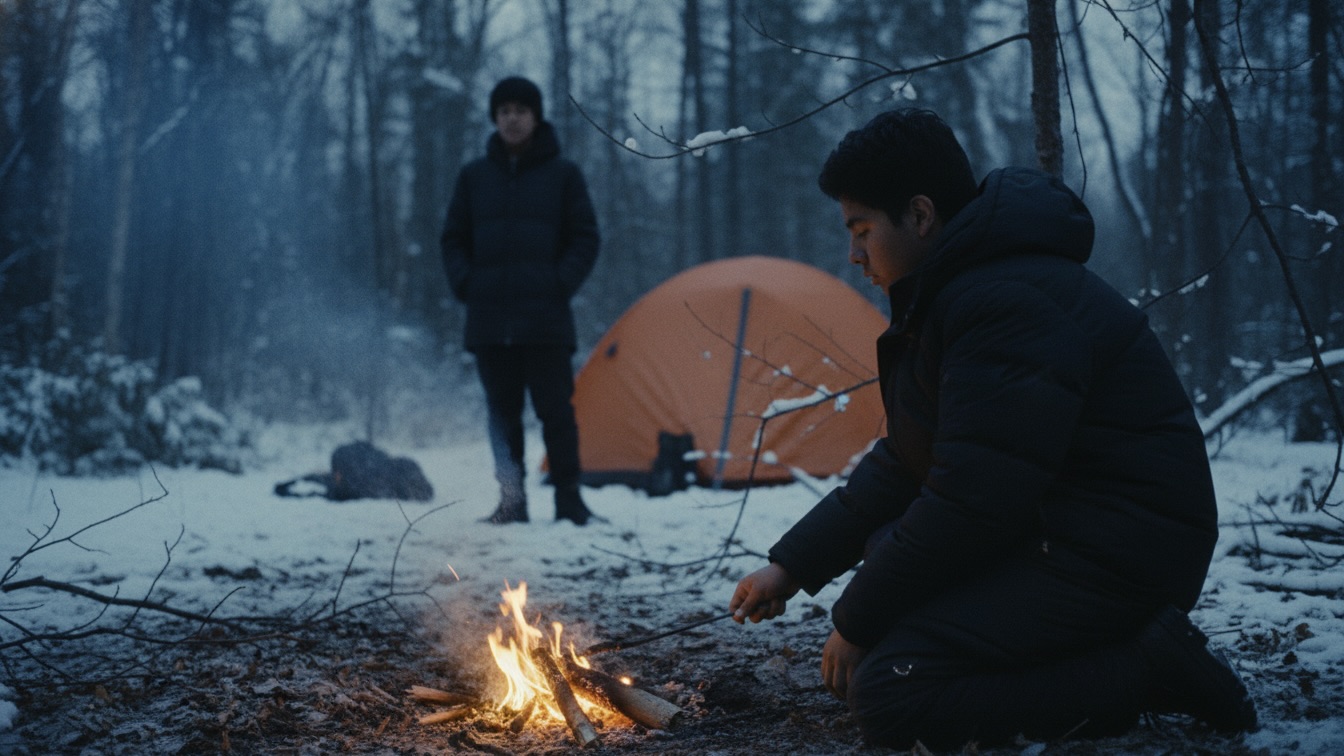
The immediate space of the campsite becomes a claustrophobic stage for the confrontation. The cleared patch of snow delineates a small, fragile zone of human activity against an endless expanse of hostile nature. Within this circle, every action is significant. Dev’s methodical construction of the fire is an act of claiming control over the space and the narrative. The fire itself becomes the psychological center of the scene, a point of primitive necessity that draws both men toward it while simultaneously highlighting the emotional coldness between them. For Sam, the tent represents a potential sanctuary, but his betrayal has poisoned it. When he finally crawls inside, it is not a refuge but a tomb, smelling of "mildew and cold plastic," a dark mouth waiting to swallow him. The open zipper, once a problem to be solved, now symbolizes the irreparable breach he has created.
The prose of the chapter is characterized by its crisp, sensory-driven diction and a rhythm that mirrors Sam’s escalating anxiety. The language is tactile and visceral, grounding the reader in the physical reality of the cold. Phrases like "bit deeper," "dry, sharp sting," and "hammering against his ribs like a trapped bird" translate abstract fear into palpable sensation. The sentence structure often begins with short, declarative statements that build into longer, more complex expressions of Sam's internal monologue, mimicking the way a single thought can spiral into a torrent of panic. The soundscape is deliberately sparse and jarring; the silence is "heavy," and the snapping of branches sounds like "gunshots," transforming the quiet woods into a place of latent violence and judgment.
Symbolism is woven deeply into the narrative fabric, with everyday objects gaining significant psychological weight. The stuck zipper is the story's central symbol, representing the snag in the friends' plan and in Sam's own moral compass; his attempt to force it is a metaphor for his reckless gambling. The fire, meticulously built by Dev, symbolizes truth, survival, and control. It is around this fire that the cold truth is spoken, and Dev’s mastery over it contrasts sharply with Sam's fumbling incompetence. The constant, high-pitched ringing in Sam’s ears—the "static"—is a powerful symbol of his inescapable guilt and anxiety, an internal noise that isolates him as much as the external silence.
The aesthetic of the piece is one of stark, northern realism. The color palette is deliberately muted—"grey wood," "black parka," "black spruce"—creating a visual landscape that is as bleak and unforgiving as the emotional one. The single splash of color, the orange of the nylon tent and ceiling, provides no warmth. Instead, it becomes the canvas for Sam's final, isolated contemplation, a cheap, artificial shelter that offers no comfort from the internal or external storm. The final image of the phone screen, a useless "glowing screen showing the time," is a poignant symbol of modern disconnection. It is a portal to the world of addiction that ensnared him, yet in this moment of profound need, it offers no signal, no connection, no escape—only a digital reminder of the time stretching out before him in a long, cold night.
The chapter situates itself firmly within the literary tradition of North American realism, echoing the works of authors like Jack London and Raymond Carver. Like London's "To Build a Fire," the story underscores how a harsh, indifferent natural world punishes human error and arrogance. However, the true "cold" in this story is not environmental but interpersonal, aligning it more closely with Carver's minimalist explorations of broken lives and silent desperation among the working class. The conflict is not about conquering nature, but about the inability to conquer one's own self-destructive impulses. The sparse dialogue and focus on internal monologue amidst a backdrop of economic precarity are hallmarks of this tradition.
Archetypally, the narrative draws on the Cain and Abel or betrayed brotherhood dynamic, where a single act of selfishness poisons a foundational relationship. Sam embodies the prodigal figure, wasting his inheritance—the shared savings—on a reckless gamble, while Dev is the stoic, responsible brother left to deal with the fallout. The story updates this timeless conflict for a contemporary world, where the temptation is not a physical vice but the glowing, abstract promise of a "parlays app." The mention of "my dad talk" adds another layer, invoking the powerful cultural narrative of intergenerational trauma and the fear of repeating the failures of one's parents, a theme prevalent in literature exploring class and masculinity.
Furthermore, the story taps into the genre of Canadian Gothic, where the vast, untamed wilderness serves as a psychological space reflecting the darker aspects of the human psyche. The "grey wood" is not just a location but a state of mind, a place of moral ambiguity and isolation. Unlike a purely survivalist tale, the tension here is not whether the men will freeze to death, but whether their bond can survive the freeze of betrayal. The crow's harsh call from deep in the bush is a classic gothic trope, an omen or a mocking commentary from a world that is ancient, wild, and entirely unconcerned with human dramas of money and lies. The story uses the Canadian landscape not as a source of national pride or beauty, but as a stark, unforgiving mirror.
What lingers most profoundly after reading this chapter is the suffocating weight of Sam's isolation, a cold that seeps far deeper than the twenty-below temperature. The final moments, with Sam enclosed in the tent, listening to the silence of his best friend just feet away, are devastating. The physical proximity only serves to amplify the immeasurable emotional distance between them. The story leaves one with a visceral understanding that the most punishing solitude is not being alone, but being with someone who has completely withdrawn their trust and affection. It is the silence, not the shouting, that remains.
The narrative poses a difficult, unresolved question about the elasticity of trust. Dev's weary disappointment feels more final than outright rage, suggesting a fracture that may be too deep to mend. The reader is left to ponder whether forgiveness is possible, or even advisable, in such circumstances. Is Sam's betrayal a one-time mistake born of desperation, or is it a fundamental character flaw, the "addict talk" that Dev recognizes? The ambiguity of Dev's ultimatum—driving home or sticking it out—hangs in the air, forcing the reader to inhabit a space of uncomfortable uncertainty right alongside Sam.
Ultimately, the chapter’s lasting impact is forged in its masterful fusion of the external and internal environments. The image of the tiny, struggling fire against the vast, dark, and freezing woods becomes a metaphor for their friendship and their future—a small point of warmth and hope that is now in danger of being extinguished by a single, foolish act. The howling of the wind through the spruce trees at the end feels less like a weather report and more like a lament for what has been lost. It is the sound of a world indifferent to a broken plan and a broken heart, a sound that echoes long after the page is turned.
The wind does not care about the seven hundred dollars. It moves through the black spruce with the same ancient indifference it has always known, testing the seams of the orange tent and pulling at the smoke from the small fire. It is a witness without judgment, feeling only the sharp edges of things: the corner of a cheap nylon shelter, the brittle tips of dead branches, the sudden heat rising from a brief and angry flame. It carries away the scent of birch bark and the sound of a bitter laugh, dispersing them into the vast, silent cold until they are nothing.
In the end, all sound is absorbed by the snow. It takes the crunch of boots, the snap of a twig, and the low, cracked whisper of a confession and buries them under a blanket of profound quiet. This is the silence that will remain long after the fire has died to embers. It is the silence of a future that has been frozen, of a trust that lies dormant and cold beneath the surface. What was said cannot be unsaid, and like a footprint left in deep snow, the impression of the betrayal will hold its shape until a thaw that may never come.