From the perspective of the landscape itself, the story is a momentary disturbance, a brief, warm-blooded struggle against an eternity of cold. The wind, an ancient and indifferent sculptor, carves the world into a featureless void, and within this roaring abyss, two human sparks flicker against the overwhelming white. This chapter is not merely a tale of survival set in winter; it is an examination of the human psyche under the immense pressure of a world reduced to its most brutal and elemental state, where the only landmarks are the faint outlines of conscience against a blizzard of self-preservation.
The chapter operates as a potent piece of psychological realism couched in the harsh conventions of a survivalist narrative, reminiscent of the Naturalist literary tradition. The central theme is the collision between primitive survival instinct and the stubborn, inconvenient persistence of human conscience. Rick’s internal conflict is framed not as a lofty moral debate but as "brutal arithmetic," a mathematical equation where adding a second life subtracts from his own. This pragmatic, almost inhuman calculus is the story’s core tension, exploring whether morality is a luxury that can be afforded only when resources are plentiful, or an intrinsic part of the human condition that endures even at the precipice of annihilation. The winter storm is more than a setting; it is the primary antagonist and a powerful metaphor for this internal state, a "screaming white chaos" that erases direction, certainty, and the flimsy structures of civilization, leaving only the stark choice between life for one or potential death for two.
The narrative voice is tightly bound to Rick’s perspective, a third-person limited narration that immerses the reader in his sensory and psychological experience. We feel the "brutal cold" of the rifle stock and the burning in his lungs; we see the world through his slitted, ice-crusted eyes. This proximity makes his initial, savage thought—Good. Let the wind have him—not just villainous but deeply, uncomfortably understandable. The narrator does not judge Rick but simply presents his internal calculations, forcing the reader to confront the same grim mathematics. The perceptual limits imposed by the blizzard are crucial; the "featureless void" means Rick navigates by memory and instinct, mirroring how he must navigate the uncharted moral territory he has stumbled into. There is no external witness, no social pressure, making his decision a pure reflection of his inner self.
This narrative framework plunges the story into profound existential dimensions. Isolated from all society, Rick becomes the sole arbiter of justice, life, and death for his rival. The frontier, as he sees it, is a place that strips away pretense and reveals the "hard, unvarnished truth of a man’s competence." Yet, his discovery of the still-breathing Ed challenges this simplistic worldview. The knowledge of Ed's survival becomes a "weight," an undeniable fact that cannot be erased by the snow. The story posits that bearing witness creates responsibility, transforming an abstract rival into a concrete human being whose fate is now inextricably linked to his own. The arrival of the wolves at the end elevates this from a personal moral drama to a primal siege, suggesting that whatever their internal conflicts, they are now united against a hostile universe that is utterly indifferent to their individual struggles or moral reckonings.
Psychological State: Rick’s psychological state is one of extreme duress, defined by a constant, grinding battle against both the external environment and his own internal impulses. He is a man who has cultivated a mindset of radical self-reliance, viewing the world through a lens of "brutal arithmetic" and pure pragmatism. The blizzard amplifies this state, forcing him into a minute-by-minute calculation for survival that leaves little room for sentiment. Yet, the discovery of Ed introduces a profound cognitive dissonance; his pragmatic mind dictates leaving Ed to die, but an unacknowledged, deeply buried part of him—a conscience he seems to resent—refuses to cooperate. This internal conflict manifests as anger and frustration, directed not just at Ed but at himself for his "stupid, pointless" moment of humanity.
Mental Health Assessment: Rick displays the mental fortitude and resilience necessary for a life of extreme isolation on the frontier, but his coping mechanisms are predicated on solitude and control. His emotional range appears constricted, with resentment and grim determination being his most accessible feelings. The introduction of a dependent, especially an enemy, shatters his carefully maintained psychological equilibrium. He is not mentally unwell in a clinical sense, but his mental health is brittle, ill-equipped for the complexities of interpersonal responsibility under life-threatening pressure. His solitude is both a strength and a vulnerability; it has made him tough, but it has also starved the part of him that knows how to connect with or care for another human being.
Motivations & Drivers: Rick's primary driver is survival, a goal so immediate and all-encompassing that it has become the totality of his existence. This is evidenced by his constant mental inventory of food and firewood. Initially, his motivation for saving Ed is unclear even to himself. It is not altruism but a more complex, almost unwilling compulsion. He is driven by the act of having "borne witness," suggesting a motivation rooted in an inescapable sense of responsibility that transcends his personal feelings. As the story progresses, a new, subtle motivation emerges: a refusal to be utterly alone. The thought of the cabin’s "absolute" silence after Ed’s potential death becomes a curse, hinting that his actions are also driven by a deeply suppressed need for human presence, even the presence of an enemy.
Hopes & Fears: Rick’s hopes are stark and simple: to see the storm break, to have enough food and fire to last the winter, to maintain his solitary independence. He hopes for a world that operates on the clear, predictable logic he understands. His fears are far more complex. On the surface, he fears starvation and freezing to death. However, his deeper fear, revealed through his actions, is the fear of what he might become if he walks away. He fears being haunted by the "image of that small, fleeting breath" for the rest of his days. By the end, he also fears a return to absolute solitude, a state that once defined his existence but now seems like its own form of death. The wolves externalize his ultimate fear: that after all his moral struggle, the indifferent violence of nature will render his choice meaningless.
Psychological State: Ed’s psychological state is a performance of intellectual defiance against the raw, physical reality of his own demise. Even when half-frozen, grievously injured, and completely helpless, his mind remains his primary tool and weapon. He uses language—sarcasm, philosophical musings, literary allusions—to create a psychological distance from his own pain and vulnerability. His "theatrical rasp" and "intellectual arrogance" are defense mechanisms, an attempt to impose his own civilized, structured worldview onto a chaotic and savage situation. He is clinging to the identity of the "eloquent, educated man from the East" because it is the only thing he has left; to abandon it would be to accept that he is nothing more than a broken body at the mercy of a brute.
Mental Health Assessment: Ed’s mental state is characterized by a powerful, almost pathological need for control, which he exerts through verbal and intellectual manipulation. His resilience is mental rather than physical. While his body is failing, his mind remains sharp, a testament to a disciplined intellect. However, his inability to cease performing, even in delirium, suggests a deep-seated insecurity. His constant need to frame their situation as a "morality play" or "drama of the absurd" is a way of intellectualizing his terror and helplessness. He copes with his fear not by facing it, but by narrating it, turning himself from a victim into a critic observing the scene from a detached perspective.
Motivations & Drivers: Ed's primary motivation in the chapter is to re-establish the power dynamic that existed between him and Rick in the civilized world of the trading post. Lacking physical strength, he uses his sharp tongue to probe Rick's motives, to assert his intellectual superiority, and to deny Rick the simple satisfaction of a charitable act. He is driven to understand the "calculus" of his rescue because, in his world, every action has a motive rooted in self-interest. To accept Rick's act as something other than that would be to concede to a worldview he does not understand or respect. His incessant talking is a fight for relevance and a refusal to be reduced to a passive object of rescue.
Hopes & Fears: Ed's most immediate hope is simply to survive, though he would likely never admit to it in such plain terms. His deeper hope is to maintain his sense of self, to not be broken by the frontier he sought to conquer with his wit and wealth. He fears being stripped of his identity and becoming merely a piece of meat, a "carcass" dependent on his rival. His greatest fear is irrelevance and intellectual defeat. Being saved by the "monosyllabic" frontiersman he disdains is a profound humiliation, and he fears the silence and simple physical reality of the cabin far more than the storm outside, because it is a world where his greatest strengths—his words and his intellect—are almost useless.
The emotional architecture of the chapter is built upon a foundation of stark contrasts, primarily the immense, impersonal violence of the storm versus the intensely personal, claustrophobic drama inside the shack. The narrative masterfully transfers the physical sensation of cold into an emotional state. Rick’s initial mindset is as frozen and unforgiving as the landscape. His first reaction to finding Ed is a "savage, ugly thing," an emotional state devoid of warmth or empathy. The turning point, the sight of Ed's faint breath, is the first crack in this internal ice, introducing an unwelcome thaw of responsibility that Rick experiences not as compassion but as a "demand" and an "inconvenience."
This internal shift is developed through a slow, resentful progression of actions. Each step Rick takes while dragging Ed, each log he places on the fire, each spoonful of water he offers is layered with a palpable sense of bitterness and resignation. The emotion is not a sudden epiphany of goodness but a grudging acceptance of a burden. The reader experiences Rick’s emotional journey not through his declarations but through his physical struggles and his relentless internal accounting of dwindling resources. This makes his eventual act of sharing the jerky feel less like a heroic sacrifice and more like a weary, almost fatalistic surrender to a part of himself he cannot escape. The emotion is raw and unsentimental, rooted in action rather than feeling.
The arrival of Ed’s voice introduces a new emotional dynamic, shifting the tone from a silent, internal struggle to a charged, verbal confrontation. Ed’s intellectual provocations are designed to elicit a reaction, to force Rick to name his motives and thus expose them to judgment. This creates a powerful tension, as Rick’s stoic silence clashes with Ed’s loquaciousness. The emotional atmosphere in the shack becomes thick with unspoken history and present resentment. The final act of sharing food and warmth is emotionally complex; it is an act of profound generosity born not of affection, but of a shared, desperate humanity. The loosening of the "cold, hard knot" in Rick's gut is the story's emotional climax, a release of tension that is immediately replaced by the new, external terror of the wolves, leaving the reader in a state of unresolved suspense.
The vast, featureless expanse of the blizzard serves as a psychological canvas upon which the story’s moral drama is painted. The "churning, roaring abyss" of the storm erases the physical world, creating a state of absolute isolation that mirrors Rick’s initial moral solitude. In this white void, there are no societal rules, no witnesses, and no consequences beyond those Rick imposes on himself. The environment strips away the external markers of identity and civilization, forcing a confrontation with the essential self. The disorienting nature of the whiteout, where direction is lost and survival is an "instinct," reflects the loss of Rick’s own moral compass as he grapples with a choice for which his life has not prepared him.
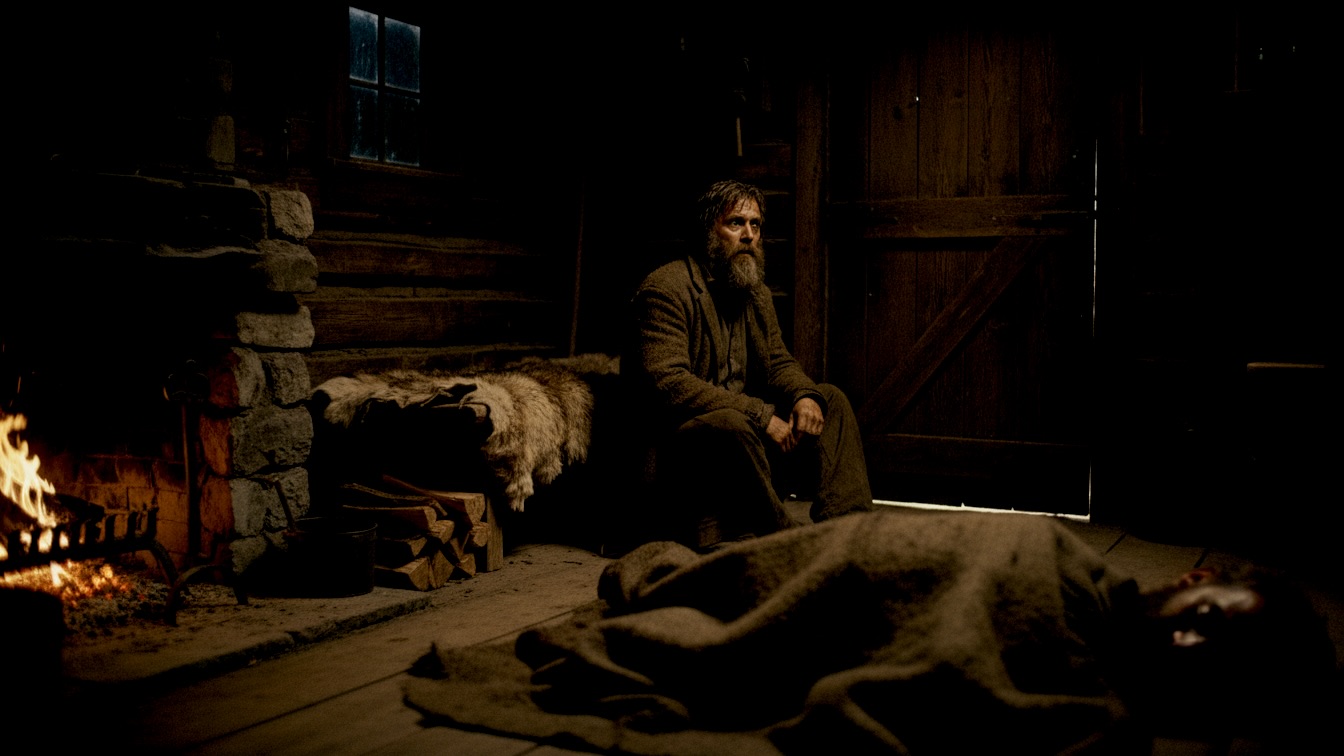
Once inside, the psychological function of space is inverted. The shack, previously Rick's sanctuary of solitude and control, transforms into a claustrophobic "cell for two." The tiny, twelve-by-twelve room becomes a pressure cooker, amplifying the tension between the two men. Every sound—Ed's ragged breathing, the crackle of the fire—is magnified in the sudden silence. The invasion of Rick's "self-contained, solitary world" is not just physical but psychological; Ed's presence fills the space, challenging Rick’s autonomy and forcing an unwelcome intimacy. The single, grimy window showing nothing but swirling white reinforces their imprisonment, emphasizing that there is no escape from each other or their shared predicament.
The environment within the shack becomes a direct reflection of their dwindling chances. The shrinking woodpile and the disappearing tins of food are not just plot devices; they are tangible, spatial representations of time running out. The fire in the hearth is the cabin's psychological center, a fragile nexus of warmth and life against the "lethal, crushing cold." Rick’s final act of moving Ed into the prime spot before the fire and taking the colder place for himself is a powerful spatial metaphor for his internal shift. He has literally and figuratively ceded the center of his world to his enemy, a profound psychological concession that redefines the emotional geography of their shared prison.
The prose of the chapter is lean and visceral, mirroring the harshness of the environment and Rick’s pragmatic worldview. The language is heavily reliant on sensory details that emphasize the brutal physicality of the cold: the wind has "teeth," the snow falls in "stinging, blinding sheets," and the rifle stock is a "brutal cold" against the cheek. This diction grounds the narrative in a tangible reality, making the abstract moral conflict feel immediate and earned. The rhythm of the sentences often reflects Rick's physical state; short, clipped phrases convey his exhaustion and the step-by-step nature of his struggle, while longer, more descriptive passages immerse the reader in the overwhelming chaos of the storm.
Symbolism is woven deeply into the narrative fabric, with the natural world serving as a constant mirror for the internal conflict. The fire is the most potent symbol, representing life, hope, and the finite resources Rick is sacrificing. Each log he adds is a piece of his own potential future being consumed for Ed’s sake. The "brutal arithmetic" becomes a recurring motif, a symbol of Rick’s attempt to apply logic and reason to a situation that ultimately demands an irrational leap of faith or conscience. The act of tearing the jerky in two is a climactic symbolic moment; the tough, fibrous resistance of the meat mirrors Rick's own internal resistance to the act of sharing, and the sound of the rip is the definitive sound of his choice being made.
The contrast between light and dark, white and black, is a central aesthetic principle. The world is a "suffocating white," a void of moral and physical clarity. Ed is first spotted as a "patch of darkness," a disruption to this uniformity. His dark wool coat and the "almost black" stain of his blood are stark intrusions on the pure, indifferent landscape. This visual dichotomy underscores the central conflict: Ed is the dark, complicated problem that has appeared in the stark, simple world of Rick’s survival. The final image of the last log splitting in the hearth, a crack appearing in the source of their warmth, is a powerful and ominous symbol, foreshadowing the fragility of their sanctuary as a new, predatory darkness gathers outside.
"The Devil's Own Luck" situates itself firmly within the literary tradition of American Naturalism, echoing the elemental conflicts found in the works of authors like Jack London and Stephen Crane. The story shares a thematic core with London's "To Build a Fire," presenting nature not as a romantic backdrop but as a powerful, indifferent force that tests the limits of human endurance and intellect. Rick, the pragmatic frontiersman, and Ed, the educated Easterner, represent two different approaches to this hostile world. Rick’s competence is physical and instinctual, while Ed’s is intellectual and ultimately insufficient against the raw power of the blizzard. This dynamic explores the classic Naturalist idea that humanity's civilized trappings are a thin veneer, easily stripped away by environmental pressure.
The narrative also draws heavily on the archetypes of the American Western. Rick is the quintessential stoic frontiersman, a man of few words and profound physical capability, defined by his solitary existence. Ed embodies the "tenderfoot" or the well-spoken outsider, whose sophistication is both a source of pride and a fatal liability on the frontier. Their rivalry over territory and pelts is a classic Western conflict, but the story subverts the genre's typical resolution. Instead of a violent shootout, the climax is a quiet, internal act of mercy, shifting the focus from external conflict to internal moral reckoning. This re-frames the frontier not just as a place of physical conquest but as a crucible for the soul.
Furthermore, the story engages with the universal archetype of the "enemy savior" or the "unlikely pairing," where two adversaries are forced into a situation of mutual dependence. This trope forces characters to look past their established animosity and recognize a shared humanity. The claustrophobic setting of the shack becomes a stage for this archetypal drama, reducing their complex social rivalry to the simple, binary state of being alive or dead. Ed's fevered quotes from poets and his framing of their situation as a "morality play" is a self-aware nod to this intertextual lineage, as if he recognizes the literary and philosophical weight of their predicament. The arrival of the wolves adds a mythological dimension, casting the two men as figures in a primal fable, their small fire a fragile outpost of humanity against a mythic, hungry darkness.
What lingers long after the final sentence is the profound, suffocating silence of the shack, punctuated only by the crackle of the last log and the howling of wolves. The story masterfully traps the reader within its confines, making the cold more than a physical sensation; it becomes an emotional and philosophical state. The chill that remains is not just from the blizzard but from the starkness of the choices presented. Rick’s dilemma feels deeply personal and uncomfortably real, forcing a quiet introspection about the line between self-preservation and moral duty. The narrative refuses to provide an easy answer, leaving the reader to weigh the "brutal arithmetic" for themselves.
The character of Ed, in particular, leaves a complex afterimage. His infuriating yet compelling intellectualism in the face of death raises unsettling questions about the nature of human dignity. Is his refusal to be anything less than himself, even at his most vulnerable, a form of courage or a pathetic delusion? His words, initially a source of irritation for Rick, become the only thing that fills the vast, empty silence, suggesting that even the most pretentious aspects of civilization have a purpose in the void. His presence transforms the narrative from a simple survival story into a dialogue about what it means to be human when everything else is stripped away.
Ultimately, the story’s resonance comes from its ambiguity. Rick's final act of sacrifice is not clean or pure; it is born of resentment, frustration, and a dawning fear of absolute solitude. This psychological messiness is what makes it so powerful. It suggests that our better angels often speak with a gruff, unwilling voice. The final scene, with the fire dying and the wolves closing in, leaves the reader suspended in a moment of extreme tension. The question is no longer whether Rick will save Ed, but whether his choice will matter at all. This lingering uncertainty about the efficacy of a moral act in an indifferent universe is the story's most haunting and enduring legacy.
In the end, the story resolves nothing, offering instead the sharp, resonant sound of a final log splitting in the heat. This small, domestic crack is a sound of finality set against the vast, inhuman roar of the storm, a punctuation mark on a choice made in the heart of a frozen world. It is the sound of one man’s carefully hoarded life being fed to the flames for another, an act of irrational accounting that defies the cold logic of survival. The warmth it provides is temporary, fragile, and perhaps, entirely futile.
The true landscape of the chapter is not the snow-covered territory but the barren wilderness of a man's soul when confronted by an unwelcome flicker of conscience. The wolves that howl outside are merely an echo of the savage calculations that prowled Rick’s own mind. Whether their arrival is a final, cruel irony or the catalyst for a new kind of shared struggle remains buried under the snow, leaving only the image of two enemies huddled together, their combined warmth a tiny, defiant anomaly in the overwhelming, patient cold.