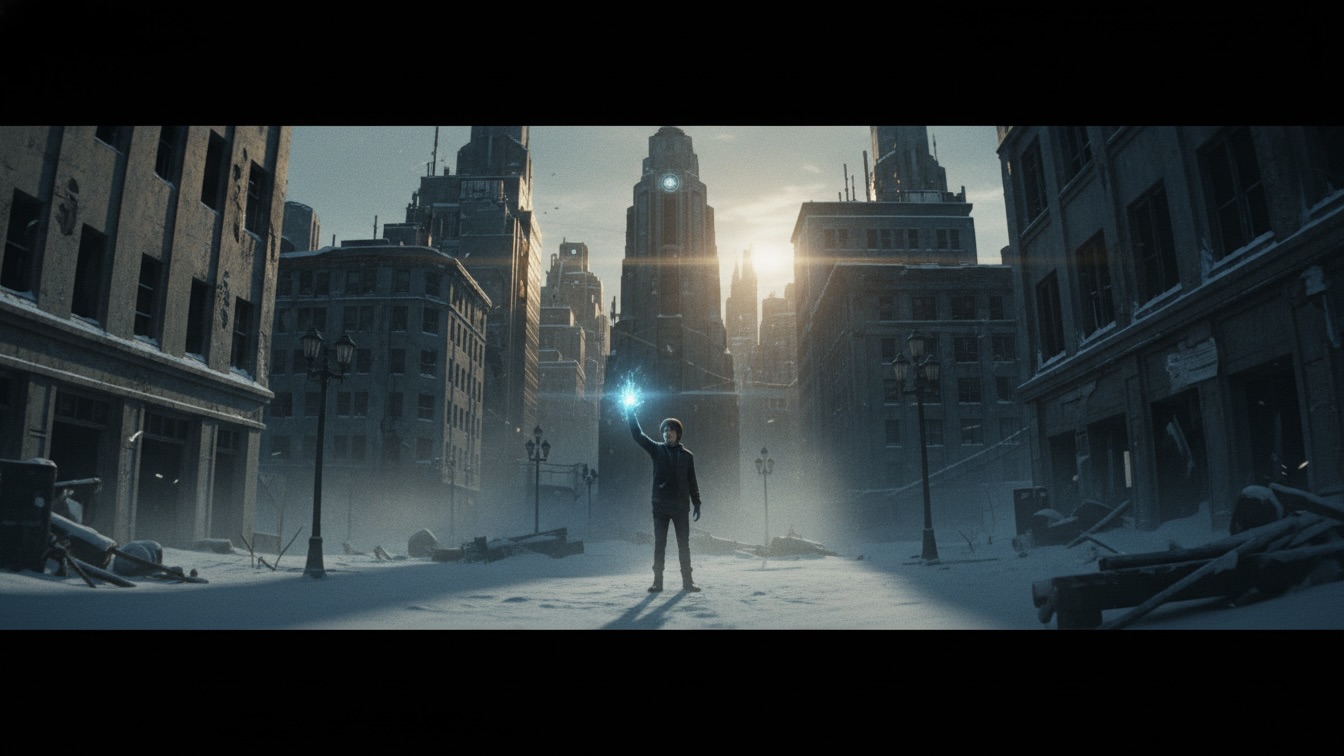
The narrative follows Kyle, a disillusioned courier navigating a brutally cold, dystopian Winnipeg. While on a mundane delivery run for a crime boss named Ma Grime, Kyle discovers a mysterious, pulsating ice artifact hidden in a derelict underpass. This object, which he dubs the "Frostbloom," exerts an immediate psychic and physical influence over him, whispering promises of power and merging painfully with his flesh.
Driven by a newfound, chemically-induced boldness and deepening paranoia, Kyle attempts to fence the item with an underworld contact named The Glazier. However, the artifact’s corrupting influence causes Kyle to perceive treachery everywhere, leading him to reject the offer and retreat into isolation. His psychological deterioration accelerates as the object fuels his rage and distorts his perception of reality.
The chapter culminates in a violent confrontation at Ma Grime’s headquarters. Convinced that his boss orchestrated the discovery to entrap him, Kyle unleashes the artifact's latent energy. This results in the horrific magical freezing of an enforcer, an act of violence that shocks Kyle even as the artifact permanently fuses to his hand. He flees into the frozen city, transformed into a beacon of dangerous magic, terrified yet seduced by the entity now parasitic upon his body.
The primary theme exploring the narrative is the seductive and corrosive nature of unchecked power, specifically when viewed through the lens of desperation. The artifact does not merely offer magical ability; it preys upon the protagonist's socio-economic hopelessness. The "Frostbloom" functions as a metaphor for addiction or a Faustian bargain. It offers an escape from the "grind" and the cold, yet the cost is the surrender of one's humanity and agency. The power is not a tool Kyle uses; it is a force that uses Kyle, exploiting his grievances to manifest itself.
Parallel to this is the theme of environmental determinism and the hostility of the natural world. The setting is not passive; the cold is described as "prehistoric" and a "living thing." This anthropomorphized winter mirrors the internal emotional landscape of the characters—cold, unyielding, and cruel. The external environment strips away the veneer of civilization, leaving behind a primal struggle for warmth and survival. The "Frostbloom" is the ultimate manifestation of this environment, suggesting that to survive the cold, one must become the cold.
Furthermore, the story critiques the illusion of control within a rigid hierarchy. Kyle believes the artifact will liberate him from Ma Grime’s control, viewing it as his "ticket out." However, the narrative irony lies in the fact that he merely trades one master for another. He swaps the external tyranny of Ma Grime for the internal, biological tyranny of the artifact. His rebellion, fueled by the object, leads not to freedom but to exile and monstrosity, highlighting the tragedy of seeking liberation through destructive means.
Kyle presents a psychological profile defined by deep-seated resentment and an inferiority complex. As a low-level runner, he perceives himself as a victim of circumstance, trapped by the economic machinery of Ma Grime and the physical oppression of the climate. His initial internal monologue reveals a man who feels erased by his environment, noting that the job is for "someone who didn't exist anymore." This lack of self-worth makes him the perfect host for the parasitic artifact, which fills the void of his identity with artificial confidence.
The interaction with the Frostbloom triggers a rapid psychological decomposition characterized by paranoia and grandiose delusions. Before finding the object, Kyle is cynical but rational; afterward, his cognition becomes distorted. He projects his own aggressive desires onto others, interpreting The Glazier’s hesitation and Ma Grime’s confusion as evidence of a grand conspiracy against him. This projection is a defense mechanism, allowing him to justify his escalating aggression as self-defense rather than unprovoked violence.
By the climax, Kyle suffers a complete loss of impulse control. The artifact acts as a disinhibitor, bypassing his moral reasoning and connecting directly to his primal "fight or flight" response. When he kills the enforcer, his reaction is a complex mix of horror and exhilaration. The horror stems from the remnants of his human superego, while the exhilaration comes from the gratification of his id. The final fusion of the object to his hand symbolizes the total collapse of his ego boundaries; he no longer possesses the rage, he is the rage.
The narrative voice is gritty, visceral, and deeply immersed in the sensory experience of the protagonist. The author utilizes a "future-noir" tone, blending the cynical worldview of hardboiled detective fiction with elements of dark fantasy. The prose is heavy with sensory details, specifically focusing on tactile and thermal imagery. Words like "rust," "failure," "metallic," and "ozone" create a texture that the reader can almost taste, grounding the fantastical elements in a harsh, industrial reality.
Pacing is used effectively to mirror Kyle’s physiological state. The early paragraphs are slow and trudging, mimicking the coughing engine of the sled-bike and the oppressive weight of the winter. As Kyle discovers the artifact, the pacing quickens, reflecting the adrenaline spike and the electric "hum" of the object. The dialogue becomes sharper and more staccato during the confrontations, culminating in the frantic, breathless action of the climax where the sentence structures fracture to match the chaos.
Metaphor plays a crucial role in establishing the atmosphere. The cold is consistently personified as a predator "clawing" and "swallowing," which heightens the sense of danger. The city is depicted not just as a location, but as a beast with "teeth" in the shadows. This stylistic choice reinforces the psychological reality of the protagonist: Kyle feels hunted by his world. The imagery transforms the setting into an antagonist as formidable as Ma Grime herself, creating a suffocating atmosphere that justifies Kyle's desperate grasp for power.