Melgund Township Winter Story Library
A Gathering at the Fort - Analysis
by Jamie F. Bell | Analysis
by Jamie F. Bell | Analysis
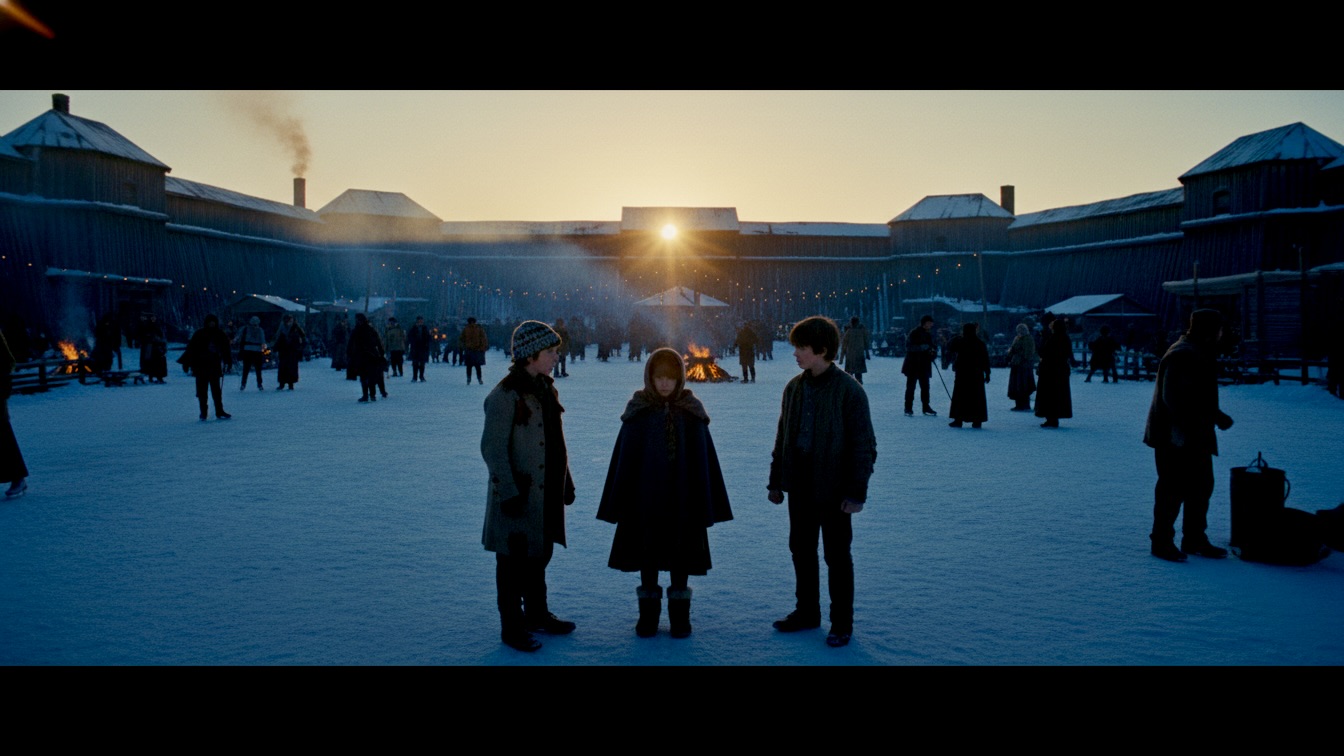
This chapter plunges a protagonist from a technologically advanced future into the harsh reality of the 19th-century Canadian frontier. Initially believing she is experiencing a glitch in a virtual history tour, she is confronted by visceral sensory details that prove her displacement is terrifyingly real. Her historical knowledge is triggered when she witnesses a childhood dispute over a toy soldier between a young, fiery Louis Riel and a settler's son, Thomas. Recognizing this as a potential "nexus" point in history, she feels an overwhelming compulsion to intervene and prevent the future animosity she knows will develop. However, her cryptic and poorly-chosen words of warning fail to mend the rift. Instead, she replaces the boys' simple anger with a far more potent cocktail of fear and suspicion, effectively ending their childhood innocence and cementing the very path of conflict she had desperately hoped to alter.
The narrative masterfully explores the tragic interplay between determinism and free will, questioning the very nature of historical intervention. The protagonist operates under the assumption that her knowledge of the future grants her the agency to "fix" the past. The concept of the "nexus" suggests a moment of profound possibility, a crack in time that might be smoothed over. Yet, her actions produce the opposite effect, implying that her intervention may have been the very catalyst required by fate. This creates a devastating paradox where the attempt to exercise free will becomes the mechanism that ensures a deterministic outcome, suggesting that some historical currents are too powerful to divert.
Closely tied to this is the theme of the corruption of innocence. The conflict between Louis and Thomas begins as a simple, understandable childhood squabble over a possession. It is a moment of pure, albeit angry, emotion. The protagonist’s intervention transforms this purity into something complex and poisonous. She does not teach a lesson in compromise; instead, she introduces the adult concepts of paranoia, calculated suspicion, and existential threat. The abandoned wooden soldier becomes a powerful symbol of this lost innocence, a childhood relic left behind as the boys are forced onto a path defined by the fear and mistrust she has just instilled in them. Her act of "help" is, in reality, an act of profound psychological violence.
Furthermore, the chapter serves as a poignant commentary on the burden of knowledge and the failure of communication. The protagonist is uniquely cursed by her foresight; she cannot see two boys fighting, but only the specter of the gallows and a nation divided. This knowledge compels her to speak, but she is unable to translate her sophisticated understanding into a language a child can comprehend. Her warning, "It's not about what you say. It’s what they will hear," is tragically ironic, as she herself falls victim to this principle. Her words are not heard as a caution but as a strange and terrifying prophecy, deepening the chasm between the two boys rather than bridging it.
The protagonist is an intellectual thrust into a visceral crisis far beyond her control. Her initial psychological state is one of profound sensory and cognitive dissonance, where the cold reality of the fort clashes violently with her expectation of a climate-controlled simulation. This disorientation gives way to a dawning horror and then a misguided sense of purpose upon her recognition of Louis Riel. She is driven by a powerful, almost messianic impulse to correct the timeline, a feeling she describes not as a choice but as a "command." This reveals a certain hubris born of her advanced education; she believes her knowledge equips her to be a historical surgeon, capable of excising the cancer of future conflict.
Her internal conflict is rooted in the clash between her noble intentions and her catastrophic execution. She approaches a child's fight with the weight of a historian, unable to see the smallness of the moment for the largeness of its consequences. Her attempt to impart a lifetime of hard-won wisdom in a single, whispered warning is both naive and arrogant. The chapter’s devastating conclusion forces upon her the realization that she has not been a savior but an antagonist. She is left shattered by the understanding that in trying to prevent a war, she may have been its first and most crucial architect, poisoning the well of a young boy’s heart with the very paranoia that will one day consume him.
Even as a boy, Louis is portrayed with the core psychological traits that would define his historical legacy. He possesses a "burning intensity" and an "unshakeable certainty" regarding what is rightfully his, refusing to be cowed by Thomas's physical or verbal challenges. His anger is direct and righteous, rooted in a clear sense of justice concerning the toy soldier his father carved. He is presented as a proud, fiery, and resolute child, a personality already forged for future conflict.
The protagonist's intervention marks a pivotal and tragic turning point in his psychological development. The "hot flame of a boy's anger" is not extinguished but transmuted into a "colder, more watchful light." The protagonist's words plant a seed of deep and terrible suspicion in his mind. He is forced to look beyond the immediate conflict with Thomas and see a world of hidden enemies and twisted truths. This moment represents the death of his youthful worldview and the birth of the guarded, haunted man he is destined to become. The fear and calculation that flicker in his eyes suggest he has learned a bitter lesson not about sharing, but about betrayal.
Thomas functions as the embodiment of the straightforward, colonial settler mindset. His logic is simple and grounded in a playground form of law: "Finders keepers." He is more physical than Louis, using a shove to assert his dominance, and his anger is less about deep-seated principle and more about immediate possession. He represents the uncomplicated antagonism that, while unpleasant, is a normal part of childhood interactions. He is a rival, not yet an existential enemy.
For Thomas, the protagonist’s appearance is a terrifying intrusion of the uncanny. Her strange clothes and cryptic whispers shift the encounter from a familiar dispute into something supernatural and frightening. His reaction is not understanding or contrition, but primal fear. He begins to see Louis not merely as a Métis boy he is arguing with, but as "something foreign and dangerous," an other who consorts with strange beings. This fear creates a far more profound and lasting form of alienation than the original argument ever could have. By dropping the soldier and fleeing, he demonstrates that the protagonist has replaced a simple rivalry with a deep-seated, almost superstitious dread.
The narrative voice is the chapter's strongest asset, employing a first-person perspective that creates a powerful sense of immediacy and psychological intimacy. The reader is trapped alongside the protagonist, experiencing her initial sensory overload, her dawning intellectual horror, and her final, crushing guilt. Her voice is analytical, processing events through the lens of her "history files," yet it is also deeply vulnerable and human, cracking under the strain of her impossible situation. This duality makes her well-intentioned failure all the more tragic and compelling.
The author uses pacing to masterfully control the chapter's tension. The opening is deliberately slow and disorienting, lingering on the protagonist's physical discomfort and confusion to establish the harshness of her new reality. The tempo accelerates dramatically with the sound of the argument and the shocking recognition of Louis Riel, infusing the scene with a sudden, desperate urgency. The climax of the confrontation is marked by an "absolute" silence, a narrative device that amplifies the weight and finality of the protagonist's words. The story then decelerates into a somber, reflective conclusion, forcing the reader to sit with the protagonist in the quiet horror of what she has done.
The prose is rich with visceral, sensory details that bridge the gap between the protagonist's futuristic origin and the historical setting. The "frozen buckle," "scratchy wool tunic," and the complex smells of "woodsmoke, roasting meat, damp fur" make the past feel tangible and immediate, not like a sterile simulation but a living, breathing world. This focus on the physical experience grounds the high-concept, time-travel premise in a gritty reality, making the protagonist's plight and the story's stakes feel incredibly real and consequential. The contrast between the cold, biting air and her memory of a "climate-controlled learning pod" serves as a constant reminder of her profound and terrifying displacement.