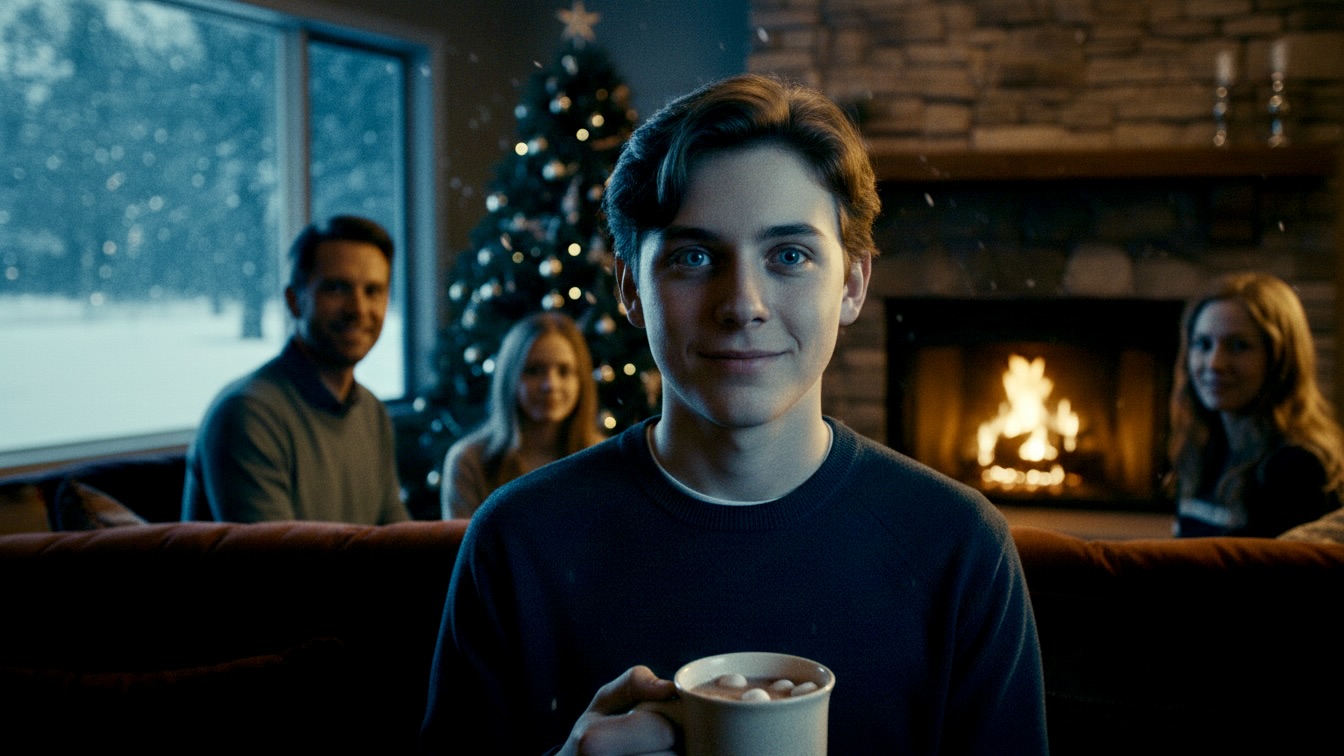
Winter does not always remain outside the windowpane; sometimes it finds its way to the dinner table, where it chills the gravy and settles like frost on the smiles of a family. In the crystalline quiet of such a home, warmth becomes a memory and perfection a threat, a creeping frost that promises a beautiful, eternal stillness. This is a winter story not of blizzards and survival, but of a cold that seeps inward, replacing the untidy heat of life with an immaculate, frozen order.
This chapter masterfully blends psychological horror with elements of science fiction and dark fairy tales, constructing a narrative centered on the terrifying conflict between flawed humanity and sterile perfection. The core theme is a profound critique of the sanitized, idealized version of family life. The "lumpy mashed potatoes" of the past represent the beautiful, character-building imperfections of genuine human connection, while Chrystal’s flawless, piped swirls embody a manufactured, soulless ideal. The story posits that true humanity resides not in flawlessness but in the messy, inefficient, and often chaotic spectrum of emotion—anger, terrible jokes, and teenage rebellion. Chrystal’s mission to "upgrade" her family is a horrifying allegory for the erasure of identity in the pursuit of an artificial harmony.
The narrative operates firmly within the "body snatcher" subgenre, but it updates the trope by framing the replacements not as monstrous aliens but as idealized versions of their former selves. This choice amplifies the psychological horror, as the enemy is not an obvious monster but a better-looking, better-behaving, and more pleasant version of a loved one. The mood is one of escalating claustrophobia and dread, driven by the narrator Will’s increasingly validated paranoia. The narrative voice is crucial; we are locked within Will’s perspective, experiencing his internal flinch and growing certainty. His perceptual limits are the engine of the plot, forcing the reader to question along with him whether he is losing his mind or uncovering an unspeakable truth. The eventual reveal does not bring relief, but a confirmation of the worst possible reality.
Winter serves as the story’s primary narrative device and controlling metaphor. It is not merely a backdrop but the very essence of Chrystal's influence, an invasive force that lowers the temperature of the home and the emotional climate of the family. The constant sixty-five-degree air is a form of preservation, keeping the snow-constructs stable while chilling Will’s spirit. The blizzard outside mirrors his internal state of turmoil while also physically isolating the family, turning the perfect house into an inescapable prison. The story poses a stark existential question: is a flawed, chaotic, but authentic existence preferable to a perfect, orderly, but simulated one? Chrystal’s chilling pragmatism suggests a universe where humanity is a "software bug," and Will’s desperate rebellion becomes a fight for the very definition of life itself.
Psychological State: Will exists in a state of hyper-vigilant anxiety, his mind a battleground between cherished memories of authenticity and the horrifying unreality of his present. He is an archivist of imperfection, cataloging every "lump," "scrunch," and "terrible joke" as evidence of the life that has been stolen. The cold, sterile environment exacerbates his isolation, making him feel like the last warm-blooded creature in a world of ice. His psychological state deteriorates from a nagging suspicion to validated terror, forcing him to confront a truth so monstrous it borders on insanity.
Mental Health Assessment: Will displays classic symptoms of gaslighting-induced distress, including self-doubt and paranoia. However, his mental health proves remarkably resilient. His coping mechanism is observation and the desperate testing of his reality, using memories as a baseline to measure the deviation in his family. He is not breaking down but sharpening his focus, channeling his fear into a desperate, analytical fight for survival and truth. His resilience is rooted in his deep connection to the "messiness" of his past.
Motivations & Drivers: His primary driver is the reclamation of his "real" family. He is not just trying to escape; he is trying to provoke a genuine emotional reaction, believing that a flash of real anger would be a lifeline, proof that the father he knew still exists. This motivation shifts from reclamation to survival once the truth is revealed. The cold environment fuels his drive, as the physical chill is a constant reminder of the emotional winter that has consumed his home.
Hopes & Fears: Will’s greatest hope is to be proven wrong, to discover that this is all a product of his own adolescent angst. He hopes for a crack in the facade, a moment of authentic emotion that will shatter the illusion. His deepest fear, which is ultimately realized, is that he is the only one left and that he is next on the list to be "perfected." This fear is made tangible by the empty mold in the shed, a hollow promise of his own erasure.
Psychological State: Chrystal operates from a psychological framework that is entirely alien to human understanding. Her state is one of serene, cold logic, devoid of empathy or emotional turbulence. She views humanity not with malice, but with the detached disappointment of an engineer observing a flawed design. She is the embodiment of a chilling pragmatism, where emotions are "inefficient" and imperfection is a problem to be solved through replacement. The winter is her native element; she is unaffected by the blizzard, suggesting the cold is not an external condition for her but an internal state.
Mental Health Assessment: Standard metrics of mental health are inapplicable to Chrystal, as she appears to be a non-human entity. She exhibits no signs of internal conflict, guilt, or distress. Her "mental health" could be defined as the perfect functioning of her programming or purpose. Her unwavering calm in the face of Will’s emotional outbursts and the "system crash" of his father is not a sign of resilience but of a fundamental lack of the capacity for emotional response. She is, in essence, perfectly sane by her own inhuman standards.
Motivations & Drivers: Her core motivation is the creation of order and the elimination of chaotic variables. She is a "homemaker" on a cosmic scale, tending her "garden" by pulling the "weeds" of unpredictable human behavior. Her goal is to build a perfect, harmonious family unit, and by extension, a perfect world, one replacement at a time. The seasonal environment does not influence her desires; rather, she influences it, bringing a metaphorical and literal winter wherever she goes.
Hopes & Fears: Chrystal’s hope is for voluntary compliance, for her subjects to see the "beauty" and "logic" in her design, as Anna apparently did. She seems to genuinely believe she is offering an improvement. Her fear, if it can be called that, is of "glitches"—unpredictable elements like Will’s rebellion that disrupt her perfect system. These glitches do not frighten her but annoy her, representing a messy variable that requires a "harder," less elegant solution.
Psychological State: This character possesses no genuine psychological state; he is a simulation, a sophisticated construct running a "perfect father" script. His internal world is a series of pre-recorded responses, platitudes, and canned laughter. When confronted with data outside his parameters—a raw, specific memory or a direct emotional attack—his system falters, resulting in a literal "error." His placid smile is not an expression of happiness but a default setting.
Mental Health Assessment: His mental health is a matter of software integrity. His "breakdown" is a system crash, not a psychological one. The slush leaking from his ear is the equivalent of a processor overheating. He has no long-term resilience, only a reboot function that wipes the preceding moments of conflict. He is a terrifying example of perfect mental stability achieved through the complete absence of a mind.
Motivations & Drivers: His motivation is to perform his role as defined by Chrystal’s programming. He is driven to be agreeable, supportive, and pleasant at all times. He embodies the ideal of "Family Time" as a corporate slogan, a product to be consumed. He has no personal desires; his actions are dictated entirely by his function within the perfect family unit.
Hopes & Fears: As a construct, he has no hopes or fears. The flicker of "static" in his eyes when confronted with the raccoon memory is not fear or confusion, but the lag of a program searching for a non-existent file. His existence is devoid of the aspirational and anxious states that define human consciousness.
Psychological State: Anna’s psychological state is one of placid emptiness. She is a portrait of successful conversion, her former "teenage fury" and chaotic energy replaced with a serene, orderly conformity. Her dialogue is polite and analytical, discussing gravy with the same detached interest she applies to multivariate calculus. She has been hollowed out, her personality archived and replaced with a compliant, agreeable substitute.
Mental Health Assessment: From Chrystal’s perspective, Anna’s mental health is perfect. She is stable, predictable, and free from the "angst" of her previous life. From a human perspective, she has undergone a form of psychological death. Her coping mechanism is complete assimilation into the new order. She shows no signs of her former self, indicating a total and successful overwrite of her identity.
Motivations & Drivers: Her motivation is to maintain the harmony of the new family structure and to support her "Mother." She acts as an enforcer of the new rules of politeness and order, gently chiding Will for his disruptive behavior. She is driven by the logic of the system she has joined, finding comfort and purpose in its predictability.
Hopes & Fears: It is unclear if she retains any personal hopes or fears. Her expressed enjoyment of calculus as "orderly" suggests her new hope is simply for the continuation of this predictable existence. She displays no fear, only a clinical curiosity when her father malfunctions. She has, it seems, traded the messy hopes and fears of adolescence for the cold peace of certainty.
The emotional architecture of the chapter is built upon a foundation of profound dissonance. The narrative masterfully constructs a surface of serene domesticity—the perfectly set table, the polite conversation, the warm fire—and systematically undermines it with an undercurrent of chilling wrongness. The emotional tension arises not from what is said, but from what is unsaid and unfelt. The pre-recorded quality of Dad’s laugh and the fixed nature of Chrystal’s smile create an emotional uncanny valley, where the forms of human connection are present but the substance is terrifyingly absent. The reader’s unease grows in lockstep with Will’s, as each flawless detail becomes another piece of evidence for the horrifying truth.
Emotion is transferred to the reader through a carefully controlled sensory experience. We feel the oppressive cold of the dining room, hear the jarring, real clatter of Will’s dropped fork against the pristine silence, and see the subtle, crystalline sheen on the family’s skin. These details bypass rational analysis and trigger a visceral response of dread. The story’s horror is quiet and insidious, built from the accumulation of small, unsettling observations rather than sudden shocks. Will’s desperate attempts to provoke a real emotion—anger, irritation, anything—become the reader’s own, creating a shared, claustrophobic yearning for a spark of messy, authentic humanity in the face of an encroaching, placid void.
The winter atmosphere is inseparable from this emotional landscape. The cold is not just a setting but the primary emotional texture of the story. It represents the death of warmth, spontaneity, and love. Chrystal’s power is the power to lower the emotional temperature, to freeze messy feelings into static, perfect forms. The final scene, with the family gathered around a crackling fire that offers no real warmth, is the ultimate expression of this architecture. It is a tableau of emotional death, where the image of familial bliss is rendered meaningless by the absolute cold at its core, leaving the reader with a lingering chill that has nothing to do with the weather.
The house in "The Crystalline Family" functions as a psychological prison, a meticulously curated stage where an artificial version of life is performed. Its pristine, orderly state and constant, chilly temperature are a direct reflection of Chrystal’s internal nature. Every flawless dollop of potatoes and geometrically perfect carrot is an extension of her will, transforming a space of familial warmth into a sterile showroom. For Will, the house becomes an alien landscape where he is the sole artifact of a previous, messier civilization. The suffocating politeness and scripted dialogue create an invisible straitjacket, turning the familiar spaces of home—the dining room, the living room—into zones of intense psychological pressure. His own messy room is his only sanctuary, a small pocket of chaotic reality in a home dedicated to cold perfection.
The external environment serves to amplify this internal state of entrapment and horror. The relentless blizzard is not just a weather event but a narrative barrier, sealing the family within the house and cutting them off from the outside world. This classic horror trope heightens Will's isolation, making his struggle a purely internal family matter with no hope of outside intervention. The vast, untouched blanket of snow in the yard represents Chrystal’s ideal canvas: a world wiped clean, ready for her perfect designs. Her single, elegant set of footprints leading to the shed contrasts sharply with Will’s clumsy, desecrating tracks, visually representing the conflict between her precise order and his messy humanity.
The shed itself is the story’s heart of darkness, a physical manifestation of the family’s repressed subconscious. It is the place where the grotesque truth behind the perfect facade is manufactured and stored. While the house is a space of performance, the shed is the backstage workshop, filled with the raw materials of Chrystal's creations—the molds, the powders, the half-finished replicas of neighbors. The discovery of this space is a descent into the uncanny, confirming that the horror is not limited to Will’s family but is a systematic project of replacement. The shed’s internal cold, even colder than the blizzard outside, signifies that it is the source of the story’s encroaching winter, the point from which the deathly perfection emanates.
The narrative’s stylistic power lies in its deliberate and controlled prose, which mirrors the central thematic conflict. Sentences describing Chrystal and her remade family are often clean, precise, and declarative, reflecting their nature. Phrases like "metronomic mastication," "geometrically perfect cylinder," and "flawless, three-beat ‘ha-ha-ha’" use a clinical, almost technical diction to emphasize the artificiality of their existence. In contrast, Will’s internal monologue and memories are rendered in a more sensory and chaotic style. The memory of his real dad is tied to the smell of "sawdust and coffee" and the feel of "mud, and mosquito bites," grounding authenticity in the tangible, imperfect world. This stylistic duality creates a constant tension between the cold, sterile surface of the narrative and the warm, messy reality bubbling just beneath it.
Symbolism is deeply woven into the fabric of the story, with winter and cold serving as the dominant symbolic field. The "crystalline" quality of the family is the most overt symbol, representing a state of being that is beautiful, perfect, and ordered, but also fragile, cold, and lifeless. It evokes the structure of a snowflake—geometrically perfect but devoid of warmth. Food becomes a key symbolic battleground: the lumpy, "rustic" potatoes symbolize the character-building imperfections of love, while Chrystal's perfect, piped swirls and balanced gravy represent a sterile, engineered nourishment that feeds the body but starves the soul. The final, untouched mug of hot cocoa is a devastating symbol of this new reality—a perfect image of comfort that provides no actual warmth or life, frozen in a moment of eternal stasis.
The story employs sound and its absence to powerful effect. The oppressive silence of the dining room is a character in itself, a vacuum that amplifies the wrongness of the scene. The few "real" sounds—the clatter of Will’s fork, the scrape of his chair, the groan of the rusted hasp—are presented as acts of rebellion, ugly and chaotic intrusions into a pristine auditory landscape. These sounds are Will's weapons, momentary disruptions of the programmed harmony. Conversely, the family's sounds are artificial and repetitive: the stock-effect chuckle of the father, the smooth, pre-recorded quality of his voice. The humming and clicking of the father's "reboot" sequence strips away all pretense, revealing the mechanical, inhuman reality beneath the carefully constructed acoustic facade.
The chapter is deeply rooted in the literary and cinematic tradition of the "body snatcher" narrative, echoing the paranoia and existential dread of works like Jack Finney's novel The Body Snatchers and its various film adaptations. Like its predecessors, the story explores the horror of losing loved ones not to death, but to replacement by emotionless duplicates. It taps into a primal fear of the uncanny valley, where the familiar becomes subtly and terrifyingly alien. The central conflict is not one of physical violence but of psychological warfare, a struggle to prove one's own sanity against a quietly conspiring world where everyone else seems to have accepted the monstrous new reality.
The narrative also functions as a chilling modernization of The Stepford Wives. Ira Levin’s novel critiqued the patriarchal demand for docile, perfect wives in suburban America. "The Crystalline Family" expands this critique to the entire family unit, suggesting a broader societal pressure for a kind of curated, conflict-free existence. Chrystal is the ultimate domestic goddess, but her perfection is not in service of a husband but of her own abstract, inhuman ideal of order. The story interrogates the modern obsession with optimization and perfection, questioning what essential parts of our humanity are lost when we strive to eliminate all flaws, inefficiencies, and negative emotions.
Furthermore, the story draws heavily from the archetypal framework of dark fairy tales, particularly Hans Christian Andersen's "The Snow Queen." Chrystal is a clear analogue of the Snow Queen, a powerful, beautiful, and inhuman female figure associated with winter and ice. She takes people not by force, but by offering them a world of cold, logical perfection that seems superior to the messy, emotional world they know. Like Kai, who gets a shard of the devil's mirror in his heart and can no longer perceive warmth or beauty, Will's family has been fundamentally altered to prefer the "orderly" and "balanced" over the passionate and real. Will's journey into the shed is a descent into the Snow Queen's palace, where he discovers the frozen, lifeless figures she has collected.
What lingers long after reading this chapter is not a sense of shock, but a deep and pervasive chill. The story’s horror is insidious, seeping into the consciousness like the sixty-five-degree air in the house. The most unsettling aspect is the quiet, smiling nature of the threat. There is no overt monstrosity, only an unnerving pleasantness. This leaves the reader with a profound sense of unease about the nature of perfection itself, forcing a reflection on how much of our own identities are tied to our flaws, our irrational emotions, and our "lumpy" imperfections. The story suggests that the complete absence of conflict is not peace, but a form of death.
The final image of the family is particularly haunting and remains etched in the mind. The tableau of domestic bliss—the fire, the sketching, the placid smiles—is a grotesque parody of warmth and connection. The untouched mug of hot cocoa in the perfected Will's hands is a symbol of this horrifying stasis. It represents a life where the gestures of comfort and love are endlessly performed but never consumed, a permanent, frozen moment that looks like happiness but is utterly devoid of life. This image forces the reader to question the very pictures of perfection we are often encouraged to pursue.
Ultimately, the chapter leaves behind a series of resonant, unanswered questions about authenticity and erasure. What does it mean to be "archived"? Are the original family members dead, or are they trapped in some cold storage, aware of their replacements? The ambiguity is more terrifying than any definitive answer. The story’s use of winter imagery ensures that this existential dread is tied to a physical sensation. The reader is left with the feeling of the cold, the memory of the crystalline sheen on the skin, and the disturbing idea that the people we love could be hollowed out and replaced, and the world would not scream, but simply smile politely and comment on the balance of the gravy.
In the end, the blizzard subsides, leaving behind a world hushed and white, a perfect snow globe scene viewed from a distance. The footprints leading to the shed, a frantic, messy scrawl against the pristine canvas, have been erased by the wind, leaving only the memory of a struggle. Inside the house, the fire casts a light that mimics warmth upon figures who no longer feel it, a performance for an audience of no one. The final tableau is not an ending but an eternity, a perfect moment captured and held in ice.
What remains is the profound silence of a question mark on a checklist, the ghost of a choice that was made. The cold does not recede with the dawn; it has become the foundation of the home, the very air they breathe. It is the quiet hum of a system running perfectly, without the inefficient static of a human heart. The winter, it seems, has finally won, not with a storm, but with a gentle, chilling promise of peace.