Melgund Township Winter Story Library
The Kindness of Strangers - Analysis
by Leaf Richards | Analysis
by Leaf Richards | Analysis
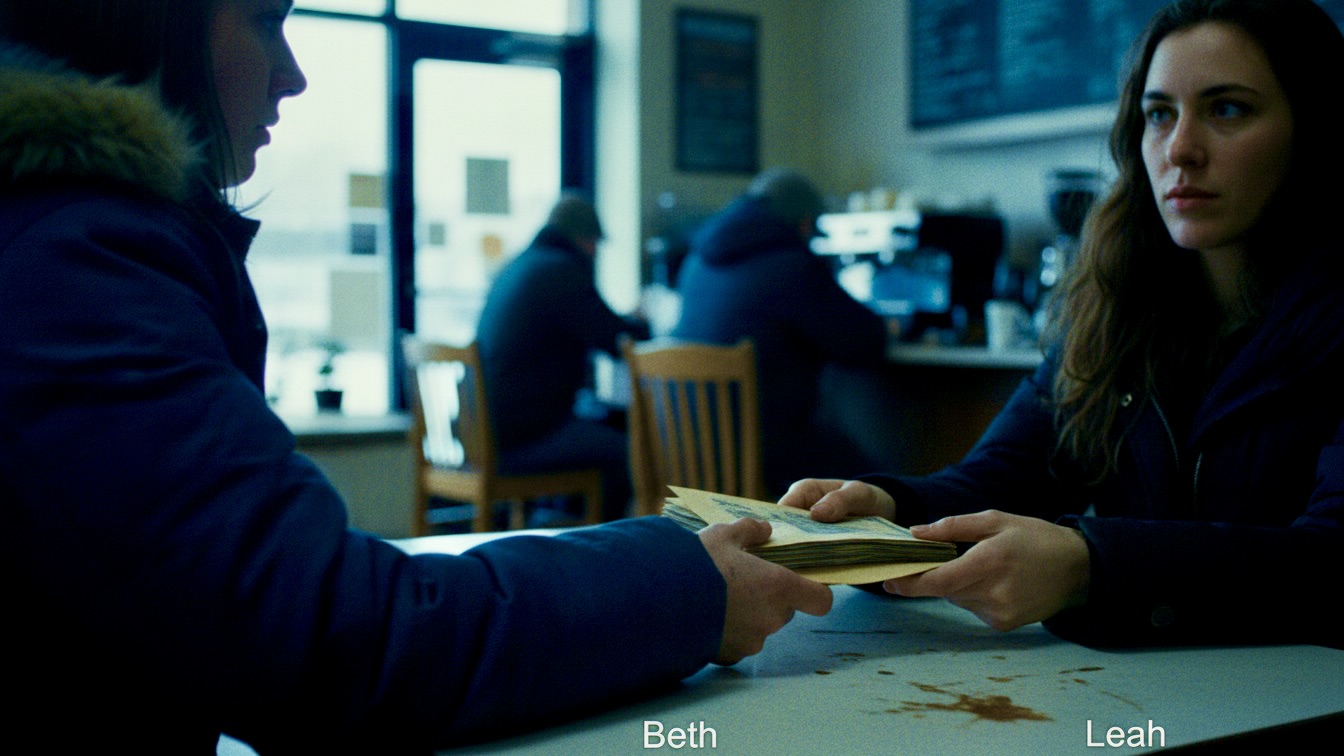
The narrative centers on Beth, a destitute mother facing the twin crises of eviction and her son Josh’s critical medical needs. After a humiliating and failed attempt to beg a pharmacist for life-saving medication, Beth is approached in a coffee shop by an elegant, mysterious woman named Leah. Leah presents herself as an agent of a charitable foundation and gifts Beth four thousand dollars in cash, asking for nothing in return but that the money be used for rent and medication. Beth accepts the money, resolving her immediate financial perils and enjoying a brief period of relief and stability. However, the illusion of benevolence is shattered weeks later when Leah confronts Beth in a grocery store. Leah reveals that the money was not a gift but a purchase of loyalty, effectively trapping Beth into servitude for a shadowy organization under the threat of cutting off her son’s lifeline.
The story offers a chilling deconstruction of the concept of altruism, specifically exploring the commodification of desperation. The narrative initially presents a classic "Good Samaritan" trope, only to invert it into a Faustian bargain. The central theme revolves around the vulnerability inherent in poverty. Beth’s economic destitution strips her of her defenses, making her the perfect target for predatory grooming. The story suggests that in a capitalist framework, even kindness can be weaponized as a transaction, where the currency is not just money, but human autonomy.
Furthermore, the text examines the psychological state of scarcity. Beth’s world is narrowed down to immediate survival—the "whistling breath" of her son and the "pink slip" on the door. This tunnel vision, a well-documented psychological response to trauma and poverty, prevents her from critically assessing the too-good-to-be-true nature of Leah’s offer. The predator exploits this cognitive load; Leah knows that a drowning woman does not check the pedigree of the hand reaching out to save her.
Finally, the story tackles the theme of ownership and freedom. Initially, Beth views the money as a tool of liberation, a way to break the chains of debt and illness. The tragic irony is revealed in the climax, where the very instrument of her supposed freedom becomes the shackle that binds her. The narrative posits that true autonomy is a luxury of the solvent, while the desperate are merely assets waiting to be acquired by those with resources. The transition from the "weight on her chest" lifting to the realization of being "owned" underscores the terrifying fragility of freedom for the working poor.
Beth serves as the archetype of the desperate protector, her identity entirely subsumed by her role as a mother fighting for her child's survival. Psychologically, she is operating in a state of chronic high alert, evidenced by her physical reactions: the "white knuckles," the "frantic" jiggling of the key, and the shame that burns hot on her cheeks. Her internal monologue reveals a woman who has exhausted all conventional avenues of support and is teetering on the brink of total collapse. She is not naive, as she initially suspects a scam, but her survival instinct overrides her skepticism.
Her transformation throughout the chapter is tragic. She moves from a state of paralyzed hopelessness to a euphoric, almost manic relief, only to end in a state of subjugation that is arguably worse than her starting point. The "shame" she feels when begging on the phone is replaced by the "dread" of realization in the supermarket. This shift marks the psychological breaking point where she realizes that her agency has been permanently excised. She is no longer fighting the system; she has become a prisoner of it.
Leah represents the banality of evil, characterized not by malice or cruelty, but by a detached, corporate efficiency. Her appearance is meticulously curated—"expensive honey" hair, a "sharp" coat—signaling wealth, control, and precision. She operates with the cold logic of an investor rather than a savior. Psychologically, she displays traits of high-functioning psychopathy or extreme Machiavellianism, viewing human interaction strictly through the lens of utility and leverage.
Her manipulation of Beth is masterfully paced. She waits until Beth is at her lowest point, the "end of the line," to intervene. By framing the initial transaction as an "investment in community wellness," she adopts the camouflage of a philanthropist to lower Beth's defenses. When she reveals her true nature in the grocery store, her demeanor shifts from sympathetic to appraising. She strips away the facade of humanity to reveal the transactional nature of their relationship, treating Beth not as a person, but as an acquired asset with a specific return on investment.
The narrative employs a claustrophobic and sensory-heavy style to immerse the reader in Beth’s desperation. The pacing mirrors Beth’s physiological state: it begins with the frantic, stuttering rhythm of the locked door and the eviction notice, slows down to the suffocating stillness of the coffee shop, and then accelerates into the "dream" sequence of the middle weeks. The final scene in the supermarket delivers a sharp, sudden stop, mimicking the sensation of a trap snapping shut. This pacing manipulation effectively places the reader in Beth’s emotional headspace, sharing her tension and her fleeting, false relief.
Sensory details are used to underscore the harshness of Beth’s reality. The environment is described in terms of temperature and texture: the "cold brass" of the key, the "sheet of ice" letter, and the "scarred laminate" of the table. These cold, hard surfaces contrast with the "expensive smells" of the market, which Beth perceives as a "personal insult." This juxtaposition highlights the alienation she feels from the comfortable world around her. The sound of Josh’s "shallow, whistling breath" acts as a grim metronome throughout the first half, a constant auditory reminder of the stakes.
The narrative voice is third-person limited, adhering strictly to Beth’s perspective. This limitation is crucial for the twist, as the reader is only privy to the information Beth possesses. We share her skepticism and her subsequent relief, making the betrayal in the final act feel personal and visceral. The dialogue shifts from the raw, jagged pleading of Beth to the smooth, rehearsed rhetoric of Leah. Leah’s language is corporate and euphemistic—using terms like "acquisition cost" and "investment"—which contrasts violently with the emotional reality of slavery and blackmail, heightening the horror of the conclusion.