Melgund Township Winter Story Library
A Grotesquely Mundane Winter - Analysis
by Leaf Richards | Analysis
by Leaf Richards | Analysis
The narrative centers on Brenda, a social media influencer who has built a lucrative brand around "tragic chic" and performative misery in the freezing climate of Winnipeg. The story opens with Brenda livestreaming a staged rant about a broken bus shelter heater, juxtaposing her expensive, ethically sourced clothing against the genuine suffering of a homeless man nearby, whom she callously ignores. Her performance of "existential dread" goes viral, validating her superficial engagement with the harsh realities of her environment and boosting her follower count. However, this digital success attracts the attention of an obsessive follower operating under the handle "Snowflake_Sadist."
Initially, the interaction follows a familiar parasocial trajectory, with the admirer sending flowery, dark messages that Brenda dismisses as harmless fan engagement. The situation escalates when physical gifts arrive at her doorstep: a preserved snowflake, a frozen sparrow on a sled, and finally, a frozen rat dressed in a scarf. Brenda attempts to rationalize these grotesque offerings as edgy performance art, failing to recognize the genuine threat they represent. She continues her routine, organizing a satirical "GloomTax" protest to create content around the city's oppressive atmosphere.
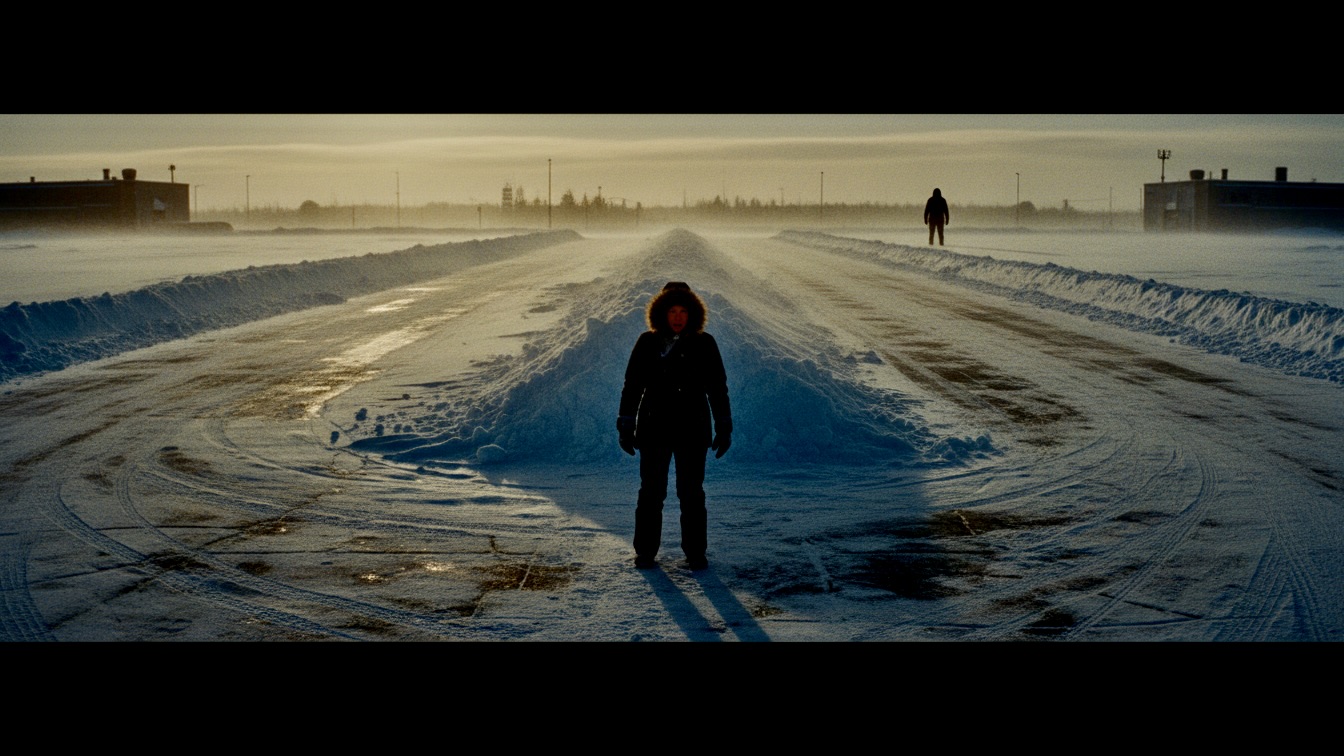
During the protest, Brenda uses a drone to capture footage and inadvertently witnesses Snowflake_Sadist sabotaging a municipal snowplow. The stalker disables the machine, creating a massive snowdrift that blocks her path home. When she confronts him, expecting to assert her dominance as the creator of the narrative, he dismantles her worldview. He critiques her curated misery as hollow and declares his intent to expose her to the "raw, unfiltered essence" of suffering. He disables her technology, stripping away her digital shield and leaving her isolated in the freezing cold, facing a terrifying reality that she can no longer edit or filter.
The primary theme of the text is the commodification of suffering and the dissonance between performative angst and genuine hardship. The story critiques a digital culture where negative emotions and difficult circumstances are repackaged as aesthetic experiences for consumption. Brenda treats the brutal Winnipeg winter not as a survival challenge, but as a backdrop for her personal brand. She speaks of "existential dread" and "unmitigated suffering" while wearing expensive alpaca wool, effectively gentrifying the experience of misery. The narrative starkly contrasts her curated gloom with the actual, bone-deep cold experienced by the homeless man in the bus shelter, highlighting the hollowness of her digital persona.
Closely linked to this is the theme of the parasocial feedback loop and the dangerous erosion of boundaries between creator and audience. The story illustrates how the internet rewards extreme behaviors and validates a disconnected view of reality. Brenda views her followers as numbers and her stalker as a mere extension of her "impact," failing to see the human volatility on the other side of the screen. Snowflake_Sadist represents the dark consequence of this dynamic; he takes her performative metaphors literally. He acts as a grotesque mirror, reflecting her "art" back at her with a terrifying, physical authenticity that she never intended to invite.
Furthermore, the text explores the psychological concept of desensitization and dissociation. Brenda is so immersed in the lens of her camera that she disassociates from the physical world around her. She feels a brief pang of guilt regarding the other commuters but quickly extinguishes it with the dopamine hit of rising viewer counts. This suggests a pathological narcissism where the self is only real when observed and validated by others. The climax of the story forces a reintegration of the self, where the loss of her technology strips away the dissociative barrier, forcing her to confront the visceral, unmediated terror of her situation.
Brenda functions as the protagonist, though her psychological profile reveals deep-seated narcissism and a profound lack of empathy. She operates as a director of her own reality, viewing the world solely as a set for her content. Her interaction with the homeless man is particularly telling; she reduces him to "background noise" because he does not fit her narrative of "aesthetic despair." This dehumanization reveals that her "gloom" is entirely egocentric. She does not mourn the state of the world; she merely capitalizes on it. Her motivation is purely extrinsic, driven by financial projections and the validation of stranger’s likes, which she uses as a "balm against the actual cold."
Psychologically, Brenda exhibits a classic case of the "online self" consuming the "authentic self." She has rehearsed her indignation to the point where she likely cannot distinguish between her true feelings and her performance. Her internal state is one of constant calculation; even her shivering is a "delicate dance" designed for the camera. This hyper-awareness of her image leaves her vulnerable to a threat that refuses to play by the rules of social media. Her conflict arises when the control she exerts over her digital narrative fails to translate to the physical world.
When confronted by Snowflake_Sadist, Brenda’s initial reaction is indignation rather than fear, illustrating her delusion of control. She attempts to frame his sabotage as "plagiarism" and an infringement on her "intellectual property," framing a physical threat in legalistic, commercial terms. It is only when her technology—her connection to the audience—is severed that her psychological defenses crumble. In that moment, she is forced to regress from a "Queen of Gloom" to a frightened individual, realizing that her ironic detachment offers no protection against genuine malevolence.
The antagonist, Snowflake_Sadist, serves as the narrative's shadow archetype. He is a male figure who embodies the literal interpretation of Brenda’s metaphorical content. While Brenda represents the superficial simulation of misery, he represents the "purist" reality of it. His psychology is characterized by an obsessive fixation and a delusional sense of artistic partnership. He does not see himself as a stalker, but as a collaborator who is elevating Brenda’s work to its logical conclusion. His critique of her—that she is a "shallow imitator"—suggests a twisted moral superiority; he believes he is doing her a favor by forcing her to experience the truth of her own brand.
His motivations are rooted in a desire to bridge the gap between the signifier (Brenda’s posts) and the signified (actual death and cold). The gifts he sends—the preserved snowflake, the frozen sparrow, the dead rat—are escalations in this lesson. They move from beautiful to morbid to grotesque, mirroring his intent to strip away the "beauty" of her sadness to reveal the rotting reality beneath. His sabotage of the snowplow is an act of environmental control, transforming the city into the prison Brenda playfully claimed it was. He is the physical manifestation of the consequences Brenda ignores, a terrifying force that demands authenticity at the cost of safety.
The narrative voice employs a third-person limited perspective that is closely aligned with Brenda’s consciousness. This allows the reader to inhabit her superficial worldview, hearing her internal monologue about "financial projections" and "aesthetic presentation." The tone begins as biting satire, mocking the absurdity of influencer culture with phrases like "artisanal despair" and "symphony of manufactured outrage." This satirical distance invites the reader to judge Brenda, creating a sense of irony that permeates the first half of the text.
However, the style undergoes a significant shift as the threat becomes tangible. The pacing, which is initially rhythmic and cyclical to match the flow of a social media feed, becomes sharp and jagged. As Snowflake_Sadist enters the physical space, the sensory details shift from visual aesthetics to visceral experiences. The descriptions change from "perfectly rehearsed indignation" to the smell of "old blood mixed with ammonia" and the "viscous fluid" of the snowplow. This shift in imagery mirrors the thematic move from performance to reality, grounding the horror in tactile, repulsive elements.
The climax utilizes silence and atmospheric pressure to build tension. The wind is personified as a "monstrous, invisible beast," and the cold becomes a "living, breathing entity." This anthropomorphism of the weather serves to isolate Brenda, making the environment an accomplice to the antagonist. The final paragraphs strip away the satirical voice entirely, replacing it with a tone of genuine dread. The abrupt sentences—"No signal. No internet. Nothing."—mimic the sudden cessation of Brenda’s digital heartbeat, leaving the reader with a chilling sense of finality that contrasts sharply with the glib opening of the chapter.