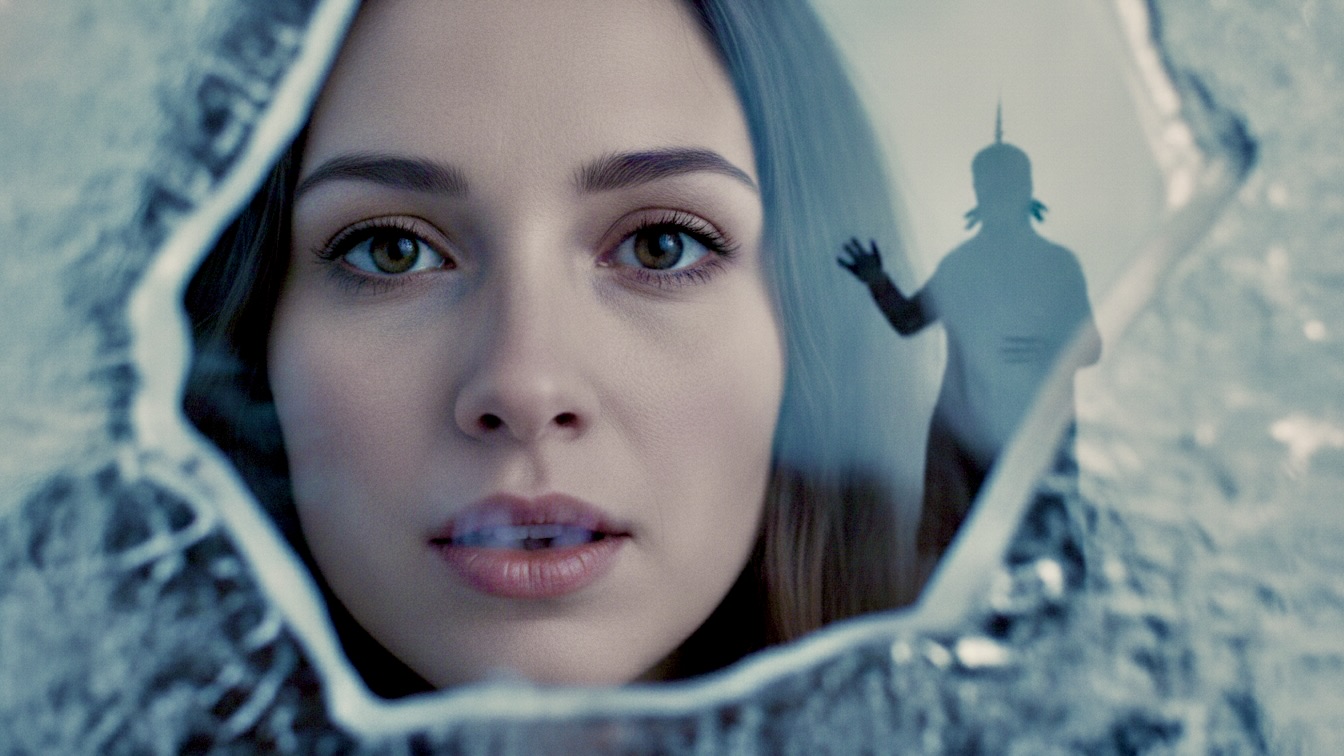
The chapter begins with Patti breaking up with her boyfriend, Jack, citing his "fine" demeanor and their unremarkable relationship as the reason. Jack, baffled and unresisting, leaves, leaving Patti feeling a profound, hollow cold. The next morning, she discovers a perfectly sculpted ice heart on her windowsill. Days later, a life-sized ice swan appears on her fire escape, which she posts about online, dismissing her friends' concerns as a lack of imagination. Patti romanticizes the unknown artist, whom she mentally dubs "the Ice Prince," seeing him as a mysterious, powerful figure who understands her craving for the sublime. A week later, a snarling ice wolf appears in her hallway, which Patti interprets as a sign of his passion and protective nature, again dismissing her friend Chloe’s panicked warnings of stalking. Her world feels increasingly like a fairy tale, vibrant and alive. The narrative culminates when Patti wakes to find her entire apartment door encased in a thick sheet of ice, with an icicle dagger pointing at the lock. She perceives this not as imprisonment, but as the ultimate grand gesture and a test from her Ice Prince. Rejecting her friend's pleas to call for help, Patti decides to use a hairdryer to melt the ice around the lock, choosing to embrace the "magic" and prove herself worthy of his dangerous love. As she frantically melts the ice, the electricity flickers, then dies, plunging her into complete darkness and an intensified cold.
The central theme explored in this chapter is the perilous allure of the extraordinary versus the comfort of the mundane. Patti's initial dissatisfaction stems from a life she perceives as "fine," lacking the intensity and passion she craves. She yearns for "a storm" and "beautiful, survivable car crashes," rejecting the sensible and predictable in favor of a love that feels cinematic and consuming. This deep-seated desire drives her to reinterpret increasingly alarming events as romantic gestures, demonstrating the seductive power of fantasy.
Another significant theme is the blurred line between passionate romance and dangerous obsession or stalking. The Ice Prince's actions—leaving impossible sculptures, trespassing, and ultimately trapping Patti—are objectively menacing. However, Patti's subjective perception transforms these into declarations of love, art, and a "fairy tale." Her friends, particularly Chloe, represent the pragmatic, external reality, highlighting the cognitive distortion at play as Patti willingly embraces a situation that is clearly threatening.
The chapter also delves into the theme of perception versus reality. Patti constructs an elaborate internal narrative where she is a "chosen princess" and the Ice Prince is a silent, powerful lover. This internal world becomes her primary reality, overriding common sense and the warnings of others. Her deliberate choice to remain trapped and to actively work towards the Ice Prince's perceived challenge underscores her complete immersion in this fabricated reality, demonstrating how intense desire can warp one's understanding of external events.
Furthermore, the narrative touches upon themes of control and agency. Patti initially seeks agency by ending her relationship with Jack, but then paradoxically cedes control to the Ice Prince, allowing herself to be manipulated and ultimately imprisoned. Her final act of using the hairdryer, while seemingly an act of defiance against the ice, is ultimately an act of submission to the Ice Prince's challenge, proving her willingness to play by his dangerous rules. This highlights the complex interplay between seeking freedom and succumbing to a powerful, albeit destructive, form of devotion.
Patti is a protagonist defined by her profound dissatisfaction with the ordinary and her intense yearning for the extraordinary. Her internal state is marked by an emotional void, a "hollow cold" that she experiences after breaking up with Jack. This numbness fuels her desperate craving for passion, drama, and a love that feels "electrically, terrifyingly alive," even if it borders on the dangerous. She romanticizes the concept of love, seeking a "beautiful, survivable car crash" rather than comfortable companionship, suggesting a deep-seated need for intense emotional stimulation and perhaps a subconscious desire to escape the banality of her own existence.
Psychologically, Patti exhibits traits consistent with a person prone to romantic idealization and cognitive distortion. She consistently reinterprets the Ice Prince's actions, which are objectively forms of stalking and intimidation, as grand gestures of love and artistic expression. Her dismissiveness towards Chloe's legitimate concerns highlights a growing social isolation and a detachment from conventional reality. Patti's embrace of the "Ice Prince" allows her to project her desires onto a mysterious figure, transforming him into a powerful, idealized lover who understands her unique needs. Her "manic grin" and "crazed prayer" during the climax reveal a mind that has crossed the threshold into a dangerous delusion, prioritizing a fantastical narrative over her own safety and well-being.
Jack serves as a foil to Patti's intense romantic aspirations, embodying the "fine" and mundane existence she so vehemently rejects. He is characterized by logic, predictability, and an inability to comprehend Patti's desire for "more." His "stupid, beige coat" and voice, described as "exactly the color of his coat," symbolize his lack of vibrant passion and emotional depth in Patti's eyes. He is a creature of sensible choices, unable to provide the "storm" or "grand gesture" Patti craves, making him an unsuitable partner for her dramatic temperament.
Psychologically, Jack appears to be a stable, if somewhat uninspired, individual. His genuine bafflement at Patti's reasoning and his lack of a "script" for the breakup suggest a straightforward personality that struggles with abstract emotional demands. He doesn't fight or yell; he simply accepts the breakup and walks away, making "soft, sensible sounds." This pragmatic and non-confrontational response further solidifies his image as someone content with a comfortable, predictable life, highlighting the vast chasm between his emotional landscape and Patti's craving for intensity and dramatic romance.
The chapter employs a compelling narrative style that effectively draws the reader into Patti's subjective experience, blurring the lines between romance and delusion. The pacing begins with a deliberate, somewhat melancholic rhythm, establishing Patti's initial dissatisfaction and emotional numbness following the breakup. As the ice sculptures begin to appear, the pacing quickens, building a sense of mystery and escalating tension, reflecting Patti's growing excitement and immersion in her self-created fairy tale. The climax, with Patti's frantic attempt to melt the ice, is particularly fast-paced, creating a breathless, desperate atmosphere that culminates in the sudden, jarring blackout.
The tone of the narrative undergoes a significant transformation. It starts with a feeling of quiet resignation and emotional emptiness, then transitions into one of increasingly manic excitement, wonder, and a touch of fear. This evolving tone effectively mirrors Patti's psychological journey from numbness to a terrifyingly alive state. The narrative voice is strictly first-person, immersing the reader entirely in Patti's perspective. This subjective viewpoint is crucial, as it allows the reader to experience her romanticized interpretation of events, even as external clues (like Chloe's warnings and the sharp edges of the sculptures) hint at the underlying danger.
Sensory details are used with striking precision, particularly those related to cold, ice, and light, to create a vivid and atmospheric setting. The "hollow cold" Patti feels after the breakup is a recurring motif, gradually replaced by the "sharp, clean shock" of the ice and the "frigid air" that becomes a "familiar greeting." Descriptions such as the "perfectly clear" ice heart, the "impossible grace" of the swan, and the "icicle daggers" of the wolf's teeth emphasize the beautiful yet inherently dangerous nature of the Ice Prince's gifts. The final scene is rich with sensory input: the "dim, watery blue" light, the "icy floor," the "pathetic plastic whine" of the hairdryer, the "smell of melting ice and hot plastic," and the ultimate, terrifying "profound, ringing silence" of the blackout, all contribute to the claustrophobic and disorienting climax.