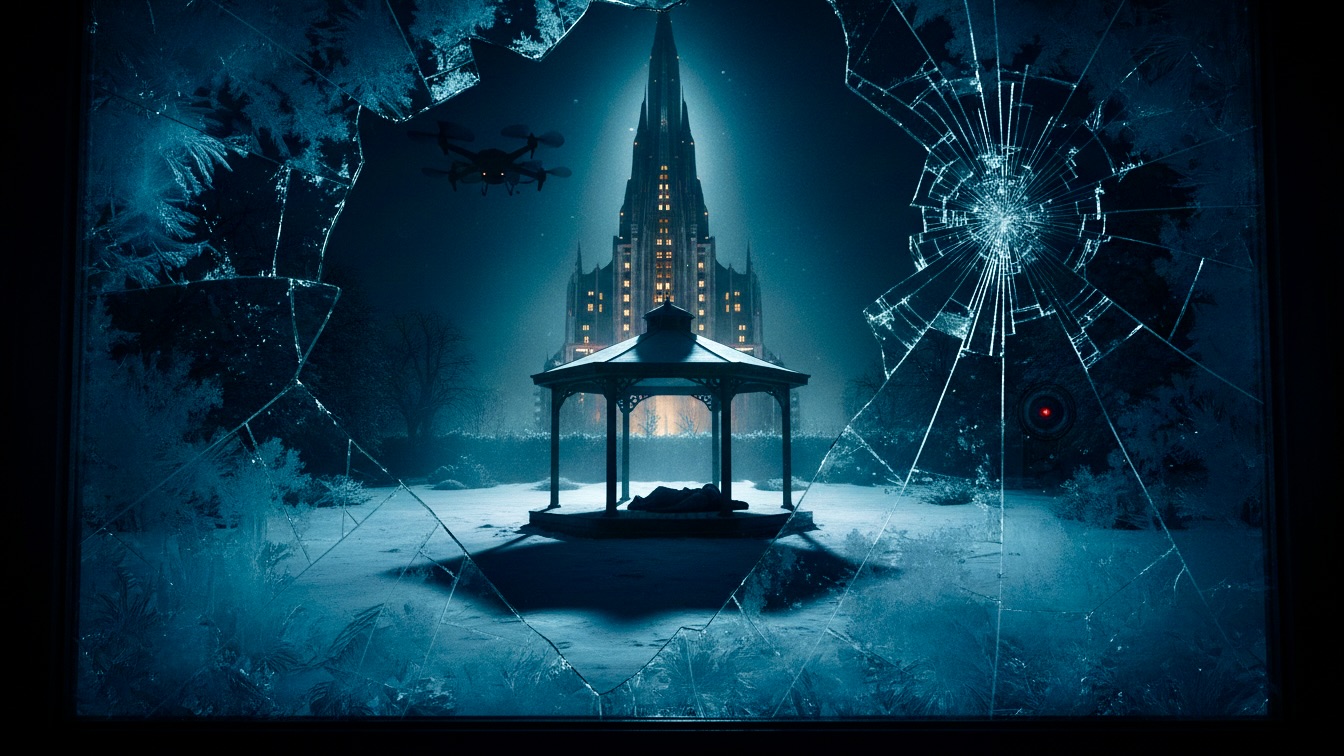
The narrative opens in the squalid, freezing confines of a clinic within the Minneapolis Autonomous Zone, where the protagonist, Theo, struggles with the humiliating task of cleaning bedpans with his injured, bandaged hands. This monotony is shattered by a BHI raid, which manifests not as a chaotic assault but as a calculated theatrical production. Mina, a pragmatic nurse, initiates an evacuation protocol, enlisting Theo to help move a catatonic patient to safety. However, as they pass a window overlooking the Reading Garden, Theo is seduced by the unfolding spectacle outside: a staged "Truth and Reconciliation" ceremony illuminated by floodlights and drones.
Overcome by his compulsive identity as a journalist and the desperate need to capture the "story," Theo instinctively releases his grip on the patient’s stretcher to grab his camera bag. This act of negligence causes the patient to fall and suffer a head injury, drawing a sharp rebuke from Mina. ignoring the immediate human cost, Theo rushes to the window to photograph the staged confessions and the subsequent execution of resistance leader Felix Arden. His attempt is thwarted by his own physical limitations and a technical failure of his equipment. Ultimately, he misses the critical moment of the execution and is left with nothing but his own complicity, facing Mina’s cold, damning judgment in the aftermath.
The central theme of the text is the transformation of violence into performance, or what might be termed the "theater of power." The BHI does not simply suppress the rebellion; they curate it into a production complete with lighting, staging, and a script. The execution of Felix Arden is not merely a killing but a "correction" designed for an audience, both present in the garden and watching via feeds. The text explores how authoritarian regimes utilize spectacle to rewrite reality, turning starving citizens into actors in a morality play about "healing" and "restoration." The physical setting of the Reading Garden, once a place of quiet contemplation, is perverted into a television studio, highlighting the intrusion of propaganda into every sanctuary of human life.
Parallel to this is the theme of the observer versus the participant, specifically the moral peril of detachment. Theo views his surroundings through the lens of "the story," a psychological defense mechanism that allows him to distance himself from his own suffering and uselessness. He believes that by documenting the atrocity, he is fighting it. However, the narrative ruthlessly deconstructs this notion. His desire to observe the event leads him to actively harm a vulnerable person under his care. The story argues that the role of the "objective witness" is a fallacy in times of crisis; one cannot stand apart from the suffering of others without eventually becoming complicit in it.
Furthermore, the text examines the relationship between physical and moral paralysis. The pervasive cold serves as a relentless antagonist that penetrates both the body and the spirit. Theo’s physical incapacity—his frostbitten fingers, his inability to scrub the bedpan, his clumsiness with the camera—mirrors his moral impotence. Just as his hands fail to perform the mechanical tasks of focusing the lens or gripping the stretcher, his moral compass fails to prioritize immediate human need over abstract professional ambition. The environment strips away the luxury of high ideals, leaving only the raw, freezing reality where a failure to act physically results in tangible harm.
Theo serves as a tragic study in the psychology of professional dissociation and the desperate reclamation of agency. He is introduced in a state of profound emasculation, reduced from a truth-seeking journalist to a crippled man cleaning human waste. The detailed description of his physical struggle with the bedpan establishes his deep-seated need to escape his current reality. He feels "stripped of everything," and his identity as a journalist is the only vestige of self-worth he retains. Consequently, when the raid begins, his psyche fractures. He separates himself from the "human" task of saving the patient and retreats into the persona of the "observer," believing that capturing the image is a higher calling than preserving the individual life in front of him.
This internal conflict manifests in a moment of reflexive betrayal. When Theo drops the stretcher, it is not a calculated act of malice but a conditioned response to the stimulus of "news." His mind is so rewired by his profession that the "light in his mind" flares not for the safety of the catatonic woman, but for the camera hidden behind the radiator. This action reveals a narcissism born of trauma; he is desperate to prove his existence and utility through his work. He needs the photo to validate his suffering, to make the cold and the humiliation "worth it." The tragedy lies in the fact that this desperation renders him incompetent in both realms: he fails as a caregiver, and he fails as a witness.
The climax of Theo’s arc is the crushing realization of his own hollowness. The technical failure of the SD card is a brutal metaphor for his internal state; he is unable to process or store the reality before him. When the camera fails, he is left defenseless against the truth. Mina’s final assessment—"You did this"—strips away his journalistic armor. He can no longer hide behind the role of the objective recorder. The narrative leaves him in a state of static silence, understanding that by prioritizing the image of the crime over the victim of the crime, he has become an extension of the brutality he sought to expose. He is no longer a hero or a victim, but a "parasite" who consumes suffering without alleviating it.
The narrative voice is intensely somatic, grounding the reader in the visceral, uncomfortable reality of the protagonist's body. The prose focuses heavily on sensory details of pain and cold: the "swollen sausages" of fingers, the "wire of fire" in a cramped arm, and the "wet, clinging" gauze. This tactile imagery creates a claustrophobic atmosphere that mirrors the psychological entrapment of the characters. The author uses short, clipped sentences—"Sponge. Wipe. Sponge. Wipe."—to mimic the monotony of Theo's labor and the fragmentation of his focus. This rhythmic, staccato style builds tension and reflects the shivering, disjointed thought processes of a man on the brink of hypothermia and panic.
The pacing is structured to contrast the slow, agonizing passage of time inside the clinic with the swift, choreographed violence outside. The opening scene with the bedpan is deliberate and grueling, emphasizing Theo’s powerlessness. This shifts abruptly with the arrival of the BHI, where the pacing accelerates into a frantic scramble. However, the climax subverts the expectation of a dramatic crescendo. The execution of Felix Arden is described with a chilling lack of fanfare—a "pop" like a firecracker, followed by a sudden collapse. This anti-climax emphasizes the banality of the violence; there is no cinematic glory, only a sudden, irrevocable cessation of life.
The tone is relentlessly bleak, characterized by a clinical detachment that mirrors the cold environment. The lighting plays a crucial symbolic role, contrasting the "dim," "flickering" interior of the clinic—representing the failing, messy reality of human survival—with the "blinding white" floodlights of the garden—representing the artificial, sanitizing lie of the regime. The use of irony is also potent, particularly in the juxtaposition of the "Truth and Reconciliation" banner with the staged, coerced confessions. The narrative voice maintains a close third-person perspective, trapping the reader inside Theo’s head, forcing them to experience his rationalizations and, ultimately, his inescapable shame.