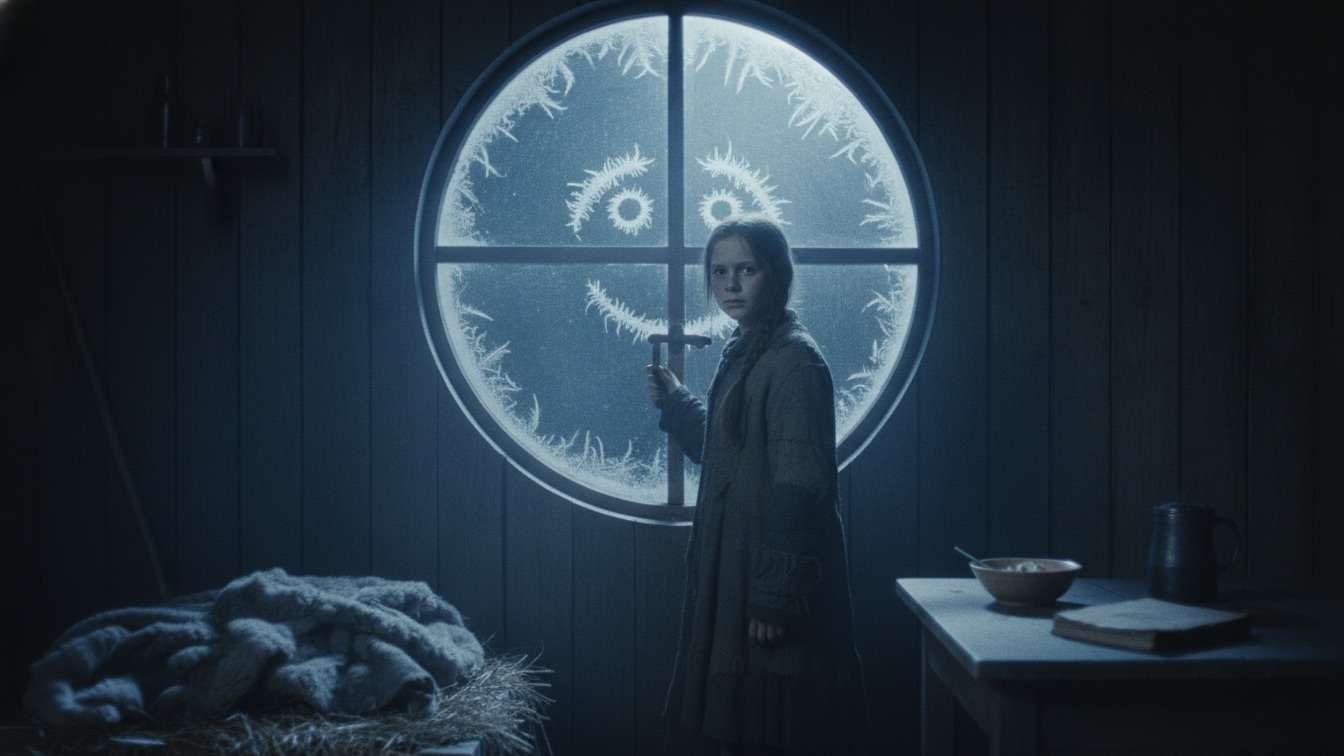
The chapter introduces Ellie, a young girl staying with her grandmother in a remote, freezing cabin. The extreme cold outside permeates the struggling cabin, mirroring Ellie's internal desolation caused by her parents' separation. Her grandmother, observing the heavily frosted window, shares a chilling legend of a malevolent "Jack Frost" who collects and freezes unique memories and objects, displaying them as temptations on windows, never to return them. Later that night, driven by a desperate longing to mend her broken family, Ellie discovers an ethereal impression of her mother's sad smile etched into the frost on her bedroom window. Despite her grandmother's dire warnings, Ellie, viewing the image as a lost piece of her family she can retrieve, forces the window open. An immediate, predatory cold floods the room, extinguishing the last embers of warmth and erasing the image. The following morning, Ellie discovers a profound and chilling consequence: the photograph of her parents' wedding on the mantelpiece now only shows her father, her mother having been completely erased from the memory.
The narrative profoundly explores the themes of loss, memory, and the perilous allure of the past. Ellie's parents' separation is presented as a shattering event, leaving her feeling like a "lonely splinter" rather than a whole, embodying the profound sense of fragmentation that accompanies familial breakdown. The physical cold of the cabin serves as a potent metaphor for her internal emotional landscape, a "quiet that was heavier than any noise," signifying the numbing impact of grief and unspoken pain.
Memory is depicted as a fragile yet powerful force, capable of both sustaining and tormenting. Jack Frost personifies the predatory nature of loss, freezing cherished moments and displaying them as temptations. This myth underscores the danger of dwelling on idealized or painful memories, suggesting that an unhealthy attachment to what is gone can lead to further devastation. Ellie's desperate attempt to reclaim her mother's smile highlights the human yearning to undo loss and restore what was, even if it means confronting a potentially destructive force.
The story also delves into the delicate balance between clinging to the past and accepting change. The grandmother's stern warning against letting Jack Frost in functions as a psychological caution: to obsess over what is lost is to invite further emptiness. Ellie's tragic decision to open the window, driven by a child's potent mix of hope and desperation, illustrates the devastating consequences of refusing to let go. Her belief that the cold might be "lonely" and "saved things" reveals a childlike attempt to rationalize and control an uncontrollable, painful reality, ultimately leading to a more profound and irreversible loss.
Ellie exists in a profound state of internal turmoil, deeply affected by her parents' separation. She articulates her distress through the powerful metaphor of "a pane of glass that got dropped," but personally feels like an "icicle, a sharp, lonely splinter," emphasizing her sense of isolation and fragmentation rather than being a part of a larger, broken whole. Her inner world is characterized by a "heavy quiet," a psychological echo of the cold, silent grief that has settled over her life since the family conflict ceased. She yearns for the warmth and completeness that has been violently taken from her, manifesting as a desperate need to restore her shattered family.
Ellie's primary motivation is a deeply ingrained child's desire to mend what is broken and restore her sense of security and belonging. She interprets the image of her mother's smile in the frost not merely as a memory, but as a tangible "piece of the glass that had shattered," believing that by retrieving it, she can magically reassemble her family. This motivation stems from a profound innocence and an inability to fully grasp the irreversible nature of adult loss, driving her to act against all warnings in a desperate, hopeful gamble. She sees the cold not as a thief, but potentially as a lonely entity that saves things, a rationalization born of her own deep loneliness and longing for companionship.
Ellie faces a significant internal conflict between her grandmother's stark, ominous warnings and her own overwhelming, almost primal, desire for restoration. Her grandmother explicitly states, "you must never, ever let him in. He doesn’t give things back. He just takes the rest of it." However, Ellie's love and grief for her mother override this caution, leading her to believe that her situation is unique and that she might succeed where others would fail. This internal struggle culminates in her physical battle with the window latch, a symbolic fight against the barriers protecting her from further pain, ultimately succumbing to the powerful temptation of reclaiming a lost piece of her past. Her actions, born of a desperate hope, lead to a devastating external conflict with the personified force of loss, as the "predatory cold" consumes not only the memory she sought but also a foundational aspect of her family's history, irrevocably altering her reality.
The chapter employs a rich tapestry of sensory details and evocative language to establish its somber tone and immerse the reader in Ellie's experience. The opening immediately grounds the narrative in a world of biting cold and struggle, with the "iron latch... a block of ice," "pathetic ribbon of smoke," and the "low, constant moan" of the wind. These details not only create a vivid physical setting but also mirror Ellie's internal emotional state, where the "cold wasn’t just outside anymore; it was inside the cabin, inside her bones." The choice of words like "starving" for the logs and "besieged" for the world personifies the environment, making it an active participant in the characters' struggle.
The pacing of the narrative is deliberate and effective, starting slow and heavy, reflecting the oppressive atmosphere and Ellie's quiet despair. It builds a sense of dread as the grandmother introduces the chilling legend of Jack Frost, creating palpable suspense. The pace quickens dramatically during Ellie's desperate attempt to open the window, conveying her urgency and emotional turmoil, culminating in the sudden, violent rush of the "predatory cold." The resolution then slows again, allowing the full weight of the devastating consequence to settle, creating a powerful, lingering sense of loss and profound emptiness.
The narrative voice is a close third-person, filtered primarily through Ellie's perspective. This allows for an intimate portrayal of her emotional landscape, her childlike yet deeply insightful understanding of her parents' fractured relationship, and her desperate hope. Metaphors are used with striking effect, such as her father's explanation of their family as "a pane of glass that got dropped" and Ellie's self-perception as an "icicle, a sharp, lonely splinter." The grandmother's dialogue is particularly impactful, shifting from the everyday to the mythical, her "eyes were not kind. They were dark and serious," lending an ominous gravity to her warnings and elevating the story beyond a simple domestic drama into a chilling fable. The contrast between the "mischievous grin" of the picture-book Jack Frost and the grandmother's "collector" version highlights the corruption of childhood innocence by harsh reality.