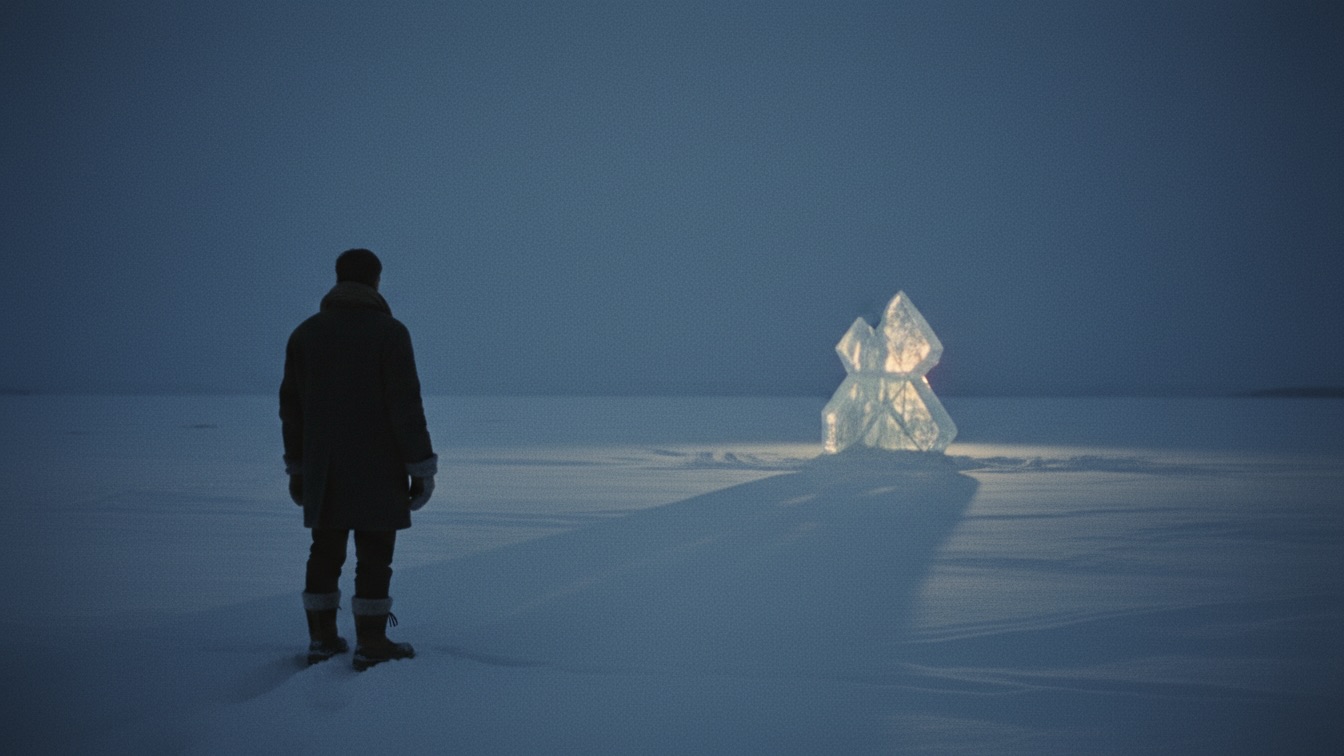
The winter landscape arrives not as a setting, but as an argument. In the profound white of the snow, all human endeavor is reduced to a temporary mark, a fragile footprint on a canvas of immense and indifferent silence. This chapter uses the cold as a clarifying agent, stripping away the noise of the city to reveal a more ancient and unsettling tension between the performance of the self and the possibility of its complete erasure.
The central thematic conflict of the chapter is the fraught relationship between authenticity and performance, particularly within the constructs of modern art and identity. Leo Casper embodies the artist as a performer, curating his life and even his disappearance as a grand, conceptual piece. His philosophical notes on "erasure" and the "negative space" are presented as profound discoveries, yet Jude, our narrator, immediately identifies them as derivative and self-aggrandizing. This tension drives the narrative, forcing both Jude and the reader to question whether Leo’s vanishing is a genuine spiritual crisis, a meticulously staged publicity stunt, or something far stranger. The story interrogates the very nature of artistic creation, suggesting that in a world saturated with performance, the ultimate artistic statement might be to cease performing altogether by simply disappearing.
The narrative operates within a hybrid genre space, blending the slow-burn pacing of a psychological thriller with the introspective character study of literary fiction. The mystery of Leo’s whereabouts provides the plot's engine, but the true investigation is internal, focused on Jude’s deconstruction of his rival’s persona and, by extension, his own artistic integrity. The introduction of folk-horror elements, articulated through Merrin Foley’s cryptic pronouncements, elevates the story beyond a simple missing person case. The wilderness is not merely a backdrop; it is a sentient, watchful entity with its own ancient logic, one that grows "tired of listening" to human ego. This imbues the indifferent winter landscape with a subtle but potent sense of menace, suggesting that the greatest threat isn't a human antagonist but the vast, non-human world's capacity to simply edit a person out of existence.
Jude’s perspective as a first-person narrator is crucial, yet inherently unreliable, colored as it is by years of professional jealousy and personal resentment. His cynicism is a shield, his primary tool for interpreting Leo’s actions as fraudulent and performative. However, the raw, physical reality of the winter environment begins to erode this certainty. The overwhelming silence and the impossible image of the footprints ending at the lake’s edge represent a direct challenge to his rational, city-forged worldview. The narrative masterfully places the reader inside Jude's conflicted mind, forcing us to weigh his logical deductions—bolstered by the discovery of the receipt—against the primal, inexplicable fear evoked by the landscape. The story’s power lies in this unresolved tension, suggesting that some truths cannot be contained by rational explanation alone.
Psychological State: Jude operates from a state of deeply ingrained cynicism and professional envy. His entire perception of the world, and especially of Leo, is filtered through a lens of resentment born from his own perceived artistic failures and Leo's commercial success. The winter landscape acts as an external correlative to his internal coldness, but it also begins to destabilize him. The city’s "chattering" anxiety is familiar, something he can navigate; the "monolithic anxiety of the wilderness" is alien and absolute, making his internal monologue feel "small and ridiculous" and forcing an unwelcome confrontation with concepts larger than his personal grievances.
Mental Health Assessment: Jude displays signs of chronic disillusionment, bordering on a depressive state, likely stemming from his stalled career and the curdled friendship with Leo. His coping mechanisms are intellectual and defensive; he deconstructs and mocks Leo’s grand gestures as a way to assert his own superiority and protect his ego. However, this intellectual armor proves inadequate against the visceral, non-rational threat posed by the wilderness. His resilience is tied to the logical, cause-and-effect world of the city, and its absence in this new environment leaves him vulnerable and psychologically adrift.
Motivations & Drivers: Jude's primary motivation is to solve the puzzle of Leo, not out of concern, but out of a compulsive need to expose him as a fraud. This quest is driven by a desire to validate his own worldview—that Leo’s success is built on hollow performance. He follows the footprints into the snow not as a rescuer but as a critic seeking the flawed final act of his rival's performance. The cold and physical hardship of the journey become a penance and a test, pushing him to confront the very real possibility that he has fundamentally misunderstood the nature of Leo’s final "work."
Hopes & Fears: Jude’s deepest hope is to be proven right, to find evidence that Leo's disappearance is just another calculated stunt, thereby restoring his own sense of artistic and moral superiority. His greatest fear, which he only begins to confront at the edge of the lake, is that Leo might have actually achieved something authentic—a genuine act of "erasure" that transcends the cynical art world they both inhabit. This fear is not of the supernatural, but of the possibility that his rival, in his final act, has created a masterpiece of terrifying sincerity that Jude can neither replicate nor deconstruct.
Psychological State: Leo, though absent, is characterized by a profound and performative narcissism. His entire existence appears to be a curated installation, from his minimalist cabin to his philosophical musings. His psychological state seems to be one of constant self-mythologizing, where he is both the artist and the subject of his own epic narrative. The retreat to the wilderness is presented as a quest for ego-death, but every action—the precisely stacked wood, the brewing coffee, the dramatic notes—screams of an ego desperate for an audience, even a posthumous one.
Mental Health Assessment: Leo exhibits traits consistent with a narcissistic personality, marked by a grandiose sense of self-importance and a need for constant admiration. His "carefully curated authenticity" suggests a fragile core identity that relies on external validation, which he cleverly manufactures by critiquing the very systems that praise him. His move to the wilderness may represent a psychological break, where the pressure of maintaining his public persona becomes unbearable, leading to a final, desperate performance designed to cement his legacy as an enigma.
Motivations & Drivers: Leo’s motivation is to author the perfect final act. He seeks to transform his life, and its end, into his "greatest work." Whether this is a literal suicide or a staged disappearance, the goal is the same: to create an unsolvable mystery that will be debated and mythologized, ensuring his artistic immortality. He is driven by a desire to have the last word in his rivalry with Jude and his critique of society, leaving behind a perfectly composed scene that defies easy interpretation.
Hopes & Fears: Leo’s hope is to achieve a form of transcendence through his art, to become a legend. He hopes to be remembered not just as an artist, but as a mystery, a man who successfully erased the self he so publicly despised. His greatest fear is irrelevance and being understood too easily. He fears being dismissed as a fraud, the very thing Jude believes him to be. The elaborate staging of his disappearance is a defense against this fear, an attempt to create a narrative so powerful and ambiguous that it can never be fully debunked.
Psychological State: Sarah is the psychological anchor of the story, representing a grounded, pragmatic realism that stands in stark contrast to the artistic neuroses of Jude and Leo. Her emotional state is even and unflappable, rooted in the tangible realities of her environment. She observes the eccentricities of outsiders like Leo not with judgment, but with a kind of weary, anthropological curiosity. The winter is not a metaphor for her; it is a condition of life to be managed with practical skill and a lack of sentimentality.
Mental Health Assessment: Sarah displays a high degree of resilience and emotional stability. Her mental health is robust, built on a clear-eyed understanding of her world and the people in it. Her coping mechanisms are straightforward: work, observation, and direct communication. Her assessment of Leo—"Always putting on a show"—and her pointed remark that people like him "author" their own heart attacks, reveals a sharp, insightful intelligence that cuts through pretense.
Motivations & Drivers: Sarah’s motivation in the chapter is simply to function and observe. She is a purveyor of goods and information, a stable hub in a transient world. She is driven by a sense of communal responsibility, informing Jude of the sheriff's involvement and Merrin's sighting, but she maintains a professional and emotional distance. She has no stake in the mystery beyond its brief disruption of her town's quiet rhythm.
Hopes & Fears: Sarah's hopes and fears are likely tied to the practical concerns of her life and community—a good season, the health of her neighbors, the continued operation of her store. She seems to fear very little, but her final warning to Jude—"It’s not a canvas. It doesn’t care about your friend’s art"—reveals a deep-seated respect for the dangers of the wilderness and a fear that city-bred arrogance will lead to tragedy.
Psychological State: Merrin exists in a psychological space that is almost pre-modern. His state of mind is deeply attuned to the natural world, operating on a level of observation and intuition that Jude finds both archaic and unsettling. He is not sentimental about nature but views it as a powerful, active system with its own rules and capacity for response. His cryptic pronouncements suggest a worldview where the boundary between the physical and the metaphysical is porous.
Mental Health Assessment: Merrin’s mental health appears exceptionally sound, reflecting a life of self-sufficiency and deep connection to his environment. He is solitary but not isolated, his mind occupied by the complex "reading" of the world around him. His resilience is profound, born from a lifetime of surviving in a harsh landscape. He processes the world through a lens of folklore and lived experience rather than abstract intellectualism, a perspective that Jude initially dismisses but cannot entirely shake.
Motivations & Drivers: Merrin’s motivation is to live in accordance with the rhythms of his environment and, when prompted, to share his observations without embellishment. He is driven by a craftsman’s patience and economy of motion, whether mending a net or whittling wood. He has no desire to solve the mystery of Leo Casper, as from his perspective, there is no mystery; Leo was a "noise" that the quiet simply "took away."
Hopes & Fears: Merrin seems to hope for little beyond the continuation of his way of life. His primary fear, implied in his critique of Leo, is for those who come into the wilderness without respect or understanding. He fears the arrogance of men who try to "scribble his own name all over a page that was already full," recognizing that such ego is not just foolish but existentially dangerous in a place that does not recognize the individual.
The chapter constructs its emotional tension not through overt action or conflict, but through the careful layering of atmosphere and psychological dissonance. The initial mood is one of weary cynicism, established by Jude’s internal monologue and his jaded perspective on Leo and the art world. This emotional baseline is methodically eroded by the encroaching power of the winter landscape. The silence of the wilderness is not peaceful but "full" and "watchful," transforming the environment from a passive setting into an active source of psychological pressure. The emotional journey for the reader follows Jude’s own: from intellectual disdain to a creeping, primal unease.
The emotional core of the story resides in the meticulously ordered emptiness of Leo's cabin. The scene is a paradox: the presence of a crackling fire and brewing coffee suggests life and imminent return, yet the sterile perfection and lack of personal effects evoke a profound and final absence. This contradiction creates a deeply unsettling feeling, a sense of wrongness that logic cannot easily dismiss. The discovery of the philosophical notes adds another layer, framing the potential tragedy in the language of artistic intent, which forces Jude and the reader to oscillate between seeing Leo as a victim of the wilderness or the author of a morbid performance.
The final crescendo of emotional unease occurs at the edge of the frozen lake. The narrative builds to this moment by filtering the impossible facts through the pragmatic voices of Sarah and Merrin, lending them a chilling credibility. When Jude finally witnesses the scene for himself—the unwavering line of footprints, the alien sculpture, and the abrupt, inexplicable end—the emotional architecture completes its purpose. The intellectual puzzle gives way to a visceral, existential dread. The discovery of the receipt offers a logical escape hatch, but the emotional impact of the scene lingers, creating a powerful and unresolved tension between the mundane explanation and the terrifying, mythic possibility. The cold ceases to be a temperature and becomes the emotional state of this unresolved ambiguity.
The story masterfully employs its settings to reflect and amplify the characters' internal states, establishing a powerful dichotomy between the urban and the wild. The city is described as a "sprawling infection," a "cage" of "a thousand chattering voices," representing a state of constant social and psychological pressure that grinds down authenticity. For Jude, it is a space of professional frustration and claustrophobia. In contrast, the wilderness is presented as a different kind of cage—a "monolithic" void whose vast, indifferent silence is just as imprisoning. This framing suggests that a change in location is merely a "transfer of pressure," and that the true prison is the self, which one carries into any environment.
Leo’s cabin is a crucial psychological space, a perfect microcosm of his entire persona. It is not a rustic retreat but an "architectural statement," a "minimalist black box" that imposes urban aesthetics onto the natural world. This space reveals the core contradiction of his character: he claims to seek erasure in nature, yet he inhabits a structure that is a monument to control, taste, and ego. The cabin’s pathological tidiness is not the mark of a man at peace but of one obsessed with stage-managing his own narrative. It is a stage set for his final performance, where every object, from the expensive coffee to the untouched snowshoes, serves as a prop. The massive window frames the forest like a museum piece, turning the chaotic wilderness into a controlled, consumable image, mirroring Leo’s own approach to life.
The frozen lake serves as the story's ultimate psychological landscape—the "negative space" made manifest. It is a featureless expanse, a "blank page" that represents both absolute possibility and total annihilation. The ice sculpture, a monument of pure intellect and ego, stands in defiance of this emptiness, a final, arrogant human statement. Yet, it is at the edge of this space that the human trace—the footprints—vanishes completely. This environment becomes the site of the story's central trauma, a place where the rules of logic and cause-and-effect break down. For Jude, standing at the edge of that impossible void, the lake becomes a mirror for his own intellectual limits and a symbol of a terrifying power that renders human ambition and art utterly meaningless.
The prose of "The Negative Space" is characterized by its precision and its use of sharp, often unsettling imagery. The opening simile, comparing the departing train to a "surgeon’s knife excising a tumor," immediately establishes a tone of clinical detachment and physical violation. This style mirrors Jude’s cynical, analytical worldview. Language is used to dissect and categorize, from Leo’s friendship tasting like "gin and tonic water gone flat" to the gallery owner possessing the "emotional range of a parking meter." This crisp, often biting diction creates a narrative voice that is both intelligent and emotionally guarded, making the moments when that guard breaks—as at the edge of the lake—all the more powerful.
Winter is the dominant symbolic system in the chapter, functioning on multiple thematic levels. The snow represents a blank canvas, a "negative space" onto which Leo attempts to project his final artistic statement. It is also an agent of erasure, covering tracks and, as the sheriff suggests, potentially bodies, smoothing over the messy details of human existence with a clean, white sheet. The cold is a constant, physical presence that serves as a test of authenticity. It exposes the inadequacy of Jude’s "city-slicker coat" and Leo’s performative "Wilderness Man" persona, symbolized by the untouched snowshoes. The cold is merciless and impersonal, a physical manifestation of the universe's indifference to human drama, a theme echoed in Sarah's final warning to Jude.
Beyond the overarching motif of winter, the story is rich with smaller, potent symbols. Leo's cabin, a "black box" in the "overwhelming white," symbolizes the intrusion of a rigid, urban intellect into the organic wilderness. The ice sculpture is the ultimate symbol of Leo’s ego: a beautiful, sterile, and ultimately ephemeral monument to himself, fated to melt. Perhaps most poignantly, the old photograph of a young Jude and Leo serves as a symbol of a past that cannot be erased. Its presence in the hermitage dedicated to "shedding the self" is a profound contradiction, revealing that even in his grandest performance of erasure, Leo could not let go of the rivalry and connection that defined him. The final discovery of the receipt and train schedule acts as a counter-symbol, representing the mundane, rational truth that threatens to dismantle the entire mythic structure Leo has built.
The narrative situates itself firmly within the literary tradition of the city-dweller’s retreat into the wilderness, a trope deeply embedded in the American cultural psyche. It engages directly with the legacy of Transcendentalists like Thoreau, who sought truth and authenticity by shedding societal constructs in nature. However, the story offers a deeply cynical, postmodern critique of this tradition. Leo Casper is a 21st-century Thoreau filtered through the lens of the contemporary art world; his quest is not for genuine enlightenment but for "carefully curated authenticity." His notes read like a parody of Emersonian ideals, repackaging old philosophies as revolutionary personal discoveries, exposing how the search for the authentic self can become just another form of branding.
The story also draws from the genre of folk horror, where the rural landscape is not a place of pastoral peace but a repository of ancient, pre-modern power that is hostile to outsiders. Merrin Foley functions as the genre’s classic harbinger figure, the local who speaks in cryptic warnings and understands the landscape’s true nature. His explanation that the "quiet gets tired of listening" and "takes the noise away" reframes Leo’s disappearance from a human mystery into a supernatural or metaphysical event. This positions the story alongside works where the land itself is an active antagonist, punishing the arrogance of modern, rationalist intruders who fail to respect its ancient rules.
Furthermore, the rivalry between Jude and Leo echoes the long history of artistic and intellectual rivalries, from Salieri and Mozart to the feuds of the Abstract Expressionists. Their dynamic explores how creativity and ambition are often intertwined with jealousy and resentment. Jude, the traditional painter of "frantic cityscapes," represents a gritty, perhaps outdated form of artistic labor, while Leo, the conceptualist with his "polished sheet of stainless steel," represents a newer, more commercially savvy form of art that values the idea over the object. Their conflict is a commentary on the evolution and perhaps the perceived corruption of the art world, where the narrative surrounding the art has become more valuable than the art itself. Leo’s final vanishing act is the logical endpoint of this trajectory: an artwork that is pure narrative, with no object at all.
What lingers long after the final page is the profound and unsettling ambiguity born from the clash of two opposing realities. On one hand, there is the neat, logical explanation provided by the bank receipt and the train schedule. This is the truth of the city, a world of cause and effect, where a disappearance is a planned escape, a clever trick. It is a satisfying, if disappointing, solution that confirms Jude’s cynicism and demystifies the artist. It allows the reader to close the book on Leo Casper, the brilliant fraud who orchestrated one last, magnificent lie.
Yet, this rational conclusion fails to erase the emotional and sensory imprint of the story’s other reality: the mythic truth of the wilderness. The image of the footprints stopping dead at the edge of the frozen lake is stark, primal, and deeply resistant to easy explanation. It is a visual paradox that lodges itself in the imagination. Merrin’s folkloric diagnosis of a landscape that "takes the noise away" offers an explanation that feels, in the context of the oppressive winter silence, more emotionally resonant than a hidden car and a walk across wind-scoured ice. The story leaves the reader caught between these two truths, intellectually accepting one while being haunted by the other.
Ultimately, the story’s staying power comes from its masterful use of the winter landscape to embody this central conflict. The cold, the snow, and the silence are not just setting; they are the source of the story’s deepest questions. Does the world operate according to the clear, hard logic of ice, or is it governed by the soft, absorptive, and mysterious logic of the snow, which can cover any trace and create a perfect, inexplicable emptiness? The reader is left like Jude, standing in the growing dark, holding a piece of paper that explains everything and explains nothing, staring out at a vast, white emptiness where a man used to be. The cold that seeps into Jude’s bones is the chill of uncertainty, a feeling that remains long after the story is over.
In the end, the narrative does not resolve itself into a single, stable truth. It leaves behind the residue of a cold, clear image: a line of footprints that leads to an edge and then simply ceases to be. This is the story's true negative space, an intellectual and emotional void that the rational mind rushes to fill with explanations of packed snow and clever detours, yet which the imagination insists on seeing as a moment of pure, impossible erasure.
The final truth of Leo Casper remains as ephemeral as the ice sculpture he left behind, a monument to ego fated to disappear with the spring thaw. Jude is left holding a mundane receipt, a flimsy shield against the vast, mythic power of the winter landscape he has just witnessed. The silence that answers him in the cabin is no longer just an absence of sound; it is the lingering presence of a question that the city, with all its noise and logic, can never truly answer.