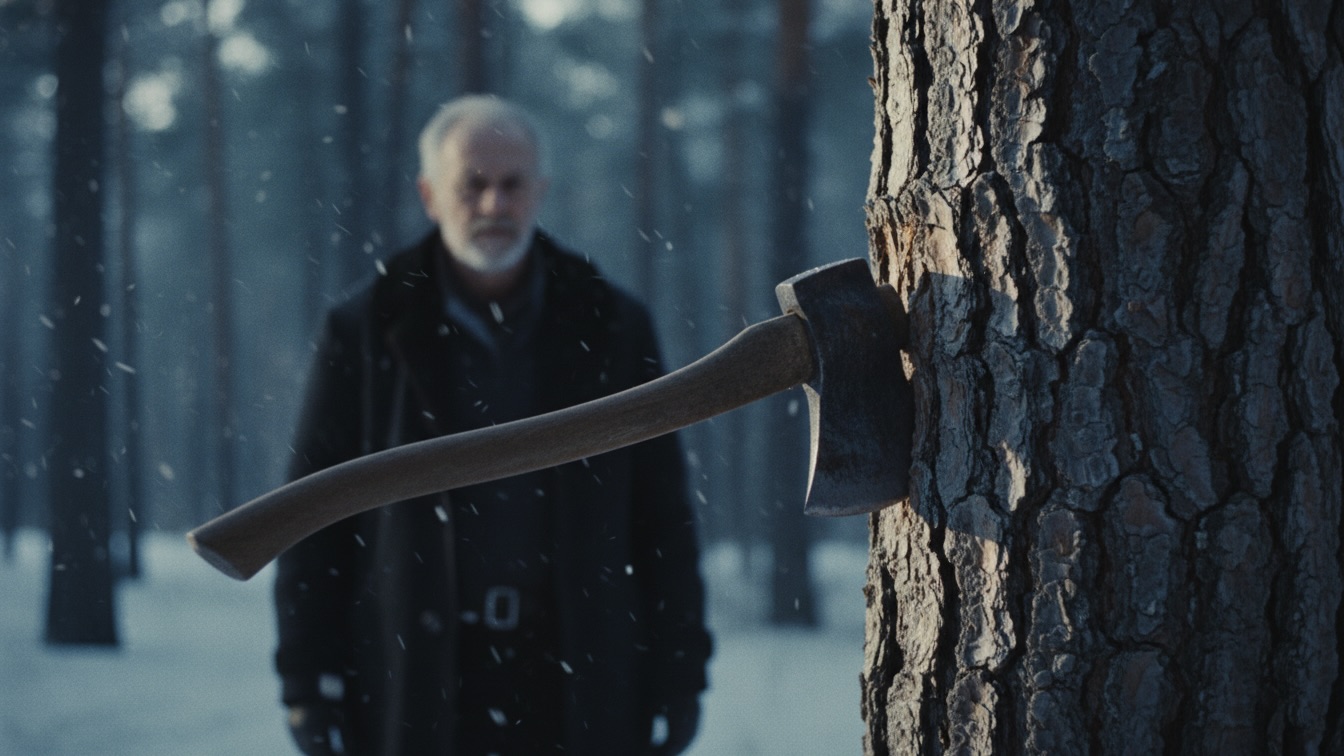
The axe, a familiar weight of purpose and survival, becomes in this chapter a silent, brutal oracle. Its sudden, inexplicable disappearance from its accustomed corner shatters the brittle architecture of a long-held domestic peace, forcing a man to confront the profound, icy chasm that has opened between his perception and his reality. This simple tool, once a symbol of his agency and mastery over the harsh environment, transforms into a terrifying cipher, its violent re-emergence a stark, undeniable testament to a truth long buried beneath layers of routine and unsaid words. The chapter unfolds as a slow, inexorable journey towards this stark revelation, each step a further excavation into the chilling landscape of a marriage's demise.
This chapter operates primarily as a psychological domestic drama, infused with elements of a slow-burn mystery and a creeping existential dread. The overarching themes revolve around the decay of a long-term relationship, the corrosive power of unspoken resentments, and the terrifying realization of profound alienation within the most intimate of bonds. The narrative skillfully explores how decades of passive acceptance and communication failures can culminate in a quiet, yet utterly devastating, reckoning. The initial mundane struggles against the cold quickly give way to a deeper, more chilling battle against an emotional freeze that has settled deep into the characters’ lives.
Winter serves as far more than just a setting; it functions as a pervasive, multi-layered metaphor and a potent narrative device. The physical cold mirrors the emotional frigidity within the marriage, while the snow, initially a softening blanket, becomes a canvas revealing hidden truths and erasing others. The isolation enforced by the harsh season amplifies the internal struggles, trapping Arnie and Martha within the confines of their cabin and their failing relationship, making escape from their shared reality impossible. This environmental pressure cooker forces latent conflicts to the surface, transforming the familiar into something menacing and unknown.
The narrative is almost exclusively filtered through Arnie’s limited and increasingly unreliable perspective. The reader experiences his confusion, irritation, and mounting dread directly, making his journey of realization deeply personal and unsettling. His perception is initially constrained by routine and an assumed understanding of his wife, leading him to misinterpret her placidity as indifference rather than a deliberate stance. The cold imagery influences his interpretation of events; his physical discomfort and the numbing effects of the environment seem to delay his cognitive processing of the axe's significance, allowing the dread to build slowly. The narrative cleverly uses these perceptual limits, leaving Martha's internal world almost entirely opaque, which heightens the mystery and the reader’s unease. Arnie’s internal monologues reveal a man who has lived a life of quiet concessions, only now questioning the foundational choices he believed were his own.
Morally and existentially, the chapter delves into the profound cost of silence and the nature of agency within a relationship. Arnie's belated realization that his life has been a "series of these small, quiet thefts" raises questions about individual responsibility for one's own happiness and the ethical implications of allowing another person to steer the course of a shared existence without true consent. The extreme isolation of their winter environment forces a confrontation with fundamental fears: the fear of being unseen, unheard, and ultimately, unknown by the person closest to you. The chapter suggests that meaning, love, and even fear can become distorted and weaponized in the crucible of long-term emotional neglect, leading to a point where familiar gestures become a language of veiled threat. The cold, stark landscape underscores the harsh reality that some truths, once uncovered, offer no warmth or comfort, only an icy clarity.
Psychological State: Arnie begins the chapter in a state of resigned endurance, accustomed to the physical discomforts of his life and the routine rhythms of his marriage. However, the mystery of the missing axe progressively shatters this stoicism, plunging him into a spiral of irritation, confusion, and eventually, profound dread and existential crisis. His mental landscape is initially dominated by practical concerns, but as the day progresses, his focus shifts inward, forcing him to confront long-suppressed resentments and a terrifying re-evaluation of his entire life. The cold, which he usually accepts as a "fact," begins to seep into his bones, mirroring the psychological chill of his dawning realization.
Mental Health Assessment: Arnie exhibits traits of long-term emotional suppression, a common coping mechanism where feelings are buried to maintain perceived peace or stability. This has led to a buildup of "small resentments" and a sense of passive acceptance, which, when challenged, manifests as a delayed, overwhelming sense of betrayal and a breakdown of his perceived reality. His reliance on physical labor as a coping mechanism is evident, as he seeks to occupy his hands and mind, deferring the emotional reckoning. The sudden, intense fear he experiences at the discovery of the axe suggests a fragile mental state, unprepared for such a stark challenge to his world.
Motivations & Drivers: Arnie's immediate motivation is practical: to split wood and keep the fire alive, a fundamental act of survival in his environment. However, this quickly evolves into a deeper drive to understand the mystery of the axe, which morphs into a desperate need to decipher his wife’s inscrutable behavior and, ultimately, to comprehend the true nature of his marriage. His underlying driver is a yearning for control and understanding in a world that is suddenly proving to be far more complex and menacing than he believed. The cold environment directly influences his desires, making the maintenance of warmth and order paramount, only to have these desires undermined by the axe’s absence.
Hopes & Fears: Arnie's core hope, though perhaps unconscious, is for a predictable, manageable existence where routines hold sway and underlying tensions remain buried. He hopes for the simple functionality of his life to continue undisturbed. His fears, initially vague and unacknowledged, solidify into a terrifying dread of the unknown, particularly concerning his wife's true nature and intentions. He fears irrelevance, the realization that he has been a passive participant in his own life, and most profoundly, the "verdict" that Martha's silence and actions seem to represent. The cold amplifies these fears, making the external environment a mirror for his internal desolation and vulnerability.
Psychological State: Martha presents an outwardly placid, calm, and maddeningly composed demeanor throughout the chapter. Her actions are deliberate and economical, suggesting a deep internal control. However, her lack of surprise regarding the missing axe, her neutral tone, and her final, resolute statement point to a powerful, hidden psychological state. Her calm is not indifference but a carefully maintained facade, possibly concealing years of suppressed frustration, resentment, or a cold fury that has finally reached a point of calculated action. The cold does not seem to perturb her, indicating an internal fortitude or a detachment that transcends physical discomfort.
Mental Health Assessment: Martha displays characteristics of extreme emotional self-control, possibly bordering on passive-aggression or a highly developed internal locus of control. Her placidity could be a long-standing coping mechanism, allowing her to navigate a relationship where her desires were often overridden, or it could be a deliberate strategy to exert power. Her actions suggest a mind that has been meticulously planning or waiting for a specific moment, indicating a strong, if unsettling, resolve. She appears mentally stable in her execution of her plan, but the underlying motivations hint at profound, unaddressed emotional wounds.
Motivations & Drivers: Martha's motivations are not explicitly stated but are powerfully implied. Her actions—removing the axe, her unreadable face, her terse and dismissive responses, and her final pronouncement—suggest a deliberate intention to force a reckoning, to break the decades-long pattern of silence and Arnie's passive acceptance. She is driven by a need for acknowledgement, for Arnie to finally "see" her and their shared reality, even if that reality is harsh and painful. Her goal appears to be to dismantle the comfortable illusion of their life, compelling Arnie into a confrontation he has long avoided.
Hopes & Fears: Martha's hopes appear to center on achieving a form of truth or resolution, no matter how unsettling. She seems to hope that by disrupting Arnie's familiar world, she can finally elicit a genuine response, a true engagement. Her fears are not directly explored, but one might infer a deep-seated fear of continuing to live an unacknowledged, unfulfilled life, or a fear that Arnie would never truly see her or understand the depth of her quiet suffering. Her actions are a testament to a desire to escape the "quiet thefts" that have defined her existence, even if it means shattering the entire structure of their shared world.
The emotional architecture of "A Quiet Reckoning" is meticulously constructed, building a pervasive sense of unease and dread through the slow accumulation of seemingly minor details. The chapter begins with a mundane, almost resigned acceptance of physical discomfort – the cold, the stiff body, the dying fire. This initial state establishes a baseline of low-level hardship, making the subsequent disruptions stand out more sharply. The narrative then introduces small frustrations, like the stiff buttons and the depleted woodpile, which create a subtle sense of tension and vulnerability in Arnie. These early moments, grounded in his physical experience, lay the groundwork for a more profound psychological disquiet.
The true emotional pivot occurs with the discovery of the missing axe. This simple absence immediately elevates the emotional stakes from mere discomfort to a nascent mystery, tinged with irritation and confusion. Martha's unsettlingly placid reaction acts as an emotional amplifier, transforming Arnie's initial annoyance into a deeper, more unsettling sense of alienation and suspicion. Her calm, contrasted with his growing agitation, creates a palpable tension that fills the "heavy and thick" silence between them. This deliberate withholding of emotional response from Martha creates a vacuum that Arnie's burgeoning fears and resentments rush to fill, turning his internal monologue into a torrent of belated realizations.
The climax of the emotional build-up arrives with the discovery of the axe embedded in the pine tree. This image is a powerful shock, shifting the emotional register from unease to terror. The violence of the act, its deliberate placement, and the implication of Martha's involvement create a profound sense of horror and betrayal. The cold, which has been a constant presence, now feels like a physical manifestation of the vast, cold emptiness that replaces Arnie's familiar anger. The final confrontation, marked by Martha's unwavering gaze and her chilling declaration, "It's time," leaves the reader with a powerful emotional afterimage of impending doom and the terrifying clarity of a truth long avoided, underscored by the deepening winter darkness outside.
The setting of the isolated cabin in the depths of winter is not merely a backdrop; it is an active participant in the psychological drama, mirroring and amplifying the internal states of the characters. The cabin itself, with its "low ceiling" and "faint smell of woodsmoke ingrained in the blankets," initially represents a familiar, albeit cold, sanctuary. However, as Arnie's internal world unravels, the cabin transforms into a psychological prison, a confined space where the unsaid things become "heavy and thick." The routine actions within its walls, like Martha's methodical coffee making or oatmeal preparation, become unsettling rituals, masking a monstrous reality. The interior, once a symbol of shared life, becomes a stage for a silent, terrifying confrontation.
The external environment, the vast, snow-covered wilderness, serves as a powerful metaphor for Arnie's encroaching isolation and the stripping away of his illusions. The "cold outside was a different beast, sharp and clean," initially offering a temporary respite from the cabin's stifling atmosphere. Yet, as Arnie's dread intensifies, the woods shift from a neutral space to a menacing one. The "black and skeletal" trees standing "silent witness" become a "conspiracy," their silence amplifying the internal silence that has plagued his marriage. The snow, initially a "fresh coat of white," later "absorbs" the sound of his futile hatchet swings, symbolizing the futility of his efforts and the overwhelming nature of the forces at play. This harsh, indifferent landscape reflects the bleakness of Arnie's internal revelation, emphasizing his vulnerability and the stark, uncompromising nature of the truth he uncovers. The cold, pervasive and inescapable, acts as an emotional amplifier, intensifying every physical ache and psychological wound, making the very act of living a struggle against internal and external forces.
The chapter's prose is characterized by a precise, sensory diction that grounds the reader firmly in Arnie's physical and emotional experience. Words like "geologic ache," "plumed in front of him," and "curdle into something else" evoke visceral responses, translating Arnie's internal state into tangible sensations. The sentence rhythm often shifts between short, declarative sentences for Arnie's actions ("He pulled on his trousers," "The space was empty") and longer, more reflective sentences for his internal monologues, creating a cadence that mirrors his struggle between external tasks and internal turmoil. This careful control of rhythm enhances the sense of building tension and Arnie's slow descent into realization.
Imagery of cold and confinement permeates the text, serving as a powerful aesthetic and symbolic motif. The "black iron box" of the stove, the "ice against the soles of his feet," and the "skeletal" trees all contribute to a pervasive sense of bleakness and stagnation. The description of Martha’s face as a "roadmap of their years together" and her eyes giving "nothing away" creates a stark visual of her inscrutability, contrasting sharply with Arnie's transparent confusion. This visual language of cold, hard surfaces and obscured depths consistently reinforces the emotional distance and the unyielding nature of the truths being revealed.
Symbolism is deeply interwoven into the narrative's fabric. The axe, initially a symbol of Arnie's masculinity, capability, and connection to the land, becomes the central, multifaceted symbol of the chapter. Its disappearance represents a theft of agency, a disruption of order, and a challenge to his identity. Its violent re-emergence, driven deep into the ancient pine, transforms it into a weapon, a statement of cold fury, and a terrifying "verdict." The cabin, once a symbol of home and security, becomes a "locked door" and eventually, an "eye of an animal," reflecting Arnie's growing alienation and fear. Martha's historical novels, filled with "useless facts and invented emotions," stand in stark contrast to Arnie's "real world" of physical labor, symbolizing their fundamental, unbridged intellectual and emotional disconnect. The pervasive silence, initially "profound quiet," evolves into "something heavy and thick," then "louder than any shout," and finally, "the silence of a held breath," symbolizing the profound breakdown of communication and the terrifying weight of unexpressed truths.
"A Quiet Reckoning" firmly situates itself within a rich tradition of winter narratives and psychological dramas, drawing on archetypes that explore human endurance and the fragility of relationships under duress. It echoes the bleak, isolating landscapes of works like Edith Wharton's Ethan Frome, where a harsh winter environment exacerbates and reflects the emotional stagnation and unspoken despair within a marriage. The story taps into the cultural understanding of winter as a time of introspection, hardship, and metaphorical death, where the external chill strips away pretense and forces characters to confront stark realities. This seasonal symbolism is a powerful, almost universal language for themes of decay and isolation.
The narrative also resonates with the genre of domestic psychological thrillers, reminiscent of authors who delve into the hidden darkness beneath seemingly ordinary lives. The slow build-up of tension, the unsettling calm of Martha, and the gradual reveal of a deliberate, chilling act bring to mind works that explore the quiet, insidious ways power dynamics play out in intimate relationships, often with a female character demonstrating a hidden strength or subversive agency. There is an echo of works where the most terrifying threats come not from external monsters, but from within the home, from the people we thought we knew best. The "quiet, subtle steering of the ship" by Martha, and Arnie's "thousand tiny concessions" can be seen as an inversion of patriarchal norms, where a seemingly submissive partner quietly gains control.
Furthermore, the story touches on the archetype of the uncommunicative male and the long-suffering, quietly powerful female, common in many literary traditions. Arnie's focus on practical tasks and his internal monologue of resentment, juxtaposed with Martha's inscrutable facade and her decisive, symbolic action, speaks to a broader cultural commentary on gender roles and communication breakdowns in long-term partnerships. The wilderness setting, a common motif in American literature, serves not just as a physical challenge but as a moral testing ground, where the raw elements expose the raw truths of human nature. The story, therefore, functions as a modern fable about the perils of emotional neglect and the explosive potential of suppressed desires, all amplified by the stark, unforgiving canvas of a long, cold winter.
The lasting emotional impact of "A Quiet Reckoning" is a profound sense of chilling unease and a lingering disquiet about the nature of intimacy and truth within long-term relationships. The slow, inexorable build-up of Arnie's dread is deeply unsettling, pulling the reader into his belated and terrifying realization. What lingers most acutely is the sense of betrayal, not just of Arnie by Martha, but of a shared life built on a foundation of unacknowledged resentments and unspoken truths. The story forces a contemplation of how well we truly know those closest to us, and the potential for a deeply familiar person to become an utterly terrifying stranger, especially when the veneer of routine is stripped away by an external force like the unforgiving winter.
Intellectually, the chapter provokes questions about agency, communication, and the subtle power dynamics that operate beneath the surface of any long-standing partnership. It challenges the reader to consider the cost of passivity, Arnie's "series of these small, quiet thefts," and the moral implications of such a quiet, calculated act of rebellion from Martha. The story leaves one pondering the nature of happiness and fulfillment, and whether a life built on concessions can ever truly be considered one's own. The starkness of the winter landscape, with its capacity to reveal and conceal, becomes a metaphor for the human psyche itself, capable of both profound clarity and terrifying hidden depths.
The cold and winter imagery are central to what lingers from this story. The feeling of the cold seeping "inside his bones," the "skeletal" trees, and the silent, snow-covered world evoke a deep sense of vulnerability and isolation. The image of the axe, driven with such force into the old pine, becomes a stark and unforgettable symbol of violence and resolution, its "cold eye" reflecting the bleakness of the new reality. The silence, initially just "profound quiet," transforms into a heavy, suffocating presence that speaks volumes, creating an emotional afterimage of a relationship frozen in time, poised on the brink of an inevitable, frigid collapse. The story's power lies in its ability to take the familiar comforts of home and turn them into a source of profound, existential dread, all under the unyielding gaze of winter.
The last vestiges of daylight clinging to the dark glass of the window offer a chilling reflection, not of two people, but of two spectral figures in a room suddenly stripped of its warmth. The pervasive cold, which had been a mere physical inconvenience for Arnie, has now become the very atmosphere of his soul, a deep, pervasive chill that promises no thaw. Martha’s quiet declaration, "It's time," resonates in this frozen space, not as a beginning, but as the final, definitive stroke of winter's long, silent reign over their shared life, marking an end to the pretense that has sustained them.
The quiet tick of the mantel clock, once a familiar comfort, now functions as a relentless metronome, counting down to a future as unyielding and stark as the snow-bound landscape outside. The silence that settles between them is no longer simply an absence of words, but a palpable, heavy thing, dense with the weight of decades of unaddressed grievances and the terrifying clarity of a truth finally unearthed. Like the axe embedded in the frozen pine, a raw, pale wound in the living wood, their relationship stands exposed, a monument to a cold, hard reckoning.