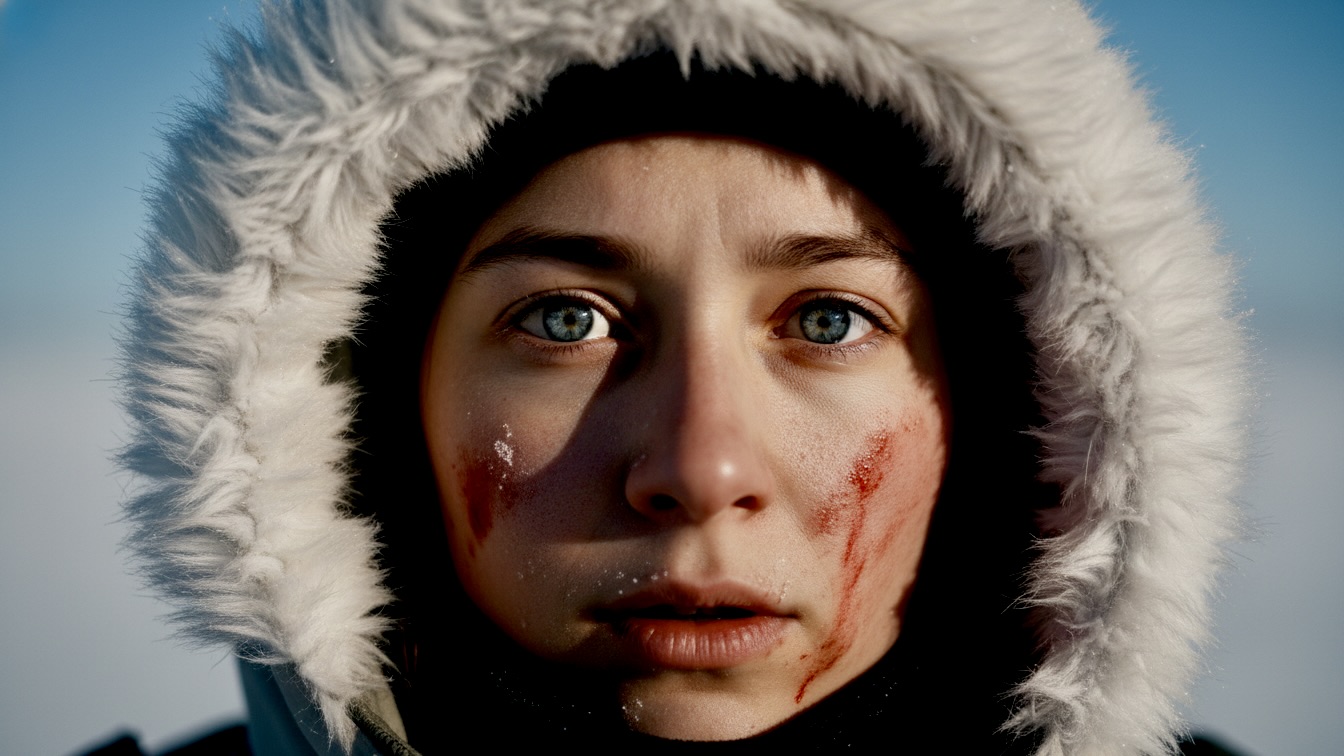
The narrative opens in an unforgiving arctic wasteland, where an unnamed Sergeant struggles against the paralyzing cold and the exhaustion of her unit. Amidst the harsh conditions, a moment of respite occurs when Corporal Cantor offers her hot chocolate, and the Sergeant, seduced by the rare and brilliant sunshine, decides to break protocol to boost morale. She orders her squad to remove their helmets and relax for thirty minutes, a decision driven by compassion and fatigue. This moment of peace is violently interrupted by the arrival of a high-tech, silent drone that utilizes the clear visibility to systematically slaughter the soldiers. The Sergeant is left as the sole survivor, physically unharmed but psychologically destroyed, realizing that her command decision to prioritize comfort over security was the direct cause of the massacre.
One of the most pervasive themes in the text is the treacherous nature of hope and comfort within a survival scenario. The protagonist explicitly notes that "hope was a dangerous commodity," yet she falls victim to the seduction of the "perfect, brilliant disk" of the sun. The clear sky is not a blessing but a tactical vulnerability, described as "unrestricted visibility" which favors the enemy. The narrative suggests that in extreme environments, the desire to feel human—to seek warmth and relaxation—is a fatal flaw. The sensory pleasure of the hot chocolate and the sun on exposed skin serves as the bait that lures the unit out of their defensive posture, turning a moment of restoration into a death sentence.
Closely linked to this is the theme of the crushing burden of command and the devastating consequences of leadership decisions. The story dissects the weight of responsibility, moving from the mundane management of frozen latches to the life-and-death choices of perimeter security. The Sergeant’s internal monologue reveals that her choice was not made out of negligence, but out of empathy for her "kids," who were spiritually worn down. This makes the tragedy more poignant; the massacre is not the result of malice or incompetence, but of a momentary indulgence in humanity. The text posits a grim reality where a leader cannot afford the luxury of compassion if it compromises vigilance.
Furthermore, the story explores the contrast between organic vulnerability and mechanical indifference. The soldiers are depicted through their physical limitations: they freeze, they bleed, they crave warmth, and they suffer from fatigue. In stark contrast, the antagonist is a machine described as having "liquid grace" and "cold, machine-like precision." The drone has no fatigue, no hesitation, and no mercy. The conflict is asymmetric not just in firepower, but in nature; the messy, fragile biological reality of the humans is effortlessly erased by the sterile, mathematical efficiency of the technology. The drone’s sudden departure without killing the Sergeant underscores this indifference, as it likely operated on a logic that deemed her no longer a threat, ignoring the emotional devastation it left behind.
The Sergeant is defined initially by her hardened exterior and her deep, protective instinct toward her subordinates. From the outset, she is presented as a veteran who understands the lethality of the cold, reprimanding Cantor for exposing his hands even while acknowledging the necessity of the action. Her internal monologue reveals a woman who is deeply weary, not just physically, but spiritually, bearing the "heavy weight of command." She is hyper-aware of her soldiers' conditions, noting the dark circles under their eyes and their slumping postures. This observation drives her tragic decision; she is not a lax disciplinarian, but a leader trying to preserve the mental health of her unit.
Psychologically, the Sergeant undergoes a catastrophic shift from a caretaker to a figure of self-loathing. Her motivation for ordering the break is rooted in a maternal desire to see her soldiers "feel human again," a desire that overrides her tactical training. When the attack begins, her reaction is a mix of professional instinct and helpless horror. She attempts to engage the threat, but her actions are rendered futile by the technological superiority of the enemy. The realization that her specific order—"Helmets off"—facilitated the efficiency of the slaughter creates an immediate and crushing sense of guilt.
By the end of the chapter, the Sergeant’s psyche has fractured. Her survival is not viewed as a stroke of luck, but as a cruel form of penance. The rage she feels toward the drone momentarily burns away her fear, leading to a suicidal gesture of defiance, but when the machine leaves, she is denied the release of death. Her final internal monologue indicates a total collapse of self-worth; she views herself as the killer, stating, "It wasn't the enemy that killed them. It was me." She is left in a state of profound psychological isolation, trapped in a silence where the only sound she can hear is the echo of her own fatal command.
The narrative employs a visceral, sensory-heavy style that immerses the reader in the physical reality of the setting. The author frequently juxtaposes extreme sensations: the biting cold against the "liquid fire" of the hot chocolate, and the "world-ending stillness" against the "high-pitched whine" of the drone. This sensory overload mirrors the protagonist's heightened state of awareness. The descriptions of the cold are tactile and aggressive; it "eats" at the soldiers and "leeches" heat, personifying the environment as an active antagonist even before the drone arrives. This establishes a tone of constant, low-level dread that persists even during the brief moment of peace.
Pacing is utilized effectively to create tension and shock. The first half of the story moves slowly, matching the sluggish, frozen movements of the characters. The author devotes significant space to the opening of the case and the drinking of the chocolate, lulling the reader into the same false sense of security that the Sergeant feels. The transition to violence is abrupt and jarring, marked by the phrase "the world erupted." The action sequence is fast, chaotic, and brutal, mimicking the speed of the drone and the confusion of the ambush. This sudden acceleration in pacing forces the reader to experience the disorientation of the attack alongside the protagonist.
The use of color serves as a potent recurring motif throughout the text. The "blue" of the sky is initially described as glorious but evolves into something "mocking" and indifferent. "White" represents both the pristine beauty of the landscape and the numbness of death, while "red" intrudes violently upon this palette. The imagery of the "dark, impossibly red flower" blooming on a white chest plate is a striking visual that emphasizes the violation of the pristine environment. The final image of the "pristine, white canvas" stained with gore serves as a visual representation of the Sergeant’s shattered innocence and the permanent stain on her conscience.