The suspended particulate matter caught in a beam of light is not merely debris, but a pulverized chronology, a suspension of time that refuses to settle. It swirls in the cold, stagnant air as a physical manifestation of memory that has lost its anchor, choking the living with the inhalation of the dead. In this suffocating atmosphere, the act of breathing becomes an involuntary communion with a past that is being systematically erased, forcing a confrontation between the transient warmth of the observer and the persistent, icy resolve of the forgotten.
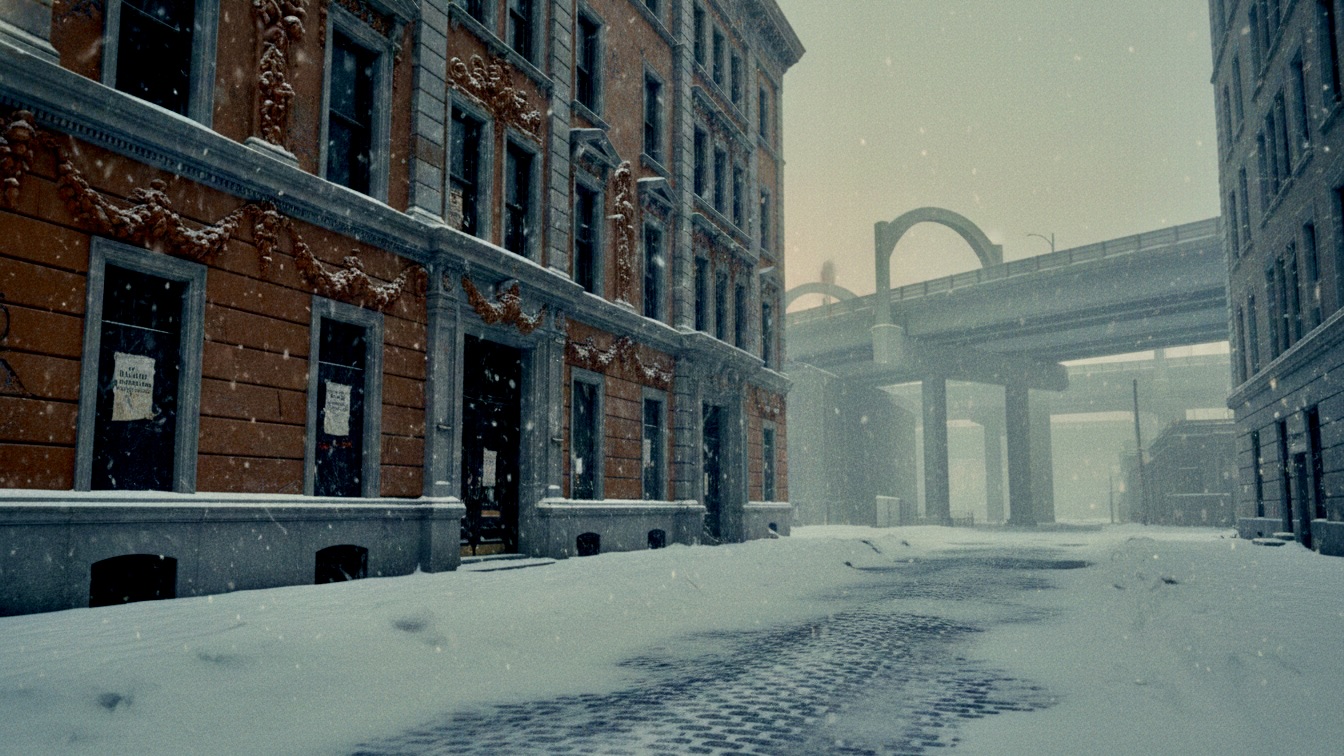
The narrative operates firmly within the tradition of the Urban Gothic, yet it subverts the typical mechanics of horror by replacing fear with a crushing, existential sorrow. The protagonist, Jeff, frames himself not as an intruder but as an "architectural mortician," a title that immediately establishes the central theme of the story: the reverence for the dying and the sanctity of decay. The setting, a condemned Beaux-Arts building named The Marlowe, serves as a colossal memento mori, standing in defiant contrast to the "soulless" modernity surrounding it. The winter setting is not incidental; it acts as a curator, stripping away the noise of the contemporary city to reveal the skeletal truth of the past. The snow functions as a shroud, silencing the external world and forcing an internal, psychological confrontation with history that has been deemed structurally unstable.
Jeff’s narrative voice is deeply romantic and intensely subjective, filtering the physical reality of the rotting structure through a lens of tragic poetry. His perception is attuned to the "ghosts" of the architecture—the peeling cornices and silent pianos—rendering him a somewhat unreliable narrator regarding the objective danger of the situation. While he sees a "library of ghosts," his companion Isabelle sees "asbestos and pigeon shit." This dichotomy highlights the perceptual limits of the romantic gaze; Jeff is so enamored with the aesthetic of loss that he becomes vulnerable to the psychic weight of the place. The cold he describes is not just meteorological but metaphysical, a "physical thing" that presses against him, blurring the lines between the temperature of the air and the emotional temperature of the haunt.
Ethically, the story interrogates the morality of progress and the violence of erasure. The demolition notice is presented as a bureaucratic lie, a diagnosis of "structural instability" that Jeff refutes by claiming the building has "bones." The narrative posits that buildings are not merely inanimate objects but vessels of collective human experience, and to destroy them is to execute a living memory. The ghost in the penthouse is less a supernatural entity and more a concentration of this displaced history. The existential horror arises not from a threat to life, but from the threat of total oblivion—the terrifying realization that a life can be reduced to a faint, sad perfume in an empty room, waiting for a wrecking ball to extinguish even that final trace.
Psychological State:
Jeff exhibits a profound sensitivity that borders on emotional permeability, operating as a conduit for the environments he inhabits. He is drawn to the "Bone Yard" not out of morbid curiosity, but out of a need to validate the existence of things that have been cast aside. His state is one of melancholic reverence; he finds comfort in the silence of the snow because it mirrors his own internal quietude. The cold does not repel him but rather clarifies his purpose, sharpening his focus on the tragedy of the inanimate. He is deeply deeply immersed in a state of anticipatory grief, mourning the loss of the building before it has even occurred.
Mental Health Assessment:
While high-functioning, Jeff displays signs of intense projection and a potential struggle with his own feelings of isolation. His identification with the building—a solitary, grand structure surrounded by incompatible modernity—suggests he feels out of step with his own time. He describes himself as an "emotional sponge," a trait that indicates low boundary maintenance between his own psyche and external stimuli. This lack of emotional shielding makes him susceptible to the "invasive species" of the ghost's grief. His mental resilience is tied to his ability to aestheticize pain; he copes with the harshness of the world by turning it into art or a story, but this defense mechanism fails when the sorrow becomes too absolute to be sketched.
Motivations & Drivers:
His primary motivation is preservation, specifically the preservation of memory through observation. He views his intrusion into The Marlowe as a duty, a last rite for a dying friend. He is driven by a desire to witness the "secret" history that the city attempts to bury under snow and concrete. The winter weather accelerates his urgency; the cold serves as a reminder of the impending freeze of death, pushing him to capture the "bones" of the place before they are shattered. He seeks a connection with the past that feels more authentic than the "disposable boxes" of the present.
Hopes & Fears:
Jeff’s deepest hope is that meaning persists after utility ends—that there is dignity in obsolescence. He hopes that by witnessing the building, he grants it a form of immortality. Conversely, his core fear is the concept of being "forgotten." The ghost represents his ultimate terror: not death itself, but the lingering, unacknowledged loop of sorrow that comes from being left behind. The "soul-crushing sadness" he encounters is the manifestation of his fear that, in the end, we are all just isolated figures standing at a window, watching a world that no longer knows our names.
Psychological State:
Isabelle serves as the grounding wire to Jeff’s high-voltage romanticism. Her psychological state is defined by pragmatism, vitality, and a keen awareness of immediate physical reality. The "crimson" of her coat against the "monochrome" landscape visually represents her psychological role: she is the pulse of life in a dead zone. She is not immune to the atmosphere, acknowledging the "tragic grandeur," but she refuses to let it seduce her. Her humor is a defense mechanism, a way to keep the encroaching darkness and the biting cold at a manageable distance.
Mental Health Assessment:
Isabelle demonstrates robust mental health and high resilience. She processes the environment through a lens of safety and logic—worrying about "tetanus," "rabid squatters," and frostbite rather than spiritual resonance. She is protective, recognizing Jeff’s vulnerability and stepping in to break the trance when he drifts too far. Her ability to joke about "sewer clowns" and "meth-addicted silent film stars" shows a healthy capacity to neutralize fear through absurdity. She remains anchored in the present, unaffected by the psychic residue that cripples Jeff.
Motivations & Drivers:
Her presence in the building is driven largely by her relationship with Jeff. She is there to act as his spotter, ensuring his safety in a physically dangerous environment. While she appreciates the adventure, her motivation is social and protective rather than philosophical. The cold motivates her to keep moving and to finish the task efficiently. She wants to extract Jeff from the "tomb" before the metaphorical and literal chill sets in too deep. Her drive is toward warmth, coffee, and life—the antithesis of the building’s stasis.
Hopes & Fears:
Isabelle hopes to maintain control over the situation and to keep their exploration within the bounds of "light-to-moderate trespassing" rather than a descent into madness. She fears physical harm—the collapse of a floorboard, the bite of the frost—but she also harbors a subtle fear for Jeff’s stability. When she asks if he is okay, noting he looks like he’s "seen a ghost," it reveals a concern that his empathy might be dragging him into a place she cannot follow. She fears the loss of connection with him, the moment when he drifts into a sadness she cannot joke away.
The emotional trajectory of the chapter is constructed like the building itself: a vertical ascent that moves from physical unease to spiritual devastation. In the basement, the emotion is primal and sensory—the fear of the dark, the "subterranean cold," and the "loamy scent of decay." This is the foundation, grounding the reader in the physical reality of the ruin. As the characters ascend to the lobby, the emotion shifts to awe and nostalgia. The space becomes a cathedral of lost time, evoking a sense of tragedy that is beautiful rather than threatening. The "amber twilight" and the "expectant" silence prime the reader for a deeper connection, moving from the visceral to the sentimental.
However, the arrival at the penthouse marks a radical shift in the emotional architecture. The aesthetic appreciation collapses under the weight of a "psychic radiation." The narrative moves from observing the past to being colonized by it. The transfer of emotion is visceral and invasive; Jeff does not merely sympathize with the ghost, he is "bulldozed" by her grief. The winter setting amplifies this transfer; the cold acts as a superconductor for the sadness, stripping away Jeff's defenses and leaving him exposed. The isolation of the snowy city below reinforces the feeling of being trapped in a singular, hermetic moment of despair.
The aftermath of this encounter changes the emotional texture of the entire story. The descent back to the street is not a return to normalcy but a retreat carrying a permanent scar. The building transforms from a "masterpiece" into a "tomb," and the sadness settles into Jeff as a "low-frequency hum." The emotional architecture extends beyond the physical structure; the grief of the Alabaster Tenant has been exported into the protagonist. The horror lies in the realization that this sadness is contagious, a residue that clings to the witness long after they have left the site of the trauma.
The Marlowe acts as a psychological mirror, its verticality representing a journey into the subconscious. The basement, dark and filled with "slumbering iron beasts," correlates to the deep, instinctual fears of the unknown and the buried past. The lobby, with its faded grandeur and frozen clockwork of social interaction, represents the persona—the public face that is now cracking and peeling. The penthouse, located at the apex and offering a panoramic view of the "white and grey" world, symbolizes the isolated ego, the place of highest consciousness where the realization of loneliness is most acute. The building is not just a setting; it is a structural map of grief.
Winter functions as the essential medium for this psychological exploration. The snow is an isolation tank, erasing the "hard lines of the world" and muting the "cacophony" of life that usually distracts from internal states. By blanketing the city in "sound-devouring white," the weather forces an introspection that is inescapable. The cold is described as a "physical thing," a pressure that restricts movement and sensation, paralleling the paralyzing effect of depression or profound grief. The environment actively conspires to trap the characters in a timeless, frozen moment, mirroring the ghost’s eternal loop of waiting.
The prose utilizes a diction of fragility and permanence to create a tension between the ephemeral and the enduring. Words like "alabaster," "bone," "pristine," and "shroud" evoke images of death and statuary, reinforcing the idea of the building as a corpse. The rhythm of the sentences mirrors the falling snow: quiet, insistent, and accumulating. In the descriptive passages, the pacing is slow and observational, allowing the details of the "peeling cornice" and "shattered window" to pile up like drifts. When the supernatural encounter occurs, the rhythm stutters; the sentences become shorter, more frantic, mimicking the "trapped bird" of Jeff’s heart.
Symbolism is woven tightly into the fabric of the narrative. The "flash of crimson" from Isabelle’s coat serves as a visual anchor, a symbol of blood and life in a world of "monochrome" death. It highlights her role as the living counterpoint to the ghost’s grey existence. The piano, "silent" and "half-covered by a sheet of fallen plaster," stands as a powerful symbol of unvoiced grief and interrupted art. It represents the potential for beauty that has been stifled by neglect. The "dust" is perhaps the most pervasive symbol—it is the atomized remains of the past, coating everything in a "funeral shroud," blurring the lines between the object and the memory of the object.
The use of sensory imagery extends beyond the visual to the tactile and olfactory, grounding the ghostly experience in the physical body. The "metallic chill," the "loamy scent of decay," and the "smell of stale cigarettes" create a textured reality that makes the intrusion of the supernatural more jarring. The ghost is not seen clearly but is felt as a "wave of profound, soul-crushing sadness." This shift from the optical to the emotional suggests that the true haunting is not a visual apparition but an affective state. The winter motif binds these elements, freezing the sensory details in a tableau of suspended animation.
The story resonates deeply with the concept of Hauntology, a philosophical framework derived from Jacques Derrida, which speaks to a pining for lost futures. The Marlowe represents a future that was promised in 1922—one of Beaux-Arts ambition and permanence—that has been cancelled by the "glass-and-steel boxes" of modernity. The ghost is not just a dead woman; she is the specter of a cultural era that has been discarded. This aligns the narrative with the "ruin porn" aesthetic of contemporary urban exploration, where the decay of the industrial age is fetishized as a site of authentic emotional experience in an increasingly sterile world.
Literarily, the text echoes the tropes of the Victorian ghost story, particularly the works of M.R. James or Edith Wharton, where the haunting is tied to a specific place and a specific tragedy of isolation. However, it recontextualizes these tropes within the modern urban landscape. The "Bone Yard" serves as the new heath or crumbling manor, a liminal space on the edge of civilization. The figure of the "woman in black" or the "waiting woman" is a classic archetype, representing the feminine containment of grief and domestic entrapment. Here, she is trapped not just in a house, but in a timeline that the city is actively destroying.
The narrative also engages with the mythology of winter as a time of thinning veils. In folklore, winter is often the season of the dead, where the earth sleeps, and the boundaries between the living and the underworld are permeable. The "silent coup d'état" of the snow creates a separate reality, a "secret" city where the laws of physics are suspended in favor of the laws of memory. This connects the story to a long lineage of winter tales where the cold serves as a revelator of truth, stripping away the artifices of life to show the bare bones of existence underneath.
What lingers after the final sentence is not fear, but a heavy, resonant melancholy. The story successfully transfers the "emotional residue" of the building to the reader, much as it did to Jeff. The haunting is effective because it bypasses the fight-or-flight response and targets the capacity for empathy. The image of the woman waiting by the piano, defined not by malice but by an "ancient" loneliness, creates a sense of complicity. We, like Jeff, become witnesses to her erasure, and the knowledge that she will be destroyed by the demolition creates a lingering sense of guilt.
The winter imagery leaves a lasting intellectual afterimage regarding the nature of progress. The contrast between the "alabaster" beauty of the past and the "disposable boxes" of the present forces a reflection on what we value as a society. The story asks whether we are building environments that can hold our memories, or if we are creating a world of transient surfaces that repel emotional attachment. The coldness of the story feels like a warning: that a society without memory is a society freezing to death, disconnected from the warmth of its own history.
Ultimately, the narrative leaves the reader with an unresolved tension between the necessity of moving forward and the tragedy of leaving things behind. The "low-frequency hum" of sadness that Jeff carries away is a metaphor for the cumulative grief of living in a changing world. It suggests that every demolished building, every forgotten name, adds a microscopic weight to the collective psyche. The story does not offer closure; instead, it offers a stain, a reminder that some things are not meant to be fixed or forgotten, but simply witnessed before they disappear into the white.
The condensation on the glass of the penthouse window has likely frozen by now, forming intricate, fern-like patterns of frost that obscure the view of the city below. In the silence of the empty room, the absence of the living is absolute. The dust motes, previously agitated by the intrusion of boots and breath, have begun their slow, spiraling descent back to the floor, reclaiming the stillness. The piano remains shut, its potential music trapped beneath the lid, resonating only with the sympathetic vibration of the wind rattling the loose panes.
This is the final state of the Alabaster Tenant: not a scream, but a crystallization. The sadness that Jeff carried out into the street was merely a sample, a thimbleful of ocean water taken from a vast, dark sea. The true depth of the grief remains locked inside the stone, intensifying as the temperature drops. As the heavy machinery prepares to breach the walls, it will not be breaking brick and mortar, but cracking open a geode of frozen sorrow, releasing a century of accumulated winter into an unsuspecting air.