The small, scuffed USB data drive, resting mundane on a cracked formica table, functions as a chilling digital seed. It holds the genomic code of an engineered apocalypse, a contained, silent detonation awaiting connection to the wider world. Its ordinary appearance belies the unfathomable weight of planetary unraveling it carries, transforming a simple piece of plastic into a conduit for global catastrophe. This tiny artifact of data becomes the fragile vessel of a truth too immense to comprehend, a key to unlocking not just a story, but the very end of a habitable future.
This chapter, "The Permafrost Papers," positions itself firmly within the eco-thriller and speculative fiction genres, infused with strong elements of a conspiracy narrative. Its overarching themes revolve around the catastrophic consequences of unchecked corporate greed, the suppression of scientific truth, and humanity's terrifying capacity for self-destruction. The narrative explores the urgency of climate collapse, not as a distant threat, but as an immediate, unfolding disaster, personified by the relentless blizzard outside the cafe window. The story effectively crafts a mood of bleak urgency and pervasive dread, hinting at a global crisis that has already passed the point of no return.
The narrative voice, belonging to Carter, is initially that of a skeptical journalist, grounded in the mundane realities of a difficult assignment, low battery warnings, and overdue rent. His perceptual limits are evident in his initial dismissal of the blizzard as merely "a bad one," demonstrating a common human tendency to normalize extraordinary events. The cold and the overwhelming white-out of the storm subtly influence his perception, blurring the lines between external reality and internal anxiety. This sensory assault contributes to his eventual susceptibility to Peterson's claims, as the external chaos mirrors the internal chaos Peterson describes. Carter's initial focus on practicalities and his editor's cynical view (“career crank”) underscore the societal disbelief and dismissal that allowed the catastrophe to brew, creating a narrative gap between scientific warning and public acceptance.
The moral and existential dimensions of the chapter are profound, questioning the ethics of corporate entities prioritizing profit over planetary survival and the responsibility of individuals to disseminate inconvenient truths. Peterson embodies the tragic figure of the prophet ignored, sacrificed for the sake of corporate cover-up. The isolation imposed by the blizzard amplifies the characters' individual struggles, forcing them into a liminal space where the fate of the world rests on a single, desperate transfer of information. The chapter asks whether truth, once revealed, can still hold meaning in the face of an unstoppable cataclysm, and whether individual acts of courage can make a difference against forces of such immense scale and power.
Psychological State: Carter begins in a state of professional detachment, tinged with mild annoyance and the everyday anxieties of a working journalist – a low phone battery, a tight jaw from the cold, and looming rent. He is initially skeptical, viewing Peterson as a potential "career crank." As Peterson's revelations unfold, Carter's psychological state rapidly shifts to one of profound shock, fear, and a terrifying certainty. He moves from journalistic observer to an unwilling participant, overwhelmed by the magnitude of the truth and his sudden, perilous role in it. The cold environment exacerbates his physical discomfort, further contributing to a sense of vulnerability and unease.
Mental Health Assessment: Carter appears to possess a baseline level of resilience, characteristic of someone in a demanding profession. His initial skepticism serves as a coping mechanism, allowing him to maintain a professional distance from potentially volatile subjects. However, the chapter depicts him under acute stress, with his "journalistic skepticism... evaporated" and his body reacting with trembling hands and disconnected legs. While not a long-term assessment, his immediate response suggests a healthy, albeit terrified, reaction to an objectively terrifying situation, indicating a capacity to process and respond to extreme threats, even if he feels like "just the package."
Motivations & Drivers: Carter is initially driven by his editor's assignment, a professional obligation to investigate a lead, however unpromising. He seeks a story, a scoop that might validate his editor's cryptic last message. Once Peterson reveals the full scope of the climate catastrophe and the cover-up, Carter's motivation shifts dramatically. He is no longer merely seeking a story but is driven by a primal need for survival and the immense, terrifying responsibility of delivering the truth. The harsh winter environment, which he initially saw as an inconvenience, becomes a powerful symbol of the truth he must carry, fueling his urgency.
Hopes & Fears: Carter initially hopes to simply fulfill his assignment and perhaps find a compelling narrative, fearing his editor's disapproval or the futility of chasing a "crank." These mundane fears are quickly overshadowed by a far more profound dread: the end of the world as he knows it. He fears the unstoppable cascade Peterson describes, the immediate threat of the dark sedan, and his own vulnerability as he becomes the unwitting carrier of a world-ending secret. His hopes, though unspoken, likely shift to simply surviving, delivering the data, and perhaps, against all odds, contributing to some form of global awareness or action, however remote the possibility.
Psychological State: Dr. Arnold Peterson is a man profoundly scarred by years of scientific ostracization and the immense burden of suppressed truth. His psychological state is characterized by intense paranoia, which the narrative confirms as justified, and a grim, almost theatrical resolve. He is gaunt, his eyes darting, and his movements stiff, all indicative of prolonged stress, fear, and possibly sleep deprivation. Despite these outward manifestations of distress, he maintains a chilling clarity regarding his scientific findings and the gravity of the situation, suggesting a mind pushed to its limits but still fiercely intellectual.
Mental Health Assessment: Peterson has clearly endured immense psychological pressure, facing professional ruin and public ridicule for his accurate predictions. His initial classification as a "career crank" highlights societal dismissal of inconvenient truths. While his paranoia is extreme, the presence of the dark sedan validates his fears, suggesting his "mental health" is more a reflection of external threats than internal delusion. He exhibits remarkable resilience in his commitment to exposing the truth, even to the point of self-sacrifice. His controlled demeanor during the transfer of the drive, despite his internal terror, speaks to a profound, almost desperate, sense of purpose.
Motivations & Drivers: Peterson is driven by an overwhelming sense of responsibility and a desperate need for vindication. Having dedicated his life to climate science and accurately predicted the unfolding catastrophe, his primary motivation is to ensure the truth, now contained on the USB drive, reaches the public. He is fueled by the injustice of his discreditation and the sheer horror of the corporate cover-up. The extreme winter conditions, which are a direct manifestation of his predictions, serve as a constant, visceral reminder of the urgency of his mission, pushing him towards his ultimate sacrifice.
Hopes & Fears: Peterson's core hope is that the information on the drive will be exposed, leading to global awareness of the impending disaster and holding Arctic Energy Solutions accountable. He hopes his sacrifice will not be in vain. His fears are manifold: the continued suppression of truth, the complete collapse of the planet, and his own capture or death before the data can be shared. The chilling certainty in his eyes, even as he faces his likely demise, suggests a man who has transcended personal fear, his greatest terror being the failure of his life's work to save humanity.
Psychological State: Cathy, the waitress, presents a psychological state of profound detachment and methodical resignation. Her movements are quiet and efficient, her voice flat, and her expression largely unchanged. She seems to exist in a state of quiet endurance, performing her duties without engaging emotionally with the extreme external environment or the tense drama unfolding before her. Her apparent lack of reaction to the violent storm or Peterson's obvious distress suggests either a deep-seated stoicism, a coping mechanism of emotional numbness, or a profound weariness born of continuous exposure to hardship.
Mental Health Assessment: Cathy's mental health appears stable in its detachment, a quiet fortitude developed perhaps from years of facing a harsh existence. She exhibits no overt signs of distress, but her unresponsiveness hints at a form of emotional blunting, a survival mechanism in a world that offers little comfort or hope. The narrator's intuition that "She knew something was wrong. But she did nothing" suggests a deeper, unarticulated awareness beneath her placid exterior, indicating a mind that processes the bleakness of her surroundings without succumbing to overt panic or despair.
Motivations & Drivers: Cathy's primary motivations are simple and immediate: to perform her job, serve coffee, and presumably, to make it home safely through the blizzard. Her methodical actions suggest a life driven by routine and necessity, rather than ambition or grand goals. The extreme winter environment likely reinforces her focus on basic survival and the maintenance of a fragile, everyday normalcy within the cafe's confines.
Hopes & Fears: Cathy's hopes are likely modest, centered on the continuity of her daily life and personal safety. She probably hopes the storm will pass and she can return home. Her fears, though unstated, are implied to be the immediate dangers of the blizzard, the uncertainty of her livelihood, and perhaps a generalized apprehension about a world that is increasingly unstable. Her quiet observation suggests a fear of direct involvement, preferring to remain a silent witness to the unfolding drama rather than a participant.
The chapter masterfully constructs an emotional arc that moves from initial discomfort and journalistic skepticism to overwhelming dread and existential terror. The opening scene immediately establishes a sense of struggle and foreboding, with the "fight" against the door, the "choked, dead clank" of the bell, and the "pressurized ringing" silence creating an immediate atmosphere of unease. This initial tension is amplified by Carter's physical discomfort—fogged glasses, frozen fingers, the cold soaking through his coat—grounding the reader in his immediate, visceral experience of the harsh winter environment.
As the narrative progresses, the emotional landscape shifts from personal discomfort to a more pervasive paranoia. Peterson's gaunt appearance, darting eyes, and whispered warnings about "them" listening inject a palpable sense of threat and conspiracy into the cafe's seemingly mundane setting. The violent whump of the wind against the window serves as a physical jolt, mirroring the psychological jolt of Peterson's revelations. This moment is a turning point, transforming the blizzard from a mere backdrop into an active, menacing force, a physical manifestation of the impending global doom. The reader, like Carter, is drawn into Peterson's world of justified fear.
The climax of emotional transfer occurs with Peterson's chilling exposition of the "methane bomb" and the corporate cover-up, leading to Carter's "journalistic skepticism... evaporated" and replaced by a "raw, terrifying certainty." The appearance of the dark sedan outside, and Peterson's subsequent, grim sacrifice, elevate the tension to an unbearable pitch, leaving the reader with a profound sense of helplessness and urgency. The cold, the howling wind, and the suffocating white-out are not just atmospheric details; they are active agents in building this emotional architecture, mirroring and amplifying the characters' isolation, vulnerability, and the terrifying, irreversible nature of the unfolding catastrophe.
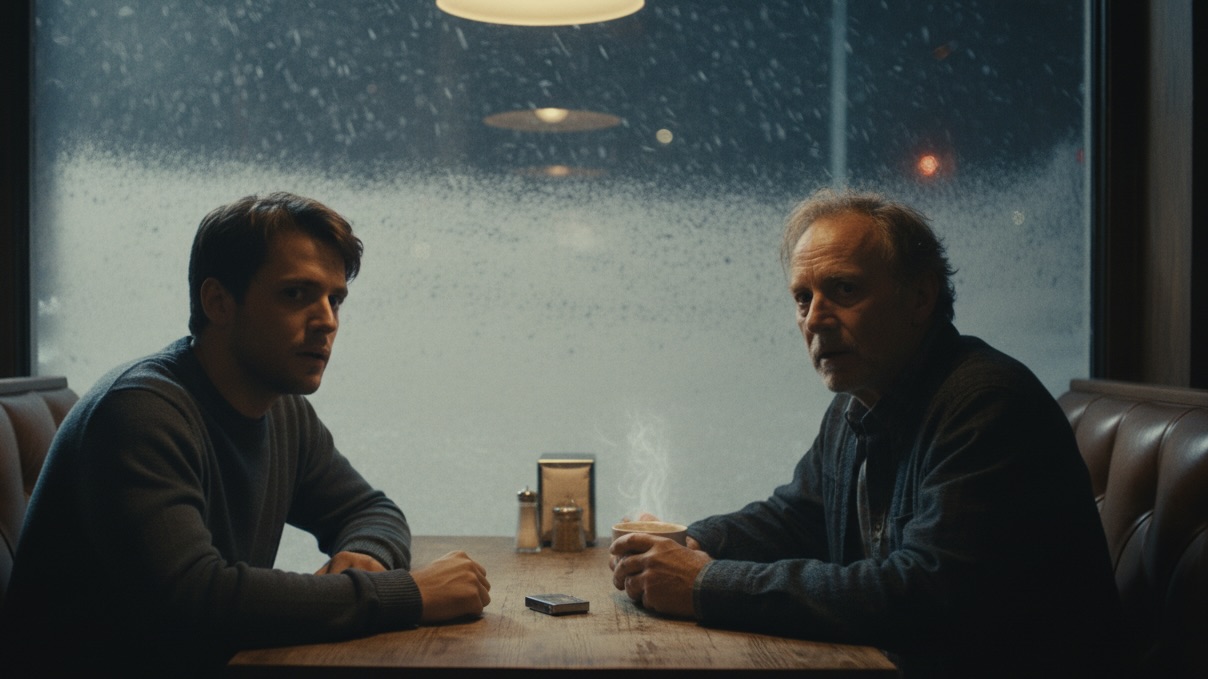
The Cafe on Portage serves as a crucial psychological crucible, a seemingly mundane refuge that becomes a stage for an apocalyptic revelation. Its cracked vinyl, burnt coffee smell, and sickly fluorescent lights create an atmosphere of faded normalcy, a fragile illusion of safety against the brutal forces outside. This internal environment, slightly dilapidated and uninviting, subtly mirrors the erosion of societal trust and the precariousness of the world Peterson describes. It acts as a liminal space, a temporary, isolated pocket where the immense global truth can be whispered before being thrust back into the chaos. The cafe’s very ordinariness heightens the shock of the extraordinary events unfolding within its walls.
The relentless blizzard is far more than just weather; it is a primary psychological force, mirroring and distorting the internal states of the characters. For Carter, it initially represents an inconvenience and a physical challenge, but it quickly transforms into a terrifying symbol of the "planetary fever" Peterson describes. The "swirling wall of white," erasing the street and buildings, visually represents the erasure of the familiar world and the impending global collapse. The cold itself is a constant, oppressive presence, seeping into bones, fogging vision, and freezing ink. This pervasive cold acts as an amplifier of fear, isolation, and vulnerability, making the characters' physical discomfort a palpable manifestation of the chilling, existential dread that permeates the narrative. The environment is not just a backdrop, but an active antagonist, a visceral embodiment of the story's core conflict.
The chapter's aesthetic and stylistic choices are meticulously crafted to build a sense of urgent realism and impending doom. The sentence rhythm often shifts, employing short, sharp declarations ("The door was a fight," "I ignored it," "Go") to convey immediate action and heighten tension, especially during moments of confrontation or decision. These are interspersed with longer, more descriptive sentences that immerse the reader in the sensory details of the environment, such as the "pressurized ringing" silence or the "horizontal river of ice particles," creating a dynamic and engaging narrative flow. This varied rhythm keeps the reader off-balance, reflecting Carter's own fluctuating mental state.
Diction is carefully selected for its visceral impact and evocative power, contributing to the bleak and urgent tone. Words like "choked," "dead clank," "sickly yellow-white," "sad-looking," "gaunt," "frayed," "rasping," "guttural moan," and "bloodless smile" paint a stark, almost unromanticized picture of decay and desperation. This precise word choice imbues mundane objects and actions with a deeper, often unsettling, symbolic resonance. The imagery consistently reinforces themes of cold, decay, and obstruction: fogged glasses, wet scarves, cracked vinyl, the "swirling wall of white," and frozen ink all contribute to a sense of physical and functional breakdown, mirroring the larger breakdown Peterson describes.
Symbolism is deeply embedded within the narrative. The permafrost itself is the central symbol, representing not just a physical geological feature but a hidden, ancient danger now unleashed, a metaphor for humanity's buried consequences and the irreversible nature of environmental tipping points. The USB drive, a small, prosaic object, becomes a powerful symbol of contained truth and immense, world-altering knowledge—a digital Pandora's Box. The cafe, a seemingly ordinary space, transforms into a fragile, liminal sanctuary, a temporary stage for a world-changing exchange. The blizzard is not merely a weather event but a potent symbol of the "planetary fever," a physical manifestation of environmental collapse that erases and isolates, reflecting the profound existential threat to human civilization.
"The Permafrost Papers" resonates deeply within the burgeoning genre of climate fiction, or "cli-fi," echoing works that explore the grim realities of environmental degradation and humanity's often-futile struggle against its consequences. It aligns with narratives like Paolo Bacigalupi's The Windup Girl or Cormac McCarthy's The Road, which depict worlds irrevocably altered by ecological disaster, albeit with a focus on the immediate onset rather than the aftermath. The story taps into a contemporary cultural anxiety about climate change, scientific denial, and the perceived helplessness of individuals against powerful corporate and political forces, transforming abstract scientific warnings into a tangible, terrifying reality.
The chapter also draws heavily from the traditions of the conspiracy thriller, channeling the paranoia and high stakes found in films like Three Days of the Condor or novels that feature whistleblowers exposing vast, dangerous secrets. Peterson embodies the archetypal figure of the truth-teller persecuted by powerful, shadowy organizations, reminiscent of figures in All the President's Men or even the science fiction trope of the mad scientist whose warnings are dismissed until it's too late. His "they listen" whispers and the ominous dark sedan outside position the narrative within a familiar framework where hidden powers manipulate information and endanger those who challenge the status quo.
Furthermore, the story leverages the rich tapestry of winter symbolism found across cultural and mythological frameworks. Winter, in many traditions, signifies death, dormancy, hardship, and the end of cycles, often associated with a period of profound struggle for survival. Here, the blizzard is not merely a setting but an active, destructive entity, reminiscent of ancient myths where harsh seasons bring about trials of endurance or represent the wrath of nature. This evokes a primal fear of the elements, elevating the stakes beyond mere political intrigue to a fundamental battle for existence, connecting to a universal human experience of confronting overwhelming, indifferent forces. The narrative subtly positions Peterson as a modern Cassandra, a prophet whose dire warnings are not only ignored but actively suppressed, leading to inevitable doom, a tragic archetype that resonates throughout literature and myth.
The most profound lingering impact of "The Permafrost Papers" is the chilling certainty of its premise: the idea that the "beginning of the end" might not be a distant future, but a present reality, already set in motion and deliberately concealed. The sudden, terrifying shift from Carter's mundane worries to the apocalyptic scale of Peterson's revelation creates a visceral sense of dread that remains long after the final sentence. The narrative compels a reflection on our own societal complacency and the ease with which inconvenient truths, particularly scientific ones, can be dismissed or suppressed for short-term gain, leaving a deep unease about the fragility of our world and the integrity of its gatekeepers.
The image of the small, unassuming USB drive, holding the blueprint for global catastrophe, is particularly potent. It symbolizes the immense power and vulnerability inherent in information, and the almost absurd contrast between the mundane object and its world-ending contents. This object becomes a focal point for the reader's anxieties, embodying the fragile hope for exposure against the overwhelming forces of corporate power and environmental collapse. The sheer scale of the lie—a corporate cover-up leading to planetary destabilization—is intellectually staggering and emotionally devastating.
The relentless winter motif, a constant physical presence throughout the chapter, amplifies these lingering feelings. The suffocating white-out, the biting cold, and the violent whump of the wind against the window are not just sensory details; they are active extensions of the story's core dread. The cold that Carter feels, the frozen ink, the "colder than the wind outside" belief in Peterson’s words—these sensations imprint the story's existential threat directly onto the reader. The chapter leaves one with an unsettling question: how many other "permafrost bombs" are quietly ticking, and how many brave, desperate "Peterson" figures are being silenced, while the world remains oblivious, lost in its own blizzard of distractions?
The Cafe on Portage, stripped of its mundane facade by the howling blizzard, becomes a crucible where the stark cold of scientific truth meets the frigid indifference of corporate power. The silence after the door slams, a "pressurized ringing," echoes the unheeded warnings that have built to this moment, a sound that is not an absence of noise but the unbearable weight of impending doom. It is in this brittle space, framed by cracked vinyl and sickly light, that the true nature of winter is revealed—not as a season, but as a symptom, a visible manifestation of a planetary body in crisis.
As Carter steps back into the "white," the cold that strikes him is not merely atmospheric; it is the physical embodiment of the terrifying certainty he now carries, a chilling truth colder than any blizzard. The story, now a tangible, dangerous package in his pocket, binds him inextricably to a future defined by permafrost’s unforgiving thaw. The enduring image is that of Peterson, a ghost in a failing cafe, his sacrifice a stark and solitary silhouette against a storm that has only just begun to rage, leaving behind a lingering, icy premonition of what "Tuesday" might truly bring.