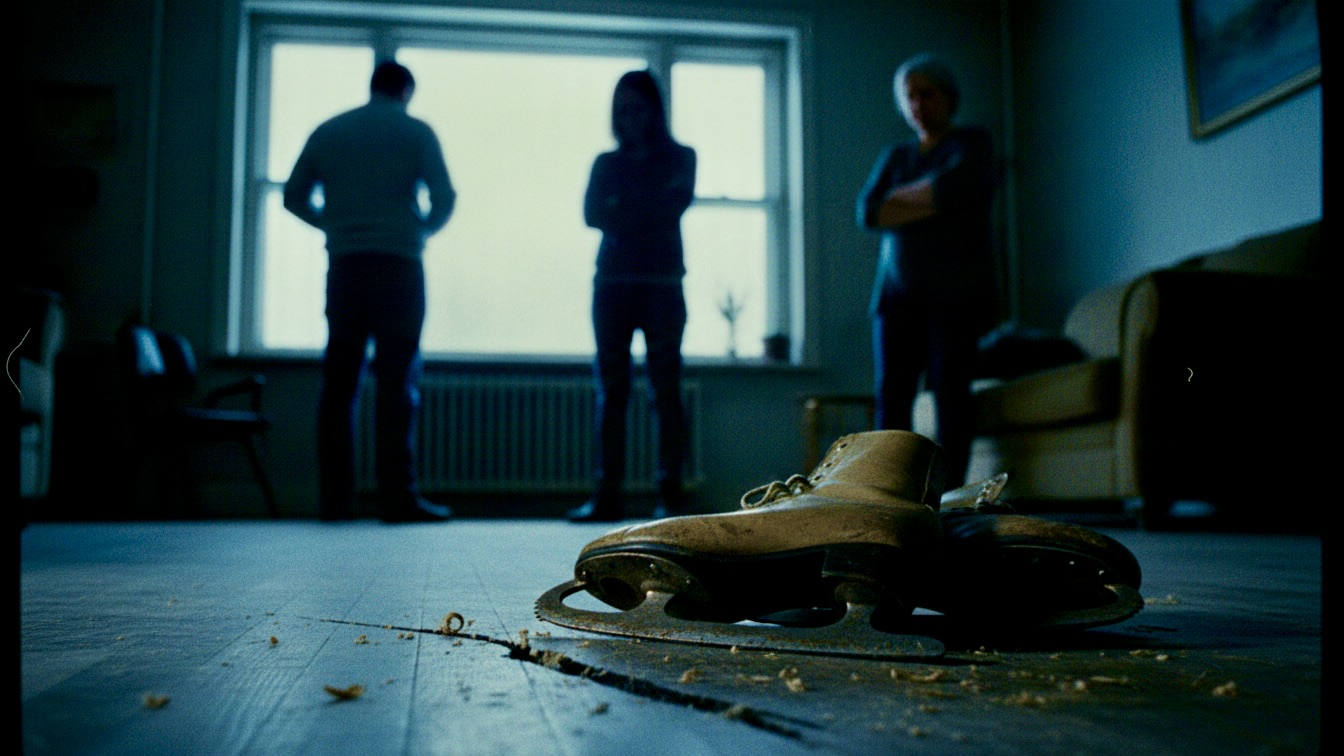
The story opens in a house stifled by emotional coldness, mirroring the bleak January weather outside. Maggie, the matriarch, observes her son Mark and daughter-in-law Sarah trapped in a silent, resentful standoff, while her grandson Tim navigates the tension like a diplomat in a war zone. Desperate to fracture the suffocating atmosphere, Maggie leads Tim to the attic and reveals a pair of antique ice skates that belonged to her late husband, Thomas. She fabricates a heartwarming story about Thomas’s father buying the skates during a time of hardship to bring the family joy, a narrative designed to inspire unity in the present.
The lie initially succeeds, melting the family's icy exterior. Mark and Sarah soften, bonding over the artifact and planning a family outing to the rink, while Tim beams with newfound excitement. However, the fragile peace is shattered the next morning by a phone call from an estranged cousin, David. He reveals the ugly truth: the skates were not a gift of love but stolen property taken by Thomas during a bitter inheritance dispute.
Mark, devastated by the revelation that his father was a thief and his mother a liar, confronts Maggie. The revelation acts as a catalyst for the underlying marital tension between Mark and Sarah to explode into a vicious argument, with the skates serving as the centerpiece of their mutual resentment. Maggie watches helplessly as her attempt to heal the family instead exposes deep generational wounds, leaving Tim traumatized and the family unit more fractured than before.
The central theme of the narrative is the corrosive nature of silence and the fragility of peace built upon deceit. The title, "A Silence That Binds," suggests a dual meaning: silence can hold people together in a shared misery, or it can restrict and imprison them. Initially, the silence in the living room is a weapon used by Mark and Sarah to avoid confrontation, a "fortress" that isolates them. Maggie attempts to break this silence with a story, but because her narrative is founded on a lie, it ultimately creates a louder, more destructive noise. The story suggests that unresolved trauma and hidden truths act like rot within the foundation of a family; painting over them with pleasant myths only delays the inevitable collapse.
Furthermore, the text explores the complex relationship between memory and mythology. Maggie has spent years "sanding down" the rough edges of her husband's past, transforming a petty act of theft into a noble fable of sacrifice. This highlights a psychological need to curate the past to make the present bearable. She believes that the emotional truth—the need for family unity—justifies the factual fabrication. However, the narrative ruthlessly deconstructs this idea, demonstrating that a legacy built on falsehoods cannot support the weight of the present. When the myth of the "saintly grandfather" crumbles, it takes the family's self-image down with it.
Finally, the story serves as a poignant examination of generational trauma and the inheritance of conflict. The skates, intended to be a symbol of joy, are actually physically scarred artifacts of a brotherly feud from fifty years ago. By passing them down to Tim, Maggie inadvertently passes down the unresolved sin of the past. The conflict between Thomas and Robert is mirrored and amplified in the fight between Mark and Sarah. The toxicity flows from one generation to the next, with Tim standing as the innocent recipient of this heavy, tarnished heritage. The ending implies that without truth, the cycle of bitterness remains unbroken.
Maggie operates as the story's tragic architect, driven by a desperate need to maintain the illusion of a cohesive family unit. Psychologically, she exhibits signs of deep-seated denial, having rewritten her own history to cope with the reality of her late husband's flawed character. Her internal monologue reveals that she views her fabricated story as a "key" to a jammed door, indicating a utilitarian view of truth; to her, facts are malleable tools to be used for emotional outcomes. She is not malicious, but her inability to confront the "stuck door" of reality leads her to force a solution that destroys the jamb entirely.
Her motivation is rooted in a protective instinct for her grandson, Tim. Seeing him navigate the "cold war" of his parents triggers her intervention, yet she fails to realize that her method—replacing silence with a lie—is just another form of concealment. When the truth is revealed, Maggie’s paralysis signifies the total collapse of her world-view. She is stripped of her role as the benevolent matriarch and exposed as an enabler of deceit. Her tragedy lies in her intent; she sought to give Tim a shield against the cold, but instead handed him a weapon that his parents immediately turned upon one another.
Mark represents the disillusioned middle generation, crushed between the weight of the past and the pressures of the present. Initially, he is depicted as a "ghost," disengaged and numbed by the "long list of things to be endured." His addiction to his phone serves as a dissociation mechanism, a way to escape the emotional vacuum of his marriage. When Maggie presents the false story, Mark’s reaction is one of profound vulnerability; he is desperate to believe in the goodness of his father because he needs a model for how to be a father himself.
The revelation of the theft destroys Mark more completely than the others because it targets his identity. His anger at Maggie is fueled by a sense of betrayal that spans his entire life; he realizes his foundation is built on sand. When he turns on Sarah, it is a displacement of this newfound shame. However, his final action—dropping the skate and taking Tim away—shows a return to his protective instincts. He rejects the toxic heritage, but in doing so, he also retreats back into isolation, leaving his mother and the lie behind.
Sarah acts as the narrative’s truth-teller, though she wields the truth like a bludgeon. Her stillness is described as "predatory," suggesting she has been waiting for an opportunity to release her pent-up frustration. She is cynical and perceptive, likely having sensed the hollowness in the family's dynamic long before the phone call. While she initially participates in the "truce" offered by the skates, her buy-in is superficial, driven by social media performativity rather than genuine connection.
When the lie is exposed, Sarah feels vindicated. She uses the revelation not to understand her husband's pain, but to win the argument she has been having in her head for years. Psychologically, she projects her dissatisfaction with the marriage onto Mark's lineage, weaponizing his family history to validate her contempt. She represents the unforgiving nature of reality that Maggie tried to hold at bay. In her hands, the truth is not a tool for healing, but an instrument of demolition.
The narrative employs a pervasive motif of coldness and stagnation to mirror the psychological state of the characters. The physical setting is described in oppressive terms: the sky is "dishwater grey," the cold seeps through the "bones of the house," and the back door is jammed. These sensory details create an atmosphere of claustrophobia and paralysis. The author uses the environment to externalize the internal conflicts; the house isn't just settling, it is "fracturing," just as the family is. The transition from the damp, grey living room to the "cedar and time" smell of the attic offers a brief, sensory promise of nostalgia, which proves to be a false sanctuary.
Pacing is utilized effectively to build and release tension. The story begins with a slow, heavy rhythm, matching the lethargy of the depressed household. The discovery of the skates introduces a lighter, faster tempo, characterized by dialogue and action—the taking of photos, the planning of the trip. This accelerates the reader's hope, making the sudden halt caused by the ringing phone more jarring. The climax is rapid and chaotic, with dialogue "flying like shrapnel," contrasting sharply with the heavy silence of the opening. This pacing shift mimics the sudden release of pressure in a closed system, leading to an explosion.
The author also relies heavily on the symbolism of the ice skates. They are described with a mix of beauty and decay—"cracked and crazed," "scars on the hardwood." They serve as a physical manifestation of the central conflict: beautiful from a distance, but sharp, dangerous, and stolen upon closer inspection. The sound design reinforces this; the "ugly clatter" of the skate hitting the floor marks the irreversible breaking point of the narrative. The prose is melancholic but precise, avoiding melodrama in favor of a gritty, realistic portrayal of domestic disintegration.