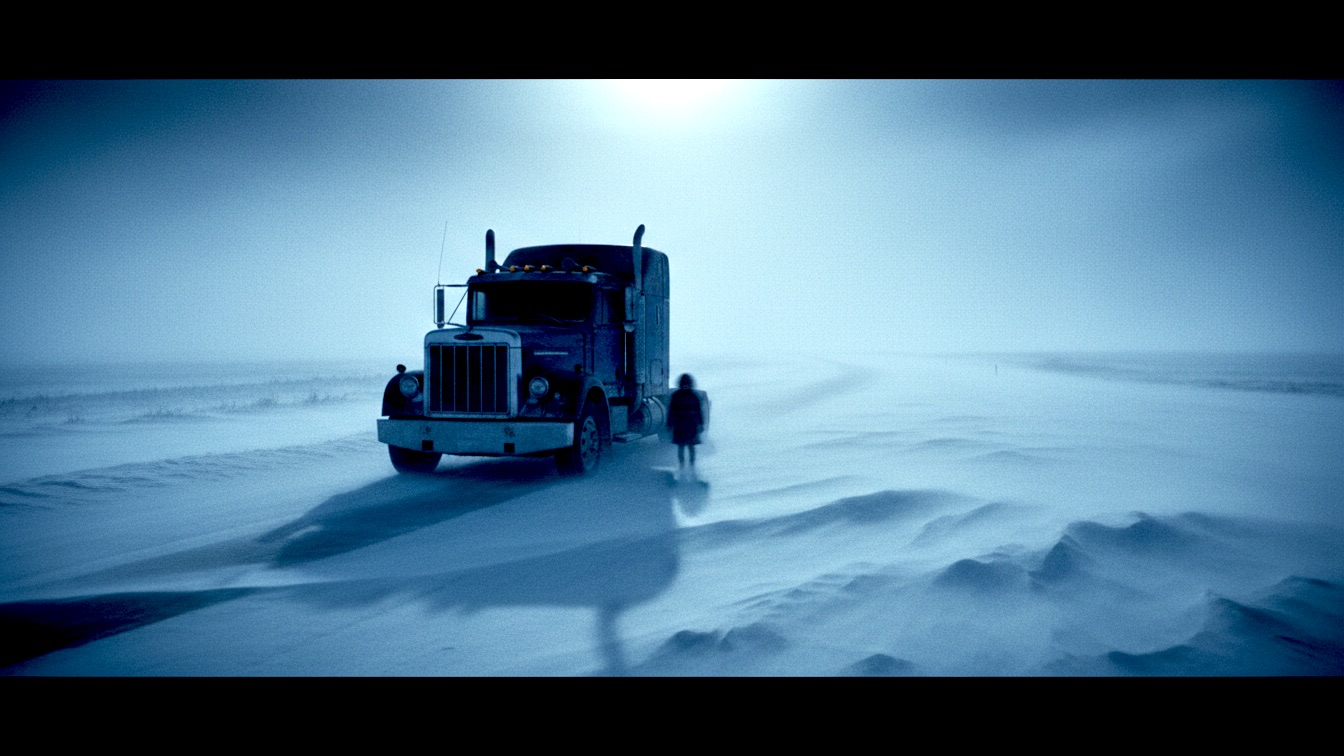
Ben, a long-haul truck driver battling a severe blizzard on the way to Thunder Bay, struggles to keep his eighteen-wheeler on the road amidst whiteout conditions. While fighting the hypnotic rhythm of the windshield wipers and the aggressive wind, he spots a small, dark figure standing motionless on the shoulder of the highway. Despite his instincts and the trucker folklore warning him never to stop, Ben's conscience overrides his fear. He cannot leave what appears to be a freezing child to die in the storm.
He pulls the rig over, leaving the engine and heat running, and exits the cab to rescue the child. However, the moment he steps into the gale, the child vanishes. When Ben attempts to re-enter his vehicle, he discovers the doors have inexplicably locked, sealing him out of his warm sanctuary. Panic sets in as the supernatural nature of the situation reveals itself. The figure reappears, not as a victim, but as a faceless entity that touches the windshield, killing the truck's engine and plunging Ben into silence and darkness before closing in on him.
The narrative is deeply rooted in the primal conflict between the fragility of human life and the indifferent, overwhelming power of nature. The storm is not merely a setting but an antagonist, personified as a "bully" that actively seeks to destroy the protagonist. This anthropomorphism of the elements suggests a universe that is hostile rather than neutral. The truck represents the pinnacle of human technological defiance against this hostility—a warm, steel "beast" that creates a micro-climate of safety. When the entity disables the truck, it strips away the illusion of human dominance, leaving Ben exposed as soft, biological matter in a frozen wasteland.
Furthermore, the story deconstructs the morality of altruism within the horror genre. Typically, empathy is a redeeming quality, but here, it is the specific mechanism of the protagonist's doom. The narrative explores the tension between the "law of the road"—survivalist instincts honed by experience—and the "law of humanity," which dictates protecting the vulnerable. Ben’s downfall is tragic because it stems from his best quality: his refusal to let a child die. The entity exploits this compassion, using the image of a helpless child as a lure, suggesting a predatory universe where goodness is a vulnerability to be leveraged.
Finally, the text explores the concept of the "Uncanny Valley" and the corruption of the familiar. The figure appears initially as a child, a universal symbol of innocence, but gradually shifts into something monstrous through subtle wrongness—the lack of shivering, the stillness, and finally, the facelessness. This progression mirrors the transformation of the truck from a "womb" of safety into a "tomb." The safe, known world is systematically inverted: the warm cab becomes a locked vault, the light becomes darkness, and the silence, usually peaceful, becomes a heavy, terrifying presence.
Ben is characterized as a veteran of the road, a man whose identity is fused with his profession and his machine. He possesses a distinct psychological duality: the hardened pragmatist and the protective nurturer. His internal monologue reveals a man well-versed in the dangers of his trade, citing "stories swapped over burnt coffee" that serve as a collective survival guide. He is not naive; he recognizes the potential danger of stopping, yet his psychological need to prevent a tragedy overrides his conditioned responses. This decision marks him not as foolish, but as deeply humane, making his subsequent punishment feel profoundly unjust.
Psychologically, Ben undergoes a rapid disintegration of cognitive control. Initially, he manages his fear through rationalization, attributing the figure to "road hypnosis." This is a defense mechanism designed to maintain his reality testing. Once he commits to the rescue, his focus narrows to a clear hierarchy of needs: get the kid, get warm, get moving. This mental structuring is a coping strategy to deal with the extreme stress of the environment. He is a man who relies on order and procedure, evidenced by his shock when the mechanical reality of the door lock defies logic.
As the supernatural elements escalate, Ben’s psychological state shifts from frustration to primal regression. The locking of the door triggers a claustrophobia-in-reverse; he is locked out of safety rather than in confinement, but the panic is identical. His pounding on the glass and screaming into the wind represents the collapse of his rational mind. By the end of the chapter, he is paralyzed. The "deep, invasive chill" he feels is somatic; his body is registering a threat that his mind can no longer process or fight, leaving him in a state of learned helplessness as the entity approaches.
The narrative voice is immediate and visceral, utilizing a first-person perspective that traps the reader inside Ben’s mounting anxiety. The pacing is masterfully controlled to mirror the protagonist's physiological state. It begins with the hypnotic, repetitive "slap-smear" of the wipers, mimicking a slow heartbeat, then accelerates into short, frantic sentences as panic sets in ("Locked. It had locked."). The sentence structure fractures along with Ben’s composure, moving from complex thoughts about highway markers to singular, jagged realizations about his impending doom.
Sensory details are deployed aggressively to create a tactile reading experience. The author focuses heavily on temperature and sound to build atmosphere. The wind is described as a "physical blow" and a "deafening roar," creating an auditory landscape that isolates the protagonist. This cacophony makes the sudden silence when the engine dies—described as falling "like a hammer"—shockingly abrupt. The contrast between the "green glow" of the dashboard and the "absolute, suffocating darkness" emphasizes the total loss of hope.
The tone is one of creeping dread that transitions into nihilistic horror. The author uses metaphor to animate the inanimate, describing the truck as "groaning in protest" and the air brakes letting out a "mournful sigh." This foreshadows the death of the machine. By giving the truck life, the author makes its eventual "death" at the hands of the entity feel like the murder of Ben's only companion. The final image of the cold entering Ben's blood rather than just his skin serves as a chilling metaphorical merger of the physical and supernatural threats.