The narrative opens with Lenny, a writer seeking solitude, struggling to start a generator in the midst of a fierce winter storm. The machine’s failure plunges his isolated cabin into silence and cold, stripping away the distractions of the modern world. Intending to use this off-grid retreat to finish a manuscript and escape a troubled past involving a woman named Chloe, Lenny instead finds himself paralyzed by writer's block and the oppressive atmosphere. As the temperature drops, he begins to hear Chloe’s voice whispering his name in the wind, an auditory intrusion that defies his rational understanding of his location.
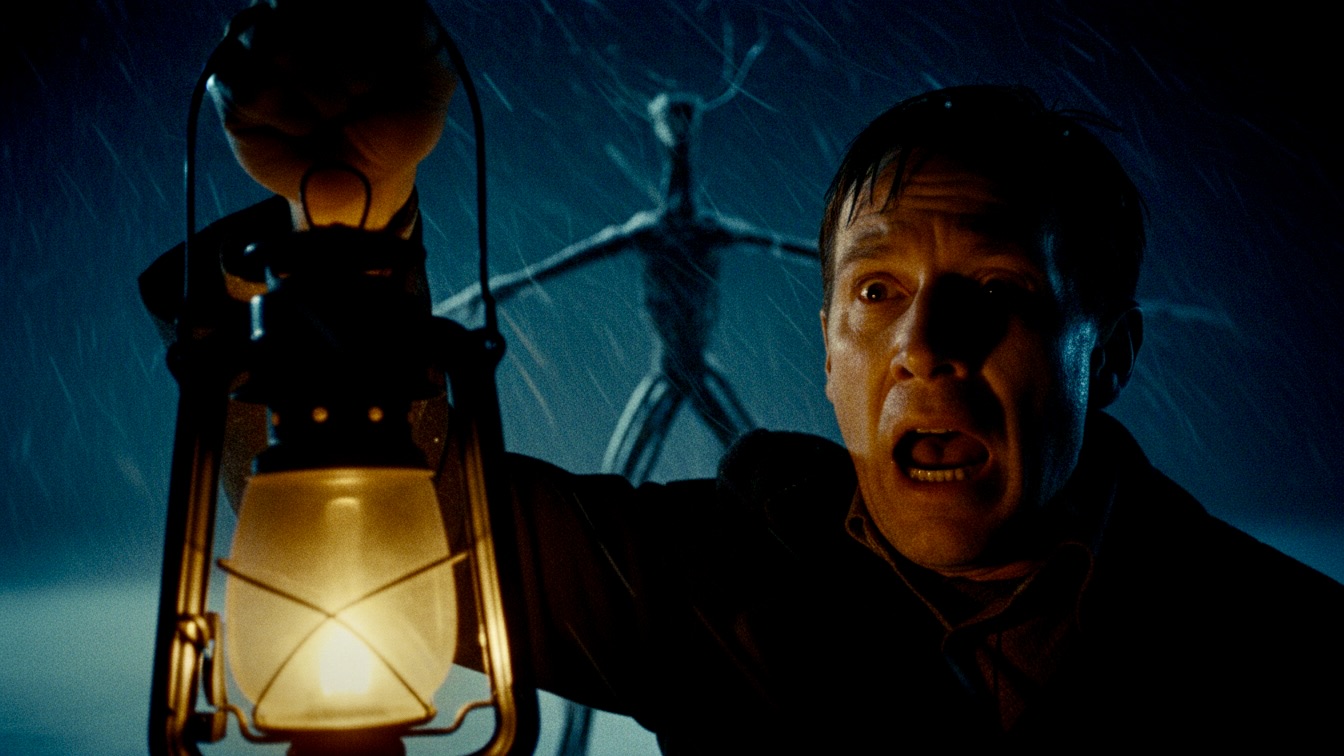
Driven to the brink of madness by the relentless whispering and his own deteriorating mental state, Lenny abandons the safety of the cabin to confront the source of the sound. He ventures into the blizzard with a kerosene lantern, only to be lured deeper into the forest by the elusive voice. The storm quickly erases his tracks, leaving him disoriented and lost in the whiteout. The whispers multiply, morphing into a chaotic chorus that guides him toward a clearing.
In the clearing, Lenny discovers a disturbing arrangement of tall, woven wooden figures that sway rhythmically in the wind. The whispers appear to emanate from these grotesque constructs. As he stands paralyzed by the sight, his lantern runs out of fuel, plunging him into absolute darkness. The chapter concludes in terrifying fashion as the silence returns, only to be broken by the sound of wood cracking and dragging through the snow, implying that the inanimate figures have begun to move toward him.
The primary theme explored in this chapter is the fragility of human rationality when confronted with absolute isolation. The story posits that civilization—represented by the generator, the laptop, and the cabin—is a thin veneer over a chaotic, primal reality. When the generator fails, it is not merely a mechanical inconvenience; it symbolizes the collapse of Lenny's tether to the logical world. Without the hum of electricity to drown out the silence, he is forced to confront the "architecture of his skull," suggesting that the true horror lies not in the woods, but within the unmediated human mind.
intertwined with the theme of isolation is the pervasive weight of guilt and the inescapability of the past. The retreat is framed as a sanctuary, a place to "figure out who I was without Chloe’s reflection," yet the setting acts as an amplifier for his repressed grief. The environment itself turns hostile and accusatory, with the wind carrying the voice of the person he is trying to forget. This suggests that physical distance is insufficient for emotional escape; the psychological "ghosts" of the city are internal passengers that cannot be left behind.
Furthermore, the narrative explores the antagonistic relationship between humanity and nature. The storm is not a passive backdrop but an active, malevolent force described with personified aggression. The wind tries to "peel" the logs back, and the cold is a "thing with teeth." This adversarial dynamic culminates in the discovery of the wooden figures. These constructs represent a perversion of the natural order—nature mimicking the human form in a way that is grotesque and terrifying. The ending implies that nature is not just indifferent to Lenny’s survival, but actively predatory.
Finally, the story examines the boundary between psychological projection and supernatural reality. For much of the text, the reader is led to believe the voices are symptoms of Lenny's malnutrition and stress. He attempts to rationalize the auditory hallucinations as "echoes" or "freak acoustic effects." However, the shift occurs when the source is revealed to be the wooden figures. The narrative moves from psychological thriller to folk horror, suggesting that while the mind may project its fears, the world contains horrors that exist independently of human perception.
Lenny is introduced as a man in a state of frantic denial, attempting to impose order on a chaotic environment. His initial struggle with the generator serves as a metaphor for his internal battle for control. He is a character defined by avoidance; he has fled to the wilderness not to find himself, as he claims, but to hide from the reality of his relationship with Chloe. His aggression toward the machinery—kicking the plastic housing—reveals a simmering frustration and a lack of resilience that foreshadows his eventual unraveling.
Psychologically, Lenny is teetering on the edge of a breakdown before the supernatural elements even manifest. His physical state mirrors his mental one: he is malnourished, cold, and exhausted. This vulnerability makes him an unreliable narrator of his own experience, as he constantly questions the validity of his senses. He possesses a desperate need for rationality, clinging to logical explanations for the impossible voices he hears. This intellectual rigidity becomes his undoing, as it compels him to leave the safety of the cabin to find a "rational" source for the noise, rather than accepting the danger of the storm.
Deep down, Lenny is driven by a profound sense of guilt. The specific nature of his relationship with Chloe is left ambiguous, but the text implies abandonment or unresolved conflict, noted by the texts he deleted and calls he ignored. The voice he hears is not angry, but disappointed and beckoning, which preys upon his specific insecurities. He is not being hunted by a monster initially; he is being seduced by his own remorse.
In the final moments, Lenny’s transformation is one of total regression. As he realizes he is lost, his internal monologue becomes pathetic and fragmented. The discovery of the wooden figures shatters his remaining psychological defenses. When the light dies, he is stripped of his identity as a writer, a rational man, and a modern human. He is reduced to prey in the dark, paralyzed by a fear that transcends his understanding of the world.
The pacing of the chapter is masterfully calibrated to mirror the protagonist's descent into terror. It begins with a burst of physical frustration, utilizing short, punchy sentences to convey the immediate annoyance of the broken generator. As the silence settles in, the pacing slows, becoming heavy and introspective. This creates a sense of claustrophobia, allowing the tension to build incrementally with each "blink" of the cursor and every whisper of the wind. The transition to the outdoors accelerates the narrative again, matching the frantic beat of Lenny's heart and the chaotic swirling of the snow.
The tone is relentlessly oppressive and gothic, utilizing sensory deprivation and enhancement to unsettle the reader. The author emphasizes the cold as a tangible, invading force, using words like "scouring," "stinging," and "slammed." Visuals are painted in stark contrasts: the "sterile blue-white" of the laptop screen against the "warm, flickering lamplight," and later, the "bobbing yellow circle" against the "white chaos." This chiaroscuro effect highlights Lenny’s isolation, framing him as a tiny speck of light in an overwhelming void of darkness.
Auditory imagery is the most crucial stylistic device employed in the text. The narrative soundscape moves from the mechanical "wet, pathetic sputter" of the generator to the silence that is "heavier than noise." The whispers are described with disturbing precision—"thin," "coiled," and "slipping through a crack." By personifying the wind and giving it Chloe’s voice, the author blurs the line between the external setting and the internal psyche. The final auditory shift—from the whispers to the "dry, multi-jointed crack"—signals the terrifying transition from the ethereal to the physical.
The narrative voice is strictly first-person, locking the reader inside Lenny’s deteriorating perspective. This limitation is essential for the horror, as the reader can only know what Lenny sees and feels. We experience his rationalizations in real-time, making the eventual collapse of logic more impactful. The prose style shifts from the cynical observations of a weary writer to the disjointed, panicked thoughts of a hunted animal, effectively utilizing the stream of consciousness to depict the unraveling of the human mind.