The story follows an unnamed male protagonist struggling with a jammed auger while ice fishing, a task made more frustrating by his deep-seated inferiority complex regarding his successful brother, Leo. While chipping at the ice, he discovers a strange, ancient-looking lure embedded in the frozen surface. Despite a sense of foreboding and the artifact's grotesque appearance, his obsession with beating Leo’s fishing record drives him to use it.
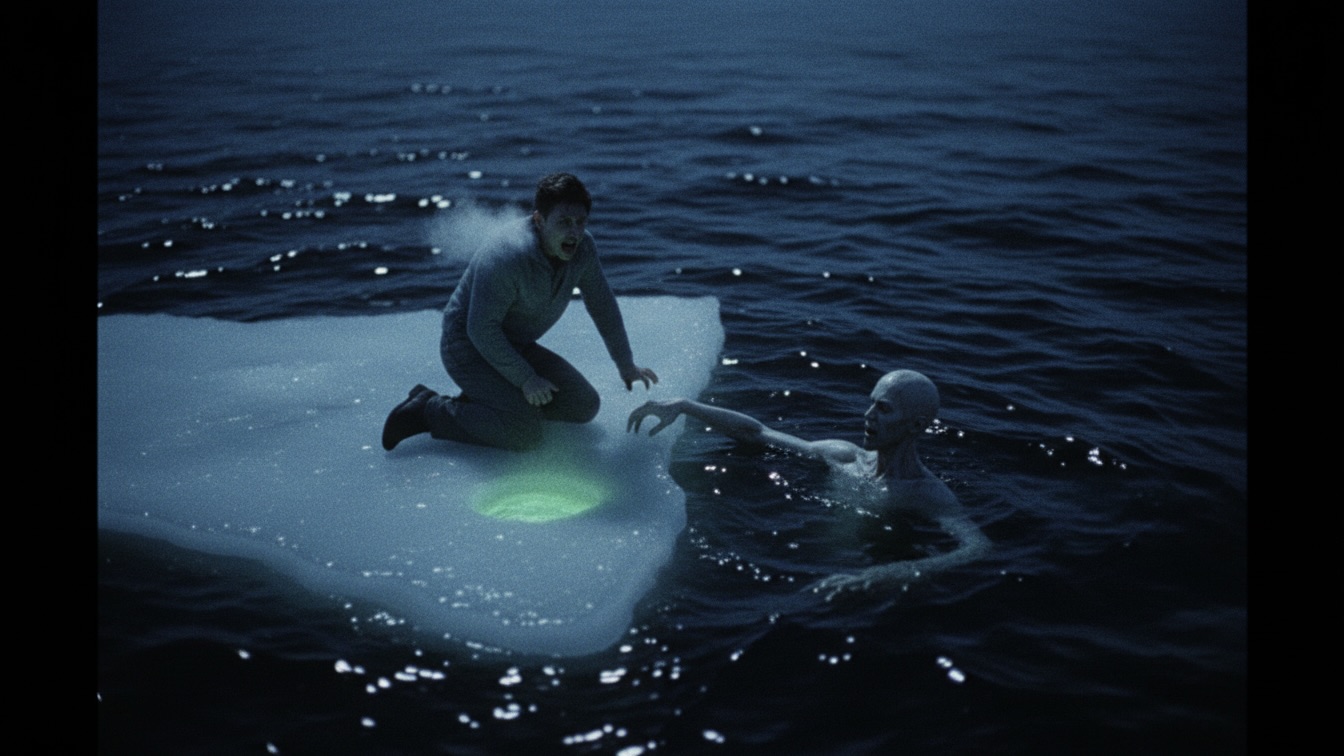
Upon dropping the lure into the water, he hooks a massive weight that is clearly not a fish. The force on the line is so immense that it begins to drag his entire portable hut across the ice toward open water. Caught between the fear of death and the refusal to let go of a potential record-breaking catch, he hesitates until the ice fractures beneath him. He cuts the line at the last second, saving himself from drowning but leaving him stranded on a small ice floe. The story concludes with a terrifying encounter as a glowing, faceless humanoid creature rises from the depths to circle his precarious raft.
The central theme of the narrative is the corrosive nature of sibling rivalry and the destructive power of comparison. The protagonist does not exist in a vacuum; his identity is entirely constructed in the shadow of his brother, Leo. The fishing trip is not a recreational activity but a desperate attempt to validate his own worth. The "record" represents more than a fish; it is a symbol of competence and masculinity that he feels he lacks. This envy acts as a blinder, preventing him from recognizing the obvious danger of the supernatural lure.
Closely related is the theme of obsession versus survival. The protagonist’s fixation on the "secret" to Leo's success leads him to ignore his intuition. The lure is described as "wrong" and "old," triggering a visceral "sick feeling," yet he suppresses these survival instincts in favor of his ego. The narrative suggests that obsession is a form of blindness. It requires the physical destruction of his safety—the collapsing hut—to snap him out of his trance and force him to prioritize his life over his pride.
Finally, the story explores the concept of the abyss and the unknown. The lake serves as a threshold between the mundane world of jealousies and gear maintenance, and a deeper, eldritch reality. The ice is a fragile barrier separating civilization from primal horror. When the protagonist pierces that barrier with the "forbidden" lure, he invites the abyss into his world. The transition from a fish to a faceless monster signifies that some depths should remain plumbed, and that nature—or what hides within it—is indifferent to human rivalries.
The narrator is a man defined by a profound sense of inadequacy. From the opening paragraph, his internal monologue is dominated by comparisons to his brother. He views his own equipment as "cheap" and "useless," projecting his self-loathing onto inanimate objects. He imagines Leo’s laugh as condescending, which reveals more about his own insecurities than his brother's actual personality. This projection suggests a fragile ego that is easily bruised by the mere memory of another's success.
Psychologically, he exhibits a dangerous lack of impulse control driven by validation seeking. When he finds the lure, he rationalizes its use immediately. He frames the artifact as a "key," a shortcut that will allow him to bypass the hard work and skill Leo possesses. This indicates a character who feels the game is rigged against him and is therefore willing to cheat—even with supernatural forces—to level the playing field. His hesitation to cut the line, even as he is being dragged toward death, highlights how deeply his self-worth is tied to this external validation.
However, the protagonist does possess a dormant survival instinct. The "clear bell" of warning in his head suggests he is not entirely lost to his obsession, though he initially ignores it. The act of cutting the line is his redemption, a moment where he finally chooses his own existence over the ghost of his brother’s legacy. Unfortunately, the ending implies that while he has conquered his internal demon by severing the connection to the record, he is now ill-equipped to face the external demon he has summoned.
The author employs a tense, sensory-rich narrative voice to establish an atmosphere of dread. The descriptions are tactile and auditory, grounding the reader in the physical discomfort of the setting. Phrases like "screaming" steel, the "dull thud" of the boot, and the "sucking sound" of the ice create a visceral experience. The cold is not just a weather condition but an oppressive force that numbs the protagonist's fingers and slows his reactions, mirroring his emotional numbness.
The pacing is carefully structured to escalate from frustration to terror. The story begins with the slow, rhythmic annoyance of the jammed auger, establishing a mundane baseline. Once the lure is introduced, the pacing tightens. The moment the hook engages, the narrative accelerates into kinetic chaos. The dragging of the hut creates a sense of unstoppable momentum, mimicking the "freight train" force on the line. This acceleration drags the reader along with the protagonist, creating a breathless urgency that culminates in the sudden snap of the severed line.
The tone shifts masterfully from psychological realism to Lovecraftian horror. Initially, the horror is internal—the fear of failure. As the story progresses, the tone becomes increasingly uncanny. The description of the lure, with its "fossilized spine" and "jet" eye, signals the intrusion of the supernatural. The final paragraph utilizes light and color—the "sickly" phosphorescent green—to contrast with the earlier black and white of the winter landscape. This shift in imagery marks the complete transition from the natural world to a realm of nightmare.