Melgund Township Winter Story Library
The Frostwork Architect - Analysis
by Leaf Richards | Analysis
by Leaf Richards | Analysis
The narrative centers on Cathy, an architect or surveyor working late within a dilated warehouse in the Exchange District during a severe winter storm. While attempting to reconcile original 1912 blueprints with the building's decaying reality, her solitude is interrupted by the faint, impossible sound of a woman humming. Initially dismissing the noise as a trick of the wind or the presence of squatters, her professional skepticism eventually gives way to a need to investigate. Driven by a mix of irritation and an architect's compulsion to solve structural puzzles, she ventures to the second floor.
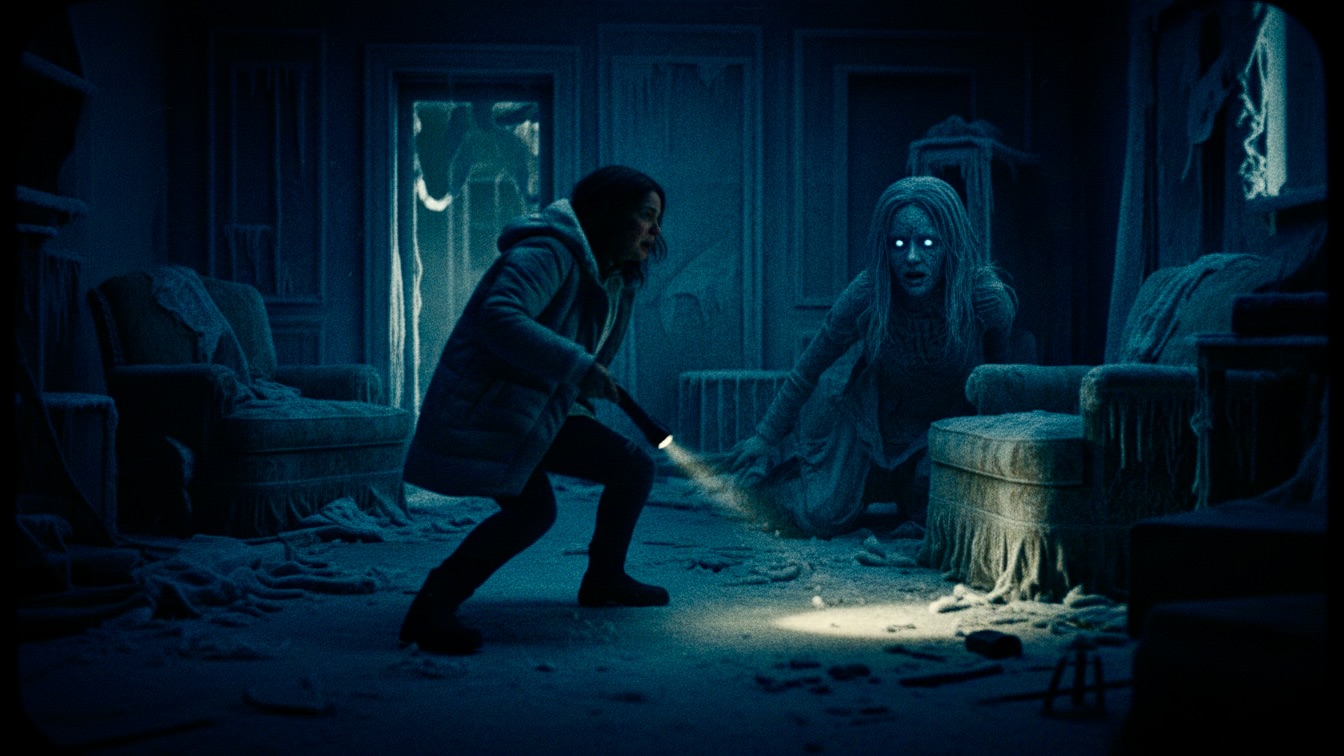
Upon entering the upper level, Cathy discovers an unnatural, glacial cold that defies the building's HVAC capabilities. Following the auditory lure of the humming, she traverses a debris-strewn corridor to a hastily erected partition and a hidden room. Her entry into this space triggers a supernatural trap; the door slams shut and freezes, sealing her inside. As hypothermia begins to set in, she is confronted by a malevolent, frostbitten apparition. The chapter concludes in terrifying darkness as her flashlight fails, leaving her trapped with the entity crawling toward her in the pitch black.
The story operates heavily on the juxtaposition of rational order and supernatural chaos. The narrative begins with the tools of logic: blueprints, measurements, and structural analysis. Cathy attempts to impose order on her environment, viewing the building as a series of math problems to be solved. This reliance on rationality serves as a psychological defense mechanism. By categorizing the strange humming as "squatters" or "wind," she attempts to domesticate the unknown, reducing a potential paranormal threat to a mundane annoyance that can be managed with a phone call or a police report.
However, the text systematically dismantles this framework of logic. The cold acts as a physical manifestation of the supernatural intrusion, defying the laws of thermodynamics and the known condition of the building. The transition from the "decaying reality" of the warehouse to the "impossible force" of the slamming door marks the collapse of the rational world. The frost that coats the room is not merely weather; it represents the encroachment of the past upon the present. The building is not just a structure of brick and mortar, but a vessel for a dormant, traumatic history that refuses to remain buried beneath renovations and plasterboard.
Furthermore, the theme of sensory perception versus reality plays a crucial role. The protagonist relies on her senses to navigate her job, yet those same senses become the instruments of her terror. The humming serves as a siren song, luring her away from safety. The visual confirmation of the ghost is initially rationalized as a hallucination induced by hypothermia, a final desperate attempt by the psyche to cling to medical logic. The ultimate failure of the flashlight symbolizes the extinction of enlightenment and reason, plunging the protagonist into a primal darkness where only instinct and fear remain.
Cathy is defined primarily by her professional competence and her reliance on tangible reality. As an architect or surveyor, she views the world through the lens of structure and intent. Her internal monologue reveals a woman who is disciplined and perhaps overly dedicated, working late hours in uncomfortable conditions to ensure accuracy. This dedication, however, borders on hubris. Her decision to investigate the noise is driven by "professional pride," a specific fear of appearing incompetent or alarmist by calling the authorities for a false alarm. This psychological rigidity is her tragic flaw; her refusal to yield to intuition or fear ultimately leads her into the trap.
Psychologically, Cathy exhibits a fascinating struggle with cognitive dissonance. As the environment becomes increasingly hostile and inexplicable, she aggressively maintains her skepticism. Even when faced with a temperature drop that defies physics, she looks for HVAC reports. This indicates a mind that is deeply uncomfortable with ambiguity. She requires a world that follows rules, where x plus y equals z. The supernatural entity represents the ultimate violation of her worldview. Her "architect's brain" compels her to move forward not just to eject a squatter, but to understand the "puzzle" of the partition and the hidden room.
As the chapter progresses, Cathy’s internal state shifts from annoyance to clinical detachment, and finally to primal panic. The pivotal moment occurs when the door slams. Until that point, she believes she is the agent of authority in the building. The moment the lock freezes, she is stripped of her agency. The transition from demanding "Let me out!" to the ragged breathing in the dark marks the total disintegration of her professional persona. She is no longer an architect inspecting a site; she is prey in a hostile ecosystem, stripped of the tools and logic that once defined her identity.
The narrative voice is third-person limited, closely tethered to Cathy’s sensory experience. This perspective creates a claustrophobic atmosphere, as the reader knows only what Cathy sees, hears, and feels. The pacing is meticulously controlled, beginning with the slow, methodical atmosphere of a late work night. The author uses the mundane details of the blueprints and the "drumming of sleet" to ground the reader in reality before introducing the discordant note of the humming. This gradual buildup creates a sense of unease that deepens as Cathy ascends the stairs, mirroring her descent into danger.
Sensory imagery is the engine of the story’s horror. The author relies heavily on tactile and auditory descriptions to build tension. The cold is not described merely as a temperature but as an active, malevolent presence—"a living thing" that sinks its teeth into the protagonist. The auditory landscape shifts from the "hollow note" of the wind to the "thin, reedy" humming, culminating in the terrifying "wet, scraping drag" at the end. These details are visceral, designed to trigger a physical reaction in the reader that mirrors the protagonist's freezing state.
The tone shifts from clinical to gothic horror. Initially, the prose is sharp and practical, reflecting Cathy’s mindset. Phrases like "truss measurements" and "ad-hoc renovations" establish a sterile, professional tone. However, as she enters the second floor, the language becomes more emotive and atmospheric. The description of the frost as "lacework" and "crushed diamonds" introduces a terrible beauty that contrasts with the decaying warehouse. The final paragraphs utilize short, punchy sentences and sentence fragments ("Darkness. Absolute.") to mimic the frantic, staccato rhythm of a panic attack, effectively transferring the protagonist's terror to the reader.