Melgund Township Winter Story Library
The Barista at the Threshold - Analysis
by Jamie F. Bell | Analysis
by Jamie F. Bell | Analysis
The faint, high-pitched crackle of ice fracturing under immense pressure serves as an auditory omen, a subtle yet insistent harbinger of a world coming undone. It is the sound of reality’s delicate shell giving way, not with a sudden cataclysm, but with a slow, agonizing splintering that signals an inescapable transformation. This pervasive sound, initially a distant whisper, grows into a sharp, distinct reverberation, marking the protagonist's forced passage from a familiar, if harsh, existence into an entirely new dimension of terrifying possibility. The very fabric of the known world thins and tears, revealing the monstrous truths that lie just beneath its frozen surface.
This chapter plunges the reader into a potent blend of urban fantasy and horror, establishing a mood of escalating dread punctuated by brief, deceptive moments of sanctuary. The narrative expertly leverages the familiar setting of a city street and a cozy cafe before violently tearing the veil between the mundane and the mythological. The "Fimbulvetr," or Endless Winter, immediately grounds the story in Norse eschatology, hinting at a world-ending event that the protagonist, Ellen, is inadvertently caught within, transforming a simple struggle for survival into a cosmic quest. This genre fusion allows for the exploration of profound themes related to hidden realities and the abrupt shattering of personal agency.
The narrative voice, presented through Ellen's first-person perspective, is inherently limited and often unreliable, especially under the duress of extreme cold and terror. Her perceptions are frequently blurred by the whiteout, her body's physical pain, and the overwhelming panic, leading to gaps in understanding what "they" are or why the cafe appears. The winter environment directly influences her perception, making the landscape a chaotic, formless threat and rendering her phone, a symbol of modern connection and reliability, utterly useless. This perceptual distortion underscores her vulnerability and the story's descent into the surreal, where logic yields to instinct and the inexplicable.
The story implicitly raises significant moral and existential questions, particularly concerning the nature of sanctuary and the burden of destiny. Ellen's immediate flight from the "outriders" highlights a primal drive for survival, yet her entry into Cathy’s cafe introduces a moral dilemma: is refuge truly safe, or merely a temporary deferral of an inescapable fate? The revelation that Ellen, a seemingly ordinary thirteen-year-old, is central to stopping an "Endless Winter" thrusts her into an existential crisis, forcing her to confront an immense responsibility she neither sought nor understands. Her journey becomes a testament to endurance, a desperate search for meaning in a world suddenly devoid of familiar comforts and besieged by unfathomable cold.
Psychological State: Ellen begins in a state of extreme panic and physical exhaustion, driven solely by the instinct for survival against an unknown, terrifying threat. Her mind is overwhelmed by the cold, pain, and fear, making rational thought difficult, as evidenced by her inability to process the cafe's impossible appearance initially. Upon entering the cafe, she experiences a profound relief that borders on dissociation, a temporary reprieve before the renewed threat shatters her fragile sense of security. The activation of the amulet pushes her into a state of bewildered empowerment, forced to tap into an unknown potential.
Mental Health Assessment: In this chapter, Ellen exhibits acute stress response symptoms, including fight-or-flight, disorientation, and a temporary inability to cope with the sudden collapse of her reality. Her mental health is under severe strain, but her quick adaptation to the amulet's power and her eventual acceptance of Cathy's directives suggest a latent resilience. She demonstrates a capacity for desperate action and a willingness to confront the impossible, hinting at deep reserves of inner strength that will be crucial for her survival in the face of seasonal adversity.
Motivations & Drivers: Ellen's primary motivation is initially pure survival: to escape the freezing storm and the pursuing entities. Her lie about being on the bus to Cathy underscores a deep-seated caution and a protective instinct, even in her desperate state. Once inside the cafe, her motivation shifts to understanding her predicament and finding true safety, which quickly evolves into a forced acceptance of her role in a larger conflict. The warmth of the cafe and the hot chocolate offer a temporary respite, but the relentless pressure of the encroaching winter ultimately drives her forward.
Hopes & Fears: Ellen's most immediate hope is for warmth, safety, and a return to normalcy, desires amplified by the brutal, life-threatening cold. She fears freezing to death, being caught by the monstrous shapes in the snow, and the utter loss of her familiar world. The discovery of the amulet and Cathy's revelation introduce a new layer of fear: the fear of the unknown, of immense responsibility, and of failing to prevent a global catastrophe. Her hopes become tied to the amulet's power and Cathy’s guidance, fragile anchors in a suddenly terrifying existence.
Psychological State: Cathy presents as remarkably calm and composed, even in the face of an apocalyptic storm and supernatural assault. Her demeanor suggests a long-standing familiarity with such events, indicating a psychological state of preparedness and acceptance rather than surprise or fear. She embodies a quiet authority and a deep understanding of the hidden forces at play, acting as a steady anchor in Ellen's chaotic experience. Her calmness is a deliberate psychological counterpoint to Ellen's panic.
Mental Health Assessment: Cathy appears to possess exceptional mental fortitude and resilience, likely honed over years of her "keeper" role. She displays no overt signs of distress, instead exhibiting focused determination and a pragmatic approach to the escalating crisis. Her ability to maintain composure, offer comfort, and provide critical information under extreme pressure points to a robust psychological constitution, possibly reinforced by her deep immersion in the world of the Fimbulvetr. Her mental state is one of enduring vigilance.
Motivations & Drivers: Cathy's primary motivation is to maintain the "sanctuary" of her cafe and to guide Ellen, the wielder of the amulet, toward her destiny. She is a "keeper of the threshold," indicating a deeply ingrained sense of duty and purpose that transcends personal safety. Her actions are driven by a long-term commitment to preventing the "Endless Winter" and protecting the fragile balance between worlds. The encroaching cold and the threat of the outriders are not surprising to her, but rather expected challenges that reinforce her resolve.
Hopes & Fears: Cathy's hopes are implicitly tied to Ellen's success in stopping the Fimbulvetr, representing a collective hope for the preservation of worlds. She fears the triumph of the Endless Winter, a cataclysm she has likely been preparing for her entire life. Her calm exterior might mask a profound underlying anxiety about the stakes, but her dedication to her role as a threshold guardian seems to quell any overt personal fears. She places her hope entirely in the ancient power of the amulet and Ellen's nascent ability to wield it.
Psychological State: Kevin initially displays a state of oblivious detachment, absorbed in his tablet and annoyed by mundane inconveniences like a potential power outage. His initial reaction to the supernatural phenomena is one of irritation and disbelief, characteristic of someone firmly rooted in a rational, everyday reality. When confronted with undeniable evidence of the impossible, his psychological state rapidly shifts to shock and terror, demonstrating a profound inability to cope with the shattering of his worldview.
Mental Health Assessment: Kevin's mental health appears to be that of an average person, unprepared for extraordinary circumstances. His initial dismissiveness and later panic are common reactions to a sudden, inexplicable threat. He lacks the coping mechanisms or resilience of either Ellen or Cathy when faced with the supernatural. His mental state is fragile when his established reality is challenged, indicative of a mind that struggles to integrate anomalous experiences, making him susceptible to psychological distress when confronted with the unknown.
Motivations & Drivers: Kevin's initial motivation is simply to continue his mundane activities, likely working or relaxing, undisturbed by the storm. His later motivation is to understand the strange occurrences, but only within the framework of his existing reality, as seen in his concern about the city grid. Once the threat becomes undeniable, his sole driver is self-preservation and a desperate need to escape the terrifying situation. The intensifying cold and the monstrous figures force him to abandon his everyday concerns for sheer survival.
Hopes & Fears: Kevin's hopes are for the storm to pass, for the power to remain on, and for his quiet cafe experience to continue uninterrupted. His immediate fears are mundane: a power outage, discomfort, or the simple annoyance of a harsh winter night. However, these fears are violently supplanted by a primal terror of the unknown, of the "thing" at the window, and the sudden, incomprehensible threat to his life. His greatest fear is the complete collapse of his familiar, predictable world, which is exactly what he witnesses.
The chapter masterfully builds and transfers emotion, primarily through the protagonist Ellen's visceral experience of the extreme cold and the encroaching supernatural threat. The initial paragraphs are a symphony of sensory deprivation and physical agony, with the screaming wind, skin-scouring ice, and the deep, invasive ache of cold seeping into bones immediately establishing a profound sense of desperation and vulnerability. This relentless assault on Ellen's body directly translates into the reader's empathetic discomfort, creating an urgent, almost breathless tension from the outset.
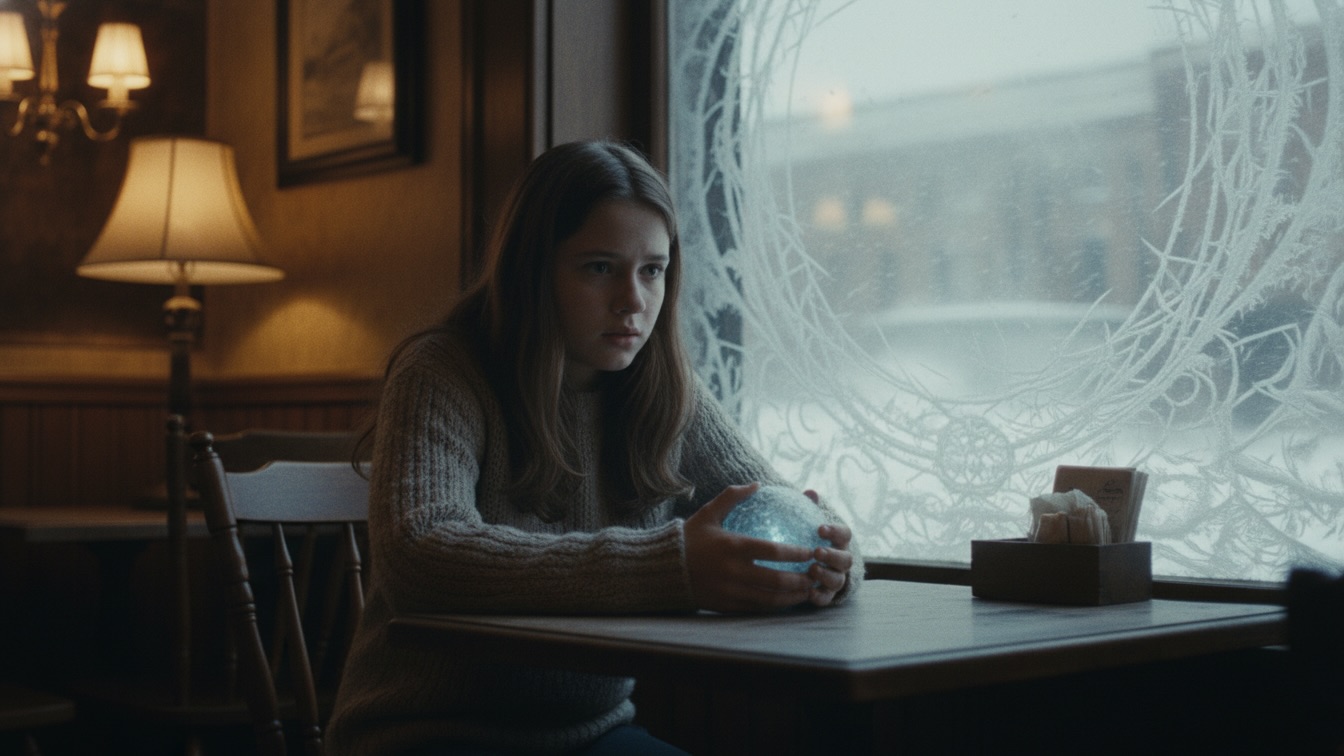
The cafe acts as a crucial emotional pivot, offering a sudden, overwhelming wave of relief that is almost painful in its intensity. The warmth, the smell of coffee and cinnamon, and the sudden silence are described with such palpable relief that the reader, too, feels the tension momentarily dissipate. This contrast is vital; it allows for a psychological reset before the next wave of terror, making the subsequent invasion of the cafe by the outriders even more impactful. The brief respite amplifies the shock and fear when the frost creeps under the door and the window cracks, signaling that the sanctuary is not truly safe.
The emotional climax arrives with Ellen's activation of the amulet, a moment of desperate empowerment born from pure panic. The burning heat of the amulet in her hand, the sudden flash of blue-white light, and the subsequent "shriek" of agony from the retreating entity are described with raw intensity, transferring Ellen's fear and sudden, unexpected power directly to the reader. This moment cultivates a complex emotional cocktail of terror, awe, and a glimmer of hope, leaving a lingering sense of profound unease as the narrative confirms that this is only a "temporary solution." The chapter concludes with a dizzying emotional leap as Ellen steps through the portal, her fear now tinged with a reluctant acceptance of her fantastical destiny.
The spatial psychology of this chapter is critically hinged on the stark contrast between the external environment and the internal sanctuary, with the winter storm serving as both a literal and metaphorical barrier. Outside, Winnipeg is rendered as a hostile, undifferentiated expanse of whiteout and screaming wind, mirroring Ellen's internal state of panic and disorientation. The cold is not just a physical sensation but an invasive ache that permeates her very bones, reflecting a deeper, existential chill that the unknown entities represent. This environment is an amplifier of fear, stripping away comfort and familiarity, leaving Ellen exposed and vulnerable.
The cafe, "The Cafe on Portage," functions as a psychological haven, a liminal space of warmth, light, and temporary safety amidst the chaos. Its sudden, impossible appearance on a familiar street suggests a blurring of reality, a distortion of the known world that foreshadows the portal at its rear. The solid, permanent feel of the cafe, with its worn wood and crammed bookshelves, offers a psychological anchor, a brief return to normalcy that Ellen desperately clings to. However, this safety is inherently fragile, gradually eroded by the creeping frost and the cracking window, demonstrating that even the most comforting spaces can be breached by overwhelming external forces, mirroring the fragility of Ellen's own psychological defenses. The transition from the mundane stockroom to the alien landscape beyond the steel door completes this spatial distortion, forcing Ellen to confront a reality far beyond her comprehension.
The chapter's prose is characterized by its visceral, sensory-driven descriptions, immediately immersing the reader in Ellen's harrowing experience. Diction choice is precise and impactful, with words like "scoured," "invasive ache," "frozen black rectangle," and "crushed glass" painting a vivid picture of physical and emotional torment. The wind's personification, screaming as a "solid wall of noise and ice particles," elevates it beyond mere weather to an active, malevolent force, reflecting the predatory nature of the outriders. This relentless sensory assault establishes a tone of urgency and desperation that propels the narrative forward.
Imagery throughout the chapter effectively employs winter motifs to enhance emotional and thematic goals. The "lanky silhouette of churning snow and something dark at its core" for the outriders transforms the natural elements of winter into something monstrous and unnatural, blurring the lines between environmental threat and supernatural horror. The contrast between the "single square of soft, yellow light" of the cafe and the "world of gray and white" symbolizes hope and sanctuary against overwhelming despair. Even the mundane detail of steam from the hot chocolate forming patterns that resemble the amulet's symbols subtly introduces the magical element, hinting at a deeper, unseen order within the chaos.
Symbolism is deeply woven into the narrative, particularly with the amulet and the cafe itself. The amulet, a "weird lump of silver" etched with an unknown language, symbolizes Ellen's latent power and her connection to a hidden, ancient world. Its transformation from a "cold weight" to a "thrumming warmth" and then a "burning pressure" mirrors Ellen's own awakening power and the escalating stakes. The cafe, initially a physical shelter, evolves into a "sanctuary" and then a "doorway," symbolizing a threshold between worlds, a place of transition and transformation. The "bruised purple sky where two moons... hung in the frigid air" in the concluding scene is a potent symbol of an alien, yet strangely familiar, reality, confirming Ellen's passage into a mythic landscape.
This chapter is deeply embedded within broader cultural and mythological frameworks, particularly drawing from Norse mythology and the archetype of the hero's journey. The explicit mention of "Fimbulvetr," the "Endless Winter," immediately situates the narrative within the Ragnarök cycle, a period of devastating winter preceding the end of the world. This invocation taps into ancient fears of cosmic catastrophe and the cyclical nature of destruction and rebirth, elevating Ellen's personal struggle to one of universal significance. The "outriders" of this winter evoke imagery of primordial, elemental forces, akin to frost giants or other chaotic entities from Norse lore.
The story also resonates with classic portal fantasy narratives, drawing parallels to works like C.S. Lewis's The Lion, the Witch and the Wardrobe. Just as Lucy Pevensie stumbles through a wardrobe into the perpetual winter of Narnia, Ellen steps from a mundane coffee shop stockroom into a world transformed by an impossible, frozen twilight. The cafe itself functions as a "threshold guardian" archetype, with Cathy embodying the wise mentor figure, guiding the protagonist across the liminal space between worlds. This intertextual connection allows the narrative to tap into established reader expectations of wonder and danger associated with such journeys, even as it subverts them with a darker, more urgent tone.
Furthermore, the chapter draws upon the universal human experience of confronting the unknown and the "call to adventure" archetype. Ellen, a seemingly ordinary teenager, is thrust into an extraordinary situation, forced to awaken a dormant power and accept an impossible task. Her initial disbelief and fear are relatable human responses to the shattering of reality, echoing countless protagonists who must rise to unexpected challenges. The winter setting, often symbolic of death, stagnation, or a period of trial, reinforces this theme of a daunting journey, where survival is not guaranteed and the stakes are unimaginably high.
The chapter leaves a profound and unsettling emotional and intellectual impact, primarily through its relentless portrayal of encroaching, existential cold. The sheer physicality of Ellen's struggle against the wind and ice, and the subsequent invasion of the cafe by the supernatural winter, creates a deep, lingering sense of vulnerability. It evokes the primal fear of being utterly exposed to an overwhelming, indifferent force, a feeling that persists long after the final page. The cafe's brief warmth, though comforting, only serves to highlight the terrifying nature of the external threat, making the reader acutely aware of the fragility of safety.
Intellectually, the story prompts a reflection on the nature of reality and the hidden layers of existence. The sudden appearance of the cafe and its subsequent transformation into a portal force a re-evaluation of what is considered mundane and what is truly possible. The questions that linger are numerous: What is the true extent of Ellen's power? What is the specific nature of the "Endless Winter" and its source? What other worlds are at stake? The abrupt, unresolved ending, with Ellen stepping into an alien Winnipeg, leaves the reader with a powerful sense of anticipation and a yearning for answers, eager to understand the rules of this newly revealed universe.
The imagery of winter, cold, and frost, woven throughout the narrative, evokes a powerful sense of dread and awe. The "bruised purple sky where two moons" hang over a frozen, impossible landscape is a particularly striking image that etches itself into the mind, signifying a world both familiar and utterly alien. This surreal tableau, combined with Cathy's cryptic warning, suggests a journey not just through a physical landscape, but through the very fabric of reality and myth. The lingering cold is not just a physical sensation, but a psychological state, a metaphor for the daunting challenges and profound isolation that Ellen now faces, leaving the reader to contemplate the immense weight of her solitary quest against an all-consuming winter.
The final click of the steel door closing behind Ellen resonates with the chill of absolute finality, severing her from the last vestiges of a recognizable world. It is the sound of a definitive boundary crossed, not with a triumphant flourish, but with the quiet, inexorable logic of a world shifting on its axis. The cold air of the two-mooned landscape, clean yet impossibly sharp, then becomes the pervasive emotional afterimage, a constant reminder of the alien terrain she has entered and the impossible task she carries.
This concluding moment, suspended between the mundane and the mythic, leaves an unsettling impression of a journey initiated out of desperation rather than choice. The lingering image of the Esplanade Riel bridge, monstrously encrusted in ice, serves as a poignant symbol of a familiar landmark twisted into something formidable and otherworldly. It is a visual testament to the profound transformation that has occurred, a cold, stark beauty that underscores the terrifying scope of the Endless Winter Ellen is now compelled to confront.