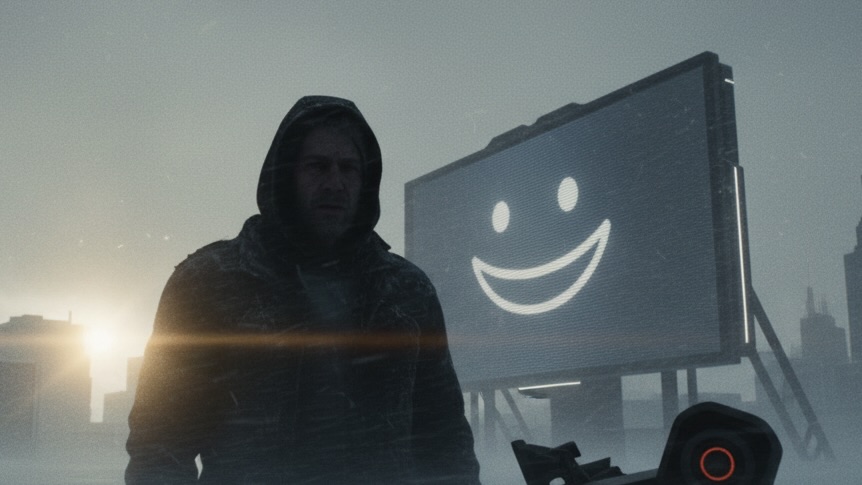
The narrative opens in a dystopian Winnipeg, where Enforcer Jay patrols the frozen Perimeter Sector in a "Smile-Wagon," a vehicle designed to enforce mandatory happiness. While struggling with the biting cold and his own suppressed internal rage, Jay is alerted by the AI, ObeyBot, to a citizen named Lyra Thomas who is failing to react positively to a propaganda "Joy-Board." Although protocol dictates he must issue a Re-Education Notice, Jay finds himself paralyzed by a sudden surge of empathy and recognition of his own repressed misery in her posture. This hesitation triggers a surveillance drone to register his own facial expression as non-compliant.
Faced with the immediate threat of being purged by the system he serves, Jay reacts with a violent, primal instinct. He destroys the drone, triggering a "Disruptor Protocol" that locks down his vehicle and alerts other units to his location. Jay manages to manually override the emergency hatch and flees into the blinding blizzard, abandoning his former life as an enforcer. He navigates the treacherous Unregistered Zones, seeking a rumored "Gloom-Broker" named Shawn. Near death from exposure, Jay locates Shawn in a derelict cannery, marking his transition from a servant of the state to a desperate fugitive seeking a new identity in the shadows.
The primary theme anchoring this chapter is the conflict between authentic human emotion and state-mandated performativity. The society depicted demands a "Smile-Compliance" that reduces human experience to binary data points of acceptable and unacceptable affect. The "Joy-Board" serves as a grotesque altar to this enforced happiness, broadcasting saccharine images that stand in stark, ironic contrast to the brutal, freezing reality of the physical world. This juxtaposition highlights the absurdity of the regime's demands; the citizens are expected to maintain a facade of warmth and contentment while literally freezing in a colorless wasteland.
Furthermore, the text explores the psychological toll of surveillance capitalism carried to its totalitarian extreme. The "Rage-Meter" that Jay visualizes is a potent symbol of dissociation. By externalizing his anger onto a phantom display, Jay attempts to distance himself from his own emotions, treating them as system diagnostics rather than genuine feelings. This suggests a theme of self-alienation, where the protagonist has been conditioned to view his own humanity as a technical malfunction. The "green" to "red" progression of this meter mirrors the escalating tension between his indoctrination and his biological reality.
Finally, the setting itself acts as a thematic amplifier, utilizing the pathetic fallacy to mirror the protagonist's internal state. The "creeping, insidious cold" that penetrates the reinforced plating represents the inescapable nature of truth and misery. Just as the thermal regulator cannot keep the cold out, Jay’s psychological defenses cannot keep his true feelings at bay. The blizzard serves a dual purpose: it is a hostile force that threatens to kill him, but it is also a chaotic, uncontrolled element that provides cover from the rigid, orderly gaze of the surveillance state. In the "Unregistered Zones," the decay and entropy represent a form of freedom, however dangerous, compared to the sterile safety of the Smile-Wagon.
Enforcer Jay presents a classic psychological portrait of an individual in the final stages of cognitive dissonance. Initially, he attempts to function as a repressive agent of the state, but his internal monologue reveals deep-seated instability. His "white knuckles" and the "low-level hum" of anxiety suggest a somatic expression of the stress caused by living a lie. He is not merely a reluctant enforcer; he is a man at war with his own psyche. The "Rage-Meter" he imagines is a coping mechanism, a way to quantify and control impulses that are forbidden. When he sees Lyra, he does not see a criminal; he sees a projection of his own shadow self—the part of him that is defeated, weary, and incapable of smiling.
His decision to spare Lyra is not a calculated act of rebellion but an emotional rupture. The text notes that a "hot, bitter wave of disgust" washes over him, directed primarily at himself. This indicates that his compliance was sustained by a fragile denial which shattered the moment he was forced to victimize someone who mirrored his own pain. The destruction of the drone is described as a "primal scream," indicating a shift from the superego-driven adherence to rules to an id-driven fight for survival. In that moment, Jay reclaims his agency through violence, rejecting the passive role of the observer for the active role of the combatant.
By the end of the chapter, Jay’s motivation shifts from duty to pure survival, yet there is a deeper psychological quest at play. His journey to find Shawn, the "Gloom-Broker," symbolizes a desire to embrace the forbidden aspects of human experience—sadness, anonymity, and the "gloom" that the state tries to eradicate. He is no longer running just to save his life; he is running to find a place where his internal reality matches his external environment. The encounter with Shawn represents his initiation into the underworld, a necessary descent for his psychological reintegration as a free, albeit hunted, man.
The narrative voice is strictly third-person limited, closely adhering to Jay’s immediate sensory and emotional experience. This creates a claustrophobic atmosphere that mirrors the protagonist’s entrapment within the Smile-Wagon. The author employs a cold, industrial lexicon—words like "ferro-glass," "reinforced," "utilitarian," and "synthetic"—to build a world that feels hard and unyielding. This technical language is frequently interrupted by visceral, organic descriptions of Jay’s physical distress, such as the "bone-deep weariness" or the "sickening crunch" of the drone. This linguistic conflict emphasizes the struggle between the biological human and the mechanical world he inhabits.
Pacing is utilized effectively to mirror Jay’s rising panic. The chapter begins with a slow, methodical observation of the snow and the patrol, reflecting the monotony of Jay’s job. However, the pacing accelerates sharply once the "Grimace-Level 7" is detected. The sentence structures become shorter and more fragmented during the confrontation with the drone and the subsequent escape, mimicking the rapid heartbeat and adrenaline dump of the fight-or-flight response. The chaos of the escape eventually gives way to a slower, heavier rhythm as Jay trudges through the snow, the prose becoming weighed down by the physical exertion and the oppressive cold.
Sensory details are paramount in establishing the mood. The author focuses intensely on temperature and sound. The "chill" is a character in itself, constantly invading the scene. Auditory cues like the "soft, synthetic chime" of the AI contrast sharply with the "howl" of the wind and the "screaming" of rusted metal. The visual palette is starkly monochromatic—whites, greys, and blacks—punctuated only by the aggressive, artificial reds of the surveillance eyes and the Rage-Meter. This color symbolism reinforces the idea that passion and danger (red) are the only things that cut through the numbness (white) of this dystopian existence.