Melgund Township Winter Story Library
The Architect of Atonement - Analysis
by Jamie F. Bell | Analysis
by Jamie F. Bell | Analysis
The steel, a constant, bitter memory, coats the protagonist's tongue, not merely as a physical sensation but as the very taste of an inescapable past. This metallic rime clings thicker than the frost blooming on a shattered pane, each crystalline frond a miniature barbed wire fence reflecting a fractured existence. It is the pervasive, grinding essence of an unassailable debt, a relentless frost that seeps into the marrow, binding him to a penance that strips away identity, leaving him raw and exposed. Through this metallic haze, the world itself becomes a cold, unyielding instrument of his self-inflicted torment, each breath a struggle against the bitter taste of an atonement he both craves and dreads.
This chapter plunges the reader into a bleak, dystopian cyberpunk world, rife with moral ambiguity and the crushing weight of existential dread. The overarching theme of redemption is presented not as a spiritual awakening, but as a brutal, physical grindstone, "slow and merciless, stripping away layers of what you thought you were." This utilitarian view of atonement, orchestrated by the manipulative "old man," raises profound ethical questions about forced sacrifice and the true cost of absolution. The narrative skillfully blends elements of noir, with its morally compromised protagonist navigating a corrupt underworld, and survival horror, as the character faces relentless physical and psychological threats in a decaying urban landscape. The mood remains consistently oppressive, tense, and melancholic, amplifying the protagonist's internal torment.
Winter in this chapter transcends mere seasonal descriptor; it functions as a pervasive metaphor for the protagonist's internal state, the dying world around him, and the relentless nature of his penance. The "suffocating, crystalline fist" of winter squeezing the city mirrors the protagonist's own constricted existence and the emotional numbness that both protects and punishes him. It is a physical manifestation of his isolation and despair, making every breath, every movement, a painful act of defiance. The biting cold also acts as a narrative device, heightening the stakes of his journey by constantly threatening his failing tech and physical endurance, pushing him closer to his breaking point.
The narrative voice, delivered through the protagonist's first-person perspective, offers an intimate yet unreliable lens into this world. His perception is deeply colored by profound guilt, exhaustion, and the constant interference of his failing augmentations. He sees the world through a filter of self-recrimination, misunderstanding the true nature of his mission and the "package" until the very end, a testament to the old man's manipulative prowess and his own self-absorption in his guilt. This limited, often distorted, perception shapes the moral and existential dimensions of the story, as the protagonist grapples with what he believes is his path to redemption, only to discover it is a meticulously crafted ritual of sacrifice. The chapter explores the unique ethical dilemma of whether one can truly atone when the act is coerced and the "justice" served is cold and predetermined, reflecting on how such extreme conditions can twist fundamental human concepts of fear, love, and meaning.
Psychological State: The protagonist is in a state of profound psychological distress, characterized by overwhelming guilt, self-loathing, and chronic exhaustion. He is haunted by vivid flashbacks of past failures, experiencing phantom sensations and auditory hallucinations ("the faces," "the sounds," "a final, wet gasp"). The pervasive winter cold exacerbates his suffering, acting as a constant, physical reminder of his self-imposed penance, causing "ancient internal scars [to] ache with a fresh, phantom burn." This external cold mirrors his internal emotional numbness and isolation. His mind oscillates between a desperate drive for atonement and moments of profound dread and self-pity, which he ruthlessly suppresses.
Mental Health Assessment: He presents with clear symptoms of Post-Traumatic Stress Disorder (PTSD), including intrusive memories, hyper-vigilance ("Every corner, every shadowed recess, held a potential threat"), and emotional dysregulation. His constant self-punishment and the relentless pursuit of a "grindstone" redemption indicate severe depression and a damaged sense of self-worth. His coping mechanisms are largely destructive, involving self-flagellation and a singular, almost suicidal, focus on completing his perceived debt. His long-term resilience is severely compromised, and his physical and mental faculties are on the brink of collapse due to chronic stress and environmental exposure.
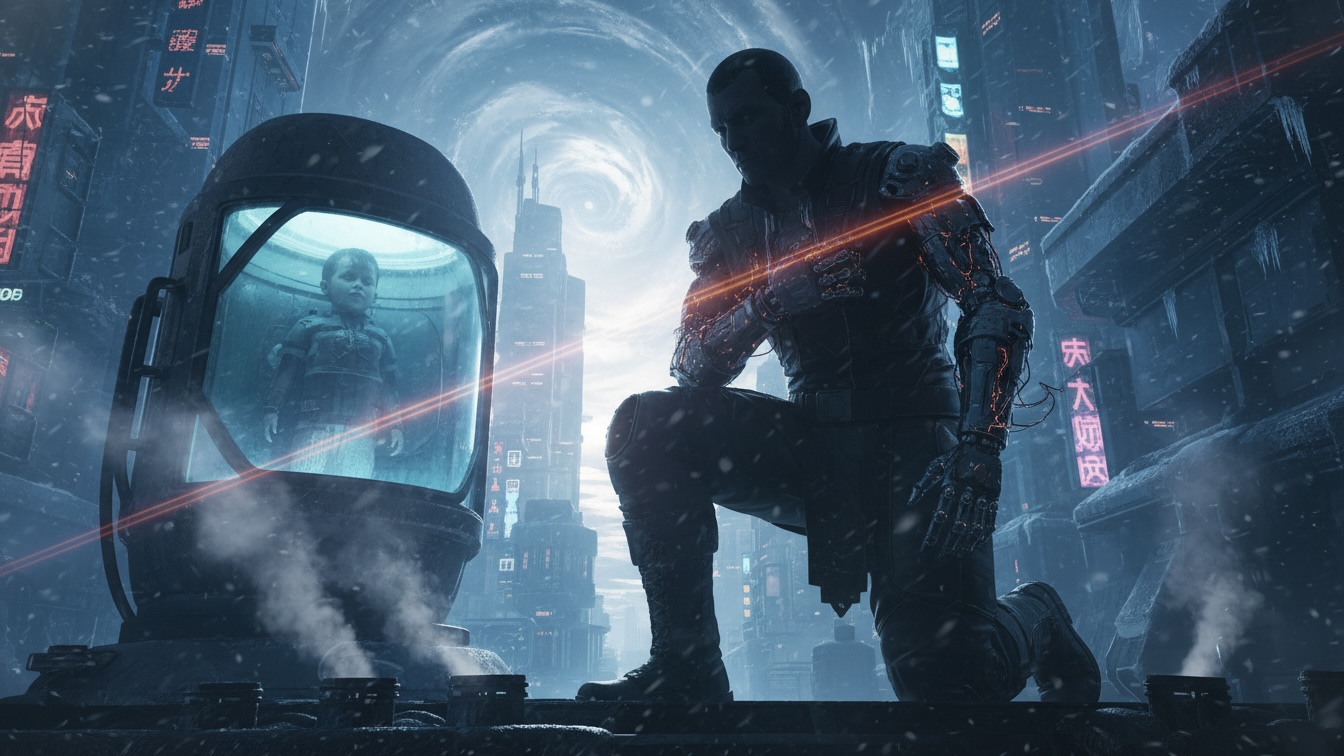
Motivations & Drivers: His primary motivation is an overwhelming, almost primal, need for redemption—to "fix something," to "rebuild," to silence the "ghosts" of his past actions. This drive is intensified by the "old man's" leverage, which initially seems to be abstract "collateral" but is later revealed as the cryo-preserved child, the son of a man he deeply wronged. This revelation transforms his abstract guilt into a concrete, desperate need to provide a future for the innocent, even at the cost of his own life. He is driven by the crushing weight of an "unpayable debt," seeking a final, albeit brutal, peace.
Hopes & Fears: The protagonist's deepest hope is for an end to his suffering and the possibility of finding peace, even if it means his own annihilation. He hopes for a genuine atonement, a way to truly "reset the scales" that he believes he tipped. His core fear is of failing again, of letting others down, and of forever being tormented by his past. The image of the "small and trusting hand" slipping through his grasp embodies this fear of impotence and loss. The child in the cryo-pod represents both the ultimate hope for true atonement and the most profound fear of failing this last, most critical task.
Psychological State: The old man exhibits a chillingly detached and calculating psychological state. He operates with an almost messianic conviction in his self-appointed role as an "architect of atonement," orchestrating complex schemes with cold precision. His actions are driven by a rigid, uncompromising ideology of "balancing the scales," which he applies with ruthless efficiency. His gaze is described as "piercing, unnerving clarity, like chips of polished obsidian," indicating a lack of warmth or empathy, and a disturbing, almost fanatical belief in his warped form of justice.
Mental Health Assessment: His behavior suggests traits consistent with a personality disorder, possibly psychopathy or a severe form of narcissistic megalomania, where he sees himself as the ultimate arbiter of fate. He manipulates others through their vulnerabilities, showing no remorse or emotional connection. His elaborate planning and long-term execution of his "justice" indicate a highly intelligent but morally distorted individual. He shows no signs of emotional distress or self-doubt, operating from a place of absolute certainty.
Motivations & Drivers: The old man's primary motivation is to enforce his own vision of justice and "reset the scales" of the world, particularly for those he perceives as wronged. He preys on the desperate guilt of individuals like the protagonist, using their past failures as leverage to achieve his objectives. He is driven by a desire for control and the meticulous execution of his grand, intricate plans, viewing human lives as mere pieces on his "grim board." His cryptic messages and veiled threats are designed to maintain control and ensure compliance.
Hopes & Fears: His hope is for the successful and complete execution of his elaborate "mosaic" of atonement, achieving what he believes is a perfect balance. He hopes to see his vision of justice fulfilled, irrespective of the cost to individuals. His fears would likely revolve around the disruption or failure of his carefully laid plans, as such an outcome would challenge his perceived omnipotence and control over the lives he manipulates.
Psychological State: The operative, described using "it" and as having a "synthesized and flat" voice "devoid of human inflection," functions as a purely programmed entity. It exhibits no discernible human psychological state, operating solely on directives. Its movements are "fluid, unnatural grace," "precise, deliberate," and "honed for efficiency, for lethal purpose," indicating a lack of human emotion, hesitation, or fear.
Mental Health Assessment: As a non-human or highly augmented machine-like entity, a mental health assessment is not applicable. It is a tool, a weapon, designed for specific functions, and its "posture subtly changed" only when it received "new orders, a shift in its programming," confirming its non-organic, non-psychological nature.
Motivations & Drivers: The operative's sole motivation is to execute its programmed directives: initially to "retrieve the package" and eliminate the protagonist if necessary, then to "contain" the protagonist when the "package must not be compromised." Its actions are entirely driven by external commands, acting as an implacable, unfeeling force in the old man's scheme.
Hopes & Fears: The operative, being a machine or a machine-like entity, does not possess hopes or fears in the human sense. Its existence is defined by its programming and its ability to fulfill its assigned tasks with cold, unwavering precision.
The chapter masterfully constructs a palpable sense of dread and desperation, largely through the protagonist's internal monologue and the relentless, oppressive environment. The constant cold acts as a physical conduit for emotional discomfort, making every description of the freezing cityscape and the protagonist's aching body contribute to a cumulative sense of suffering. The flickering tech, the gnawing hunger, and the pervasive pain ("ancient internal scars ache with a fresh, phantom burn") are meticulously detailed, drawing the reader into the protagonist's visceral experience of misery. This physical agony is directly linked to his emotional torment, creating a seamless transfer of his internal guilt to the reader's empathetic response.
Tension is expertly built through a series of escalating threats and revelations. The initial sense of being hunted, amplified by the cryptic comm unit messages and the ambiguous nature of the "package," keeps the reader on edge. The introduction of the implacable operative, described with chilling precision ("fluid, unnatural grace," "red optics unblinking"), transforms the abstract threat into a concrete, immediate danger. The claustrophobic chase through the vent shafts and maintenance tunnels, punctuated by close calls and physical injuries, sustains a high level of suspense. The shift in the operative's directives from elimination to containment subtly alters the tension, hinting at a larger, more sinister purpose for the protagonist.
The emotional climax is reached with the horrifying revelation of the "package" as the cryo-preserved child and the protagonist's own role as the activation key—his "sacrifice" as the trigger for the child's awakening. This twist creates a profound sense of tragic empathy, as the protagonist's desperate quest for redemption culminates in a forced, yet ultimately selfless, act of martyrdom. The juxtaposition of the child's innocent awakening with the protagonist's final, quiet collapse on the icy rooftop evokes a powerful blend of sorrow, relief, and the chilling realization of the old man's cruel, yet effective, justice. The pervasive cold throughout the narrative amplifies this unease, making the final peace the protagonist finds in death feel like a cold, hard-won stillness.
The urban landscape of this chapter is not merely a backdrop but an active participant, a psychological mirror distorting and amplifying the protagonist's internal state. The "dying sector" with its "shattered pane" and "fractured walls" directly reflects his own fractured existence and broken spirit. The oppressive, skeletal cold that "seeped from the fractured walls" is a physical manifestation of his emotional numbness and the relentless weight of his guilt, functioning as a constant penance. The city's decay—rusted grilles, smashed windows, skeletal sky-bridges—symbolizes a world in decline, a bleak future devoid of true warmth or hope, mirroring the protagonist's own perceived lack of a future.
The journey through the city's underbelly, from the forgotten hovel to the "canyons of shadow and ice," and further into the "decommissioned energy plant" and its "vent shaft," represents a descent into the protagonist's own psychological abyss. The claustrophobic, dark tunnels and the "mausoleum of obsolete technology" are physical metaphors for his internal struggle, the buried memories, and the hidden horrors of his past. The treacherous climb up ice-slicked ladders and the precarious gantry reflect his desperate, fragile struggle for survival and atonement, each step a battle against both external elements and internal despair. Winter, in this context, is not just weather; it is an omnipresent, malevolent force that actively seeks to break him, making every physical challenge a psychological one, amplifying his vulnerability and isolating him further in his suffering. The environment becomes a crucible, forging his ultimate, tragic choice.
The chapter's prose is characterized by a visceral, almost tactile quality, achieved through precise diction and evocative imagery, creating a harsh, unforgiving rhythm. The sentence rhythm often shifts, moving from short, clipped sentences during moments of intense action or internal struggle ("The steel bit. Always the steel.") to longer, more introspective passages that delve into the protagonist's guilt and despair. This varied rhythm effectively mirrors the protagonist's fluctuating mental and physical states, creating a dynamic reading experience. Diction is notably metallic, cold, and descriptive of decay, with words like "grinding," "metallic," "bitter rime," "suffocating," "crystalline," "vile," "gouges," "skeletal," and "corroded" painting a vivid picture of a world and a soul in disrepair.
Imagery is dominated by pervasive cold, ice, and metallic decay, which serve not merely as descriptive elements but as powerful symbolic motifs. The "crystalline frond, a miniature barbed wire fence" on the windowpane not only depicts the winter but also symbolizes the protagonist's trapped, fractured existence. The "suffocating, crystalline fist" of winter is a forceful personification of the environment's oppressive nature, directly reflecting his internal struggles. The constant reference to "steel" and "chrome" symbolizes not only the protagonist's augmentations and the cyberpunk setting but also the unyielding, unforgiving nature of his past and the world he inhabits. The "ghosts" of his actions, dancing in the air and surfacing behind his eyelids, are a potent symbol of his inescapable guilt, a digital scar across his vision.
Symbolism is deeply integrated, with winter and cold acting as central motifs. Winter symbolizes the protagonist's emotional desolation, his isolation, and the harsh, purifying nature of his penance. It is a season of death and dormancy, reflecting his own fading life and the dying hope for conventional redemption. The "old man" embodies a cold, calculating, almost demonic justice, using others' guilt as leverage, turning the concept of atonement into a transactional, brutal process. The "package," initially a mystery, ultimately symbolizes innocence and future, contrasting sharply with the protagonist's past and impending demise. His final act of activating the cryo-pod with the chip, as his own life ebbs away, is a profound symbol of sacrifice, transforming his personal narrative of failure into one of tragic, selfless redemption.
The chapter firmly establishes itself within the cyberpunk genre, echoing seminal works like Ridley Scott's Blade Runner with its portrayal of a bleak, decaying urban dystopia where advanced technology coexists with profound human suffering and moral decay. The protagonist, a lone, augmented figure haunted by his past, navigating a treacherous city, is reminiscent of characters found in William Gibson's Neuromancer, grappling with identity in a world where the line between human and machine blurs. The "borrowed tech" and "chrome" elements ground the narrative in a future where augmentation is common but often unreliable, highlighting the vulnerability of the enhanced human condition.
Intertextually, the narrative also draws heavily from the traditions of noir fiction. The protagonist embodies the classic noir archetype: a morally ambiguous individual, caught in a web of manipulation and betrayal, forced to undertake a dangerous "last job" in a corrupt, unforgiving city. The "old man" serves as the shadowy, controlling puppet master, a figure akin to the powerful, unseen antagonists in many noir tales, pulling strings from the background. The pervasive sense of fatalism, the internal monologue steeped in regret, and the bleak outlook on the possibility of true justice or happiness all resonate strongly with the genre's defining characteristics.
Beyond genre, the story taps into deeper cultural and mythological frameworks, particularly those surrounding sacrifice and atonement. The protagonist's agonizing journey and ultimate self-immolation for the sake of another's future evoke archetypes of martyrdom and the hero's descent into the underworld. His passage through the city's "bowels," the "decommissioned energy plant," and the "vent shaft" can be read as a metaphorical katabasis, a journey into a personal hell to confront his past and secure a form of salvation, not for himself, but for the innocent. The "resetting the scales" motif speaks to ancient concepts of cosmic balance and retribution, where a life may be demanded to offset a past transgression. Furthermore, the relentless winter and cold landscapes carry symbolic weight found in various mythologies, often representing death, hardship, purification, or the end of a cycle, a time of profound testing before a potential, often distant, rebirth. This cold, stark setting aligns with narratives of endurance and existential struggle in extreme environments, such as those found in Jack London's works, emphasizing the brutal struggle for survival against overwhelming odds.
The chapter leaves a profound emotional and intellectual impact, primarily shaped by the relentless, all-encompassing motif of winter and cold. What lingers most acutely is the chilling realization of the true nature of redemption as presented: not a gentle absolution, but a brutal, calculated exchange of one life for another. The image of the protagonist's final, quiet surrender on the freezing rooftop, his body succumbing to the cold that has tormented him throughout, while the child in the cryo-pod stirs to life, creates a deeply melancholic and unsettling emotional afterimage. It forces a contemplation of the value of a life, the weight of past actions, and the cruel beauty of a sacrifice compelled by guilt.
Intellectually, the story provokes questions about the ethics of forced atonement and the authenticity of redemption when it is orchestrated by a manipulative external force. The old man's chilling logic, his fanatical belief in "resetting the scales," leaves a lingering unease, challenging conventional notions of justice and forgiveness. The narrative compels reflection on the protagonist's agency: was his final act a choice, or merely the culmination of a meticulously crafted trap he could never escape? This ambiguity, amplified by the bleak, unforgiving winter landscape, suggests that even in death, true peace might be elusive, overshadowed by the lingering shadow of manipulation.
The cold, as a persistent presence, evokes a sense of profound isolation and the ultimate finality of death. It is not just a seasonal element but a character in itself, a silent, unblinking witness to suffering and sacrifice. The memory of the "steel bit," the "grinding, metallic taste," and the "suffocating, crystalline fist" of winter continue to resonate, symbolizing the protagonist's inescapable past and the harsh, unyielding nature of his world. The image of the child's awakening, juxtaposed against the protagonist's demise into the absolute cold, leaves a haunting impression: a fragile new beginning forged from a brutal, frozen end, forever marked by the bitter embrace of winter.
The final, quiet hum of the cryo-pod cuts through the roaring blizzard, a new sound, clean and purposeful, echoing in the space once filled by the protagonist's frantic heart. It is the sound of a debt paid, not in coin or deed, but in the cold, hard currency of a life. The ice on the rooftop, which had been a relentless torment, now offers a final, stilling embrace, turning the world into a silent, frozen mausoleum for one, and a nascent cradle for another. The profound chill that permeated every moment of his agonizing journey now settles as an absolute peace, a paradoxical warmth in the face of oblivion.
The child's awakening, serene and oblivious, marks a new beginning, a fragile spark against the backdrop of a dying world and a life extinguished. Yet, the lingering question remains, carried on the biting wind: what kind of future awaits in a world where redemption is a transaction, orchestrated by the cold, calculating hand of another? The blizzard continues to rage, indifferent to the sacrifice, a constant reminder that some debts are paid in solitude, and the stillness that follows is often as stark and unforgiving as the winter itself.