Melgund Township Winter Story Library
The Case of the Missing Cord - Analysis
by Leaf Richards | Analysis
by Leaf Richards | Analysis
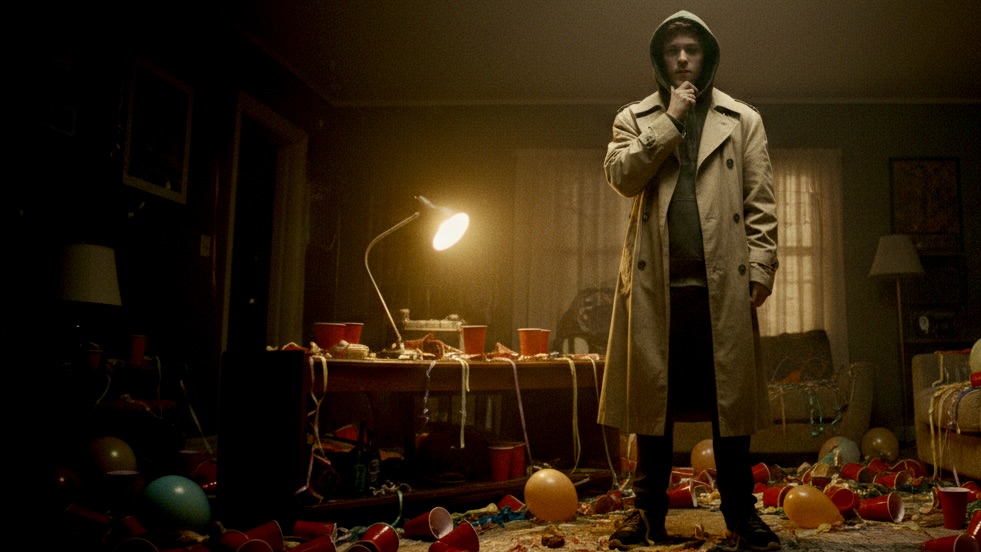
In this chapter, the narrator, Jesse, attends a house party hosted by his friend Becca. When the music abruptly stops due to a missing auxiliary cord, the party's energy dissipates, creating a social vacuum. Jesse, who fancies himself a hardboiled detective, seizes this as his moment to shine. Donning a trench coat and a persona of grim authority, he declares the apartment a crime scene and launches a theatrical investigation. His clumsy interrogation yields no leads until he zeroes in on Randy, a nervous boy whose bulging hoodie pocket seems to confirm his guilt. In a grand, public accusation, Jesse exposes Randy, only to be utterly humiliated when the bulge is revealed to be a Ventolin inhaler. The true culprit is an absent-minded friend who accidentally took the cord, a fact revealed by a text message. The party dissolves in a wave of awkward laughter, leaving Jesse alone to reckon with his catastrophic failure.
The story masterfully explores the theme of performed identity versus authentic self. Jesse is not a detective; he is a young man playing a role he has absorbed from fiction. His trench coat is a costume, his notebook a prop, and his dialogue is filled with "manufactured gravity." This performance is a desperate attempt to impose a narrative of competence and importance onto a situation where he feels insignificant, initially relegated to investigating a depleted onion dip. The chapter dissects the psychological need to construct an identity that offers power and control, but it also reveals the inherent fragility of such a facade. The entire performance collapses under the weight of a single, mundane fact—the inhaler—exposing the insecure, awkward boy beneath the cheap polyester uniform.
Furthermore, the chapter serves as a poignant commentary on the fragility of modern social structures. The party's vibrant atmosphere is not sustained by genuine human connection but by a constant stream of music, described as the gathering's "life support." The moment this technological stimulus is removed, the "roaring fire" of the party is extinguished, and the underlying reality of "a hundred private conversations" and social anxiety is revealed. The missing cord is more than an inconvenience; it is a catalyst that dissolves the social glue, demonstrating how dependent the group's collective comfort is on a shared, passive experience. Without the music to fill the space, the attendees are left to their own devices, quickly "plotting their escapes" from the ensuing awkwardness.
Finally, the narrative is a powerful cautionary tale about the dangers of confirmation bias and the projection of narrative. Jesse does not conduct an investigation; he hunts for evidence to support a story he has already written in his head. He interprets every detail through the lens of his detective fantasy. Randy’s nervousness is not seen as social anxiety but as "classic guilty behavior." The bulge in his pocket is not ambiguous; it is definitively a "coiled shape" of bundled wire. Jesse's perception is entirely shaped by his desire for the narrative to be true, leading him to victimize an innocent person for the sake of his own ego. The devastating climax is not just about being wrong; it is about the public and painful consequences of forcing reality to fit a preconceived, self-serving story.
From a psychological standpoint, Jesse is a character driven by a profound sense of inadequacy and a yearning for significance. He sees himself as an overlooked observer, a corner-dweller whose initial "case" is the trivial "Dip Depletion." The missing cord is not a problem to be solved for the good of the party; it is a personal "moment," an opportunity to cast himself as the protagonist. His adoption of the detective persona is a classic defense mechanism, an elaborate fantasy constructed to shield his fragile ego from feelings of social invisibility. The trench coat, the notepad, and the noir-inflected inner monologue are all crutches he uses to project an authority and confidence he does not naturally possess.
His motivations are rooted entirely in self-aggrandizement. He is not interested in restoring the party's music so much as he is in the glory of being the one who cracks the case. His questions are not designed to gather information but to perform the role of an interrogator. He dismisses a witness as "unreliable" for providing a mundane detail and relishes the drama of his public accusation. This reveals a deep-seated narcissism, where the feelings and reputation of others, like Randy and even his friend Becca, are secondary to the validation he seeks. He craves the spotlight and is willing to manufacture a crisis to ensure it finds him.
Jesse's primary internal conflict is the immense gap between his grandiose fantasy self and his actual, insecure identity. This is brilliantly illustrated by the contrast between his internal narration and his physical actions. He internally praises his voice for its "manufactured gravity" right after admitting that it cracked on the first try. He imagines himself as a "shark" circling his prey, yet he is standing on a "wobbly dining chair." The story's climax represents the violent collision of these two selves. When the inhaler is revealed, his fantasy world is annihilated, leaving him exposed and stripped of his performative armor. His final realization that he is the perpetrator of his own "crime of being a complete and utter moron" marks the painful, but perhaps necessary, death of his delusion.
The narrative voice is the cornerstone of the chapter's success, employing a first-person perspective that immerses the reader directly into Jesse's delusional worldview. The prose is a masterful blend of hardboiled detective cliché and the raw awkwardness of teenage experience. Lines like "The music didn't just die. It was murdered," are immediately undercut by the reality of the situation and the reactions of the other characters, such as the snort he elicits from the crowd. This stylistic juxtaposition creates a rich vein of dramatic irony and humor, allowing the reader to see the absurdity of Jesse's performance even as he takes himself with the utmost seriousness.
The author manipulates pacing and tone to mirror Jesse's emotional journey. The chapter begins with a measured, observational pace as he assesses the party from the periphery. Once the cord goes missing, the pace quickens, driven by Jesse's manic energy as he launches his investigation. The tone builds from one of mock-seriousness to a fever pitch of theatrical drama during his grand accusation. The climax is marked by a sudden, jarring halt in momentum, plunging the narrative into a "dense, heavy, physical" silence. The tone then shifts irrevocably to one of abject humiliation and quiet despair, as the slow, "orderly exodus" of guests mirrors the draining of Jesse's own spirit.
The use of metaphor and sensory detail enriches the narrative, elevating a mundane party mishap into a high-stakes drama. The party's energy is a living entity, a "roaring fire," and the silent speaker is a "black plastic tombstone," framing the event in the epic terms Jesse prefers. Sensory details, like the "progressively stickier" floor and the "cheap polyester scratching my neck," ground the story in a tangible, slightly grimy reality that constantly contrasts with Jesse's glamorous self-perception. The final image of the missing cord "on a bus, heading into the night" serves as a perfect metaphor for his "chance at redemption," a fleeting opportunity that has already passed him by, leaving him alone in the wreckage of his own making.